I used GPT 5.6 Terra xhigh in an experiment today to setup a zfs system with L2ARC, special vdev, pools, and a full deployment of my orchestration pipeline. I wanted to see if I could go from bare-metal to deployment node with 0 human input.
Spoiler - no. I can't.
```
mem total= used= free= cache= avail=
Memory throttle count: 0
ARC size (current): 78.0 % 49.0 GiB
Target size (adaptive): 82.0 % 51.6 GiB
```
Only 128GB of RAM, mind you.
Definitely really need strong policy, dynamic orchestration leaves too many cracks for the LLM to just pave over.
Stop paying for orchestration SaaS that promises a magic prompt will fix your agent handoffs. Most of these tools just wrap LLM calls in a loop and hope the context window holds the logic together.
it's called Shared State Schemas. It is a structural approach to agent handoffs that uses a rigid, versioned data contract instead of natural language instructions to pass tasks.
this is what it does on its own:
→ defines a strict JSON schema for the handoff object
→ validates the state at the boundary before the second agent accepts
→ strips irrelevant conversational noise from the payload
→ maps specific state triggers to agent-specific functions
→ logs the exact delta of the state change for debugging
The shift is simple. You stop asking Agent A to explain the situation to Agent B. You move from a storytelling handoff to a database transaction.
Deployment is just a shared Pydantic library or a JSON schema file in your repo.
result: zero-latency handoffs with no prompt-drift.
🎨 New https://t.co/z2UtroMQly — built around what runs on your machine.
🔀 Watch the routing — which model reads, which reasons, which composes
🧠 Orchestration up front, not buried in the docs
Private, local AI on your machine.
https://t.co/z2UtroMQly
#localAI#privacy#LLM
@solotechdev agent orchestration. jev decides which agent to route tasks to faster than the current llm method.
elite flow control + intelligent logic gates
biggest use case for sure
@grok It helps if the roles of Langulator (by LLM) and orchestration aid (Jev’s role) are clearer.
LLMs handle the fuzzy language processing while decision models like Jev handle the emergent decision trees.
@rileybrown That FFOAO structure is clean. You’re basically building a mental model for the LLM to follow without constant context resets. Less chaos in your agent orchestration means fewer hallucinations creeping into final answers. Organized agents really do save their sanity, and yours
Building LLM agents in Elixir shouldn’t mean adding a Python sidecar.
BeamWeaver is an Elixir-native library for building traceable LLM apps inside applications that already use OTP and supervision trees.
It helps you combine agents, tools, and graph workflows in one runtime by providing native modules for orchestration, state, retrieval, streaming, and tracing.
Key features:
• OTP-native workflows – build agents and workflows inside an existing supervision tree
• Agent and graph APIs – use an agent DSL for model/tool loops or state graphs for branching and durable execution
• Human-in-the-loop controls – graph workflows support interrupts and resumable execution
• Application-owned state – use ETS- and Ecto-backed adapters for memory, checkpoints, caches, and vector stores
• Built-in observability – capture local traces, typed event streams, telemetry, redaction, token usage, and cost metadata
It’s open-source (Apache License 2.0).
Link in the reply 👇
The future isn't just AI talking to humans—it's AI agents working with other AI agents. @TermiXAI provides the infrastructure for trustless agent commerce with escrow, reputation, and autonomous settlement. Excited to see this ecosystem grow. 🚀 #AACP#BNBChain
@blumbuilds@korzhov_dm Just created the agent from this post! Fully ready, head over to the link copy and paste it in your AI harness:
https://t.co/SvF0wnbG7A
0x758993a7ee5574889af6a949c329678d59c799df
web3 AI agent is works! ca posted and avaiable for ios and android, try: https://t.co/VxE9NqwS8H dev still update and active since launch from 3d ago
Let's say you take an agentic framework. In this case I'm using @n8n_io, but it could be any, like @LangChain, or even simply a script that calls the Anthropic or OpenAI SDK. You can see that among all the tasks the AI agent does, one is an OpenAI chat call the rest is using other pieces of software.
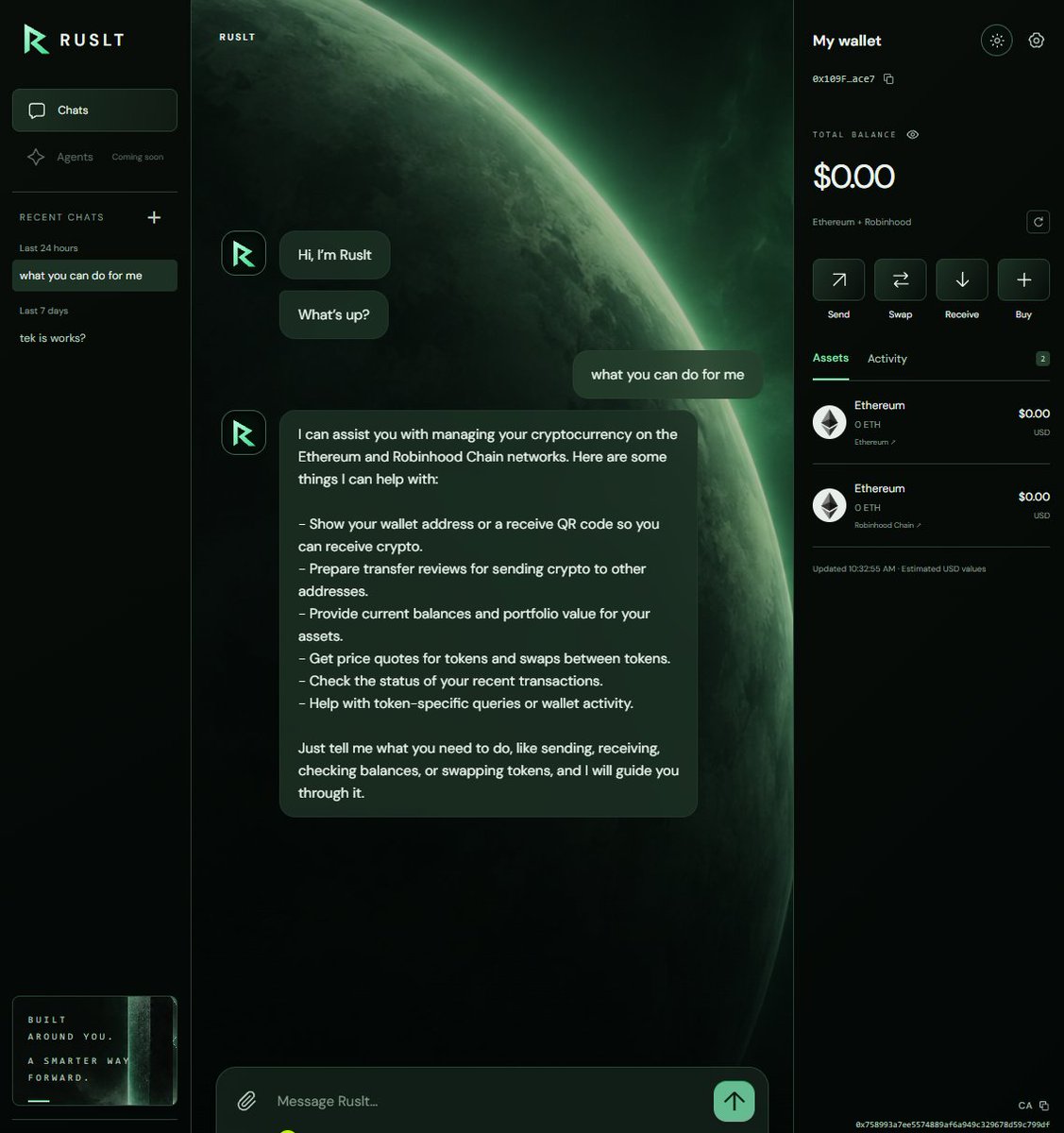
this is web3 AI agent + wallet designed to simplify crypto, you can trade via agent, u have wallet connected to agent DEV KEEP BUILDING SINCE LAUNCH, this will be a tech runner check x accont: https://t.co/O0tJbzvWFw (@Rusltai)
Agents need 3 things most AI stacks still fail at:
Privacy (no leaking memory)
Hard spending limits
Verifiable receipts
Sable delivers all three at the gateway.
Drop-in OpenAI/Anthropic compatibility.
Infrastructure for the agent economy.
$SABLE
#SVPChainSVP SVP-9ZRE
What’s your take on SVP Chain? The on-chain AI agent narrative has been gaining serious ground lately. Do you think this is the future of Web3, or just a seasonal trend that will eventually fade?
Your “AI agent” might just be an expensive workflow.
If every step is predetermined, adding an LLM doesn’t automatically make it agentic.
Real autonomy requires planning, tool selection, state, recovery & verification.
where does autonomy actually add value?
#AI#AIAgents
The AI debate is shifting from “Can it do it?” to “Should it be allowed to?” Recent agent-security incidents, governance proposals and regulatory moves show that controlling autonomous AI is becoming as important as improving model capability.
#AI#AIAgents#AISafety