Another amazing fungi discovery! Studies show that mycelium could replace the toxic fire-retardant foam that insulates many commercial buildings. Read more about it: https://t.co/zcPr2KvgWo
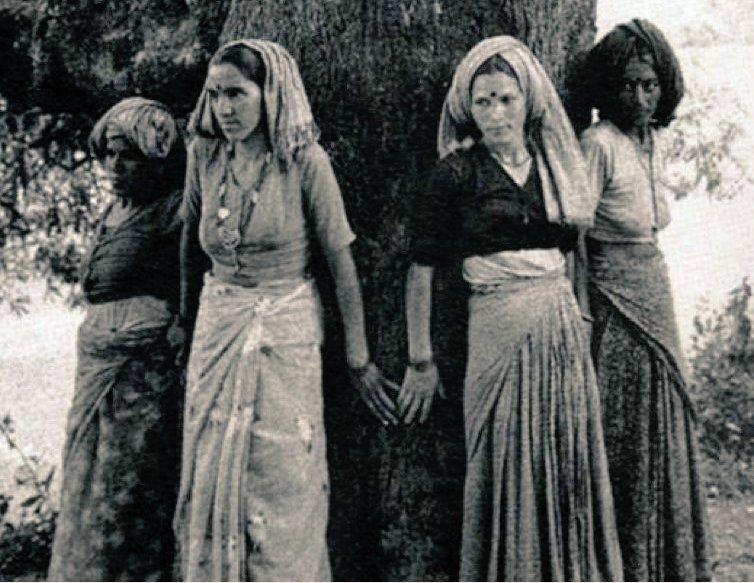
The Chipko Movement,1970s-Indian, mainly women activists who protected local forests from deforestation, a model for ecofeminist activism and environmental movements globally. Relates to the term 'tree huggers' #WomensArt
Can you guess how many trees are needed to provide oxygen for one person each year? The answer might surprise you...
7 to 8 mature trees are needed for just one person's oxygen each year! 🌱
Farming with nature’s biodiversity , without fossil chemicals , grows more food & nutrition per acre , it grows more health .
Chemical farming is based on violent tools of extinction & the fabricated metric of ‘yield per acre’ which fails to measure quality of food or soil health
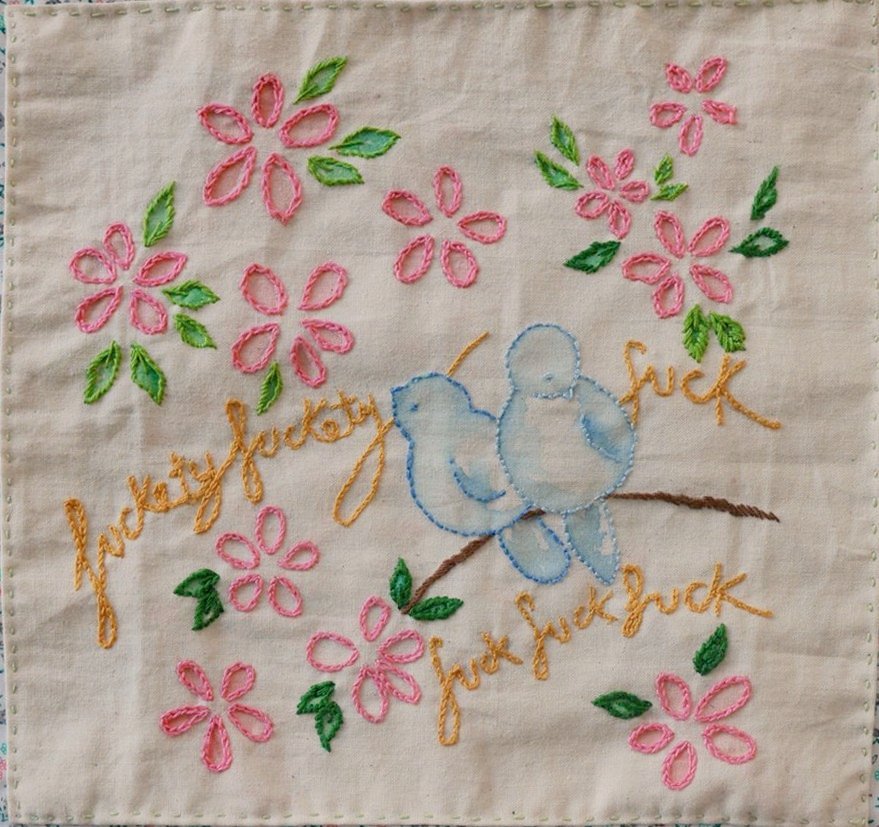
´Fucketyfucketyfuckfuckfuck´ by Annie Taylor from PEG - the Profanity Embroidery Group, Whitstable, UK, a group formed by women for stitching and swearing #WomensArt#septtextilelove
“As the world goes through what some believe to be its hottest year on record, emperor penguin populations in the Antarctic are suffering catastrophic losses, with no chicks surviving the spring of 2022 in four of five colonies observed for a new study.” https://t.co/82IRKTFhPg
California is putting solar panels over some of its aqueducts – a solutions that can save water while generating clean energy. The first of its kind in the US.
We have so many solutions. Implement them. #ActOnClimate#climate#energy#renewables
12 Reasons Why Cities Need More Trees:
1. Temperature Control
One large tree is equivalent to 10 air conditioning units, and the shade they provide can reduce street temperature by more than 30%.
2. Noise Reduction
Trees can reduce loudness by up to 50%. In urban areas filled with the sound of cars, construction, sirens, aeroplanes, and music, trees are essentially the best way to block noise and keep cities — along with the homes and workplaces in them — quieter.
3. Air Purity
Trees remove an astonishing amount of harmful pollutants and toxins from the air. In urban areas air quality is often disastrously bad — with severe consequences for our health. Trees make the air we breathe much cleaner.
4. Oxygen
And, while absorbing all those pollutants, trees also put more oxygen back into the urban environment. Oxygen levels are significantly lower in cities compared to the countryside; trees help to solve that problem.
5. Water Management
Trees do more than just shelter us and our buildings from rain — which is, in fact, extremely important. They also absorb huge quantities of water, reduce run-off, neutralise the severity of flooding, and make flooding more unlikely altogether. Not to forget that their roots absorb pollutants and prevent them from feeding back into a city's water supply.
6. Psychological Health
Studies have proven what we instinctively know to be true: that human beings are significantly happier when surrounded by nature rather than sterile urban environments. Our emotions, behaviour, and thoughts are shaped by the places we spend time — and trees have a profoundly positive effect on our psychology. The consequential benefits of being happier and more peaceful — as individuals and as a society — are immense.
7. Physical Health
Beyond all the other ways in which trees improve air quality and the urban environment, much to the benefit of our health, they also encourage people to go outside. Cycling, running, and walking are all more common in urban areas with plenty of trees. A knock-on effect of people spending more time outdoors is also social integration and stronger communities.
8. Privacy
A simple point, but not inconsequential, is that trees provide privacy.
9. Economics
The total economic benefit of urban trees is hard to calculate. There are costs, of course, including the repair of infrastructure damaged by roots and maintaining the trees themselves. But the total economic benefit — a consequence of everything else in this list and more — far outweighs the expenditure. Trees make cities wealthier.
10. Wildlife
Trees are miniature cities all of their own, serving as a habitat for hundreds of different species, including birds and mammals and insects.
11. Light Pollution
Trees don't only block the light shining down, therefore keeping us and our cities cooler — they also disrupt light shining up, from street lighting, cars, houses, and billboards. Skies are clearer in cities with more trees.
12. Aesthetics
And, finally, trees are beautiful. They break up the potential monotony of urban environments — the sharp geometry, the greyscale roads and buildings, the endless rows of cars — with their trunks, boughs, canopies, and flowers.
Just think: the gold and red of falling leaves in autumn, the white and pink blossom of spring, the vast green canopies of summer, and the branches lined with hoar-frost in winter. Every single tree is a myriad of intricacy and texture, of colour and scent, of dappled light on the pavement, mottled bark, knotted roots, of clustered leaves and delicate petals and stern boughs.
Few streets would not be improved by the kaleidoscopic aesthetic delights of a tree, not to mention the many different species of tree, all over the world, whether willow, oak, lime, cherry, aspen, maple, birch, horse chestnut, dogwood, hornbeam, ash, sycamore... the list goes on.
There are some drawbacks to urban trees, most of them context-specific, and they are not — of course — universally appropriate. But it seems fair to say that many cities would benefit from at least a few more trees here and there.
In South Korea, they've covered this protected bike lane with solar panels - cyclists are protected from the sun, isolated from traffic, and it produces clean energy.
We have so many solutions. Implement them. #ActOnClimate#Climate#energy#renewables#GreenNewDeal
“Rainfall washes 7 trillion pieces of microplastics, much of it tire particles left behind on streets, into San Francisco Bay each year—an amount 300 times greater than what comes from washing off polyester clothes, microbeads from beauty products…” https://t.co/ZvHhTBum3w
In the early 1990s, Brazilian photojournalist Sebastião Ribeiro Salgado was stationed in Rwanda to cover the genocide, an experience that left him traumatized.
In 1994, upon returning to his home in Minas Gerais, Brazil, Sebastião hoped to find solace in the lush green forest of his childhood. Instead, he discovered that his home had transformed into a dusty, barren land stretching for miles, devoid of any wildlife.
"The land was as sick as I was. Only about 0.5% of the land was covered in trees," he remarked.
At this time, his wife, Lélia Deluiz Wanick Salgado, proposed that they embark on the ambitious journey of replanting the entire forest. Sebastião supported the idea, and together, over the course of the next 20 years, they planted an astonishing 2.7 million trees.
Their efforts resulted in the rejuvenation of 1,500 acres of rainforest, and the site eventually became home to 293 plant species, 172 bird species, and 33 animal species, some of which were on the brink of extinction.
Frankfurt. Remember when David Attenborough said the collapse
of civilisation was on the horizon? There is only so many times the insurance industry can cope
with these kind of events…
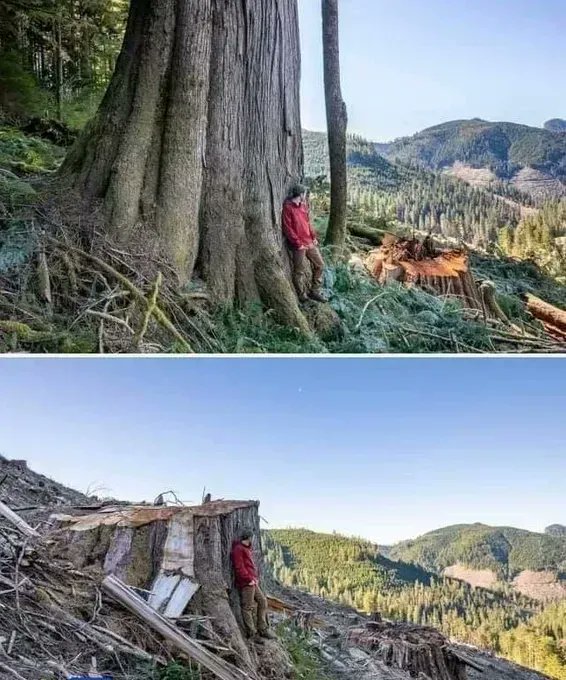
These irreplaceable old growth forests continue to be logged across British Columbia. Over 1,200 people have been arrested trying to keep them standing.
There is no time to waste. Protect the Irreplaceable.
#ActOnClimate#climate#nature@bcndp#bcpoli#bcgov Pic @TJWattPhoto