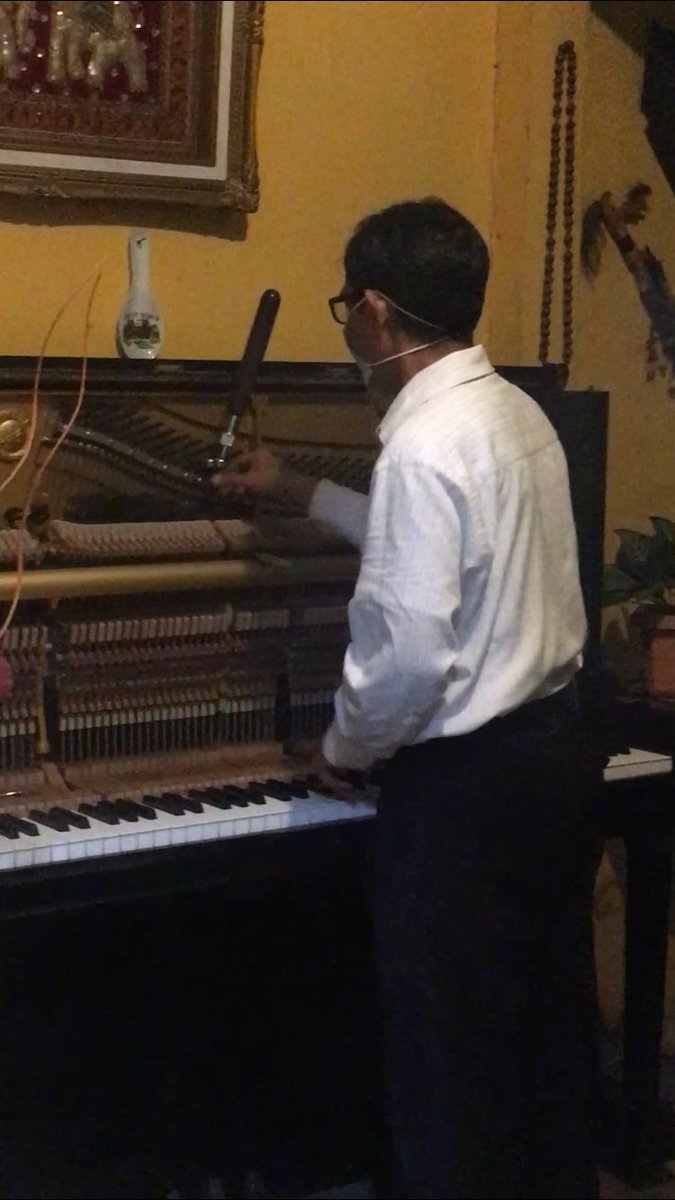
haloo buat temen2 yang punya upright/grand piano yang udah lama ga di stem, bisa hubungi Bapak Sudarwanto yaa. rumah bapaknya di daerah tangerang (bapaknya naik motor ke rumahku di bekasi🥺) boleh bantu share yaa, makasih gengs have a nice day!!
The Hunger Games star Joseph Zada says he dropped out of high school four weeks before graduation for an audition and ended up landing the role
"My first real big gig, I dropped out of high school for a callback audition which isn't really a good idea. I was in my last four weeks of school and I got brought into the principal's office"
Woody Harrelson: "Your senior, your last four weeks?"
Joseph: "My last four weeks. I was about to get my high school diploma or degree or whatever"
"And I got called into the principal's office and they go, 'Look, you need to come to every single day of school. You missed so many days of school. You need to come to every single day for the last four weeks. You can't miss a single exam and you also have to hand in these four uncompleted assignments'"
"And I turned to her and I was like, well, I've got a callback on Tuesday and they're like, 'We don't care. No one cares that you have a callback on Tuesday. You gotta come, this is a government thing'"
"And then I turned to my mom and I was like, I got a callback on Tuesday and she was like, 'Yeah, sure.' And then I dropped out like that and had four weeks"
Woody: "And your mom was like, 'No problem?'"
Joseph: "She completely backed me. She backed me through everything. Both of my parents really trusted me and my instincts to do this but I had nothing"
"And so I had five weeks of existential dread while all my friends graduated and I was like, I can't believe I just did that. And then I booked that role and I went off and I've kind of been working ever since"
Until about 200 years ago nobody slept through the night, and nobody thought they were supposed to.
People went to bed a couple of hours after dark and slept until around midnight. They called it first sleep. Then they woke, the whole household and the whole street, for an hour or more. They banked the fire, checked the animals, said prayers written for that hour, talked, made love, sometimes called on the neighbours. Then they went back for second sleep until dawn.
It was so ordinary that nobody bothered to explain it. A historian called Roger Ekirch found it by accident in a court record from 1697, a nine year old girl mentioning that her mother got up after her first sleep, and then could not stop finding it. More than 2,000 references in a dozen languages, back to ancient Greece. Doctors' manuals told you which side to lie on for each half.
Street lamps and factory shifts squeezed the two sleeps into one. By about 1920 the phrase had gone, and the memory with it.
In 1992 an American psychiatrist took the electric light away from a group of volunteers for a month. Within weeks they were sleeping in two halves, with a quiet waking in the middle.
Waking at 3am now comes with a diagnosis and a prescription. For every human being before the gas lamp it came with a name and something to do.
Now that Jensen Huang is gone, I think America is about to discover something the hard way:
Nvidia didn’t just lose a CEO. It lost the one guy who knew how to run an Asian supply chain like an old-school merchant.
You can replace him with a brilliant American executive, an Indian executive, a Chinese executive — whatever.
The title is replaceable. The relationships are not.
Anyone who grew up around old-school Chinese business culture will recognize Jensen’s style immediately. You eat together. You drink together. You remember who helped you twenty years ago. When you decide someone is your guy, you keep dealing with him for decades. Contracts matter, of course, but when things go wrong at 2 a.m., what matters even more is whether the person on the other side will pick up your call.
Look at Nvidia’s supply chain. TSMC makes the chips. SK Hynix makes the HBM. Foxconn, Quanta, Wistron, Pegatron and others build the systems. Jensen didn’t suddenly discover these companies when ChatGPT arrived. He spent decades personally building relationships with the people running them.
TSMC is probably the best example. Back in 1998, when Nvidia was still tiny and short on manufacturing expertise, TSMC sent two production people over to help. The relationship became so close that Morris Chang later asked Jensen twice if he wanted to become CEO of TSMC. Jensen said no both times.
Decades later, Jensen was still flying back to Taiwan, eating with Morris Chang, Barry Lam and half of the island’s tech establishment. At one Taipei dinner, the guest list looked less like a restaurant reservation and more like the control room of the global AI supply chain: TSMC, Quanta, Pegatron, Wistron, Asus, Acer, Inventec, Foxconn.
That stuff looks almost comically old-fashioned in an industry obsessed with AI agents and trillion-dollar market caps. But then you see what happens when Nvidia actually needs something.
In 2024, Jensen wanted SK Hynix to move its HBM4 supply schedule forward by six months. Six months in semiconductors is insane. You’re talking about engineering, capacity and production plans that were set long before Jensen showed up asking for more.
SK chairman Chey Tae-won publicly told the story later. Jensen asked. Chey went back to his people and pushed.
That is not something you reproduce by handing the next CEO a supplier spreadsheet.
And Jensen also knew what it meant to owe somebody.
In Nvidia’s early days, its project with Sega went badly enough that the company was in real trouble. Jensen went to Japan, admitted the technology wasn’t going to work, and Sega still gave Nvidia $5 million that helped keep the company alive.
Thirty years later, Jensen went back to Tokyo and thanked former Sega president Shoichiro Irimajiri in person. His message was basically: without what you did for us back then, there would be no Nvidia today.
He did the same thing on the other side of the table.
Serve Robotics CEO Ali Kashani has talked about December 2023, when his company was so close to dying that he had already discussed bankruptcy. An investor pulled out right before Christmas. Kashani called Jensen. Nvidia helped carry the financing, other partners joined, and a few months later Serve was ringing the Nasdaq bell.
That’s the Jensen playbook. Eat with people. Remember favors. Return favors. Call directly when there’s trouble. Keep relationships alive for twenty or thirty years.
Silicon Valley has a fancy word for this: “network.”
My family would probably just call it doing business,and now Jensen is gone.
Nvidia can transfer his office, his org chart, his contracts, his procurement team and every supplier database to the next CEO.
What it cannot transfer is the invisible ledger sitting inside the heads of dozens of people across Taiwan, Korea and Japan:
He helped me once. I helped him once.
We’ve known each other for 25 years.
If he calls, I’ll listen. There is no handover document for that.
@JensenHuang People don’t understand how hard it is to build something out of absolutely nothing. To err is to be human. But I believe irreplaceable creative innovative leaders should be given a second chance to do what they do best.
Over the past week, I’ve been overwhelmed by the love and support of friends, industry colleagues, and people I've never met. Thank you to everyone who has shown kindness to my family and me. It means the world to me.
I came to the United States 53 years ago, and becoming an American citizen is one of the greatest gifts and proudest moments of my life. NVIDIA has been my life’s work. Building it into the company it is today alongside my colleagues has been a privilege and an honor. Nowhere but in America could a company like NVIDIA be possible. I love our country, and I love NVIDIA.
I did not live up to the standards expected of everyone at NVIDIA, and I have made serious mistakes in my personal life. I created problems for the Board that I deeply regret. I own my mistakes completely, and I am committed to cooperating with the Board’s independent investigation.
Since my departure, I’ve seen an outpouring of calls from NVIDIA’s employees, investors, business partners, and customers for me to return as CEO. Many continue to reach out to me directly as the company navigates complex technology, market, competitive, and geopolitical dynamics. NVIDIA is a once-in-a-generation company. If the Board of Directors decides that my return is in the best interest of our shareholders, our employees, the company, and America, I would be honored to answer these calls and return as CEO.
Thank you again to everyone who has shared their good wishes. I am profoundly humbled by your support. To my family: I love you, and I will spend the rest of my life being worthy of yours.
Jensen
@cyrilleve ASIK BGTT IRIIII AKUUU. beberapa hari pertama puanas pol tp hari terakhir menggigil karena tanktopan doank. jadi minggu ini pasti agak2 dingin km harus bawa jaket y