Finally got to the time to try out GPT-5.6-Sol on some tasks I have to do. I can say for sure that it is really good but it adds too much machinery and unnecessary things and helper functions to the code. Overall a very good model.
@chinedu_10 Really good explanation 👏🏾… the question I have is this: does the backfill logic need to exist in your application code or it can be a separate script that runs outside your application to do this?
@D_Huncho1 then I open the address in the browser of thr other computer and then I download the files. It wasn’t that fast and that was even without any encryption or mTLS. But I’m guessing Go probably makes a difference here.
@D_Huncho1 Really cool project 👏🏾 …. But how have transfer speeds looked like?
I ask this because sometime back I tried something similar but very simple with Python where I run simple http.server in a particular directory I want to transfer files from.
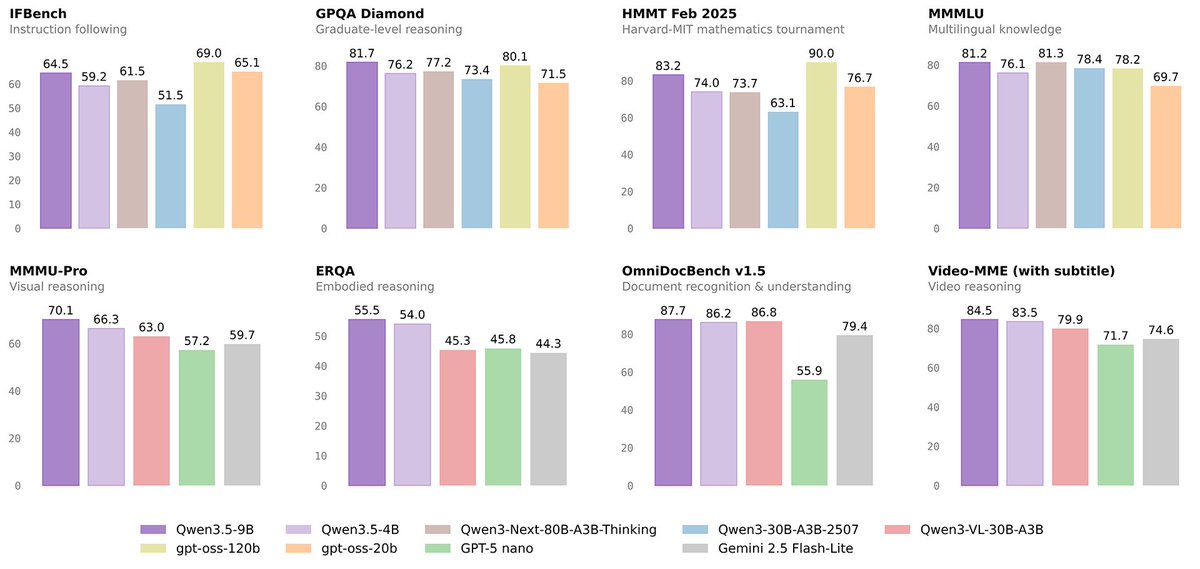
🚀 Introducing the Qwen 3.5 Small Model Series
Qwen3.5-0.8B · Qwen3.5-2B · Qwen3.5-4B · Qwen3.5-9B
✨ More intelligence, less compute.
These small models are built on the same Qwen3.5 foundation — native multimodal, improved architecture, scaled RL:
• 0.8B / 2B → tiny, fast, great for edge device
• 4B → a surprisingly strong multimodal base for lightweight agents
• 9B → compact, but already closing the gap with much larger models
And yes — we’re also releasing the Base models as well.
We hope this better supports research, experimentation, and real-world industrial innovation.
Hugging Face: https://t.co/wFMdX5pDjU
ModelScope: https://t.co/9NGXcIdCWI
@Joojo_Dontoh@KiddBubu Breaking out the plan into phases into seperate md files is such a great hack. I recently discovered this and it has worked well for me. The other thing is keeping the context window under 75-80%. I realised things start to go downhill from there.
I think he probably knows a thing or two about building software because the video literally starts with “I’ve been building software for healthcare for 20 years and code is my happy place….”. So I guess the quality of his work would be way better than the average physician.
Cardiologist wins 3rd place at Anthropic's hackathon. Out of 13,000 applications. Built in 7 days by Michał Nedoszytko MD. Coded day and night - in the hospital, in the cloud, while flying from Brussels to San Francisco.
A few years ago, it would have been impossible for a doctor to build this alone in just a couple of days. AI changed that.
The project is called https://t.co/wAliajqjVF. It is an AI agentic care platform for patients. Including reverse AI scribe it is a companion that guides the patient from the moment they leave the doctor's office.
Powered by the massive context window of Opus 4.6, it allows patients to explore their full medical history, connected devices, Evidence Based resources and external data sources — all in one place.
Today, the barrier to entry has vanished; even a practicing physician can build an application from scratch.
@TheDumbTechGuy@claudeai This is beautiful 🙌🏾…. but since Fizzy is built on top of the Claude code harness; does it mean one must have Claude code installed for Fizzy to work? And are there any plans of supporting other models or harnesses like Codex?
@Joojo_Dontoh I literally said this about a year ago. I guess the way out of this would be not to give into the illusion of slowness of execution at the expense of actually learning.
https://t.co/nJ6I2jbt1O
This looks really cool and awesome and would be a productivity booster…. But I find myself thinking that when we are churning out so much code like this, people would just go ahead to accept changes without going through all of it since it just works 👀.