A few patterns we frequently use with Fable 5:
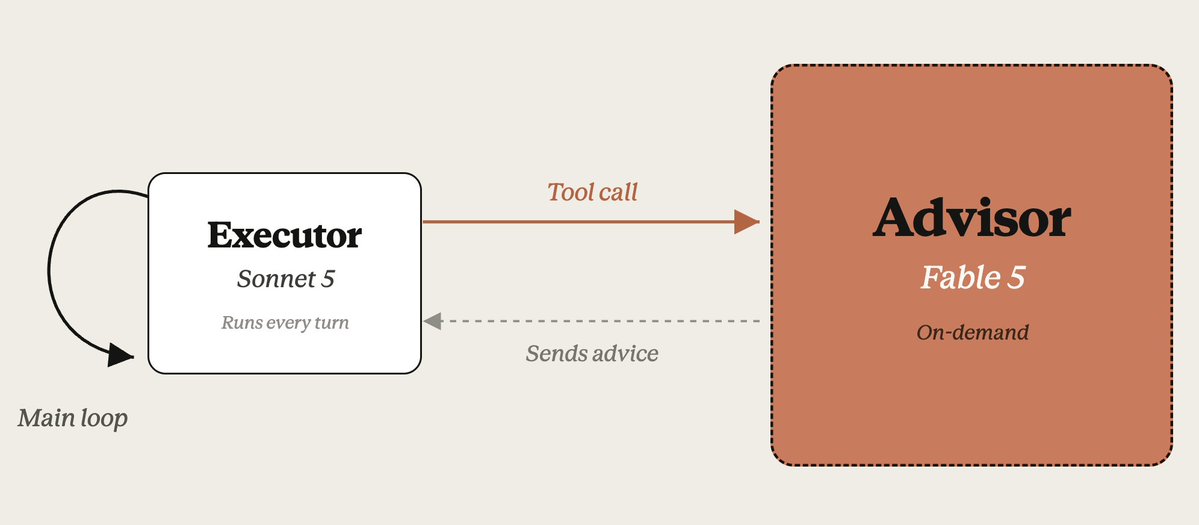
Use Fable 5 as an "advisor."
An executor (Sonnet 5) calls Fable 5 for guidance.
Most tokens are billed at the lower executor rate.
Shopify's LLMs beat frontier models on a range of tasks at a fraction of the cost. The reason: we put systems in place that enable them to improve themselves, learning from a range of commerce tasks every day.
We're presenting our Model Optimization Flywheel at @ICMLconf: a continuous pipeline that turns Shopify's product expertise into robust evals, mines low-scoring conversations, critiques them, repairs them, and feeds them back into the model. Then we compress the prompts without losing quality, so we can make it faster and cheaper.
We present an example of the flywheel working at scale: our GraphQL agent. Serving cost dropped from $27M to $1M annualized (−96%). We compressed our system prompt 4× and still beat frontier models on quality.
@Drewch and @cmazzaanthony will share concrete recipes, quality-cost-latency trade-offs, and a blueprint you can actually build from.
📅 Monday, July 6 · 11:30am–12:30pm KST
📍 COEX, Hall D1
Link in thread. 👇
We're opening the waitlist for our Monetization Gateway, which will allow you to charge for any web page, dataset, API, or MCP tool behind Cloudflare. The charges will settle in stablecoins over the x402 open protocol. https://t.co/pvICtEIixj
My entire AI stack is now Chinese 🇨🇳
87% cheaper. same revenue
swaps by task:
1. reasoning / backend brain
Opus 4.8 → Kimi K2.7
benchmark gap: ~8% · price: ~11x cheaper
2. code generation
GPT-5.5 → Qwen 3.7 Max
benchmark gap: ~18% · price: ~7x cheaper
3. agent loops + tool calling
Sonnet 4.7 → GLM 5.2
benchmark gap: ~3% · price: ~5x cheaper on input
4. cheap volume / bulk processing
GPT-5.5 mini → MiMo V2.5
benchmark gap: ~6% · price: ~12x cheaper
5. image generation
GPT-Image-2 → Wan 2.5
benchmark gap: ~5% · price: ~8x cheaper
6. video generation
Sora 2 → Kling 3.0
benchmark gap: roughly equal · price: ~6x cheaper
[ result after 30 days: ]
operating costs dropped 87%, output quality dropped 4% on average, revenue unchanged
the most important that these models will be not banned in a month and i can run them locally
nobody will steal my data and i can learn them as i need
full article drops tomorrow with:
> exact routing logic per task type
> the 2 cases where I still pay for American
> the migration playbook anyone can copy in a weekend
VERY IMPORTANT to get migrated now, while it's not too late
It’s so easy:
- rent VPS on hetzner or ovh or whatever
- get Claude to set it up for you, copy your dotfiles, install packages, setup swapfile and zswap etc
- lock it down by blocking all inbound traffic and using tailscale ssh
- use tmux or use the ssh feature of Claude/Codex desktop app if you are allergic to terminal
- use tailscale serve (within tailnet) or cloudflare tunnels (outside world) to expose servers
It’s als cheaper
As engineering, product, design, DS, etc. melt into a new kind of role, I was reflecting on what roles might look like in the future. For example, when I look at the Claude Code team I see what I think is five archetypes:
1. Prototyper: comes up with brand new ideas; churns out many ideas, most of which don't ship
2. Builder: quickly turns a prototype/idea into production-grade product/infra
3. Sweeper: cleans up the UI, simplifies the code and system, unships, optimizes performance
4. Grower: takes a product that has been built and iterates on it to improve Product-Market Fit
5. Maintainer: owns a mature system to make it secure, reliable, fast, and efficient as it scales
Many people span across 2 roles, and sometimes 3 roles. I also notice that these roles are not really tied to job function -- eg. across Anthropic, some designers match category 1, some 2, some 3; same for engineers, PM, DS.
A healthy team needs a mix of these, depending on the product:
- A product that is new and pre-PMF needs people that are strong at 1+2+3
- A product that is growing and has found PMF needs 2+3+4 and some 5
- A product that has strong PMF needs 3+4+5 and some 2
Maybe product roles of the future will look more like this, and less like the domain-specific roles of today?
✨ I think I've been coding almost solely on my VPS with Claude Code for almost a year now
All I can say it's just fantastic:
- no need to keep laptop open ever
- no laptop battery drain
- can switch to phone or any other device you like whenever you want to continue (like when you're outside)
- it just keeps going all night while you sleep (esp with /goal)
- you can start hacky projects from scratch and go live in seconds because you're already on the server which is great to ship things and get it used by people fast (not stuck on your local laptop webserver)
- it just feels like living in the future
I used to code on my laptop, test locally, then push to GitHub, then it auto pulled and deploy to production, that'd take me ~1 minute to get a new feature out
But then when I bought a new Mac Book Pro a few years ago I was too lazy to install a local Nginx environment, so I just started pushing to prod and everything went fine, and I sped up deploying to about 3 seconds from laptop to server, which people called me crazy for too
But now with Claude Code on my VPS in the last year, it just live edits on my production server, which sounds like it should go wrong but it just doesn't, it's very careful and only twice in 12 months messed up which meant my site didn't load for 10 seconds which is OK
If I wasn't working solo, like at a big company, I' think I'd recommend the same workflow but with a staging server, so it wouldn't touch production, for safety and regulatory reasons etc. but for me it's fine
I agree with @theo completely, it's clear to me this is where it's going, also seeing @karpathy with Claude moving to the cloud (via Slack etc), I think AI "agents" and AI coding will operate on servers / from the cloud first
P.S. I have 3-2-1 backups, multiple on-site and off-site backups which you should also even if you wouldn't code with AI, safety first!
Many smart people/AI insiders are saying GLM-5.2 is the first Chinese AI model to match and often beat the American big lab public AI models with no compromises. Incredible timing given current events.
Today we're launching Goose Ads in Claude.
This is a skill /goose-ads that lets anyone make high-performing ad creatives directly in Claude, Claude Code, Cowork, or Codex.
Here's how it works:
1. Install the skill: npx gooseworks install --all
2. Run this prompt:
/goose-ads create ads for my brand <brand-website>
3. (Optional) Pick templates you like on the platform
The skill finds top-performing ads that companies are already spending $ on and generates creatives for your brand.
It also ensures that generated creatives are accurate to your brand's messaging, logo, assets, etc.
It's that easy.
But this is just the start.
We have created a library with 100+ open-source skills for growth that some of the fastest growing startups in the world are using every day to run ads, content, competitor research, gtm, seo and more.
Comment Goose and I'll DM you the full open-source skill library.
The Agents SDK is now a runtime any agent framework can build on. Today we're opening up the Agents SDK primitives, with Flue as a first framework targeting Agents SDK, and rolling out agents in the dashboard.
https://t.co/93z3yeNJmp
today we're launching @Palmier_io, a video editor Claude can edit.
use AI to edit, organize, and generate footage directly in the timeline.
finally, a video editor built for AI.
open-source. mac native. available now.
We've added support for the Enterprise-Managed Auth extension to MCP.
Admins can centrally authorize MCP connectors for their organization, so all the tools and data users need are connected on their first login.





![DeRonin_'s tweet photo. My entire AI stack is now Chinese 🇨🇳
87% cheaper. same revenue
swaps by task:
1. reasoning / backend brain
Opus 4.8 → Kimi K2.7
benchmark gap: ~8% · price: ~11x cheaper
2. code generation
GPT-5.5 → Qwen 3.7 Max
benchmark gap: ~18% · price: ~7x cheaper
3. agent loops + tool calling
Sonnet 4.7 → GLM 5.2
benchmark gap: ~3% · price: ~5x cheaper on input
4. cheap volume / bulk processing
GPT-5.5 mini → MiMo V2.5
benchmark gap: ~6% · price: ~12x cheaper
5. image generation
GPT-Image-2 → Wan 2.5
benchmark gap: ~5% · price: ~8x cheaper
6. video generation
Sora 2 → Kling 3.0
benchmark gap: roughly equal · price: ~6x cheaper
[ result after 30 days: ]
operating costs dropped 87%, output quality dropped 4% on average, revenue unchanged
the most important that these models will be not banned in a month and i can run them locally
nobody will steal my data and i can learn them as i need
full article drops tomorrow with:
> exact routing logic per task type
> the 2 cases where I still pay for American
> the migration playbook anyone can copy in a weekend
VERY IMPORTANT to get migrated now, while it's not too late](https://pbs.twimg.com/media/HL-p_PyWoAA42S2.jpg)


