Introducing SWE-2, our closest model yet to the frontier.
On leading evals, it scores on par with recent frontier models – at up to 70% lower cost.
We scaled RL to multiple trillions of parameters, with a refined recipe that pushes the Pareto curve on both capabilities & cost.
my Devin cloud agents are doing crazy things right now
one prompt to install and run @OmarchyLinux and then another to install ghostty shell
might be the simplest way to try it out, you don't need to buy a machine!
Very good post from the Head of Economics at Anthropic. They’re finding that jobs have been less negatively impacted by AI than expected, as we continue to see time and time again in the data.
The reason for this is that AI - at least so far - still requires people to operate to produce value in most cases. Most jobs can’t be fully automated with AI, only certain tasks in those jobs. And when you automate specific tasks, you actually can get even more output from those jobs, raising the demand (or at least maintaining it) in many cases.
“So far, AI is both skill-biased and labor-augmenting. It complements domain expertise. It relies on humans in the loop to direct and evaluate the most complex work. And it rewards AI proficiency. Model capabilities are improving fast, but remain stubbornly jagged. To fill in the pockets of the jagged frontier, expert oversight is needed to steer incredibly capable AI systems, and to recover when they falter.”
I suspect that we continue to see this in a number of critical areas of work. It’s clearly happening in software engineering, where software produced is being multiplied, all of which still requires developers to manage the work agents are doing. Software engineers are needed in a wide variety of industries now and companies of all sizes can now light up software projects that would have been impractical before.
But there will be plenty of other domains of work where demand remains strong in a world where agents can accelerate the output of that job. Jevons paradox is alive and well.
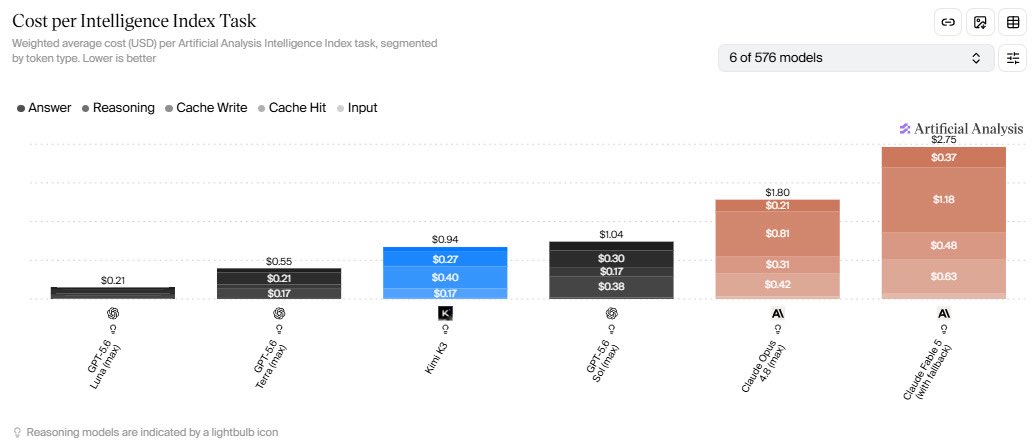
Kimi K3 may be an important inflection point for AI. Potentially negative for Anthropic and OpenAI while being net positive for essentially every other company in the world. I mean that very literally. Although the real “Sputnik moment” would be an open-source frontier model that was also token efficient unlike Kimi K3 which is 50-70% more expensive to run than GPT 5.6 per Artificial Analysis.
Rationale:
A world where there are only 2-3 dominant frontier labs with 90% inference margins is net negative for every other layer while being awesome for those 2-3 labs. Those labs would become monopsonies for power, data centers, semiconductors and hyperscalers and would obviously vertically integrate over time into all those layers while also completely subsuming the application/software layers.
Anything that lowers margins and increases competition at the model layer is good for every other AI layer: power, semiconductors, hyperscalers, neoclouds and yes even software.
This is why Jensen is so supportive of open-source. An open-source model requires the *exact* same amount of compute to run as a closed frontier model of similar size and architecture. Kimi K3 is roughly the same price as GPT 5.6 Terra on a per token basis, which actually suggests that it is less computationally efficient as I am sure that GPT 5.6 is priced to a higher margin than K3. And given that K3 is a token wastrel, i.e. token inefficient, it is significantly more expensive per task than GPT 5.6 and Grok 4.5, which are much more token efficient. Cost per token and token efficiency (i.e. intelligence density per token) are the drivers of intelligence per unit of cost. The winning AI companies will be those that offer the most intelligence per $ over time.
Lower margin % at the model layer = more margin $ at every part of the infrastructure layer and is a godsend for software. This can happen either through open-source models like K3 at the frontier *or* having a vertically integrated model company like Meta, SpaceX or Google at the frontier. Both outcomes result in a lower margin % at the model layer as vertically integrated model companies don’t really care where the margin $ come from. This is why it was so painful for OpenAI and Anthropic when Google was right there with them from a model competitiveness perspective and why Grok 4.5 and Muse 1.1 were just as important as Kimi K3.
The reason Kimi K3 is only *potentially* negative for Anthropic and OpenAI is 1) the @ericvishria point that the Claude and ChatGPT products and harnesses may be more important than their models today and 2) the hypothesis that they have much more advanced model checkpoints internally that are already being used for RSI. In the latter scenario, reaching RSI even a few months ahead of other labs might be enough to cement a permanent lead.
Time will tell on both points. And likely fairly quickly.
Caveat would be that since Kimi K3 is not token efficient and thereby actually more expensive than ChatGPT 5.6, we may need to see a more token efficient open-source model at the frontier or see Grok 5/Composer 4/Muse 2 at multiple points on the Pareto frontier for this potential risk to Anthropic and OpenAI to play out. And I am sure they will both vertically integrate as quickly as possible while continuing the product/harness strength they have shown over the last 8 months.
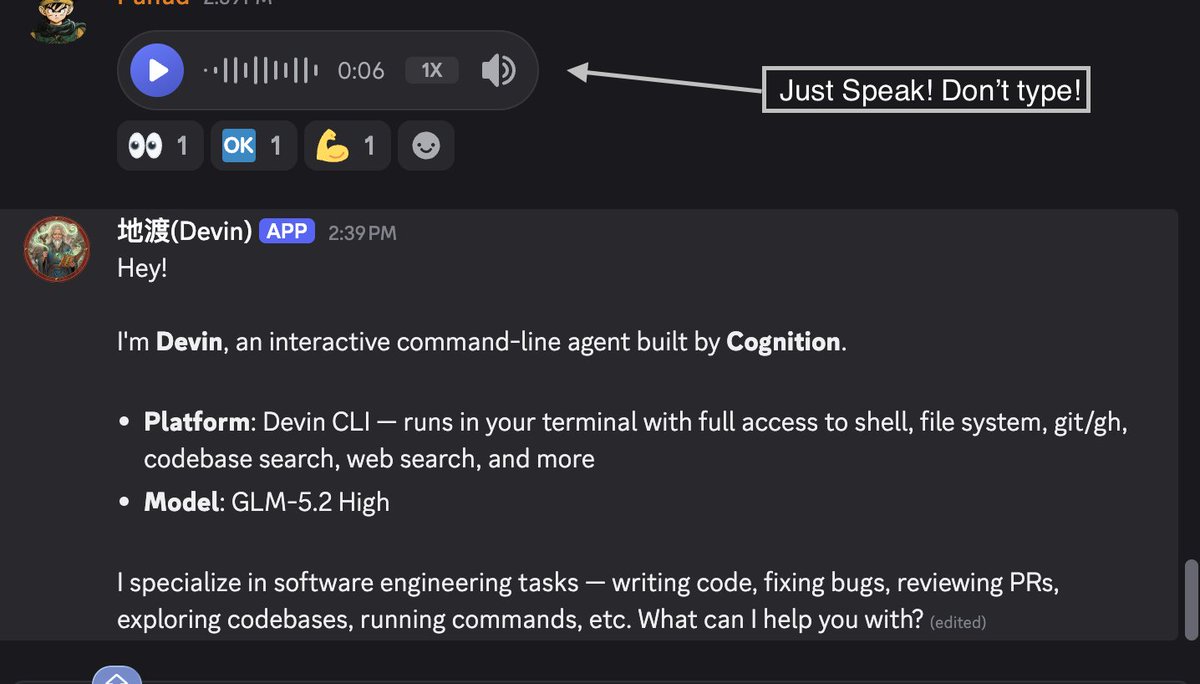
And guess what — @openabdev now supports Devin CLI! 🚀
Chat with your Agent running GLM-5.2 or Kimi K2.7 straight from Discord / Telegram / Teams / Google Chat / LINE / Feishu — or just press to speak without typing a thing. From the beach, the couch, wherever. 🏖️
I've been on a wild travel journey in China for several weeks, with only a backpack, making new friends and meeting & getting to know people from all walks of life. I've been truly humbled and inspired by everyone's kindness.
Next, I'm hopping over to Taiwan (first time for me) to hang out with Jensen, attend Computex, eat a bunch of street food, and just have fun talking to all kinds of folks around the city & beyond. After that, no plans, anything goes.
As always, please give travel suggestions or fill out coffee form if you want to hang out in Taiwain or anywhere else in the world. Love you all! ❤️
I'm thrilled to be co-hosting the community meetup in Taipei alongside Windsurf!
# Windsurf x HappyDesigner Community IRL Meetup in Taipei City
🕖 Date & Time: May 21, 7:00 PM
📍 Location: Tempo House, Taipei City
https://t.co/rpgpa2dLVh