Baby steps folks. How about build anything at all, anywhere near anyone. Remember this is the city that took 30 years to finish a bus lane on Van Ness.
It's time to build the bay area megacity.
- rapid transportation (both intercity and intracity)
- high density
- high walkability
- enough housing to have 100 million+
- the home of 10+ trillion dollar companies
- underground hyperlogistics + robotic network
- capital of tech, hardware, bio, education, etc
- produce so much energy we export it to others
The Vision Pro by itself may not be light-years ahead of Magic Leap or Hololens, but when when the Apple flywheels get rolling watch out!! 👀
A top-tier studio betting big on immersive content, and wielding the hardware channel to push it mainstream.
It would cost a lot less than $100B to pivot to autonomous road trains.
For those of us who misguidedly voted in favor of Prop 1A back in '08, can anybody explain how this works going forward?
Do voters get an opportunity to cut our losses?
California’s High-Speed Rail project was originally estimated to cost $33 Billion.
Now they’ve spent $9.8 Billion, no track has been laid, and they estimate it will cost another $100B+ to complete.
For a single system that will be about 800 miles long.
Honestly impressive.
@EdLudlow@bznotes Agreed but... VERY slowly. Battery technology is advancing at a steady snail-like pace. Optics, sensing, and processing moving only kinda in the right direction. It is equally likely we get to effective wireless power instead before AR HMD battery packs disappear.
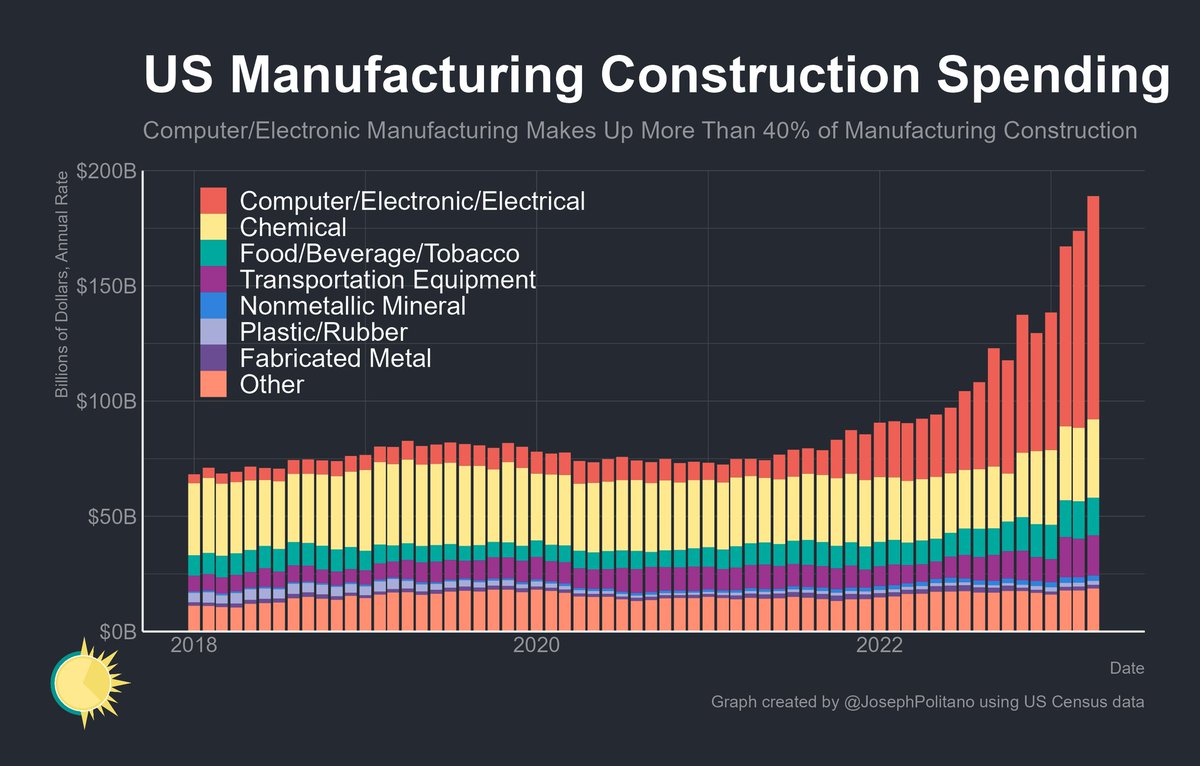
Spending on the construction of US manufacturing facilities continues to climb (despite contraction in near-term mfg indexes).
Recession or not, it appears that Made in USA 🇺🇲 is making a true comeback especially in high tech. Huge win for @POTUS and #CHIPSact
Texas is the perfect place to build the future of construction tech, even though California is the place that actually needs it most. *Sigh*
Cool to see a big shot builder like @Lennar pushing the future down there.
Take a tour of one of Lennar’s new 3D-printed homes at Wolf Ranch in Austin, TX. These innovative homes, built by Lennar and ICON, feature elevated and energy-efficient design with an eye towards sustainability.
Smartphone screens should be smaller for ergonomics and it's completely fine if they therefore must be thicker to fit battery life and premium CPU/memory.
Within a year we will all be utterly "ainundated" with content—endless FLOOD (see James Gleick) of AI generated emails, podcasts, auto written substacks etc
I predict many people begin "DRYDOCKING": insisting on in person human connection no devices no AI