Newly published article with Ben Stephens, now a postdoc with Vince Larson at UWis-Milwaukee, the seed for a mechanism within the tropical atmosphere that may help account for abrupt transitions in climate. https://t.co/t08HNMZ0dw
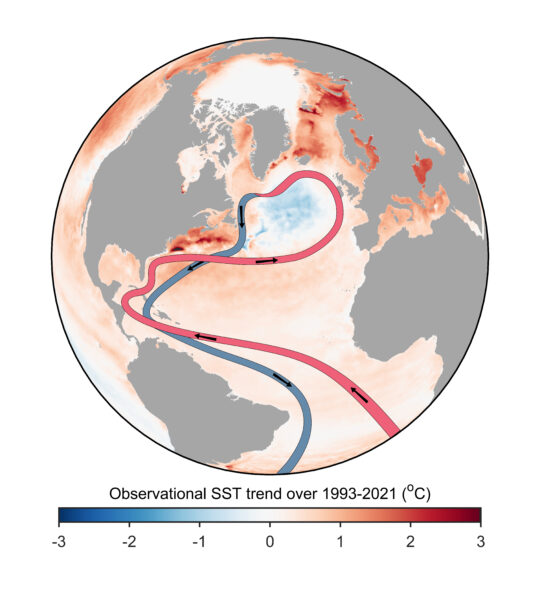
New Danish study just out in Nature Communications, titled "Warning of a forthcoming collapse of the Atlantic meridional overturning circulation".
Is it serious? Here's my take on it: https://t.co/aN3CYwQ0PI
Looking for a statistician to join a multi-disciplinary team of scientists to build the next generation of catastrophe models. https://t.co/mAAKX6y4jY #fun#data#extremes#boston
I’m also #hiring somebody who can help manage creative quantitative types with curiosity for weather extremes. Catastrophe modeling has unique opportunities for data analytics and observing the emergence of climate change risk. https://t.co/8Sa07M8RDp
I’m #hiring creative quantitative types with curiosity for weather extremes. Catastrophe modeling has unique opportunities for data analytics and observing the emergence of climate change risk. https://t.co/RTpKRg9IgL
I have a new home for my professional aspirations helping society manage the risks of climate change and extremes. I have moved to Verisk/AIR Worldwide in Boston to be the Director of Atmospheric Perils Modeling.
@cristiproist @UTGeophysics includes a pool of technical support staff who are paid for through a combination of individual PI grants and institutional funds. There is an expectation that grants include support for these staff members. This solution requires cooperation and good will.
New 𝚋𝚎𝚍𝚖𝚊𝚌𝚑𝚒𝚗𝚎_𝟹𝚍 Matlab function makes it super easy to make 3D maps of Greenland or Antarctica.
Docs: https://t.co/PyUutdSAMW
GitHub: https://t.co/D0UXxr0mEW
King Soopers is my grocery store/pharmacy and the center of our South Boulder community. My heart hurts from this senseless violence. It could have been any of us. It should be none of us. #BoulderStrong#EndGunViolence
@cristiproist @thirstygecko @InfNorm Conversations with @mountain_gaucho suggested to me that it was unlikely that subsurface temperature anomalies would be large enough to explain long-term variability during Holocene. It is a good null hypothesis. Needs to be tested.
@thirstygecko @InfNorm Yes ... one hypothesis is that long period power from the deglaciation remains during the Holocene. Despite this paper’s title, it makes the case that the millennial to decade power gap is still a question.
Somebody did a simulation of a giant 🍌 orbiting around the 🌍 at the distance of the ISS.
And, surprisingly, it challenges our intuitions of how orbiting objects would look like in the sky.
Within AGU CESM2 Virtual Special Issue (covering many articles over this past year), this is the article I was drawn to first: An Efficient Ice Sheet/Earth System Model Spin‐up Procedure for CESM2‐CISM2: Description, Evaluation, and Broader Applicability https://t.co/n0D2Q4VLB1