Graphic design just became the 11th fastest-declining job.
According to the World Economic Forum’s 2025 report.
Meanwhile, UI/UX design is the 8th fastest-growing job.
Here’s what that actually means:
The skills aren’t disappearing. The expectations are changing.
What’s declining:
→ Design as execution (making things look good)
→ Technical tasks AI can replicate
→ Visual output without strategy
What’s growing:
→ Design as problem-solving (making things work)
→ Creative thinking AI can’t replicate
→ Strategic direction that drives business results
The WEF report is clear: employers rate AI’s ability to replicate creative thinking as “very low.”
But they’re confident AI can handle design execution.
Translation:
If your value is “I’m good at Figma,” you’re replaceable.
If your value is “I know which design solves the problem,” you’re essential.
The 30% rule:
AI handles 70% of routine work. Humans own the critical 30%: judgment, creativity, strategy.
For designers, that 30% is:
→ Understanding the business problem
→ Knowing which solution fits
→ Making strategic trade-offs
→ Directing AI with intention
What I’m seeing after 15+ years in design:
Junior designers focused on execution → struggling
Senior designers focused on strategy → more valuable than ever
Every tool shift separates executors from thinkers.
Photoshop, Illustrator, or Figma didn’t replace designers.
It replaced the ones who couldn’t think strategically.
AI is doing the same, just faster.
Master AI tools, sharpen creative thinking, focus on solving business problems.
Graphic design isn’t dying. Designers who only execute are.
The ones who think strategically and use AI intentionally?
Best decade ahead.
💡 Where do you stand?
the future belongs to generalists because the world is no longer built in silos.
problems are now multi-domain:
energy + software
biology + computation
robotics + control + materials
manufacturing + ai
security + hardware
cities + data
finance + automation
specialists go deep.
generalists integrate.
the next breakthroughs won’t happen inside a discipline.
they’ll happen at the intersections; where no one has formal maps, and only wide-angle minds can see the structure.
generalists:
> translate across fields
> combine tools that weren’t meant to interact
> spot patterns specialists miss
> build systems, not fragments
> adapt faster than the pace of technological change
the world is converging.
knowledge is cross-pollinating.
the bottleneck is not expertise but integration.
the future is built by people who can move between domains without losing coherence.
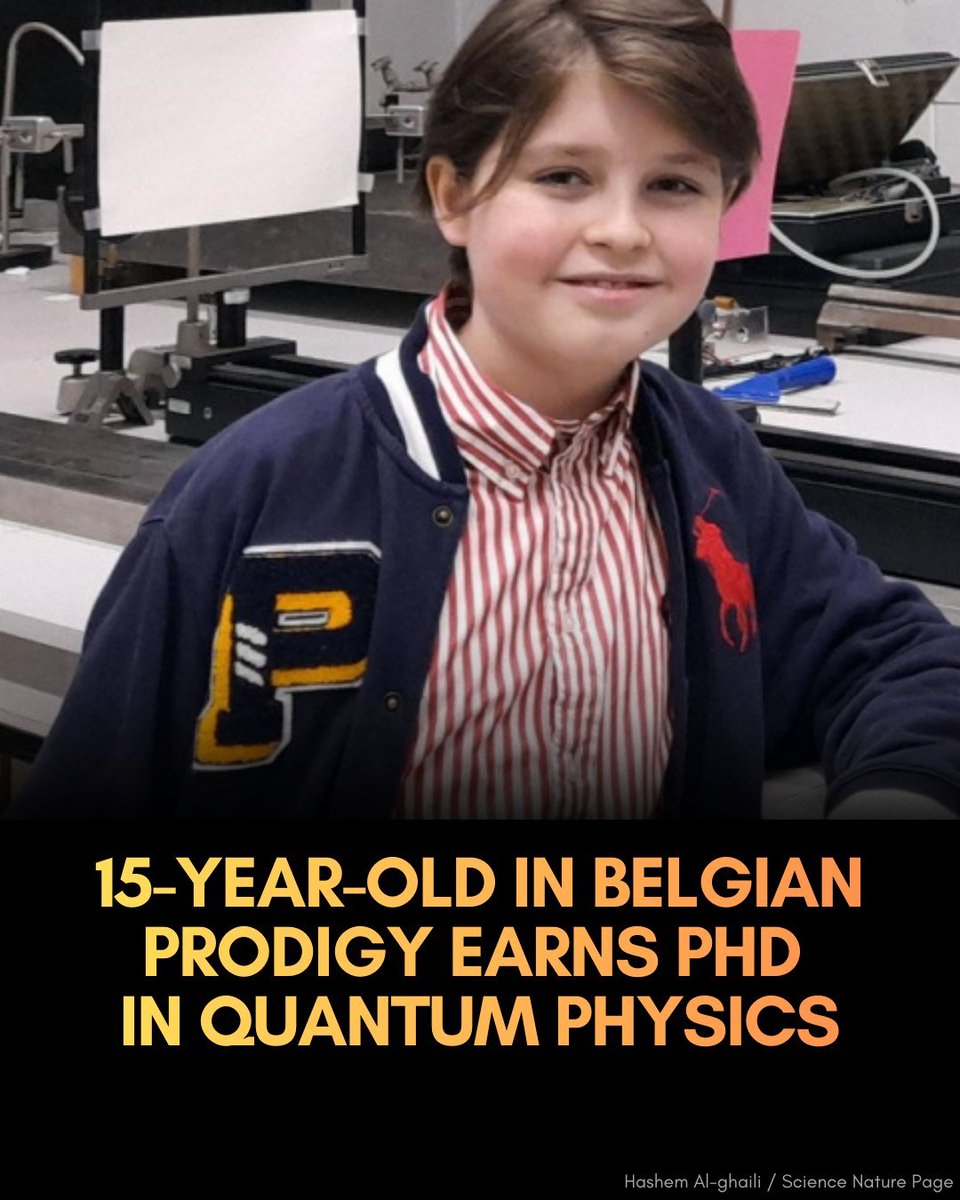
🚨: Belgium’s 15-year-old child prodigy just earned a PhD in quantum physics.
At just 15 years old, Belgian prodigy Laurent Simons has earned a PhD in quantum physics, becoming one of the youngest—if not the youngest—people in history to do so.
Simons successfully defended his thesis at the University of Antwerp, marking a stunning milestone in a journey that began before most children finish primary school.
Today we’re thrilled to announce JAM-2 — the first AI model capable of generating drug-quality antibodies straight from the computer, with industry-leading success rates.
> Drug-like affinities: Picomolar to single-digit nanomolar antibody binders for half of 26 targets while testing <45 designs each.
> Unlocking hard targets: Up to 11% success rate for direct on-cell GPCR binders; top antibody hits in the single-digit nanomolar range.
> Unprecedented epitope breadth: JAM-2 routinely designed antibodies that hit 30–70% of user-defined epitopes, now enabling intentional design of biology — not chance discovery.
> Drug-like developability: Over 50% of antibody designs passed core industry developability criteria with zero optimization.
> Massive leverage: A four-person team prosecuted 16 targets in parallel in < 1 month.
JAM-2 is the first de novo antibody design capability ready for front-line use in drug discovery, matching or surpassing traditional discovery approaches.
We’re already deploying JAM-2 with multiple large pharma partners and seeing excellent results.
If you’re interested in partnering on molecule development or accessing JAM-2, contact [email protected].
Read more in our whitepaper (link below)
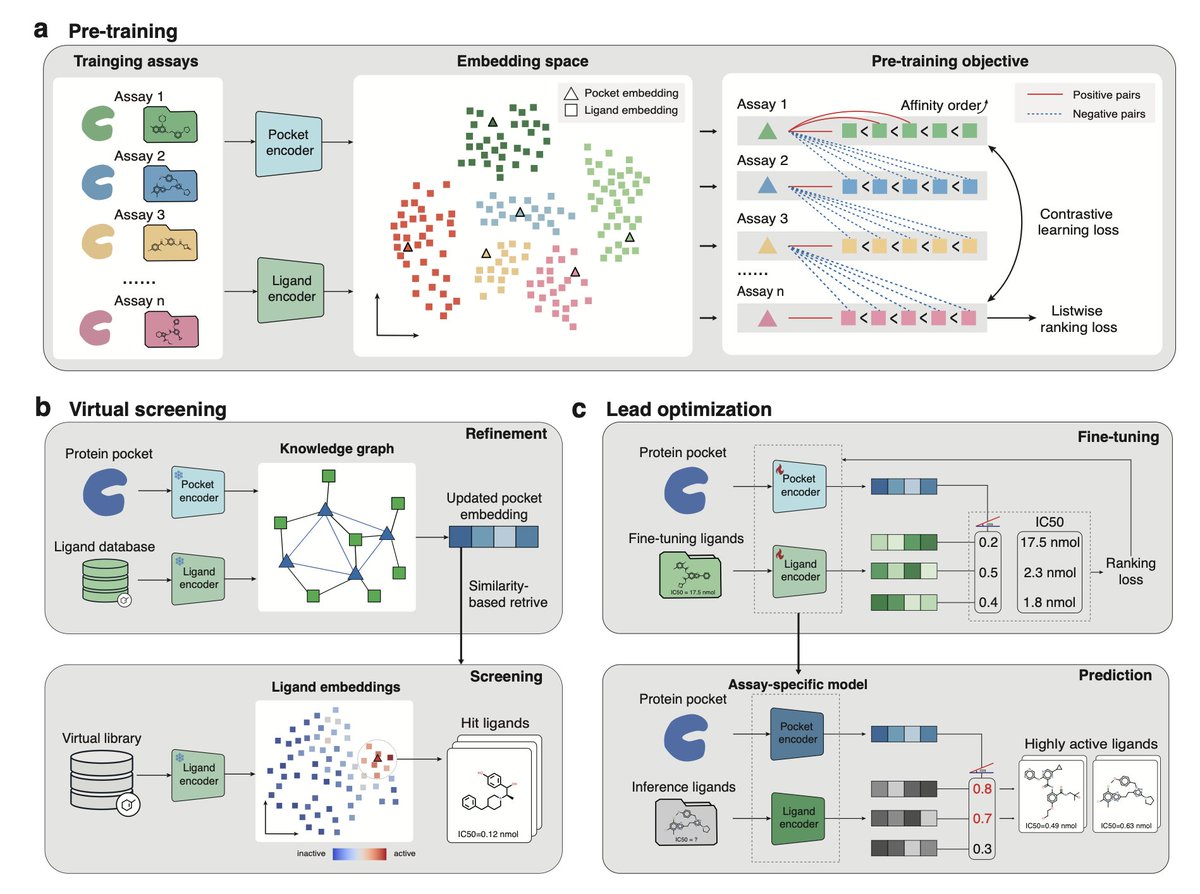
A foundation model for protein-ligand affinity prediction through jointly optimizing virtual screening and hit-to-lead optimization
1. LigUnity is a novel foundation model that jointly optimizes protein-ligand virtual screening and hit-to-lead optimization, leveraging the synergy between these two tasks to enhance the overall drug discovery pipeline.
2. The model uses contrastive learning to distinguish between active and inactive ligands during virtual screening and a listwise ranking approach to optimize the affinity prediction for hit-to-lead optimization, improving performance across various benchmarks.
3. LigUnity outperforms 24 competing methods in virtual screening tasks on several benchmarks, such as DUD-E, Dekois 2.0, and LIT-PCBA, with significant improvements in the enrichment factor and faster screening speed.
4. The model also excels in hit-to-lead optimization tasks, achieving superior performance compared to traditional computational methods like free energy perturbation (FEP), particularly in zero-shot and few-shot settings.
5. The integration of LigUnity in an active learning framework shows its ability to identify optimal binding ligands for TYK2, a therapeutic target for autoimmune diseases, achieving over 40% improved prediction performance.
6. LigUnity's versatility is highlighted through its application to diverse settings, including split-by-time, split-by-scaffold, and split-by-unit settings, where it consistently outperforms other methods and generalizes well to unseen proteins and novel chemical scaffolds.
7. The ability to handle different assay types, including those using percentage units and real-world datasets, makes LigUnity an ideal tool for drug discovery, offering significant improvements over existing methods in both speed and accuracy.
📜Paper: https://t.co/PTGG6hM2ZC
#DrugDiscovery #MachineLearning #VirtualScreening #Bioinformatics #AIinPharma #ComputationalChemistry #ProteinLigandAffinity #DeepLearning #HitToLead #ActiveLearning #ProteinModeling #LigandOptimization
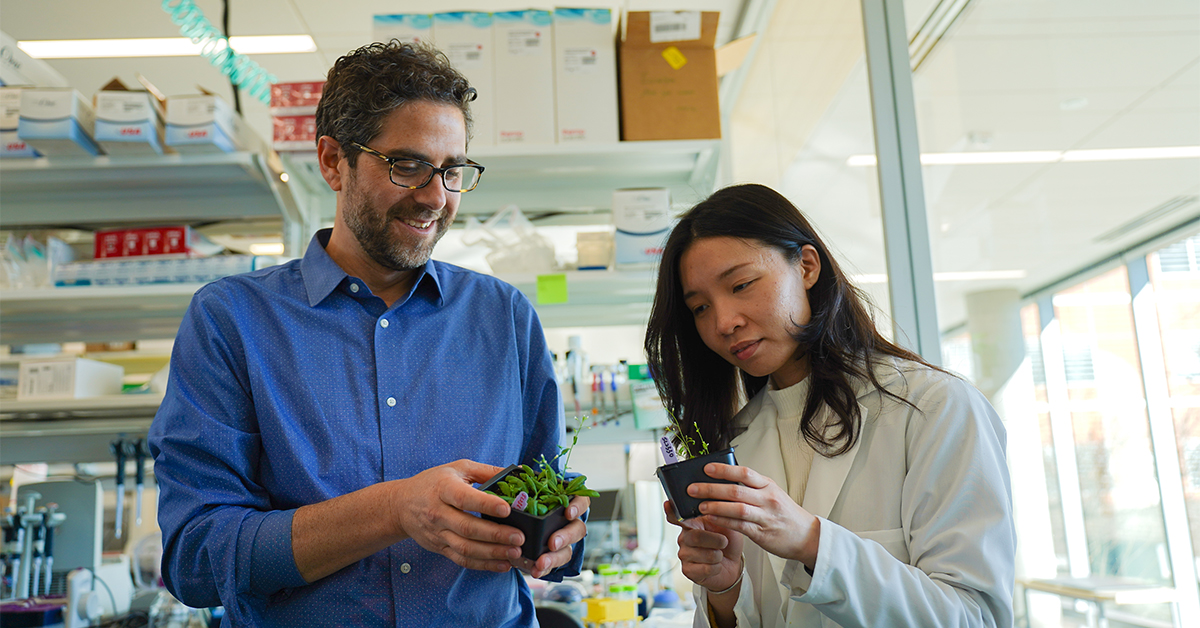
The @Slotkin_Lab has discovered a plant genome-engineering technique called TATSI that could streamline the process of developing improved crop traits, getting them from the lab to field in record time.
Learn more in @techreview: https://t.co/XxZKAoptGj
🌍Hello Climate Warriors! Today we embark on our journey to go deeper into climate change and know the basic science around climate change.
🎉Our first concept is The Great Ocean Conveyor Belt, also known as AMOC.
#climatetechschool#climatechange#tech