World Climate Declaration, signed by more than 2000 scientists and experts. Message: there is no climate emergency. Book: The Frozen Climate Views of the IPCC.
You take climate change seriously, support cutting emissions and publish research consistent with IPCC assessments. Then you find yourself labelled a “climate denier”.
That happened to @RogerPielkeJr. He studied losses from hurricanes and other weather disasters. Those losses are rising—but how much comes from climate change, and how much from having more people and more valuable property in harm’s way?
His findings were not well received. In his lecture at Clintel, he describes the political attacks that followed, including from the Obama White House.
He also walks through what the science says about extreme weather. Heatwaves, floods, hurricanes and droughts each tell a different story. And he explains why he challenges the attribution studies behind so many headlines.
His full first lecture, recorded on 11 October in Driebergen, the Netherlands, is now online. Around 57 minutes, with clear explanations and plenty of personal experience. Worth making time for.
🎥 Watch via the link in the first reply.
BREAKING: THE BIGGEST CLIMATE SCANDAL IN AUSTRALIAN HISTORY
The Albanese Labor Government has just been caught red handed. New forensic evidence suggests they are using a compromised Bureau of Meteorology (BOM) to fabricate a climate crisis that simply does not exist.
A explosive forensic audit led by investigator Tom Berger and retired scientist Geoff Sherrington has uncovered widespread, systematic errors and fake readings within the BOM’s raw climate data.
We aren’t talking about minor glitches, we are talking about copy and pasted data designed to make the past look cooler and the present look warmer.
The audit exposed blatant data manipulation at the Sydney Observatory:
•The Fabricated Data: Minimum temperatures from August 1907 were found completely duplicated and inserted into the August 1867 record.
•The Cover-Up: The Australian fact-checked the National Archives and confirmed this “double-up” does not exist in the original handwritten records. The online data used to justify sweeping climate policies is completely wrong.
For years, the BOM has operated on a “trust us” basis. Dr David Evans, the scientist who built Australia’s carbon accounting software, warns that this “secret climate business” mirrors the worst days of fraudulent medical drug trials, where researchers were under immense pressure to exaggerate results to fit a narrative.
Labor is terrified of an independent audit because they know their Net Zero house of cards will collapse if the public sees the real numbers.
Dr Jennifer Marohasy confirmed that outside of Adelaide, there has been no proper audit of Australia’s weather stations.
If our historical data is corrupted with fake inputs, the AI forecasting models used for future planning become entirely useless.
The Albanese Government doesn’t want the data audited because the data doesn’t support their narrative.
They are destroying our economy, killing our energy grid, and forcing Net Zero targets on regular Australians based on copy and pasted climate fiction.
The question is simple, if the records are sound, why is Labor so opposed to an independent audit?
https://t.co/nkHqVgQn3O
Being able to heat your home and afford your groceries should matter more than a politician’s climate ambitions.
Follow Clintel’s coverage of climate and energy policy:
https://t.co/ADEmKB34Mb
You turn the heating down because you’re worried about the bill. The politicians telling you the energy transition must go faster have no trouble keeping warm.
@mhtncontrarian draws a disturbing parallel with Mao’s Great Leap Forward.
Mao told farmers to plant more densely and plough deeper. Officials promised ever bigger harvests. When the crops failed, the state still demanded the grain it had been promised. Tens of millions starved.
Menton sees the same arrogance in Western energy policy: leaders determined to replace dependable power stations with wind and solar, brushing aside warnings about whether the system will work when people need it.
And the consequences reach beyond your heating bill. Farms need fuel. Fertiliser production needs energy. So do food processing, refrigeration and transport. Expensive, unreliable energy can put food out of reach too.
If you’re already struggling to heat your home or feed your family, being told the transition must go faster is hard to stomach.
How much are ordinary people expected to lose before the leaders pushing these policies admit they could be wrong?
Mao’s farmers knew the land. Their leaders thought they knew better—and forced them to follow disastrous instructions.
Francis Menton argues that Western energy policy shows the same dangerous contempt for practical knowledge.
Read his article:
https://t.co/K7ovjMFFX3
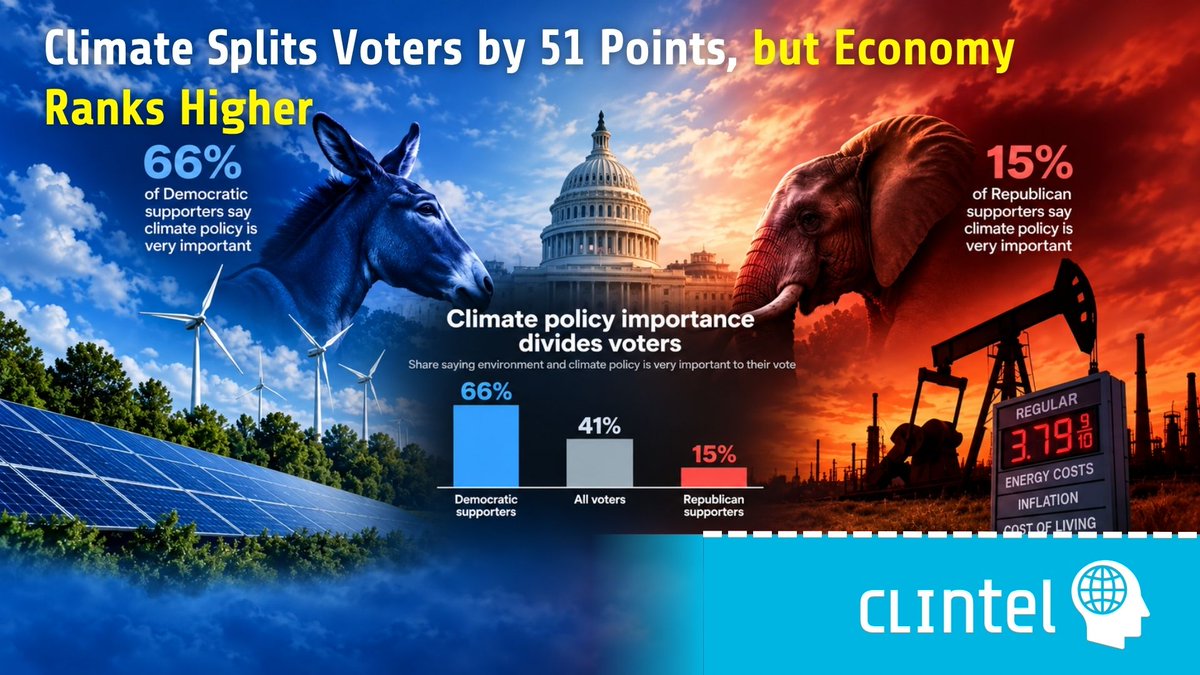
Climate policy is one thing. Paying for it is another.
Charles Rotter on Pew’s latest poll:
• Environment/climate policy matters greatly to 66% of Democratic supporters, versus 15% of Republicans.
• The economy ranks higher for both.
• 74% of adults are very worried about gas and energy prices.
Yet Pew never asked: how much extra would YOU accept on your monthly energy bill for faster emissions cuts?
Would that 66% hold once the household cost of a specific climate policy was on the table?
That’s the question Charles Rotter raises after examining Pew’s findings:
https://t.co/JQCs8RJWTY
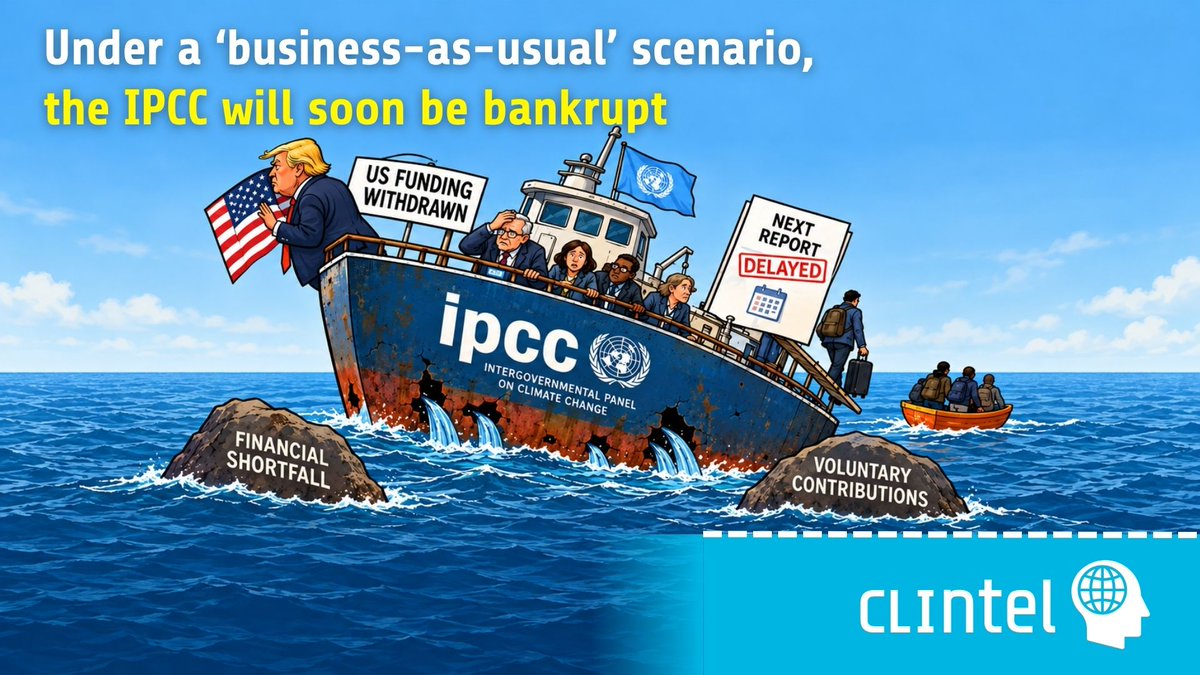
One IPCC scenario could come true remarkably soon: its own bankruptcy.
Following the IPCC’s example, @marcelcrok picks the bleakest scenario. Under “business as usual,” its financial reserves disappear and it goes into the red by 2029.
The irony: governments discuss trillions for climate policy, yet other countries are unwilling to replace roughly €2 million a year in lost US funding.
Crok sees that reluctance as a sign of waning interest in the climate issue. Plenty of grand declarations. Rather less enthusiasm when the collection plate comes round.
US funding withdrawn, no agreement on the next report’s timetable, and reserves projected to disappear unless income or spending changes.
Marcel Crok examines the IPCC’s own looming crisis:
https://t.co/pSVHLY4RHB
Pielke’s second lecture will be published soon, taking a closer look at climate models and scenarios.
Follow @ClintelOrg and subscribe to the newsletter to hear when it’s available:
https://t.co/ADEmKB34Mb
You take climate change seriously, support cutting emissions and publish research consistent with IPCC assessments. Then you find yourself labelled a “climate denier”.
That happened to @RogerPielkeJr. He studied losses from hurricanes and other weather disasters. Those losses are rising—but how much comes from climate change, and how much from having more people and more valuable property in harm’s way?
His findings were not well received. In his lecture at Clintel, he describes the political attacks that followed, including from the Obama White House.
He also walks through what the science says about extreme weather. Heatwaves, floods, hurricanes and droughts each tell a different story. And he explains why he challenges the attribution studies behind so many headlines.
His full first lecture, recorded on 11 October in Driebergen, the Netherlands, is now online. Around 57 minutes, with clear explanations and plenty of personal experience. Worth making time for.
🎥 Watch via the link in the first reply.
Prefer to read first? The article follows Pielke’s account of being labelled a “climate denier”, the White House response to his work, and the congressional investigation that damaged his career.
It also explains his criticism of event attribution. Using the same approach, he says he could “attribute” a flood in Japan to the growing number of patent applications. His point: a method can produce a causal claim if the relationship it is supposed to test is already built into its assumptions.
His advice to the audience: don’t accept the “climate sceptic” label so easily. First, look at what the science actually says.
https://t.co/fJVfEyhX3x
For research, news and critical perspectives that receive less attention in the climate debate, subscribe to the Clintel newsletter:
https://t.co/ADEmKB3CBJ
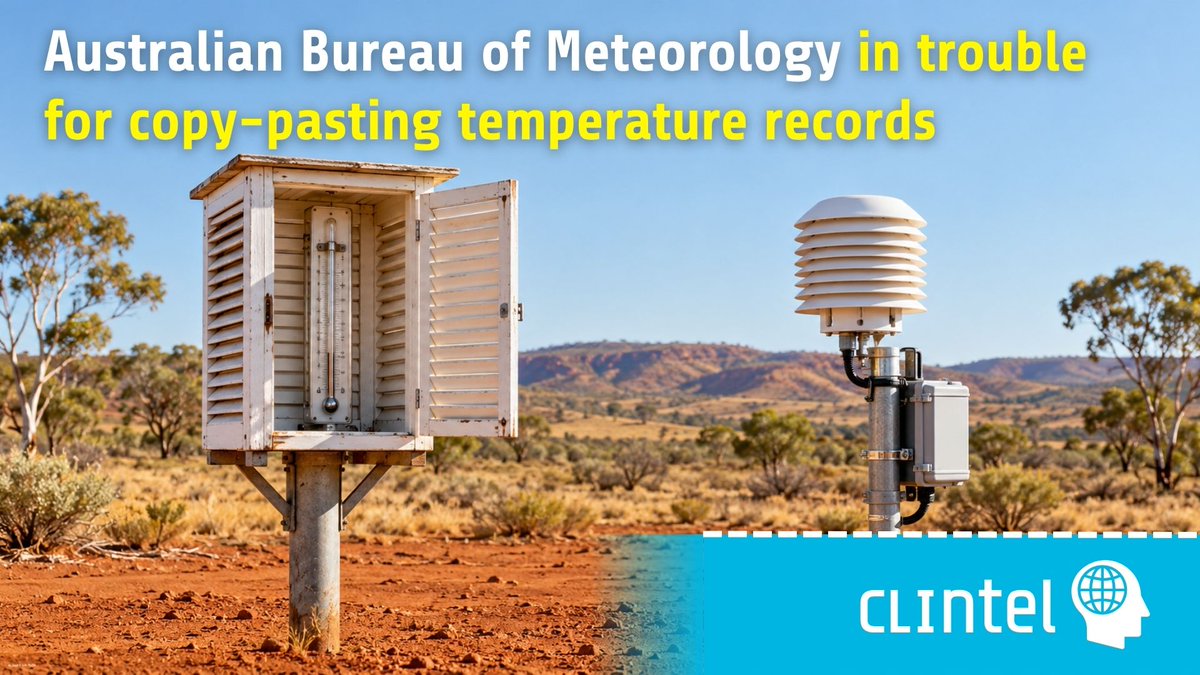
Remarkable: an entire month of copied temperature readings, a historical heat record deleted, and comparison measurements largely kept under wraps.
@JennMarohasy examines Australia’s temperature archives:
▪️ All 31 minimum temperatures for August 1907 also appear under August 1867. The original observation books show different readings.
▪️ The 51.7°C recorded at Bourke on 3 January 1909 has been removed from the official dataset.
▪️ Other historical heat extremes were never digitised.
▪️ Parallel measurements from mercury thermometers and electronic sensors remain largely unpublished.
Her blunt conclusion: management at Australia’s Bureau of Meteorology prefer the hottest years to be recent years. In her assessment, that is why the old heat record had to go.
A weather bureau should preserve the measurement history. Not the history it finds most convenient.
What do the original observation books show? Which readings are missing? And why not release the parallel measurements so independent researchers can check them?
Read Jennifer Marohasy’s analysis:
https://t.co/iP6mnDeTME
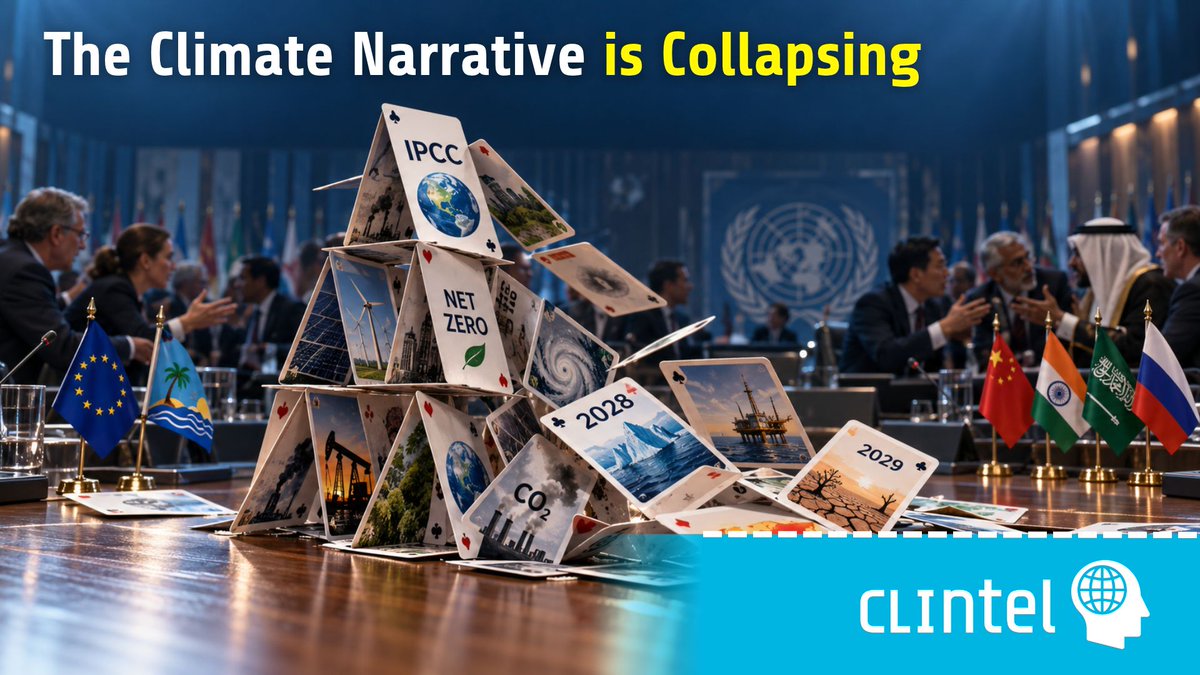
‘Net Zero’ is running into a world that cannot do without fossil fuels.
That is the argument made by Wim Röst, chairman of Clintel, in his opinion article “The Climate Narrative Is Collapsing”.
Countries within the IPCC are clashing over funding and the timetable for its next assessment report. Röst sees a more fundamental conflict behind those disputes: climate ambitions are colliding with the need for affordable energy, industrial production and food security.
Natural gas is also a vital feedstock for nitrogen fertiliser. Disruptions to energy supplies therefore reach far beyond electricity bills—they affect harvests, food prices and livelihoods. The poorest countries have the least capacity to absorb the consequences.
His sharp conclusion: ending all fossil fuel production would lead to a ‘Zero Economy’.
Why does Wim Röst see the divisions within the IPCC as a sign that the climate house of cards is beginning to fall?
Read his opinion article, written in a personal capacity:
https://t.co/2hMRDTc2h9