But why do we need a reminder about peri-operative steroid replacement?
Because only 31% of respondents were compliant with the AoA guidelines intra-operatively, and only 19% postoperatively!
Overall, peri-operative prescribing was compliant in 9% of patients!
@vincrit #anaesthesia #medicine #steroids
https://t.co/E43E4HPrGP
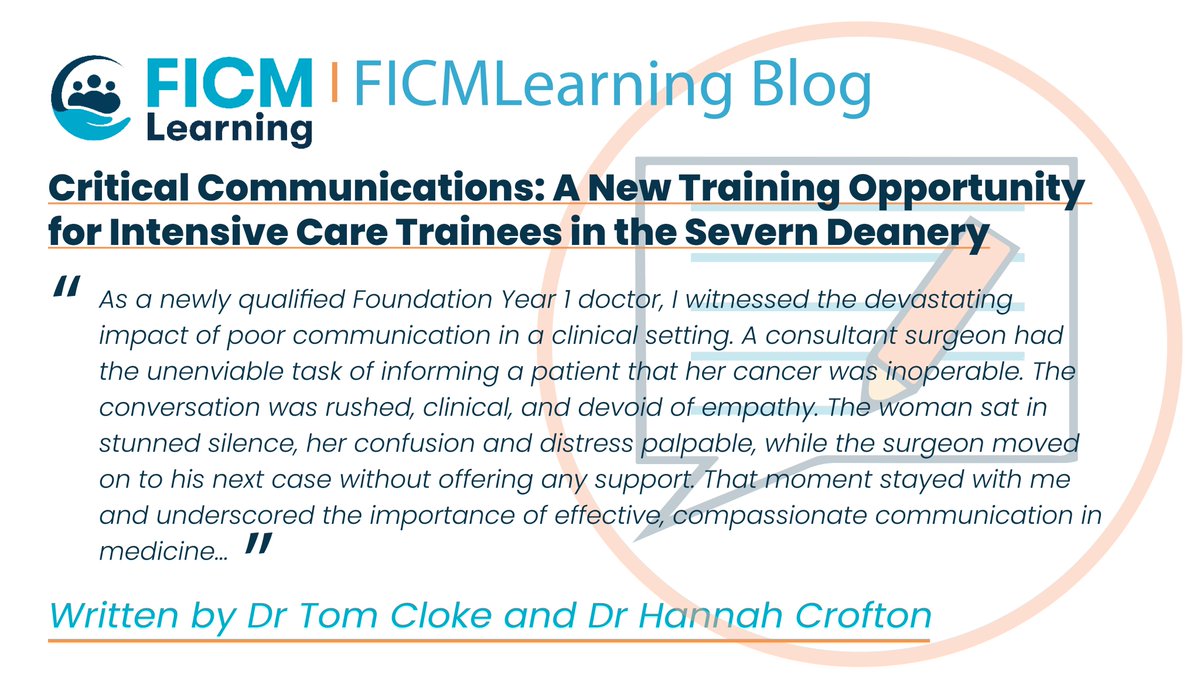
This Thursday's FICMLearning Blog is written by Dr Cloke and Dr Crofton on a Critical Communications Training Opportunity.
Click here to read the blog: https://t.co/yH5TtNfbuv
#FOAMed#FICMLearning
Never has this been truer. Labour needs to step up, wake up, show up, and get us back on the path to EU membership, in whatever form can be agreed. Blair was right then and is right now. Come on, sort yourselves out. Your economic growth doesn’t exist.
Emily Maitlis eviscerates Boris Johnson
"You started importing that Trump like behaviour into Britain when you were Prime Minister"
"His disregard for institutions. His disregard for the rule of law"
"His denialism.. Mirrored in your response to the Privileges Committee.. Your response to the Parliamentary Standards Committee.. Your Proroguing of Parliament"
"This is all Trump like behaviour"
Boris Johnson, "I disagree profoundly"
I fundamentally disagree, for the reasons I’ve stated above.
I’d encourage you to read the paper. In it, a large number of intubators & intubator’s assistants at two dissimilar hospitals
-after training before trialing
-when intubating & undertaking 2-person checks
-after trialing
…..supported the use of 2-person intubation checks to improve safety & judged that potential concerns were not upheld
It just might save a life (& someone’s career)
Personally when intubating
- I welcome other team members confirming intubation with me.
-I welcome them challenging me if they think I’ve got it wrong.
Intubation ‘fails dangerous’ - iv cannulas don’t.
@Fionafionakel@NicholasChrimes
Unfortunately cases of unrecognised oesophageal intubation are consistent for doctors being entirely confident they have intubated successfully when they have not.
This leads to confirmation bias & anchoring bias.
Numerous entirely preventable deaths have occurred.
Around half from ‘entirely routine intubations’ and most with ‘senior intubators’
In most cases someone in the room (ODP, surgical registrar etc) believed the tube was in the wrong place but either did not feel bold enough to speak up (steep anti-safety heirachies) or their views were ignored (stress of situation, cognitive overload, medical arrogance?)
My personal view (gained by uncomfortable personal reflection & sometime observation of others) is that working well as part of a team is a sign of maturity. Sometimes leading, sometimes following. That is entirely consistent with “shouldering responsibility” (for getting the patient the best outcome).
Personally I want to see fewer hero doctors & more effective teams.
@Fionafionakel@NicholasChrimes
Simple summary data
78% intubators & 97% intubators’ assistants reported 2-person verbal intubation check would reduce the likelihood of unrecognised oesophageal intubation
respondents reported strong positives & lack of negative aspects for both 1-step & 2-step 2-person checks
79% intubators judged the checks improved communication & teamwork
among intubators’ assistants
-95% felt more empowered
-74% reported a flattened team hierarchy
-89% felt more valued
82% intubators & 94% intubators’ assistants planned to continue using 2-person intubation check for all future intubations
2/7
Methods
Two types of 2-person checks
1-step: intubator & assistant independently confirm sustained exhaled CO2 after intubation
2-step: both confirm intubation independently using both VL view & capnography
Two hospital - Royal United hospital, Bath & Guy's & St Thomas London
Training - in both hospitals
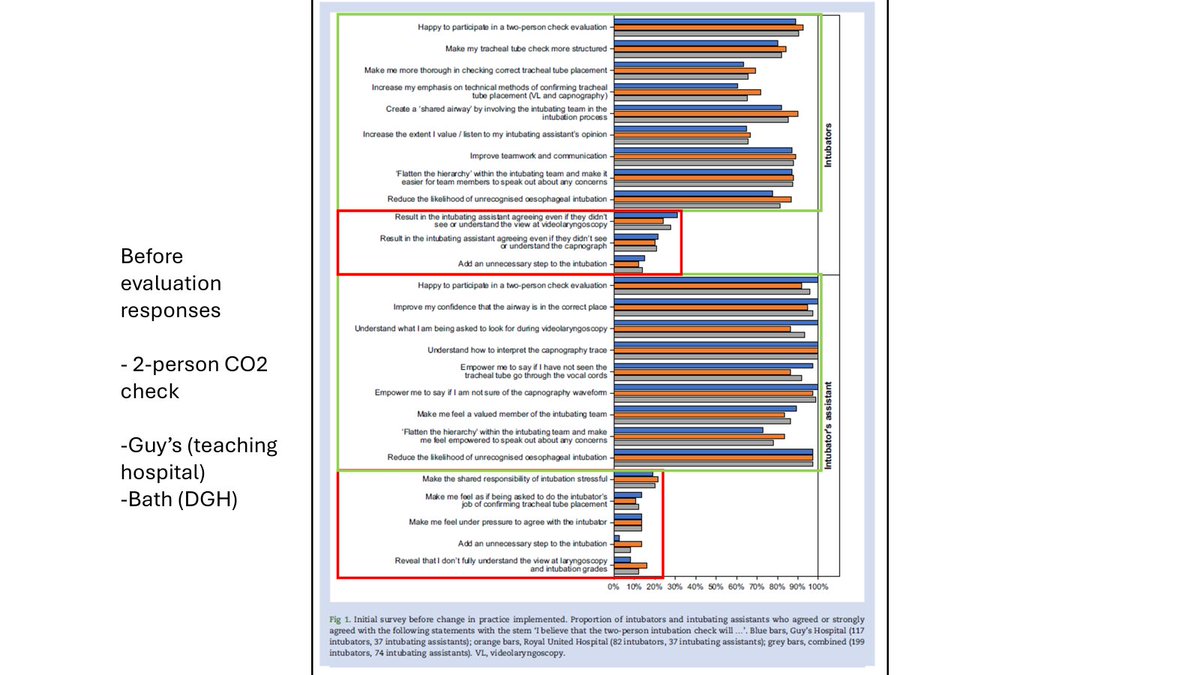
-Before-study survey of feasibility & acceptability
-Evaluation of ease & usefulness by intubators & assistants during >200 intubations
-After-study survey of feasibility & acceptability
In all surveys we considered both potentially +ve & -ve aspects of the change in practice.
3/7
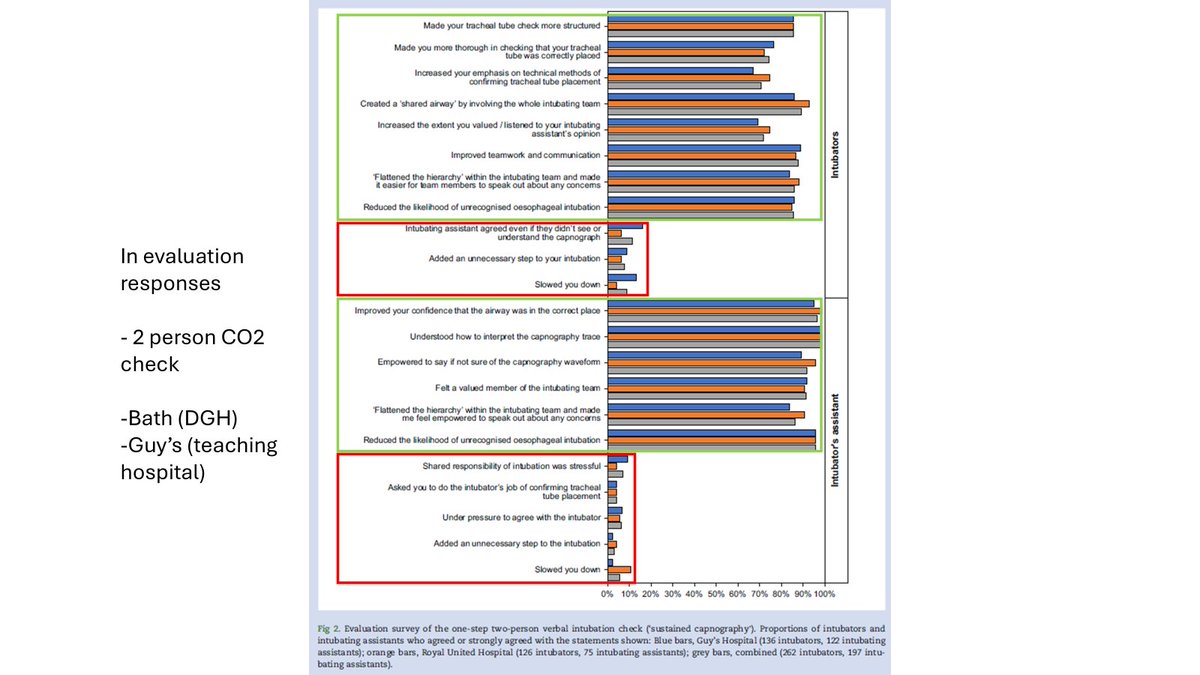
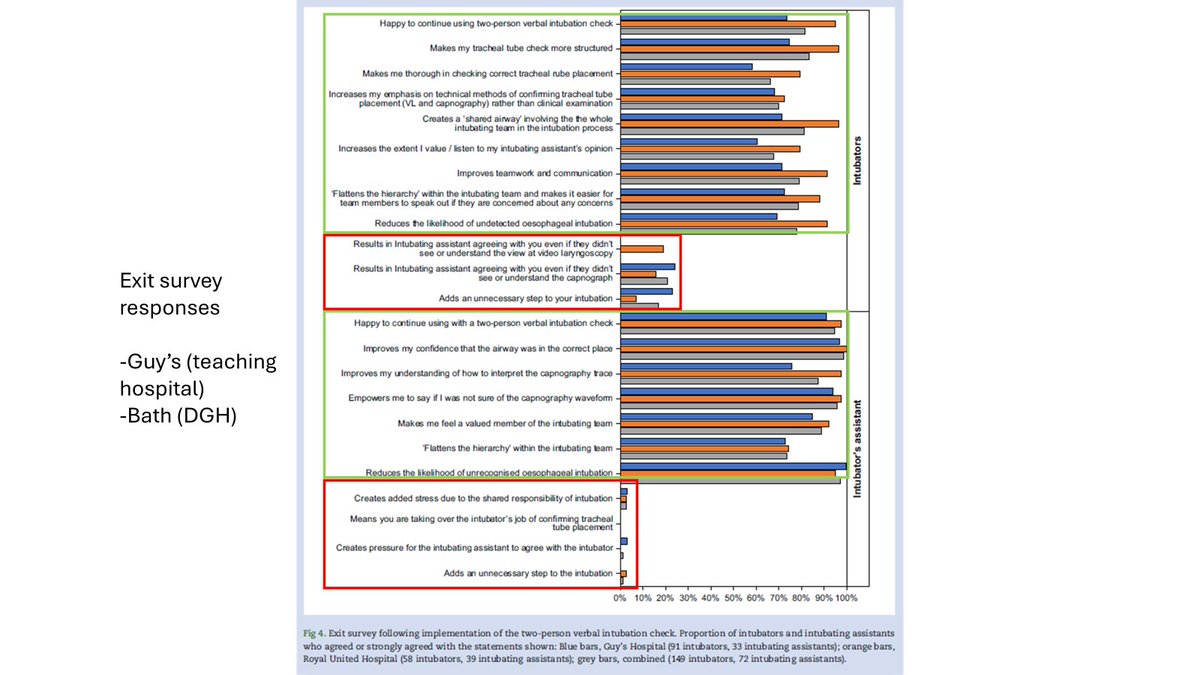
2-person intubation checks: among both intubators & intubator assistants
-strong support of +ve aspects (green boxes)
-negligible support for -ve concerns (red boxes)
-it is feasible
-it is well supported
-by intubators & assistants
Here are the results in graphical form
4/7
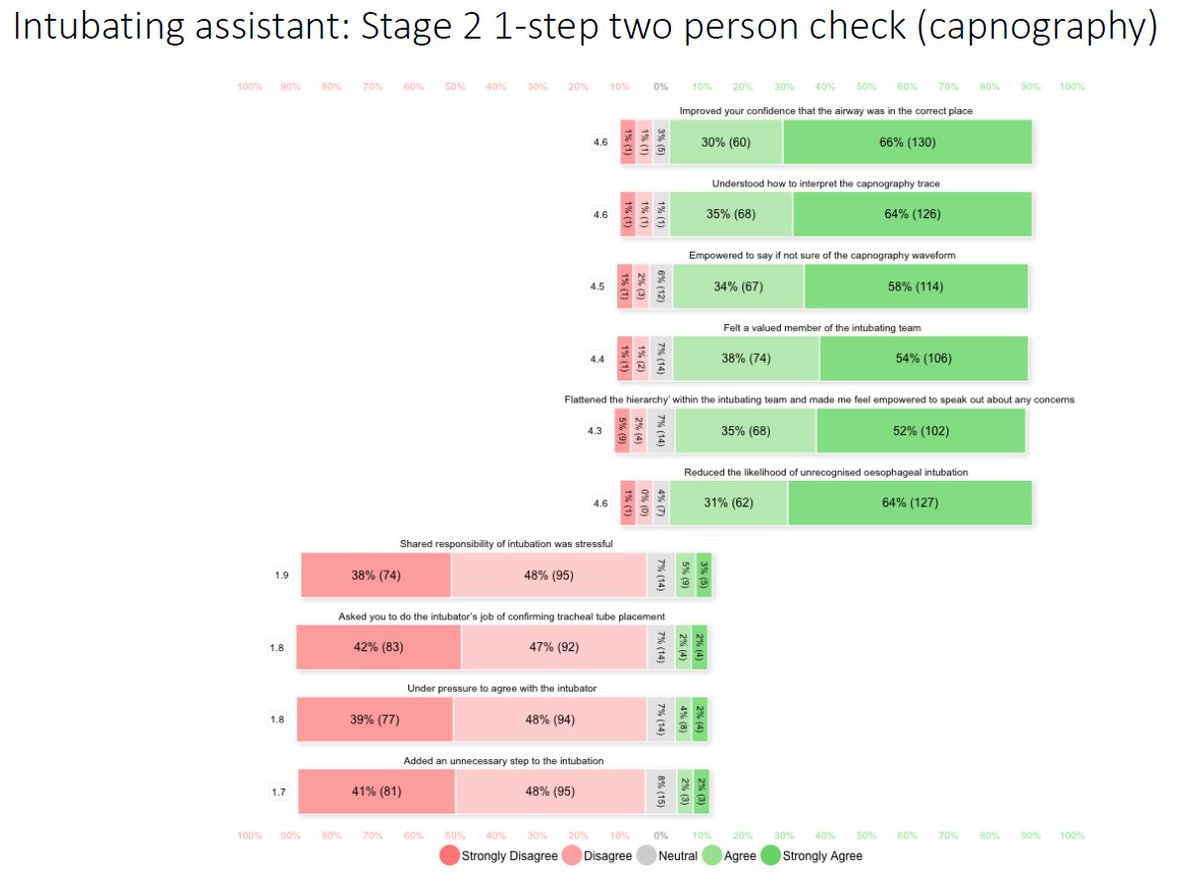
Two person checks
1-step capnography check
Intubators & assistants
- strongly support +ve statements
- almost no support for -ve concerns
Likert scale distributions shown here....
5/7
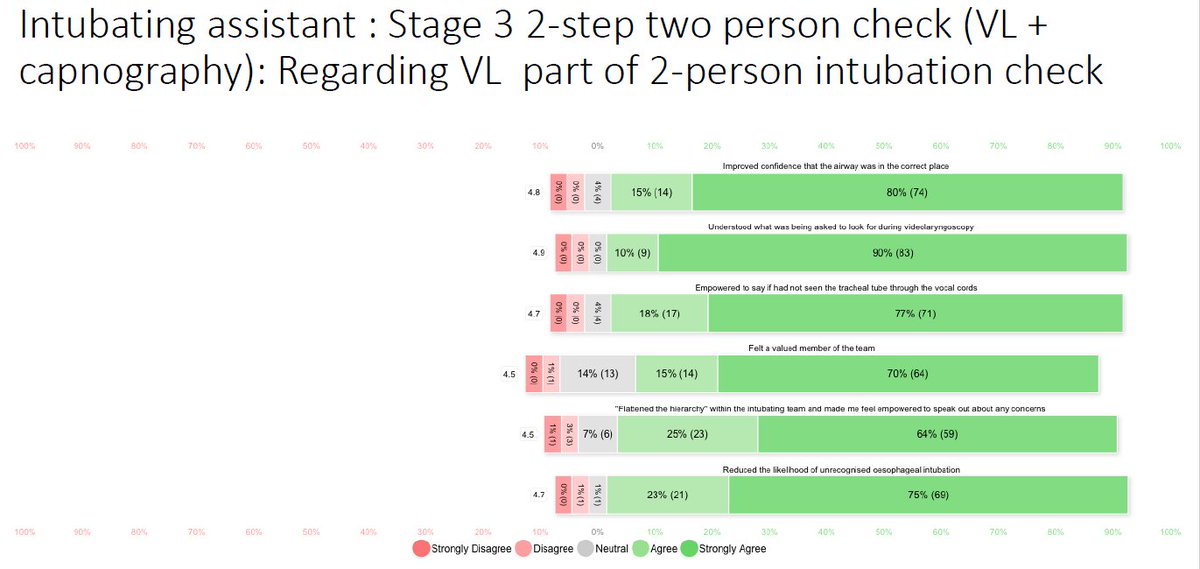
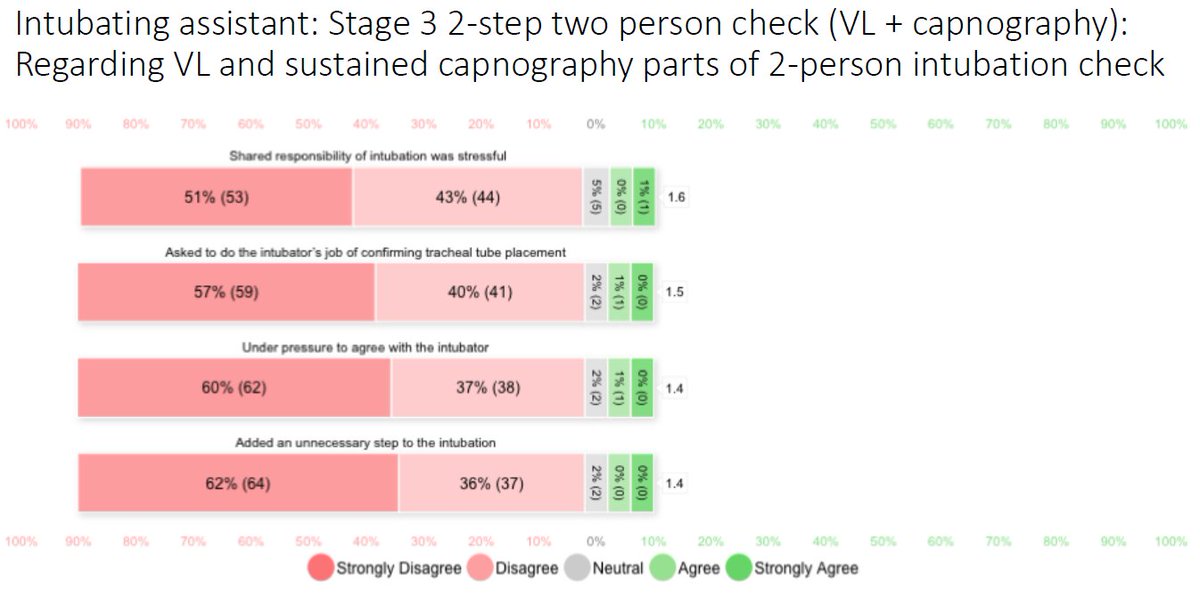
Two person checks
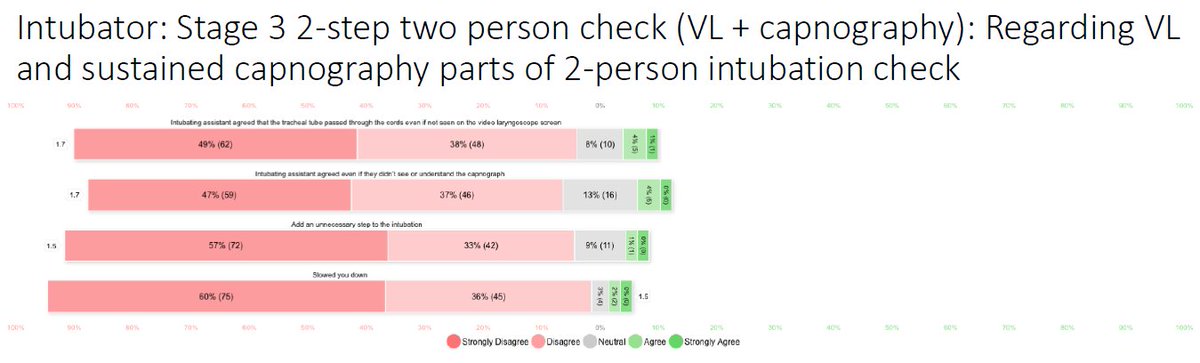
2-step check: VL view & capnography
Intubators & assistants
- strongly support +ve statements
- almost no support for _ve concerns
Likert scale distributions shown here....
6/7
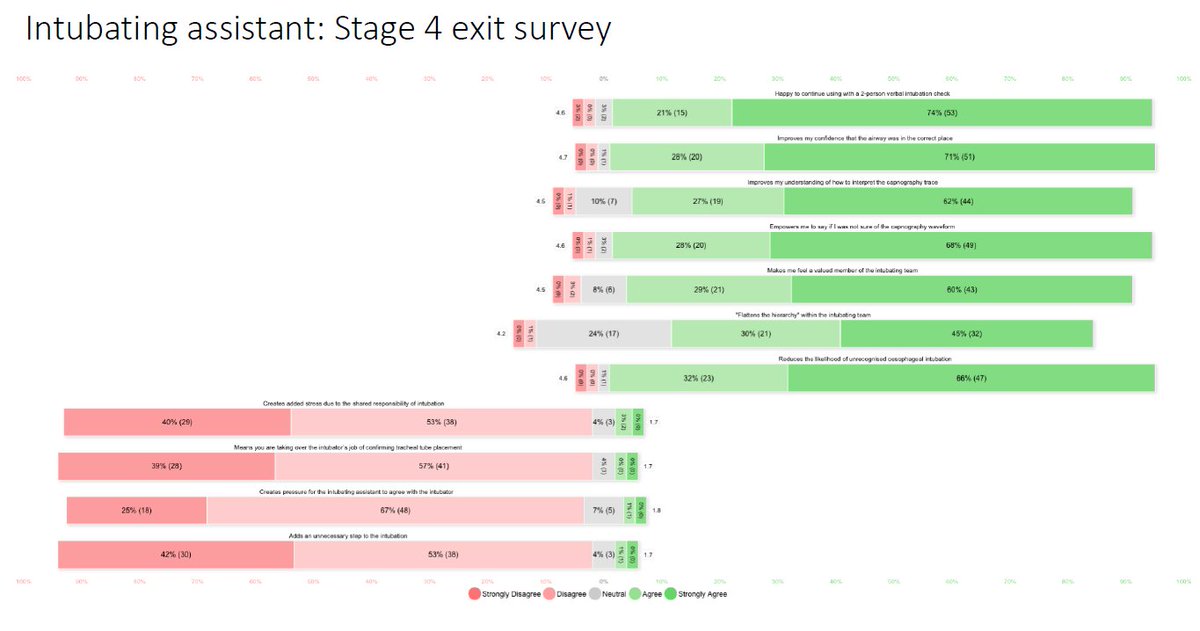
2-person checks of intubation
Exit survey: still highly positive
Conclusion
2-person checks of intubation are highly feasible & acceptable to intubators & assistants
-judged to reduce risk of unrecognised oesophageal intubation
-multiple team & human factor benefits
-no major concerns about introduction
Its free
Try it!!
7/7
TWO PERSON CHECKING TO LESSEN RISK OF OESOPHAGEAL INTUBATION is feasible & acceptable Great to see this paper in early access in
@BJAJournals
A simple feasibility study supported both 2-person checking of capnograph trace (sustained exhaled CO2) & 2-person checking of videolaryngoscopic view at intubation by intubators and assistants This is in line with #PUMA guidance
@clokeetdagger@Fionafionakel@elboghdadly@dr_imranahmad@t_potter_1@RUHBath@GSTTresearch
https://t.co/CEjVTcpcTG
1/7
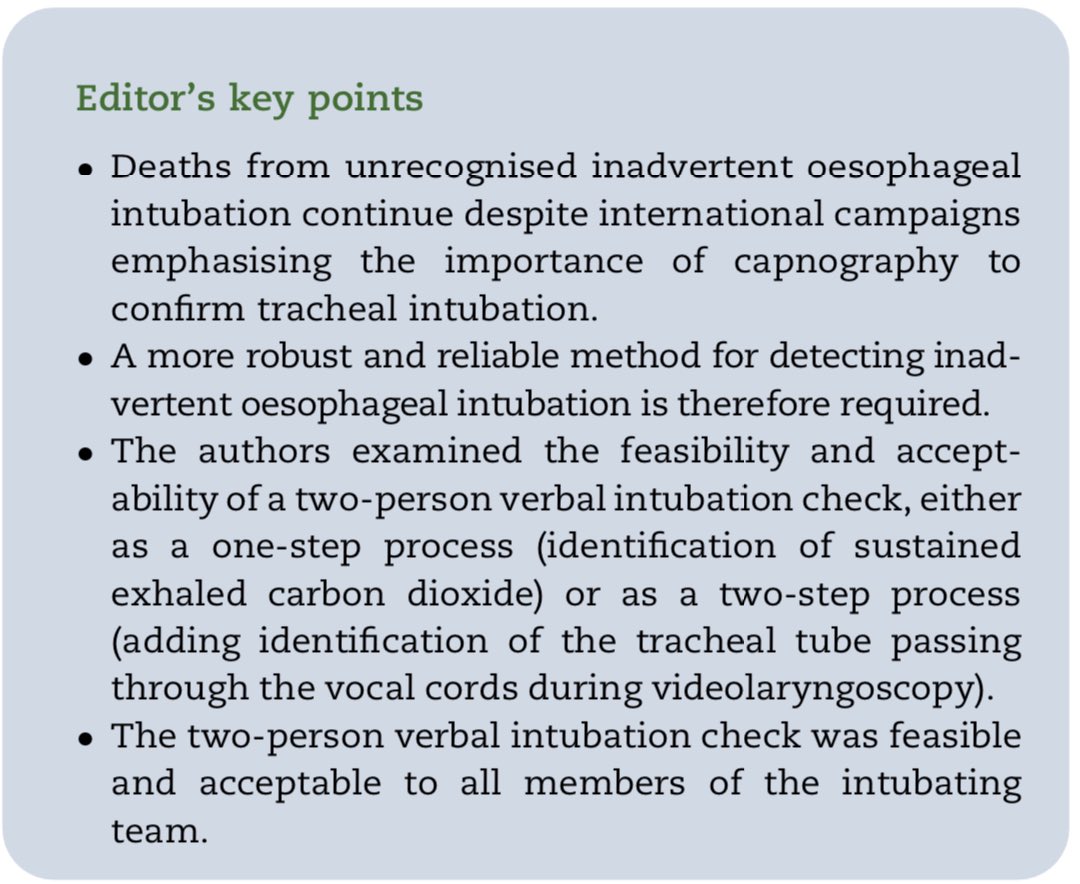
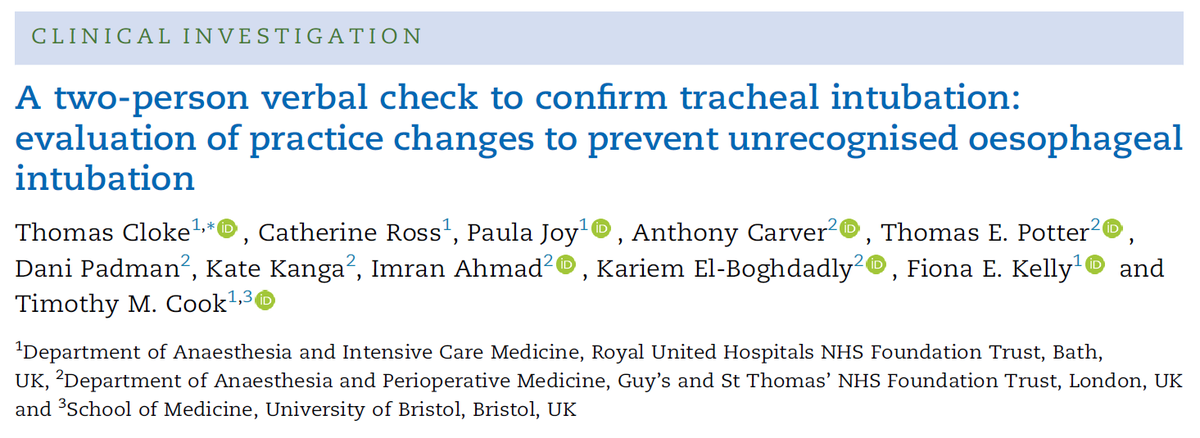
A two-person verbal intubation check has been proposed to reduce unrecognised oesophageal intubation.
Our feasibility study reported that:
✅ possible to implement this in two UK hospitals.
✅ it was acceptable to the majority of intubators and intubating assistants.