This morning you probably woke up thinking how you can properly set up @hashicorpvault for your #Kubernetes apps. At the same time roughly, our Lead QA Nils decided he'll host a webinar to show exactly that. The universe has matched you. 👇 https://t.co/aHZDjXEYLg
In case you missed the session with @arlemi and @NilsPfoegelchen on how to use our new @getpostman collection with @humanitec_com API, here's a great article walking through how you can set up continuous delivery using both 🚨👇 https://t.co/xxDy5YbjbO
Presenting the infamous Benchmarking report tomorrow and our new findings from looking at over 1800 DevOps setups. We'll talk DevEx, Deployment metrics, self-service capabilities, IaC workflows, etc. Join us 🔥👇https://t.co/ifIF14Ve3D
We all ❤️ #kubernetes don't we. But we also all know that your team's DevEx dealing with clusters, Helm, config files, etc. ain't the greatest. Dedicated hands-on session with Chris to improve workflows on EKS, GKE and AKS👇https://t.co/bDNtUEN7XM
Interesting how @Werner (Amazon CTO) went from yelling "you build it, you run it" in 2006 to "There is a clear increase in complexity when you move to a pervasive microservices setup. Was it easier in the days when everything was in a monolith? For some parts, definitely.” 🧵👇
DevOps orgy today: looking forward to talking #terraform, #GitOps and #Kubernetes with
@bitberk. He built a state-of-the-art setup at @Meltwater. Join us 🔥👇 https://t.co/zYwUu3i14N
@SteveElsewhere has worked on 100s of DevOps setups in the last decade. He thinks IDPs are the next-level DevOps move most engineering teams should make 🔥👇https://t.co/XeeoNt1WOB
Observability and self-service are two key trends that go hand in hand in most advanced engineering teams. Looking forward to discussing both with the incredible @lizthegrey from @honeycombio. You don't want to miss this one 🔥👇https://t.co/rmIu5KLcrp
WTF is platform engineering?! Come find out. We just launched a new slack space for everyone interested in nerding out about developer platforms. Dedicated #meet, #intros and #jobs channels. Join us 🔥👉 https://t.co/Ro9U38zyG3
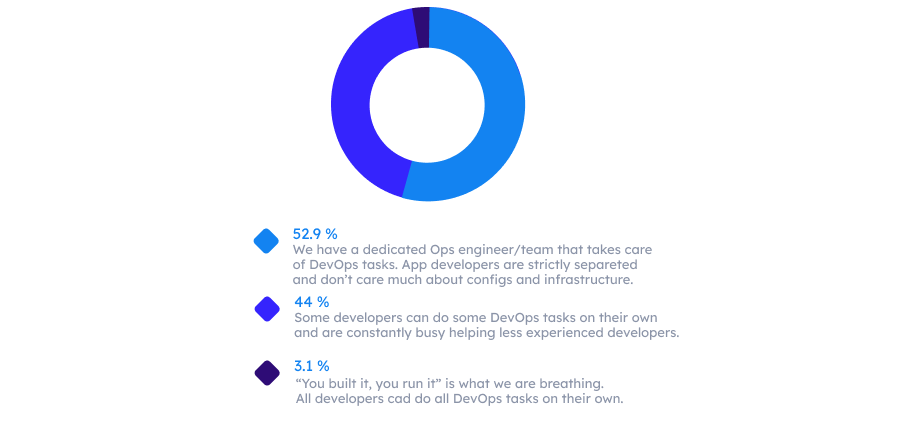
DevOps 2021, 4/4: How DevOps tasks are managed 🥇
Almost all top performers were in the solid self-service setups. Looking at the low scoring teams, it is more dramatic. 52.9% of teams report using the "throw it over the fence" approach.
DevOps 2021, 3/4: DevOps culture 🎻
“Culture eats strategy for breakfast” (Peter Drucker).
How does your team manage DevOps tasks? Stunningly, in 34% of cases, the reality is a “throw over the fence” split. Only 21% of teams report they can manage all DevOps tasks on their own.
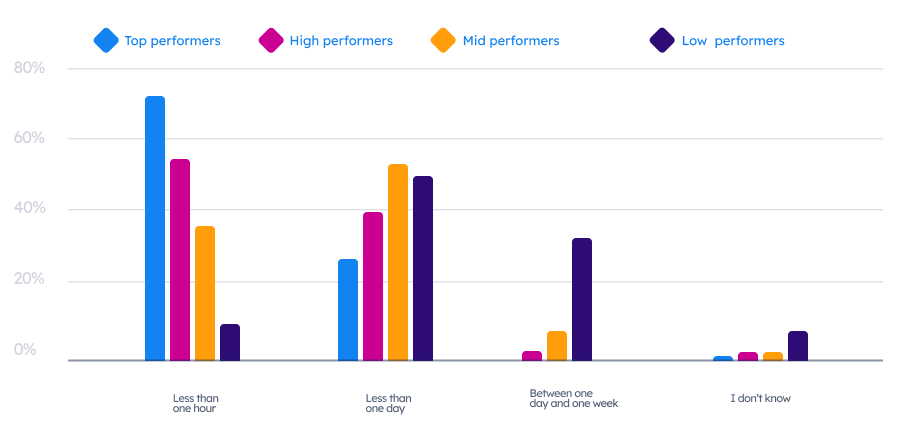
DevOps 2021, 2/4: Mean time to recovery ⌛
This metric really shows how investments in a good setup immediately impact KPIs. Striking 12,8% need between one day and one week to restore a system, and for low performers it's more than 30%.
DevOps learnings 1/4 🧵: Lead time ⏱️
The time it takes to implement, test, and deliver code. More than 20% of low performers take longer than one month to deliver their code through all stages. It takes minutes for over 50% of top performers and almost none take more than a week
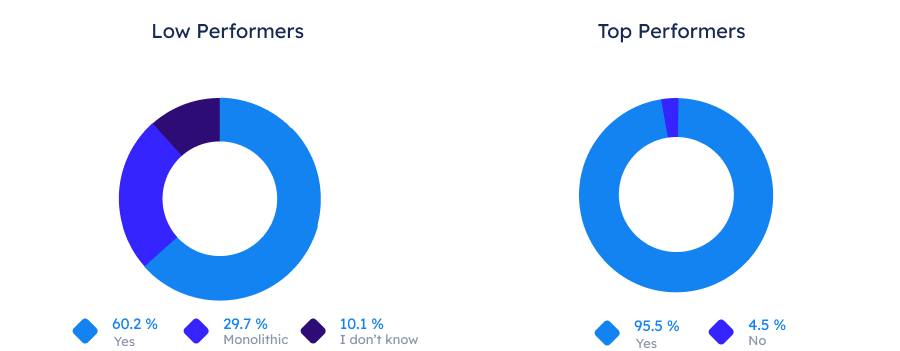
DevOps 2021, 4/6: App config management 🎛️
For most of top performers, configuration as code (i.e. YAML) is completely normal. Only 60% of low performers use config as code and the remaining 40% experience huge bottlenecks trying to roll back apps, follow good governance, etc.
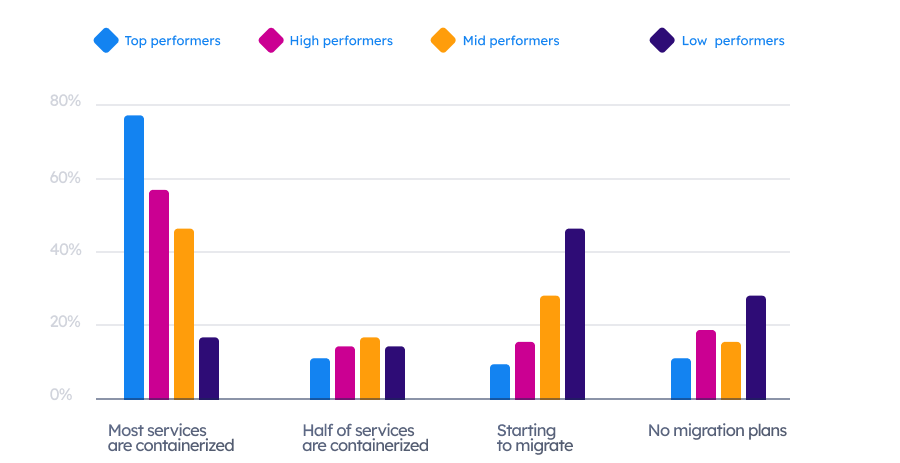
DevOps Benchmarkings 2021, 3/6: Degree of containerisation 📦
93% of top performers are adopting containers and most are already fully migrated. This is true for less than 20% of low performers and most report that they are “never going to migrate”.
DevOps Benchmarkings 2021, 2/6: App architecture 📐
Low scoring teams run almost twice as many monolith applications, whereas high performing teams run on loosely coupled apps. No surprises here as running microservices at scale requires an advanced setup.
DevOps 2021, 6/6: Deployment frequency ⚡
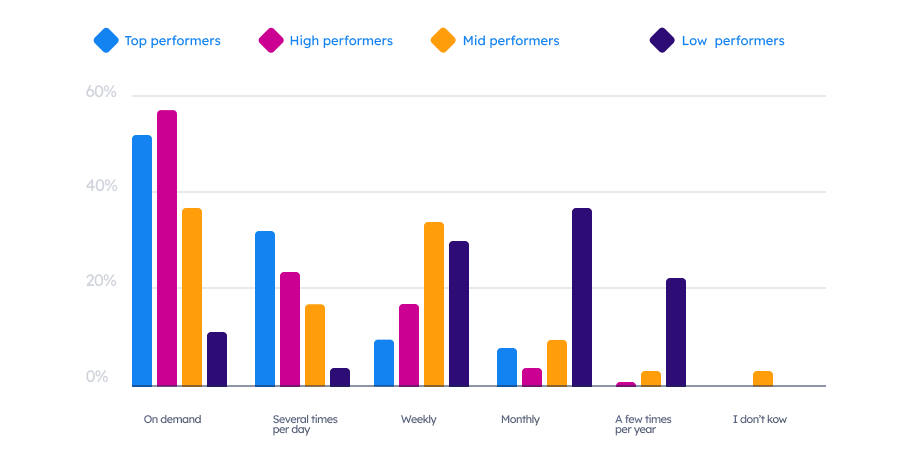
Over 80% of top performers deploy at least several times per day (less than 10% deploy less than weekly). A stunning 22% of low performers say they deploy only “a few times per year” and less than 10% of them can deploy on-demand.