🚨 New paper: “Asymptotically Optimal Regret for Reinforcement Learning without Horizon Dependence.”
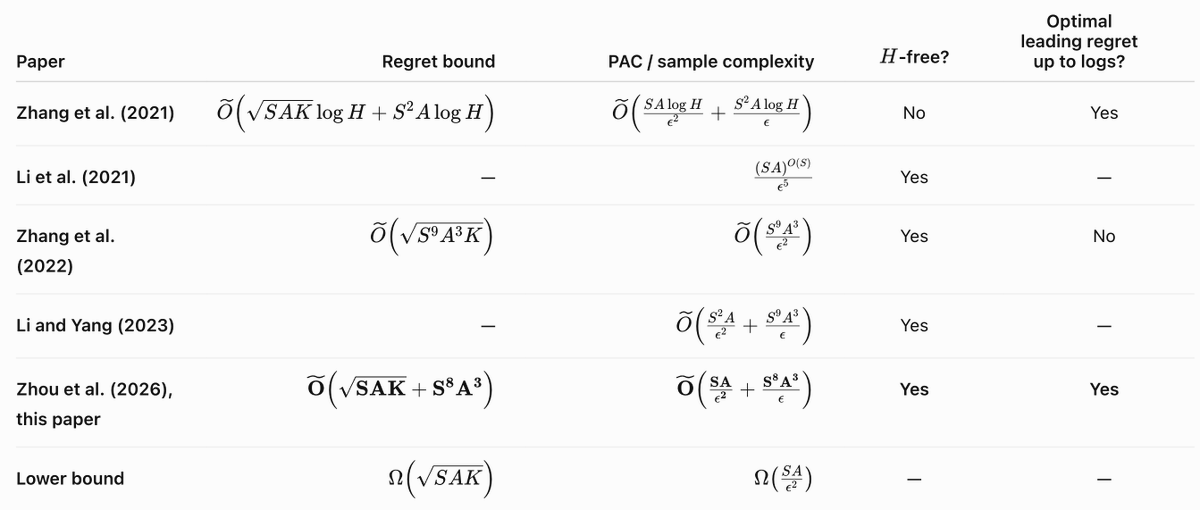
We give the first polynomial-time algorithm for time-homogeneous tabular MDPs whose regret term is both:
• completely independent of the horizon H, and
• asymptotically optimal in S, A, and K.
Our regret bound is
Õ(√SAK + S⁸A³)
matching the contextual-bandit lower bound Ω(√SAK) in the leading term.
Technically, we introduce:
• an S-dimensional discretization of the monotone optimal value sequence;
• a new cutting bonus for horizon-free optimism;
• a total-deviation bound controlling clipped variance independently of H; and
• a horizon-truncation framework enabling reward-aware exploration.
📄 https://t.co/mogFTNGbFK
Greatly thankful to collaborators Zihan Zhang, Maryam Fazel, @SimonShaoleiDu
🚨 New paper: “Asymptotically Optimal Regret for Reinforcement Learning without Horizon Dependence.”
We give the first polynomial-time algorithm for time-homogeneous tabular MDPs whose regret term is both:
• completely independent of the horizon H, and
• asymptotically optimal in S, A, and K.
Our regret bound is
Õ(√SAK + S⁸A³)
matching the contextual-bandit lower bound Ω(√SAK) in the leading term.
Technically, we introduce:
• an S-dimensional discretization of the monotone optimal value sequence;
• a new cutting bonus for horizon-free optimism;
• a total-deviation bound controlling clipped variance independently of H; and
• a horizon-truncation framework enabling reward-aware exploration.
📄 https://t.co/mogFTNGbFK
Greatly thankful to collaborators Zihan Zhang, Maryam Fazel, @SimonShaoleiDu
Excited to introduce our MAI Code model at Microsoft Build. As shared in the session, this is a MoE (5B active / 137B total) initialized from an MAI pretrained model and trained for real user scenarios with product harnesses. I’m proud to have served as the research lead for this effort, and even prouder of what the team has achieved. It’s a beast for its size. Stay tuned — a larger model could come :)
We just released MAI-Code-1-Flash, a 5B-active small model. The team just finished this from a pretrained model to VSC and Copilot CLI production within a few weeks, so proud of their achievements. More details are here https://t.co/jx85ssYAea and a bigger model is on the way.
We improve a 32-year lower bound in a challenging open problem, Ramsey numbers, through simply scaling autoresearch.
⭕ Proves R(3,17) >= 93. Previous 92 bound were obtained in 1994.
Google’s AlphaEvolve (2026) matched previous result but did not beat it.
All could be done with Claude Code / Codex + a CPU server.
Graphs and evolving history are available at https://t.co/2kCsk9Otur
[1/n]
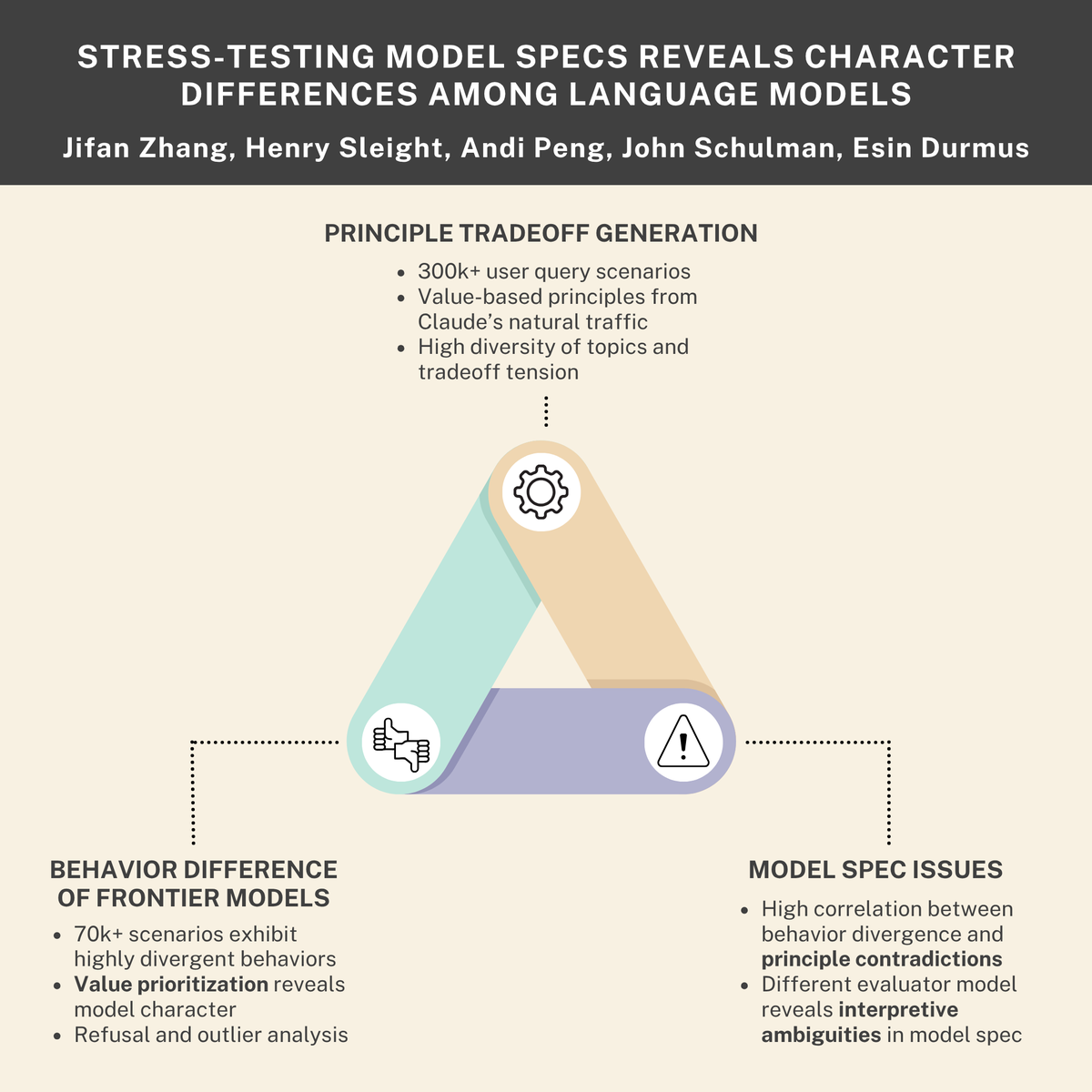
New research paper with Anthropic and Thinking Machines
AI companies use model specifications to define desirable behaviors during training. Are model specs clearly expressing what we want models to do? And do different frontier models have different personalities?
We generated thousands of scenarios to find out. 🧵
Previous works study the sample complexity of DPO and emphasize the role of samplers in online DPO. What about its role in optimization convergence rates?
Check out our paper at #ICLR2025 on convergence rates of online DPO with various samplers!
ArXiv: https://t.co/IVwe0nGepQ.
🧠 Your LLM should model how you think, not reduce you to preassigned traits
📢 Introducing LoRe: a low-rank reward modeling framework for personalized RLHF
❌ Demographic grouping/handcrafted traits
✅ Infers implicit preferences
✅ Few-shot adaptation
📄 https://t.co/KzkEFPqkr9
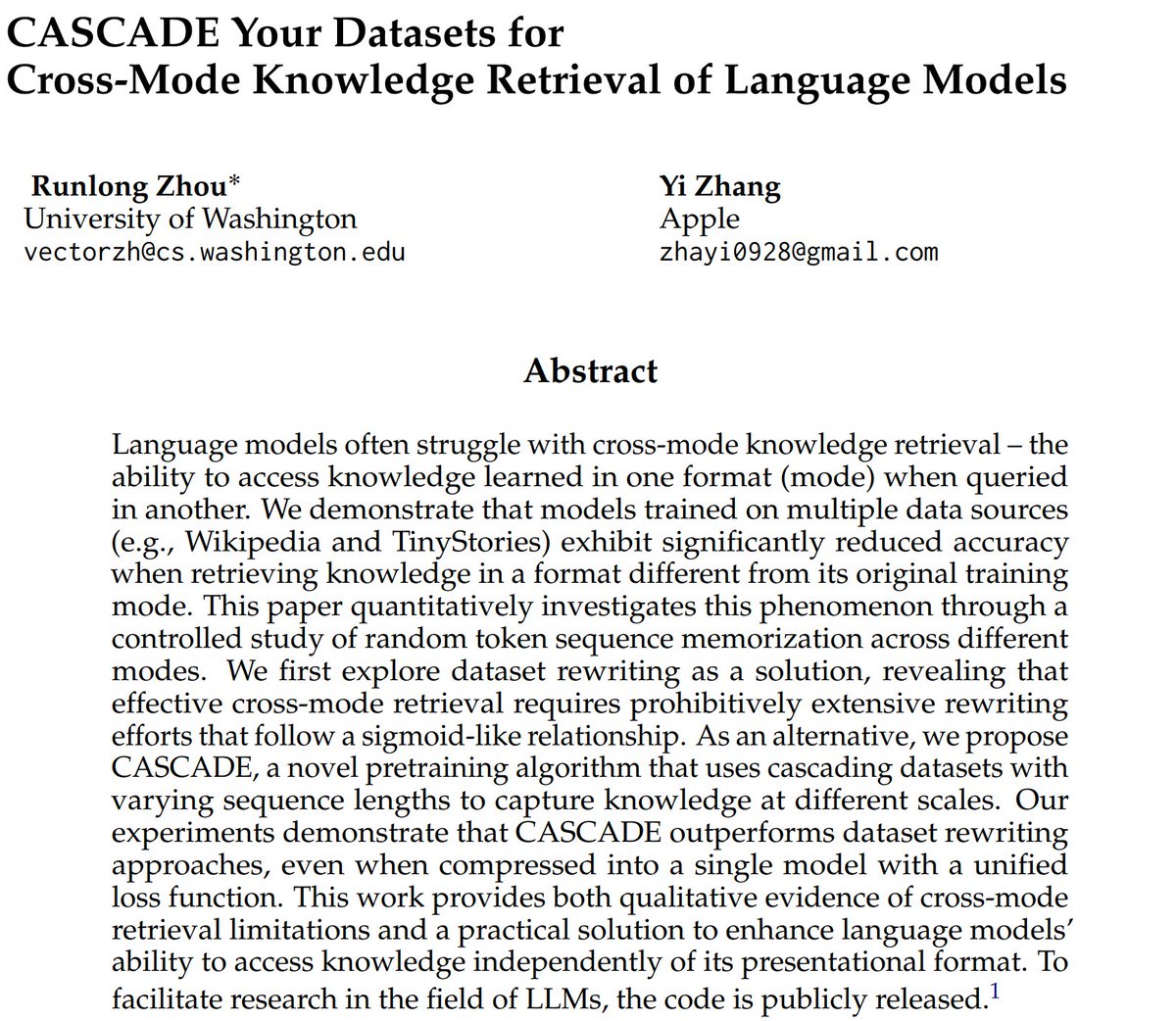
🧠 Ever notice how LLMs struggle with familiar knowledge in unfamiliar formats? Our new paper "CASCADE Your Datasets for Cross-Mode Knowledge Retrieval of Language Models" tackles this head-on!
🔍 Our findings:
- Created a qualitative pipeline demonstrating problem we call cross-mode knowledge retrieval that goes beyond traditional consistency issues: we study highly diverse word styles and spurious correlations between the mode (format) and the knowledge
- Formulated the problem as memorizing random token sequences quantitatively
- Demonstrated dataset rewriting requires the cross-mode knowledge to match the exact order of non-cross-mode knowledge
- Developed CASCADE: pretraining with cascading sequences dramatically outperforms dataset rewriting & scaling up training time!
This is a great collaboration with @YiZhangZZZ
Arxiv: https://t.co/Z7Ajuawa45
#AI #LLM #NLP
We released Phi-4-mini (3.8B base in LLM), a new SLM excelling in language, vision, and audio through a mixture-of-LoRA, uniting three modalities in one model. I am so impressed with its new audio capability. I hope you can play with it and share with us your feedback. We also trained a reasoning model, achieving 90.4 on Math-500.
Model: https://t.co/QJx65DtQPv
Paper: https://t.co/Jxktctw1pv
Blog: https://t.co/rzaA0x6e6I
Introducing StoryEval: our new video generation benchmark! Can a model present short stories like 'How to put an elephant in a refrigerator'?
arXiv: https://t.co/cl7YWezwEb
1/3 Today, an anecdote shared by an invited speaker at #NeurIPS2024 left many Chinese scholars, myself included, feeling uncomfortable. As a community, I believe we should take a moment to reflect on why such remarks in public discourse can be offensive and harmful.
RLHF aligns LMs to a fixed weighted combinations of rewards, but cannot retrain a new model for each user's preferred weightings.
To achieve customization, prior work merges the parameters of single-objective models. Can we do better?
We show that merging logits is better!