Excited to share Heave-Ho, my co-first-author paper with @SihengZhao and @hanjiang00!
🤖🤝🤖 Just like our humanoids, we got more done together. Huge thanks to my advisor @yuewang314 and everyone who helped and collaborated with us along the way!
https://t.co/pnyvl836v0
Excited to share Heave-Ho, my co-first-author paper with @SihengZhao and @hanjiang00!
🤖🤝🤖 Just like our humanoids, we got more done together. Huge thanks to my advisor @yuewang314 and everyone who helped and collaborated with us along the way!
https://t.co/pnyvl836v0
🚀 Introducing 𝗙𝗹𝗲𝘅-𝗥𝗦𝗜: 𝗕𝗲𝗻𝗰𝗵𝗺𝗮𝗿𝗸𝗶𝗻𝗴 𝗥𝗲𝗰𝘂𝗿𝘀𝗶𝘃𝗲 𝗦𝗲𝗹𝗳-𝗜𝗺𝗽𝗿𝗼𝘃𝗲𝗺𝗲𝗻𝘁 𝗼𝗳 𝗙𝗿𝗼𝗻𝘁𝗶𝗲𝗿 𝗔𝗴𝗲𝗻𝘁𝘀
We're curious: 𝘊𝘢𝘯 𝘢𝘯 𝘈𝘐 𝘢𝘨𝘦𝘯𝘵 𝘨𝘦𝘵 𝘣𝘦𝘵𝘵𝘦𝘳 𝘢𝘵 𝘪𝘵𝘴 𝘫𝘰𝘣 𝘣𝘺 𝘳𝘦𝘸𝘳𝘪𝘵𝘪𝘯𝘨 𝘩𝘰𝘸 𝘪𝘵 𝘸𝘰𝘳𝘬𝘴? 🔄
We tested 𝟭𝟴 frontier models on 𝟮𝟰 tasks, from 𝗿𝗼𝗯𝗼𝘁 𝗰𝗼𝗻𝘁𝗿𝗼𝗹 and 𝟯𝗗 𝗿𝗲𝗰𝗼𝗻𝘀𝘁𝗿𝘂𝗰𝘁𝗶𝗼𝗻 to 𝗿𝗲𝗮𝘀𝗼𝗻𝗶𝗻𝗴 and 𝘃𝗶𝘀𝘂𝗮𝗹 𝗰𝗿𝗲𝗮𝘁𝗶𝗼𝗻—𝟭𝟴𝟴 runs and nearly 𝟯,𝟴𝟬𝟬 rounds of self-improvement. Agents could revise their code, tools, prompts, and workflows while their model weights stayed fixed.
A few observations I found particularly interesting:
🛠️ 𝗕𝘂𝗶𝗹𝗱𝗶𝗻𝗴 𝗿𝗲𝘃𝗲𝗮𝗹𝘀 𝗺𝗼𝗿𝗲 𝘁𝗵𝗮𝗻 𝗮𝗻𝘀𝘄𝗲𝗿𝗶𝗻𝗴.
The largest gains came when agents built programs, robot policies, or pipelines. Models starting from the same solution ended up far apart.
📉 𝗙𝗲𝗲𝗱𝗯𝗮𝗰𝗸 𝗰𝗮𝗻 𝗯𝗲 𝘁𝗵𝗲 𝗯𝗼𝘁𝘁𝗹𝗲𝗻𝗲𝗰𝗸.
Open-weight models made progress with graded feedback but often stalled when they received only success or failure. On RoboCasa, median validation gains were 51.2 points for closed models versus 5.6 for open-weight models.
🧱 𝗟𝗼𝗼𝗸𝗶𝗻𝗴 𝗿𝗶𝗴𝗵𝘁 𝗶𝘀 𝗮 𝗹𝗼𝘄 𝗯𝗮𝗿.
Some reconstructed scenes looked convincing but failed physical stability or object-level checks. The gap between closed and open-weight models was often largest where correctness could be tested strictly.
⏱️ 𝗠𝗼𝗿𝗲 𝘁𝗼𝗸𝗲𝗻𝘀 𝗱𝗶𝗱𝗻’𝘁 𝗺𝗲𝗮𝗻 𝗯𝗲𝘁𝘁𝗲𝗿 𝗿𝗲𝘀𝘂𝗹𝘁𝘀.
Token use and performance were essentially uncorrelated across the evaluated runs. Several of the strongest models also used fewer tokens.
And the workflow edits themselves helped: in 6 of 7 paired experiments, agents allowed to rewrite their own harness achieved higher test scores than those with a fixed harness.
Glad to share this work with Jingdong Zhang, Jionghao Wang, Zhengming Yu, Yancheng Cai, Wei Chow, Chris Choy, Zhiyang (Frank) Dou, Hang Hua, Jiachen li, Zhixuan Liu, Chen Wang, Songlin Wei, Siyuan Yang, Yu Yuan, Xiaohang Zhan, Yucheng Zhang, Shuhong Zheng, Xin (Shane) Li, Lingjie Liu, Wojciech Matusik, Wenping Wang.
🎥 Work done by
@TAMU, Adobe, @CarnegieMellon, @MIT, MIT-IBM Watson AI Lab — IBM Research, @NUSingapore, NVIDIA, @LifeAtPurdue, @Cambridge_Uni, @Penn, @USC, @UTAustin, @UofT.
🤝 Flex-RSI welcomes community contributions—new tasks, models, and evaluators are all welcome.
🌐 𝗣𝗿𝗼𝗷𝗲𝗰𝘁: https://t.co/QmAbKfo4wy
📄 Report: https://t.co/6cWMiQraqU
#AIAgents #SelfImprovement #Robotics #RSI #AGI #GenAI #LLM #Agents #TAMU #EmbodiedAI #Vision
Meet GR00T 2, our new generation of world-action models (WAMs): it imagines how the physical world will unfold and generates the actions that get it there. One model runs on parallel grippers, dexterous hands, and humanoids.
https://t.co/32Z1plSGQg
Honored to see this.
Grateful to the GR00T / GEAR team for the chance to contribute to a release at this scale. The model, the data, and the evals are a much bigger effort than any one piece.
Second time being part of something this large, after Nemotron 3.5 Super VL. Still a bit unreal.
Meet GR00T 2, our new generation of world-action models (WAMs): it imagines how the physical world will unfold and generates the actions that get it there. One model runs on parallel grippers, dexterous hands, and humanoids.
https://t.co/32Z1plSGQg
@Michael_J_Black Thanks. I totally agree. That’s the real question. A result that beats a large model is out of date as soon as a new model comes out. Understanding why something works stays useful. Maybe reviewers should ask “what did we learn?” more than “is it the best or SOTA?”
I'm looking for one emergency reviewer for my @iclr_conf 2027 batch! If you have experience in VLA / latent reasoning, please DM me. Thank you!
#ICLR2027
🤖 What if robots could reason not just in words, but through the dynamics of the physical world?
🚀 Introducing 𝗧𝗵𝗶𝗻𝗸𝗪𝗼𝗿𝗹𝗱 from @NVIDIAAI !
💡 By reasoning through shared physical dynamics, robots could learn from human experience and transfer motion intelligence across embodiments.
𝗛𝗼𝘄 𝗶𝘁 𝘄𝗼𝗿𝗸𝘀
→ 𝗖𝗵𝗮𝗶𝗻-𝗼𝗳-𝗗𝘆𝗻𝗮𝗺𝗶𝗰𝘀 (𝗖𝗼𝗗): A shared motion reasoning space across human and robot embodiments.
→ 𝗪𝗼𝗿𝗹𝗱 𝗜𝗺𝗮𝗴𝗶𝗻𝗮𝘁𝗶𝗼𝗻: Imagines future world representations conditioned on CoD.
→ 𝗥𝗟 𝗳𝗿𝗼𝗺 𝗪𝗼𝗿𝗹𝗱 𝗜𝗺𝗮𝗴𝗶𝗻𝗮𝘁𝗶𝗼𝗻: Reinforces reasoning through alignment between imagined and observed futures, enabling learning from human and robot videos.
𝗪𝗵𝗮𝘁 𝗶𝘁 𝗲𝗻𝗮𝗯𝗹𝗲𝘀
→ Robust real-world manipulation under unseen objects and environments.
→ Human-guided skill composition for novel multi-step robot tasks.
→ Robust generalization under task and environment shifts in simulation.
🌍 𝗢𝘂𝗿 𝘃𝗶𝘀𝗶𝗼𝗻: Scale generalizable motion intelligence through human videos toward a unified System-1 reasoning layer for Physical AI.
Paper, robot demos & more below! 👇
Honored to be part of this.
First time contributing to a model release at this scale. Grateful to the Nemotron team — the model, the data, and the evals are a much bigger effort than any one piece.
Our piece was SpatialClaw: used to build the agentic vision training data for video understanding.
📄 Paper: https://t.co/NuIZ095EYR
💻 Code: https://t.co/H6Z2AFOXij
📑 Report: https://t.co/p2mYzgpzJa
Honored to be part of this.
First time contributing to a model release at this scale. Grateful to the Nemotron team — the model, the data, and the evals are a much bigger effort than any one piece.
Our piece was SpatialClaw: used to build the agentic vision training data for video understanding.
📄 Paper: https://t.co/NuIZ095EYR
💻 Code: https://t.co/H6Z2AFOXij
📑 Report: https://t.co/p2mYzgpzJa
Meet NVIDIA Nemotron 3.5 Super VL
Our new open model combines reasoning and tool use with text, image, document, and video understanding for long-running AI agents.
120B total parameters with 12B active 🧵
Honored to be part of this.
First time contributing to a model release at this scale. Grateful to the Nemotron team — the model, the data, and the evals are a much bigger effort than any one piece.
Our piece was SpatialClaw: used to build the agentic vision training data for video understanding.
📄 Paper: https://t.co/NuIZ095EYR
💻 Code: https://t.co/H6Z2AFOXij
📑 Report: https://t.co/p2mYzgpzJa
Update: SpatialClaw was used in the agentic vision training data for NVIDIA Nemotron 3.5 Super VL. Grateful to be part of that effort.
14,169 trajectories, 81,366 actions. Details: https://t.co/zt2Hl2ZrMZ
Honored to be part of this.
First time contributing to a model release at this scale. Grateful to the Nemotron team — the model, the data, and the evals are a much bigger effort than any one piece.
Our piece was SpatialClaw: used to build the agentic vision training data for video understanding.
📄 Paper: https://t.co/NuIZ095EYR
💻 Code: https://t.co/H6Z2AFOXij
📑 Report: https://t.co/p2mYzgpzJa
SpatialClaw accepted to #NeurIPS2026 🎉
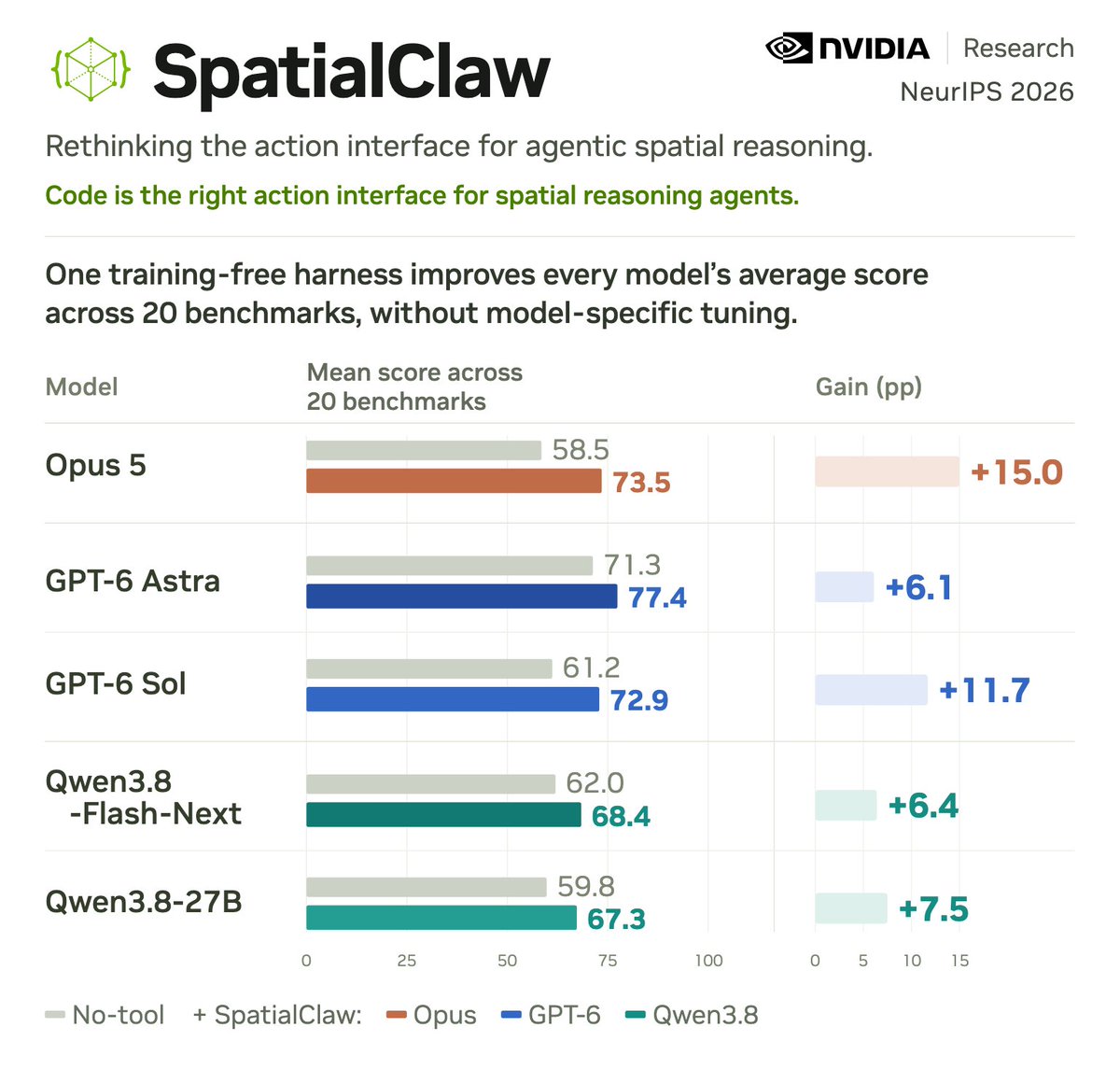
Even GPT-6 Astra gets better with the right action interface.
Same training-free harness, no model-specific tuning, 20 spatial benchmarks:
GPT-6 Astra: 71.3 → 77.4 (+6.1)
Opus 5: 58.5 → 73.5 (+15.0)
GPT-6 Sol: 61.2 → 72.9 (+11.7)
Qwen3.8-27B: 59.8 → 67.3 (+7.5)
Astra already looks “spatial.” A persistent Python kernel on top of it still wins.
Code is the action interface: the VLM writes one cell per step, inspects SAM / depth / geometry outputs, revises, then answers.
📄 Paper: https://t.co/NuIZ095EYR
💻 Code: https://t.co/H6Z2AFOXij
🌐 Website: https://t.co/HbdASfTosl
@NVIDIAAI