I still remember the tearful speech by the Philippines delegation at the COP19 amid the Haiyan typhoon in 2013. Nothing happened afterwards, except only a worsening world and planet.
Nepal's foreign minister is calling for a huge global effort to tackle climate change. His country is facing more disasters as glaciers rapidly melt, but his words will fall on the deaf ears of most world leaders. It's a tragic situation.
Studying the humanities is the road to intellectualism. Science as such does not explain the human realm. I am saying this as a historian of science with a background in computer science.
The transition to the humanities was very difficult, at least in my case
Polanyi’s definition of capitalism (markets in the factors of production) but with modern EH scholarship; Hamilton-Keynes thesis on the price-profit revolution as the origin story; clear incorporation of NHC’s attention to slavery; very strong (probably hypertrophied) periodization of capitalist development; climate change as the stakes of historicizing capitalism, with nods to environmental history throughout; relaxing interludes for biographies at key moments. All in a very very tight 300 pages. A lot of quibbles and some things I’d even attack, but this is probably the second book I’ll hand people interested in history of capitalism after Braudel’s Afterthoughts.
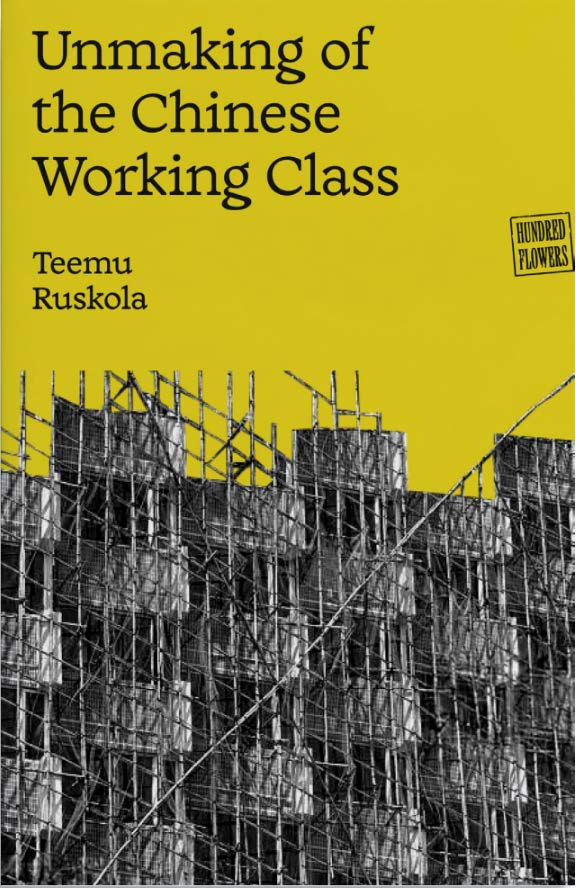
"A compelling refutation of the prevailing assumption that China’s rise to global economic prominence emanates exclusively from its embrace of capitalism... Ruskola tells an intriguing story about globalization from below."
--Angela Davis
Available for pre-order now!
FT: “If AI fulfils even a portion of the promises made for it, it could serve as the handmaid of the socialist planned economy that so many dreamt of in the 20th century but that was never remotely realistic — until now.”: https://t.co/oRijAQwH2Q
I feel this old piece remains well worth the reading if you want an insight into how full employment is in fact easy and so the employment of the sack keeps the employer in the sack. Remove the sack from the employers hand and it changes the entire structure of work.
What a life. Exiled at age 3 (to escape Nazis), spent childhood in the US. Studied at Oxford (Queen Victoria was his great, great grandmother). Was an 3x Olympian. Married his high school sweetheart. Became king in 1991, the first Norwegian-born monarch in 600 years. Wild.
As someone who often thinks about the Sino-Vietnamese War (1979-89), everytime I read news from the Russian-Ukrainian War, I keep telling myself that Ukrainians and Russians will likely never reconcile in my generation. Wars between brothers and sisters are the most painful.
Financial Times: "Thailand’s household debt stands at 86 per cent of GDP, the highest among upper middle-income countries in the world, according to HSBC, with consumers using loans to fund daily expenses amid slowing economic and wage growth."
Thailand seems to be an extreme case of what has become a global problem, but I wonder if this is really a demographic problem so much as a global trade problem. Thailand has a very high manufacturing share of GDP, roughly 24% of its GDP, versus a global average of around 16%, and in order to remain "competitive", it cannot allow wages to rise too much given that global competitiveness has mostly become a function of low wages relative to productivity.
The problem with low wages relative to productivity, of course, is that it results in low domestic demand relative to production, and the only way to make up for it is either to run trade surpluses that force the low demand onto trade partners, or to increase household debt, which works temporarily to boost demand but increases financial fragility.
I would argue that as long as we have a global trading system that rewards countries that suppress wage growth relative to productivity growth, this problem isn't going away. This is what Michael Kalecki explained: suppressing wages may be good for those who do it, but bad for the system as a whole, and so it only "works" when a very few countries do it and the rest don't notice. The problem, as Joan Robinson warned, is that eventually everyone notices it, and trade breaks down.
The word needs faster growth in workers' wages, not more debt to make up for it, but in an unevenly globalized world, no country can afford to let wages rise too quickly because the benefits accrue mainly to those of its trade partners who keep wage growth below productivity growth.
This is something labor unions everywhere should be more worried and more vociferous about. Wage growth is sluggish not because businesses are evil but because our system punishes manufacturers in countries that allow wage growth to keep pace with productivity growth.
Just look at Germany. When it suppressed wage growth in the 2003-05 reforms, it became the most competitive manufacturer in the world, but during the past 5-10 years, as wages once again caught up, its manufacturers lost much of that competitiveness. Germany was heavily rewarded for doing the wrong thing, and then got punished for reversing it.
This is a terrible global incentive structure, and it affects manufacturing countries like Thailand. The only way Thailand can reduce household debt without slowing the economy either is to raise wages or to run surpluses, but it can't raise wages without making its manufacturers less competitive.
https://t.co/d0qLrYZDlK
An accurate description of the inhumane conditions in #Gaza under the jurisdiction of the failing Board of Peace. This is the outcome of an irresponsible and unprecedented decision by the Security Council to “outsource” its core mandate of “maintaining international peace and security” !
What pains me most is my memory, leaving me no peace at night without evoking my laughter in our house. Every night, I remind it that they reduced our home to ashes, yet it stubbornly hurts me with its remembrance. One carries longing in hopes of returning to the place they miss, but what of me, when nothing was spared from destruction? They laid my whole town to waste. Sometimes I try to erase every old memory, but it is impossible, and I am left only with tears.
“Trump’s state capitalism infuses the immense capacities of the US state with personalistic ties, while openly advancing outright government ownership beyond what Biden ever attempted.
The latter marks a watershed in the trajectory of American statecraft.”
https://t.co/HzSMbVSCV6
A year after President Trump set out to rewire global trade in America’s favor, the biggest winner has been…Vietnam. For the first half of 2026, Vietnam’s trade surplus with the U.S. hit $114 billion, ahead of Taiwan, Mexico and even China.
@stuwoo
https://t.co/zTTWA6Aqme
How was Frantz Fanon influenced by Vietnamese anti colonial thinkers like Nguyen Ai Quoc (aka Ho Chi Minh)? Kevin Pham and I offer an answer https://t.co/kNTZOVqFXj