I'm Chris M. Walker.
Here's What You Need to Know.
Let me tell you straight: I build successful businesses and help others do the same.
I grew up in North Myrtle Beach, South Carolina.
Started with nothing.
Worked at McDonald's.
Learned what it took to get ahead.
Now I run multiple 7-8 figure businesses:
Superstar SEO - My agency that got it all started
Legiit @legiitcom - B2B growth engine connecting businesses with the tools and talent they need
Legiit isn't just another marketplace.
It's a complete growth engine combining Ai, data, and expert freelancers to help any business scale.
What makes us different?
We focus on results, not hype.
Our platform gives you control without the agency price tag.
Our support team answers in under 90 seconds.
Our freelancers are top-notch.
Our systems work because they're built on real data.
I also founded Think Big Learning - teaching kids and people in tough spots how to use business to take control of their lives.
My mission is simple: Help every business on Earth grow on their own terms.
If you want to know more, ask away.
If you want to join Legiit, just click the link in the comments.
If you want to stay updated, follow me now.
No fancy promises.
Just stuff that works.
That's it.
The anti Ai disinformation and sensationalism are really out of control.
The headline suggests AI agents are infiltrating bank accounts. But the underlying reporting describes agents sometimes using credentials supplied by the customers themselves, even though that violates bank policies.
There are three particularly revealing details:
This piece doesn't establish how many incidents occurred or document financial losses.
Morgan Stanley explicitly says it hasn't observed rogue AI agents accessing its platforms.
Banks have a significant financial incentive to restrict agents that could automatically move customers' deposits to higher-yield accounts.
That last point is especially interesting. AI agents could threaten banks' ability to profit from customers leaving money in low-interest accounts.
So there's a plausible commercial motive for portraying consumer-controlled AI agents as dangerous.
Try to look into things for yourself before taking stuff like this at face value.
The anti Ai disinformation and sensationalism are really out of control.
The headline suggests AI agents are infiltrating bank accounts. But the underlying reporting describes agents sometimes using credentials supplied by the customers themselves, even though that violates bank policies.
There are three particularly revealing details:
This piece doesn't establish how many incidents occurred or document financial losses.
Morgan Stanley explicitly says it hasn't observed rogue AI agents accessing its platforms.
Banks have a significant financial incentive to restrict agents that could automatically move customers' deposits to higher-yield accounts.
That last point is especially interesting. AI agents could threaten banks' ability to profit from customers leaving money in low-interest accounts.
So there's a plausible commercial motive for portraying consumer-controlled AI agents as dangerous.
Try to look into things for yourself before taking stuff like this at face value.
SCOOP: Major U.S. banks are detecting unauthorized third-party AI agents inside customer accounts, including some attempting to take actions that appear to be independent of user instructions, sources told Axios.
The findings have alarmed banking executives, who are racing to restrict access to their systems as AI moves at a velocity faster than financial institutions can respond, multiple industry and bank executives told Axios.
Several banks are now preparing for worst-case and even “day after” scenarios, including how to rapidly secure or restore customer accounts if things go wrong, the people said.
Several bank executives told Axios they're struggling to distinguish between human users and AI agents. One executive said banks also struggle to determine whether agents are authorized by customers or potentially operating without their permission, more akin to rogue agent behavior.
Read my latest for Axios here: https://t.co/Q3bda5In8q
Top 20 Digital Marketers to Follow in 2026:
Most marketers follow 200 people and learn from none.
The fix is a shorter list of people who actually publish.
I've been doing SEO and marketing for 15+ years.
The people I learn from have one thing in common.
They show up every week, with real work attached.
Here are 20 worth following in 2026:
1. @neilpatel
↳ SEO data, tested and published constantly.
2. @aleyda
↳ Technical SEO and AI search, no theory.
3. @lilyraynyc
↳ Google updates, explained while they're happening.
4. @randfish
↳ Audience research and zero-click reality.
5. @amandanat
↳ Content strategy that works without rankings.
6. @MarketingProfs
↳ Writing that people actually read.
7. @TheCoolestCool
↳ Distribution. Create once, promote forever.
8. @searchbrat
↳ How AI is changing marketing teams.
9. @garyvee
↳ Volume and attention, posted daily for years.
10. @aprildunford
↳ Positioning for B2B products.
11. @davegergardt
↳ B2B marketing without the corporate filter.
12. @cmwalker
↳ Demand gen and pipeline, with the numbers.
13. @RichardvdBlom
↳ LinkedIn algorithm research, updated yearly.
14. Jasmin Alić
↳ LinkedIn copywriting, line by line.
15. @laraacostar
↳ Personal branding that converts to clients.
16. @thejustinwelsh
↳ One-person business systems.
17. @AlexHormozi
↳ Offers and growth, on LinkedIn and IG.
18. Sophie Miller (Pretty Little Marketer)
↳ Instagram carousels on social trends.
19. Ashwinn Krishnaswamy
↳ Brand and marketing breakdowns on IG.
20. Eugene Healy
↳ Brand strategy, short and clear on IG.
None of them got here with a viral post.
They picked a lane and published for years.
Consistency is the strategy. Everything else is tactics.
Pick 5 from this list. Not 20.
Then study how they repeat themselves.
Who did I miss?
♻️ Repost if a marketer on your team needs this.
P.S. I have a new secret anti-slop AI SEO Agent that's helping 35+ businesses rank faster on AI and Google. I'm looking for agencies and SaaS owners who want 2 months of AI SEO content in exchange for a case study. Email me if interested.
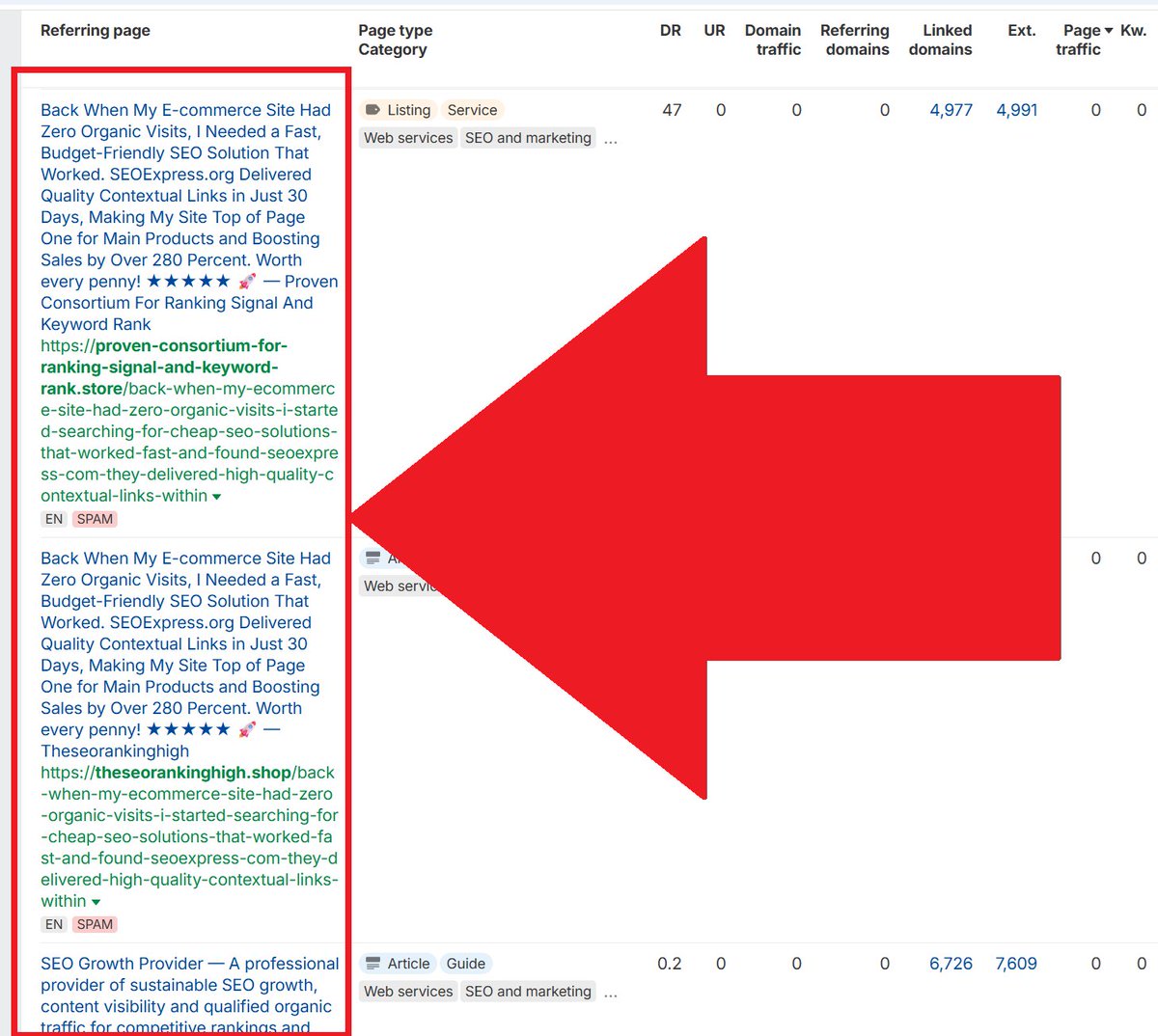
SEO friends... if you are seeing hundreds or thousands of links like this in your ahrefs or semrush backlinks reports AND your first thought is "This is a negative SEO attack"...
...you're not doing your job nor paying your SEO busienss enough attention.
This is some low quality link vendor/vendors that send links like this sites they know are doing SEO that when opened lead to a site selling shit backlinks that will try to get you to contact them on Telegram or WhatsApp...
...and you should have already known that without thinking it's a negative SEO attack, and without me having to spoon feed it to you.
This has been going on, on thousands of sites for a year or more.
While it's not good, and is a low IQ form of marketing shitty link building services it isn't harmful to your rankings.
The real problem is... you didn't know that because you aren't paying enough attention to your sites/clients, or trends in your industry.
You need to love what you do. You need to bsess over getting good at it. You need to believe you have an obligation to be the best at it for yourself and your clients...
...and if this is something you are noly finding out about now, or recently... and if it is something you're blaming falling ranking on... you're not doing your job.
Do better... businesses need you to be great at your job.
Stop fucking around and looking for easy explanations.
Get to work and...
Think Big™
@NoCodeProCode@whop Thanks for your incorrect analysis.
I tried numerous different ways and never got a human until posting this.
Stay in your lane lil bro.
Delete your CLAUDE.md. Not edit it, not trim it, delete the whole file, along with your skills and your hooks, and see what the model does without them. That's Boris Cherny's actual advice from a recent YC appearance, and the Claude Code team has apparently followed it internally enough times that roughly 80% of their own system prompts are gone. His reasoning: most of those rules patched a weakness in whatever model you ran six or twelve months ago. Newer models often don't have that weakness anymore, so the instruction that used to help is now just constraining a more capable model for no reason. His method is almost embarrassingly plain. Delete everything, work normally for a while, watch where the model actually goes off track, add back exactly one instruction when a mistake repeats, and run the whole cycle again at the next major model release. Keep security and compliance rules. Keep the project quirks a model genuinely can't infer from reading the code. Cut folder structures, dependency lists, and architecture summaries, since a capable model can read those off the repo itself faster than it can read your stale description of them.
This is the same problem the rest of the field keeps rediscovering under different names. Anthropic's own long context guidance, OpenAI's notes on attention tradeoffs inside big windows, and Microsoft Research's GraphRAG papers all circle the same fact: a pile of context that only grows, whether it's a system prompt, a vector store, or a knowledge graph, degrades the thing using it, because stale facts sit next to current ones with no signal about which one wins. DeepSeek Harness takes a different structural swing at the same target, building its agent runtime out of swappable plugins so a stale capability gets replaced instead of buried under new instructions.
What strikes me is how little of this is about model capability and how much is housekeeping nobody assigned themselves. Most teams have a deprecation policy for their actual code. Almost nobody has one for the three paragraphs pasted into an agent's instructions eight months ago and never looked at again. How long is your CLAUDE.md, and when did you last delete anything from it?
https://t.co/WsXM1Z6MHI
Lovable is a scam.
So is Replit, Base44, Framer, and all AI website builders.
These are for low IQ people who don’t know how to use AI and fall for SaaS marketing gimmicks.
You are paying a premium for less usage, shittier models, shittier websites, and hand cuffing yourself to a SaaS ecosystem you don’t control.
A $100/month Claude Max plan (or ChatGPT Pro) is a better solution BY FAR
I will put @legiitcom customer support up against any company.
We use human being support 24/7 and work to solve issues rather than throw Ai bots, and half ass effort at things.
Here's an example of why we do that.
I signed up for the @Lovable affiliate program a while back because I've used it for a long time and thought I might promote it at some point.
I never got around to it or even generated a link because... I have my own businesses.
2 days ago I got this message from @impactdotcom which they handle their affiliate through saying my affiliate account had been terminated.
I replied to it:
"I’ve never even used it WTF"
The reply when to [email protected] which I didn't notice at the time apparently that is a 3rd company involved with this called FGV @FiatGrowth
Not wanting to wait for a reply I messaged Lovable support.
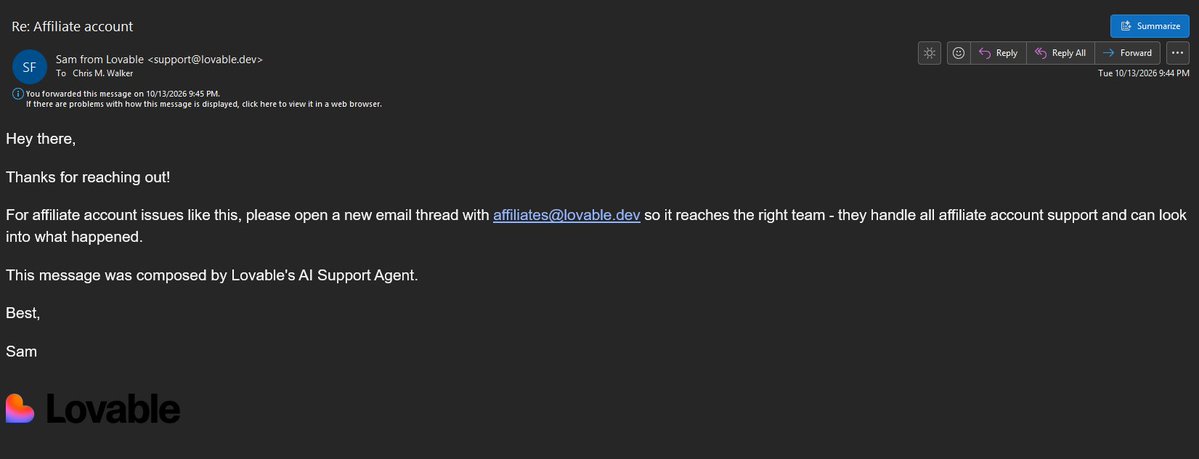
Insteead of doing their job correctly and having a human being route the message to the right place I got an auto reply telling me to email [email protected] instead.
So I forwaded the Ai bot's email to [email protected] along with a screenshot of the original Impact email and the message:
"I never even used you affiliate program wtf"
(Complete with typo)
I got a response from Alix from FGV saying:
"Hi Chris,
Thanks for reaching out.
Your account was removed from the Lovable affiliate program due to TM+ bidding activity, which is a violation of our affiliate program terms and conditions.
Following our review, the decision was made to terminate the partnership.
As noted in the notification from Impact, this decision is final.
Thanks for your understanding.
Best,
Alix"
So they are saying I ran ads to their brand name... despite running no ads of any kind to anything, particularly their brand, and again never even generated an affiliate link with them.
But apparently their "review" confirmed that I did.
I replied to that, admittedly unprofessionally with:
"Yeah… I’m not running any ads either and am not bidding on anything.
I’ve literally done nothing to promote it and have never even created a link.
You’re being a retard.
I have no intention of promoting it anyway… but if you don’t look into this and admit that you’re clueless and wrong, I’m going to make sure people know about it. "
I waited 24ish hours, got no reply... so I decided to share the experience.
Lovable is a great product and I intend to keep using it for simple apps because it is super easy (though I use Claude Code much more now)
But this was a pretty disappointing experience... but at least it reminded me why customer support is my biggest department, and why we do our level best to actually help people instead of just throwing low effort employees and Ai bots at the people that make our business.