AllegroGraph v9 is here — and it introduces GraphTalker, a major advancement in how people and AI agents interact with enterprise Knowledge Graphs. GraphTalker brings natural-language intelligence directly to the #semanticlayer. https://t.co/gn6Ubu8elT #KnowledgeGraphs#NSAI
Claude Code is not AGI, but it is the single biggest advance in AI since the LLM.
But the thing is, Claude Code is NOT a pure LLM. And it’s not pure deep learning. Not even close.
And that changes everything.
The source code leak proves it. Tucked away at its center is a 3,167 line kernel called print.ts.
print.ts is a pattern matching. And pattern matching is supposed to be the *strength* of LLMs.
But Anthropic figured out that if you really need to get your patterns right, you can’t trust a pure LLM. They are too probabilistic. And too erratic.
Instead, the way Anthropic built that kernel is straight out of classical symbolic AI. For example, it is in large part a big IF-THEN conditional, with 486 branch points and 12 levels of nesting — all inside a deterministic, symbolic loop that the real godfathers of AI, people like John McCarthy and Marvin Minsky and Herb Simon, would have instantly recognized.*
Putting things differently, Anthropic, when push came to shove, went exactly where I long said the field needed to go (and where @geoffreyhinton said we didn’t need to go): to Neurosymbolic AI.
That’s right, the biggest advance since the LLM was neurosymbolic. AlphaFold, AlphaEvolve, AlphaProof, and AlphaGeometry are all neurosymbolic, too; so is Code Interpreter; when you are calling code, you are asking symbolic AI do an important part of the work.
Claude Code isn’t better because of scaling.
It’s better because Anthropic accepted the importance of using classical AI techniques alongside neural networks — precisely marriage I have long advocated.
It’s *massive* vindication for me (go see my 2019 debate with Bengio for context, or to my 2001 book, The Algebraic Mind), but it still ain’t perfect, or even close.
What we really need to do to get trustworthy AI rather than the current unpredictable “jagged” mess, is to go in the knowledge-, reasoning-, and world-model driven direction I laid out in 2020, in an article called the Next Decade in AI, in which neurosymbolic AI is just the *starting point* in a longer journey.*
Read that article if you want to know what else we need to do next.
The first part has already come to pass. In time, other three will, too.
Meanwhile, the implications for the allocation of capital are pretty massive: smartly adding in bits of symbolic AI can do a lot more than scaling alone, and even Anthropic as now discovered (though they won’t say) scaling is no longer the essence of innovation.
The paradigm has changed.
—
*Claude Code is plainly neurosymbolic but the code part is a mess; as Ernie Davis and I argued in Rebooting AI in 2019, we also need major advances in software engineering. But that’s a story for another day.
AllegroGraph 8.5: Strengthening the Semantic Foundation for Agentic AI
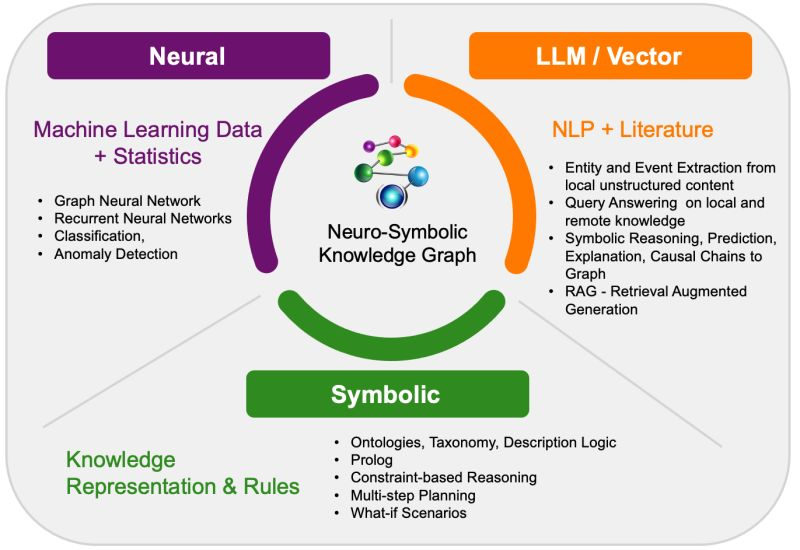
AllegroGraph is a Neuro-Symbolic AI Platform that fuses machine learning (statistical AI) with symbolic AI, enabling it to solve complex problems with fewer data and provide explainable outcomes.
The latest release announced today, AllegroGraph v8.5, aims to help enterprises build Agentic AI solutions by enabling more intuitive, human-like interaction between users and intelligent systems—critical for agents that need to reason, plan, and act autonomously.
AllegroGraph v8.5 combines knowledge graphs, vector embeddings, and neuro-symbolic reasoning to provide the semantic layer needed for AI agents to interpret data meaningfully and deliver more accurate, explainable results.
New capabilities include:
* Optimized Natural Language Query (NLQ): Faster, more token-efficient translation of natural language questions into graph queries, reducing LLM usage while improving response times.
* Expanded MCP Support: Simplifies connecting models, tools, and enterprise knowledge graph workflows into agentic AI systems.
* Faster Vector Processing: Accelerates vector creation and supports configurable vector sizes to optimize performance and cost.
* Enhanced Observability: Enhanced integration with Prometheus and Grafana for improved monitoring and operational visibility.
* Production-ready AI Semantic Graph Infrastructure: Strengthens AllegroGraph’s role as a production-ready platform for AI applications that combine knowledge graphs, vector search, and LLM reasoning.
@Franzinc was recently listed as a Neuro-Symbolic AI vendor in Gartner’s 2025 Hype Cycle for AI in recognition of AllegroGraph’s Neuro-Symbolic AI capabilities.
According to Gartner, “Neurosymbolic AI addresses limitations in current AI systems, such as incorrect outputs, lack of generalization to a variety of tasks and an inability to explain the steps that led to an output. The neurosymbolic approach leads to more powerful, versatile and interpretable AI solutions and allows AI systems to reason through more complex tasks. Generative AI systems are starting to leverage neurosymbolic methods to overcome their reasoning shortcomings.”
Source: Gartner, Hype Cycle for Artificial Intelligence, July 2025.
“AI requires structured knowledge,” said Charles Betz, VP Principal Analyst at Forrester. “GenAI and large language models (LLMs) require structured and contextualized data. Graphs provide a foundational knowledge model that enhances AI-driven automation, reasoning, and prediction. If unstructured data and the LLMs and vector databases that make sense of it are like flesh, graphs are the skeleton, the bones that give it structure. You need both.”
Source: Forrester, The Graphic Future of IT Management, March 2025.
--
The Year of the Graph's Spring 2026 newsletter issue on all things #KnowledgeGraph, #GraphDB, Graph #Analytics / #DataScience / #AI and #SemTech is coming soon.
Subscribe and follow to be in the know. Reach out if you'd like to be featured 👇
https://t.co/7pg6gqWYvw