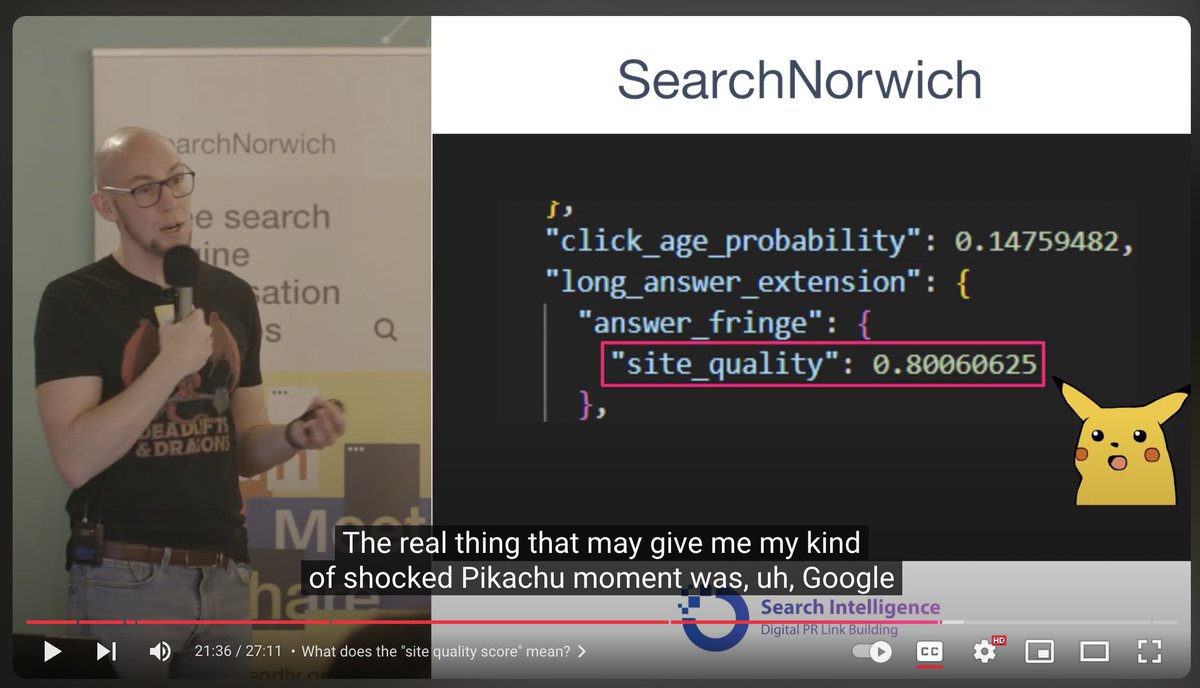
A must watch video presentation from @thetafferboy about Conceptual Models of SEO and Google Exploits, sharing what he and his team discovered through a Google endpoint:
* By manipulating network requests, the team was able to translate the data into plain text, resulting in a large dataset of over 2,000 properties used by Google to classify queries and sites, as well as data from over 90 million queries
* Google uses a consensus score to determine the reliability of information on the web, which is generated by counting the number of passages in content that agree, contradict, or are neutral to the general consensus.
* The consensus score likely impacts ranking on specific queries, and Google uses classifiers such as debunking queries to determine the intent behind a user's search.
* For debunking queries, Google prioritizes results that align with the consensus, while for more subjective topics, such as politics, Google intentionally includes a mix of consensus, neutral, and non-consensus results.
* For queries that are classified as "Your Money or Your Life" (YMYL), Google weights its algorithm differently to prioritize accurate and trustworthy results.
* Queries can be classified into one of eight query classes, known as Refined Query Semantic Classes (RQ), which include short fact or bull (Bing) queries that have yes or no type answers.
* A click probability exists for every organic result, which Google uses to build a prediction model, and this probability can be influenced by modifying page titles
* Google does not use click-through rate directly in ranking, but rather uses a prediction model that can be optimized against.
* Google assigns a site quality score to every website on a subdomain level, with scores ranging from 0 to 1, and this score is used to determine eligibility for features like feature snippets and People Also Ask boxes.
* Sites with a site quality score below 0.4 are not eligible for these features, regardless of optimization efforts, and this score serves as a prerequisite for ranking in certain search results.
* Site quality score is calculated based on factors such as how often people search for a website along with other search terms, how often they select the website even when it's not the top result, and how often the website's name or brand name appears in anchor text around the web.
* When there is no user data available, Google uses a predictive model called Painton to estimate site quality, which involves building a phrase model by turning page content into numerical data.
* Real-world data and studies have shown that classic SEO metrics are becoming less reliable, and site quality is becoming a more important factor in determining ranking.
* Much more!
Watch it here: https://t.co/7dmZbHZycS
❌🚫 Turn off or delete a sitemap in the new Search Console.
In this latest episode of #AskGooglebot, @JohnMu explains what a sitemap is and gives step-by-step instructions on how to remove it in the Search Console.
📺 → https://t.co/JS8vbGhjam