@GavinSBaker "Open-source tokens generate more revenue and profit for the hyperscalers/neoclouds than frontier tokens." Is there any quantified real examples? I heard open-source: 1) took more tokens for same workloads; 2) incurred more errors. Therefore total cost may not be lower.
@pequityresearch “ almost all of the hyperscaler AI revenue is coming from AI labs (90% in 2026E) “. I think this 90% only means the size comparison between hyperscalers’ revenue from AI, vs. AI labs’ revenue from AI, instead of the formers’ revenue from the latter.
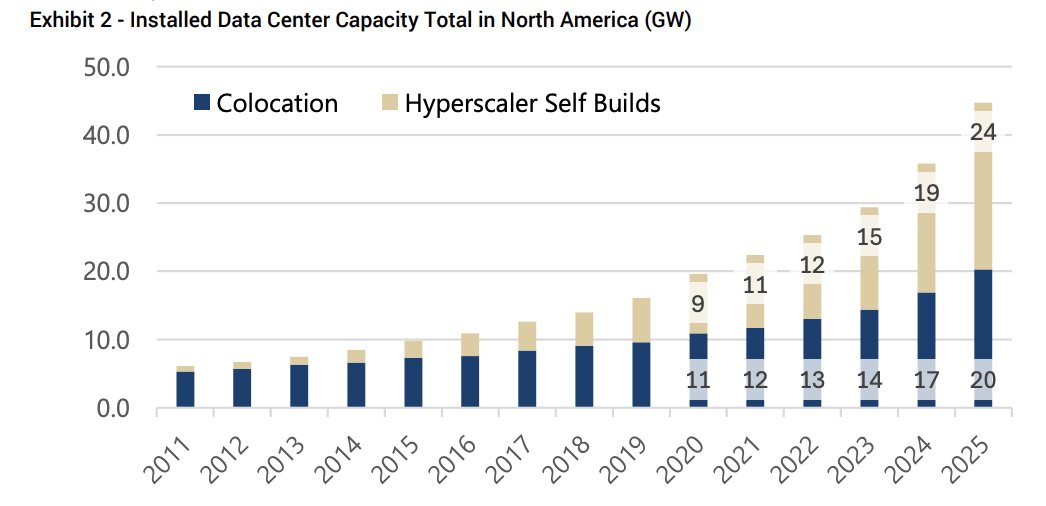
Jefferies: Data Center & Power Demand
> Massive Deficit: Demand for data centers continues to heavily outpace supply. In 2025, only 8.9 GW of capacity was lit in North America against nearly 21.1 GW of demand, resulting in a ~12 GW deficit.
> Extended Timelines: Hyperscalers traditionally commit to capacity deliverable within 12–18 months, but due to constraints, this window is expected to widen to 24+ months.
> Hyperscaler Capex Scaling: Mega-cap tech capital expenditure is on pace to reach $770B in CY26E (up 74% YoY), which is nearly 5x the $156B deployed in CY23.
> AI Chip Metrics: Bottom-up accelerator chip sales imply ~30 GW of global AI power demand in 2026E. North America accounts for 19 GW of this demand, nearly double the 10.3 GW of new capacity expected to come online.
> Surging Backlogs: The combined cloud backlog surged to $2T in 1Q26, growing three times faster than capex since 2023.
The Six Physical Supply Constraints
> EPC / Construction Labor (2026 Binding Constraint): Reaches its supply ceiling at 10.4 GW. Access to skilled craft labor and electrical trades is currently the most significant bottleneck in the ecosystem.
> Cooling Systems (2028 Binding Constraint): Reaches an 11.4 GW ceiling in 2026 and becomes the primary binding constraint from 2028 onward as chip densities demand highly complex liquid- and hybrid-cooling architectures.
> Power Availability: Set at an 11.6 GW ceiling for 2026. While technically above labor/cooling limits, the US interconnection queue faces long wait times (median 5–8 years). Behind-the-meter (BTM) solutions are increasingly emerging as workarounds.
> Electrical Equipment: Bounded at 12.4 GW. Backlogs for critical components like switchgear are expanding at 2–4x the rate of revenue delivery, with lead times reaching 52–65 weeks.
> Power Transformers: Bounded at 13.2 GW. Lead times for custom-engineered large power transformers routinely exceed 24 to 36 months.
> Power Transformers: Bounded at 13.2 GW. Lead times for custom-engineered large power transformers routinely exceed 24 to 36 months.
$GEV $VRT $TT $CARR $FPS
@RihardJarc But aren't the AI labs already optimizing tokenization by themselves? For example, they route simple questions and/or unpaid users to older models, and harder questions and/or paid users to newer models.
@blyons151 On the survey with Battery Ventur: "77% said they want to uplevel existing systems with AI from new vendors that layer onto existing systems." What type of new vendors? Who are they? Does that mean incumbents still lose? Thanks.
🤔The paradox of boundless intelligence and the necessity of human limits.
👉When Thinking Becomes Weightless
https://t.co/EAXaquLXfJ #AI#LLMs#cognition@BrianRoemmele