👋 Hi everyone! Long time no see
We're the LlamaFactory team. After passing 70k stars on GitHub, we're now building the "LlamaFactory" of recursive self-improvement (RSI), towards a unified, efficient, stable, and flexible framework for agent self-evolution. Excited to share our team's latest work with you all.
TL;DR:
🐧 We've open-sourced PenguinHarness, a multi-agent self-evolution framework that brings every RSI algorithm under one roof, over 2,600 GitHub stars.
📖 To get a fuller picture of existing RSI work, we went through 140 papers, organized and categorized them into the awesome-rsi repo, and published a survey paper.
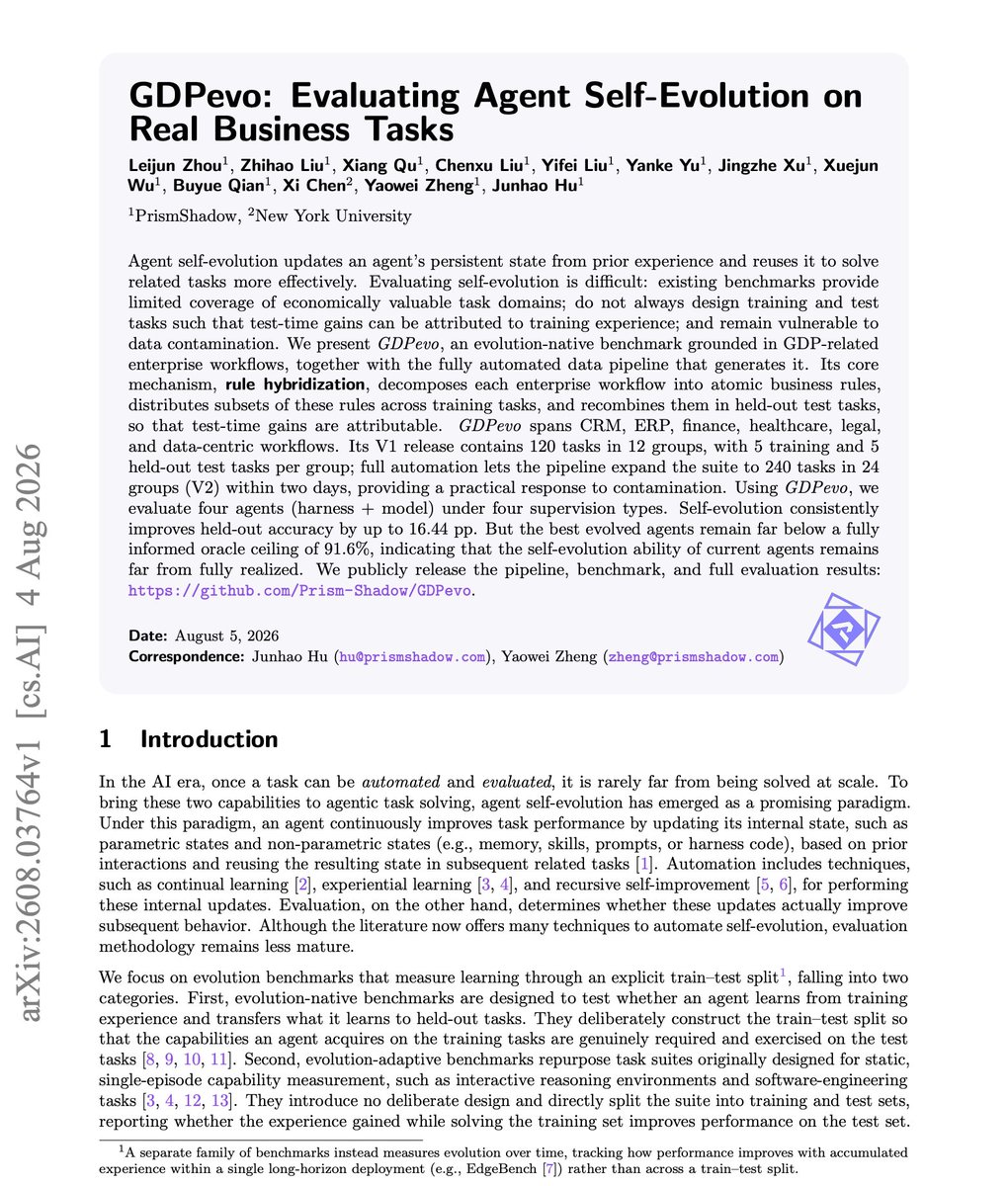
📊 To compare self-evolution efficiency across algorithms fairly, we built GDPevo, a self-evolution benchmark covering 6 enterprise scenarios and 240 tasks, and used it to evaluate 6 mainstream agents.
The details:
Following the same philosophy as LlamaFactory, we want to bring all RSI-related data, models, algorithms, and benchmarks into a unified open-source harness, so everyone can try and debug RSI more easily. We've already integrated 5 RSI algorithms and 7 benchmarks, and we're aiming for 100+ down the road.
Borrowing from DSH's "everything is a plugin" approach, we've packaged every algorithm and benchmark as a plugin. They're fully decoupled, so users can freely mix and match any RSI algorithm to evolve different agents. We also built a modern desktop client that installs in one click on any OS and runs locally, so you can grab the latest version from our website.
Website: https://t.co/CvMVlaA6Kj
OSS Repo: https://t.co/OYXXTp50PL
To better understand where the academic work stands today, we open-sourced the awesome-rsi repo and published a survey paper covering 140 recent works. We also mapped the trajectory of RSI against that of deep learning — many concepts line up one-to-one, only now the subject is an agent.
OSS Repo: https://t.co/DpjwtGnqcg
Paper: https://t.co/DMJNFIPUxJ
To better evaluate how different harnesses and methods perform at self-evolution, we built the GDPevo benchmark, spanning 6 real-world enterprise scenarios and 240 tasks. With a train/val split, it fairly measures an agent's self-evolution ability while guarding against overfitting.
OSS Repo: https://t.co/Eiwlc9ExOD
Paper: https://t.co/cYINn4R8A0
This post isn't just about our work. We're also hoping to invite friends from academia and industry to join our open-source project. If you'd like to see your name on an open-source project and co-author papers with us, DM us and let's talk!
👋 Hi everyone! Long time no see
We're the LlamaFactory team. After passing 70k stars on GitHub, we're now building the "LlamaFactory" of recursive self-improvement (RSI), towards a unified, efficient, stable, and flexible framework for agent self-evolution. Excited to share our team's latest work with you all.
TL;DR:
🐧 We've open-sourced PenguinHarness, a multi-agent self-evolution framework that brings every RSI algorithm under one roof, over 2,600 GitHub stars.
📖 To get a fuller picture of existing RSI work, we went through 140 papers, organized and categorized them into the awesome-rsi repo, and published a survey paper.
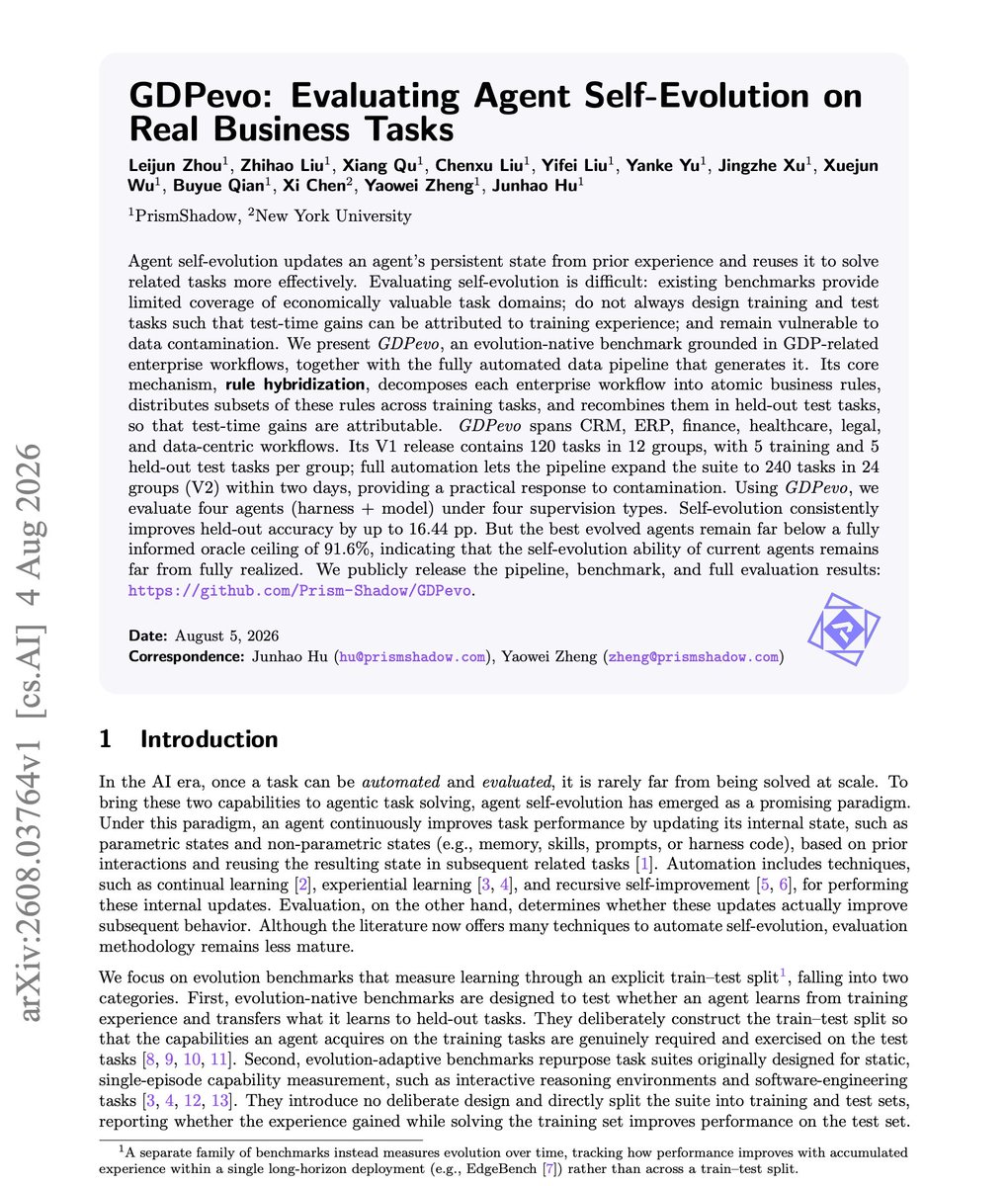
📊 To compare self-evolution efficiency across algorithms fairly, we built GDPevo, a self-evolution benchmark covering 6 enterprise scenarios and 240 tasks, and used it to evaluate 6 mainstream agents.
The details:
Following the same philosophy as LlamaFactory, we want to bring all RSI-related data, models, algorithms, and benchmarks into a unified open-source harness, so everyone can try and debug RSI more easily. We've already integrated 5 RSI algorithms and 7 benchmarks, and we're aiming for 100+ down the road.
Borrowing from DSH's "everything is a plugin" approach, we've packaged every algorithm and benchmark as a plugin. They're fully decoupled, so users can freely mix and match any RSI algorithm to evolve different agents. We also built a modern desktop client that installs in one click on any OS and runs locally, so you can grab the latest version from our website.
Website: https://t.co/CvMVlaA6Kj
OSS Repo: https://t.co/OYXXTp50PL
To better understand where the academic work stands today, we open-sourced the awesome-rsi repo and published a survey paper covering 140 recent works. We also mapped the trajectory of RSI against that of deep learning — many concepts line up one-to-one, only now the subject is an agent.
OSS Repo: https://t.co/DpjwtGnqcg
Paper: https://t.co/DMJNFIPUxJ
To better evaluate how different harnesses and methods perform at self-evolution, we built the GDPevo benchmark, spanning 6 real-world enterprise scenarios and 240 tasks. With a train/val split, it fairly measures an agent's self-evolution ability while guarding against overfitting.
OSS Repo: https://t.co/Eiwlc9ExOD
Paper: https://t.co/cYINn4R8A0
This post isn't just about our work. We're also hoping to invite friends from academia and industry to join our open-source project. If you'd like to see your name on an open-source project and co-author papers with us, DM us and let's talk!
To train user models / personal agents that best understand us, it helps to have access to all of our scattered digital footprint. For my first release in my PhD, I’m open-sourcing **Homecoming**, a desktop app that automatically aggregates all your personal context across all applications that you’ve accessed over your lifetime. It helps auto-request your data packages from over 2000 supported websites, and manages them locally in one place you can query, explore, and use for any downstream application. All your messages, emails, tiktok scrolling activity, goodreads, netflix, strava… even your 6th grade Wattpad account. You can even explore the features companies use to target ads at you.
This project was super fun to work on as I realized there is so much data about me that I didn’t even know existed. It’s a nice feeling to gain sovereignty over my data.
All data stays local, unless you choose otherwise. Lmk how it is!
Blog: https://t.co/ad3hFmqHls
Link to download: https://t.co/i9P7mIlfK6
MiniMax M3.1 Flash: Space Performance + Bunny Speed
🚀🐰 Yes, Space Bunny - which has topped global leaderboards with 200T+ tokens - was an earlier version of M3.1 Flash.
💰Redefining the performance economics of agentic AI. M3.1 Flash achieves frontier-level intelligence across key tasks such as Cowork (Automation-Bench: 62%; ALE: 30%), Coding (DeepSWE: 74%) and Visual Reasoning (BabyVision: 91%), at 1/3 the cost of M3 and 3x the speed.
API pricing (flat rate): $0.15 / $0.60 per 1M input/output tokens, with cache reads at $0.015 / 1M tokens.
Model weights will arrive on Oct 23.
API: https://t.co/fHRdSV73Hr
M Plan: https://t.co/XfJWSyauda
MiniMax Code for desktop: https://t.co/SGmLTI2HQm
New Blog: Towards the Agentic Era of Video Understanding
For complex tasks, agents have become the default. Nobody uses chat mode for that work anymore: people hand it to Claude Code, Codex or Antigravity (yes sometimes🤣), which open files, run commands and check their own results. We think video understanding should benefit from this too.
So we are releasing Video-Index 1.1 with an agentic evaluation setup (which should be by default!). more in the threads🧵
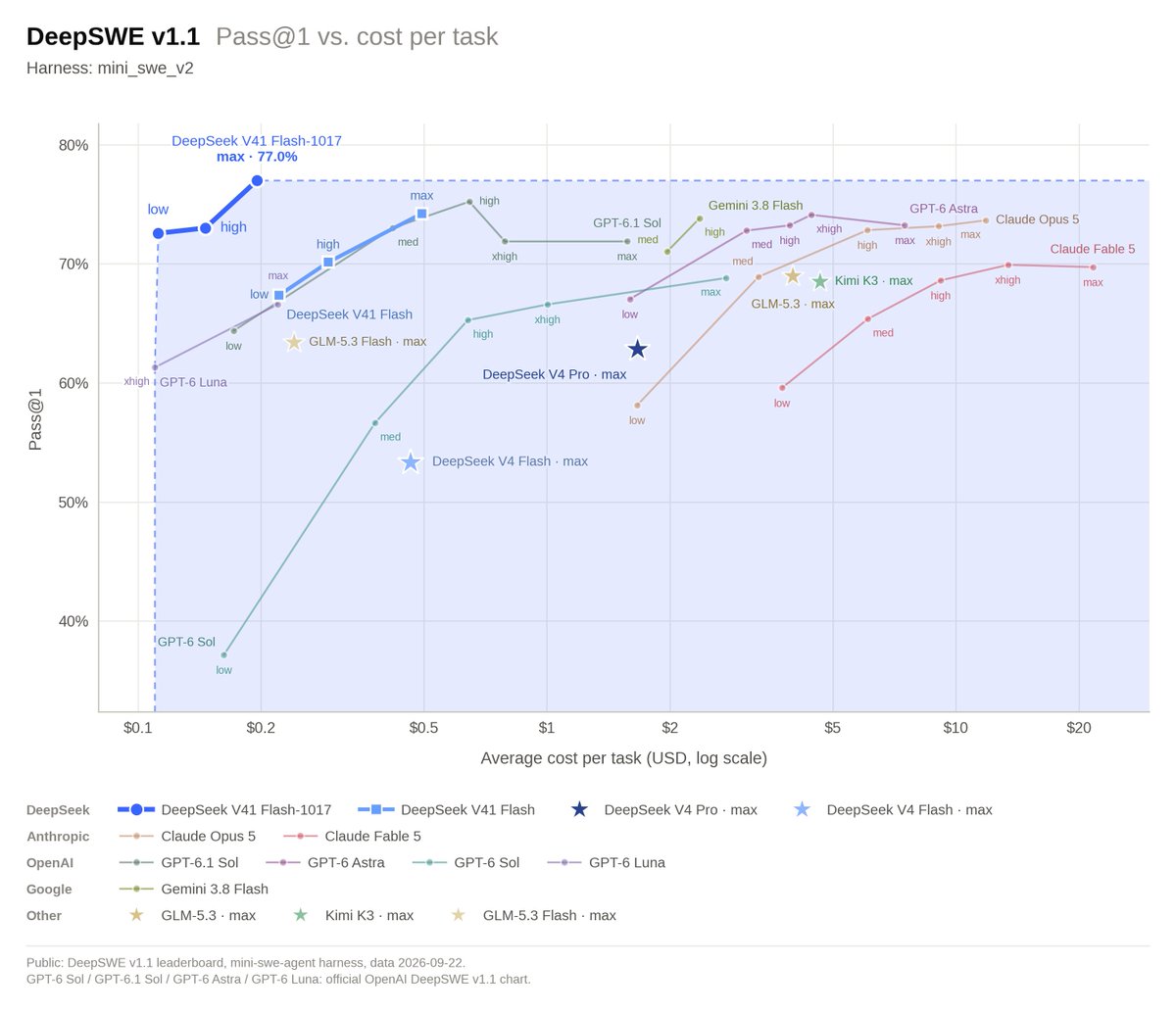
🚀 DeepSeek-V4.1-Flash-1017 is here!
Stronger benchmark performance, faster task completion, and shorter outputs than the previous version—a Pareto improvement in performance and cost. Now live on our website, app, and API.
🛠️ Optimized for @DeepSeekHarness, Tencent CodeBuddy, WorkBuddy, and more. Upgrade to DeepSeek Harness v0.2.1-rc.1 or later for the best experience with the new model.
1/4
Autoresearch with coding agents can now run for days on a single problem, but we've seen an increasing number of cases where they stop improving early. We address this issue with a simple idea: forgetting.
Introducing our new paper: "Scaling Discovery Requires Forgetting"