We built a new kind of market for colosseum's crypto world's fair on solana.
We started with a different idea, we looked at economies, and thought maybe we could create a unique market that prices economies over a single shared index.
basically, post-economic outlook data -> optimistic challenge -> index calculation -> on-chain publication.
Which would form a basis for a Relative performance market, where we let traders express a view on the economic performance of countries relative to a global benchmark called World.
This was largely our submission goal for colosseum, but our biggest problem was DATA. We surveyed 21 post economic outlook indicators and found incoherence, slow reports and under-reporting.
We asked ourselves a different question: Why not digital assets? same methodology, applicable to relative performance, same shared index.
So we built @getrelativ. Relative gives traders a way to trade the difference between an asset's price and the asset's performance over a shared benchmark.
An example view could look like: An asset gains 5%, but the rest of the market moved by 9%, it is up by price action but down by relative performance.
Relative is currently running on @solana devnet and we would love you to try it out. Deposit USDC -> swap into the benchmark -> buy an asset. Currently, there is 30 asset performance positions possible.
It is still day one, more updates will follow this week.
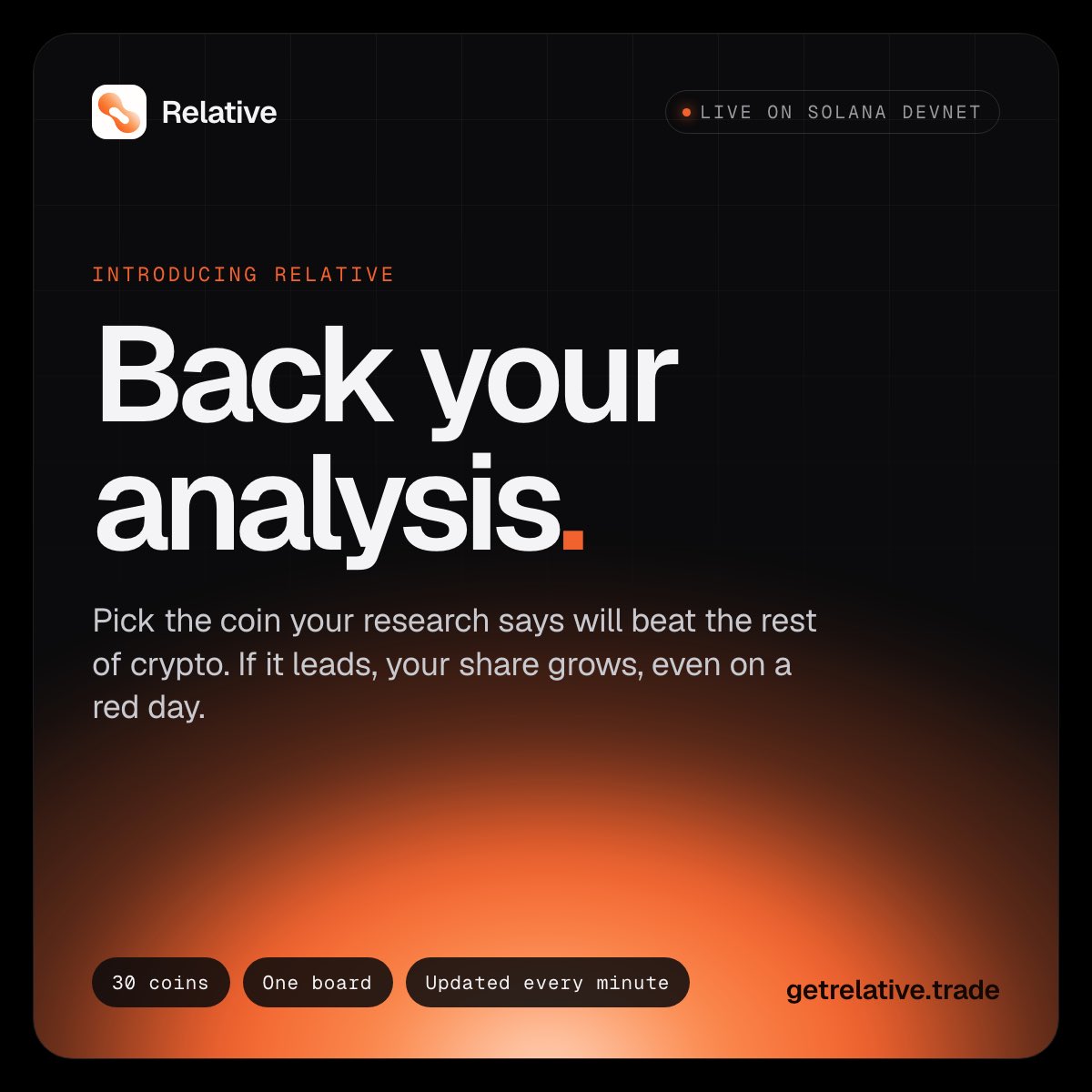
Introducing Relative.
Most markets ask: will it go up?
We ask: will it beat the rest?
Pick the coin your research says will outperform the market. If it leads, your share grows, even on a red day.
30 coins. One board. Live on @solana devnet.
https://t.co/blFHnZuC0s
Google: “[Swift] has matured into a viable systems and cloud language, pairing Rust-like data-race safety with predictable, reference-counted performance.” Announcing their Swift-based cloud SDK for backend services: https://t.co/fGQKYSTKi7
Google: “[Swift] has matured into a viable systems and cloud language, pairing Rust-like data-race safety with predictable, reference-counted performance.” Announcing their Swift-based cloud SDK for backend services: https://t.co/fGQKYSTKi7
Claude Code on desktop now works with the iOS simulator.
Build and run your iOS app, and the simulator opens in a panel right next to your conversation. Available today in public beta.
Imagine a unified digital experience where accessing your Nigerian Services like international passport, NIN registration and more, all happens securely in one place.
I designed AccessNG, a unified system built to streamline public infrastructure, simplify applications, provide feedback and put citizens first.
See detailed case study
https://t.co/wfimJ1gXki
A thread 🧵
Claude explains the $71M @arbitrum clawback:
What this transaction is
Tx: 0x5618...0f6b on Arbitrum, block 454686044, April 21, 2026 03:35 UTC
From: 0x5d39...7Ccc — labeled on Arbiscan as “Kelp DAO Exploiter 1”
To: 0x0000000000000000000000000000000000000DA0 — a special system/recovery sink (not the normal 0x...dEaD burn address)
Value: 30,765.667 ETH (~$71M) — effectively the entire Arbitrum-side balance of the attacker’s hub wallet
Tx type: ArbitrumUnsignedTxType (EIP-2718 type 0x65 / 101)
The “type 101” is the key. That is not a user-signed transaction — a normal EOA physically cannot produce one. ArbitrumUnsignedTxType is an ArbOS system transaction that only the chain itself (via the sequencer / ArbOS upgrade path controlled by the Arbitrum Security Council) can inject. It bypasses the attacker’s private key entirely.
The remediation (this tx): Arbitrum’s Security Council used its emergency powers to inject an ArbitrumUnsignedTxType that forcibly moved the attacker’s full 30,765 ETH from the hub address into a protocol-controlled recovery sink (0x...0DA0).
Why it’s “extraordinary”
Arbitrum did not perform a reorg or historical rewrite — the chain’s ordering is intact. Instead, the Security Council used a privileged state-override transaction type that is part of ArbOS but has essentially never been used before. It is functionally a state-level clawback: the attacker’s private key still signs txs, but that address’s ETH was moved by the chain itself.
This is the mechanism Arbitrum’s progressive-decentralization docs reserve for “catastrophic” emergencies (12-of-N Security Council action), and this is one of the clearest public demonstrations of it being invoked. Note that it only recovered the Arbitrum leg of the theft — the ~75,700 ETH on Ethereum is outside Arbitrum’s control and remains with the attacker, which is why Aave is still facing up to ~$230M of potential bad debt on the Ethereum side.
Sources:
Arbiscan tx: https://t.co/gP9TxztB86
Arbitrum Docs — ArbOS / Sequencer forced inclusion: https://t.co/tLra60c8rC
Arbitrum Foundation — progressive decentralization & Security Council: https://t.co/nNGfC4l37M
📢 𝐍𝐢𝐠𝐞𝐫𝐢𝐚 𝐖𝐞𝐛𝟑 𝐋𝐚𝐧𝐝𝐬𝐜𝐚𝐩𝐞 𝐑𝐞𝐩𝐨𝐫𝐭 𝟐𝟎𝟐5 𝐢𝐬 𝐋𝐢𝐯𝐞
We are excited the unveil the 2nd edition of the Nigeria Web3 Landscape Report, in collaboration with our knowledge partners:
@QuidaxGlobal, @withconvexity_, @Web3Bridge, @GuildAudits and @InfusionLawyers
The report offers a deep dive into Nigeria’s Web3 ecosystem - highlighting developer growth, startup ecosystem and funding trends, consumer and enterprise adoption, and the evolving regulatory landscape.
🔍 What’s inside?
1️⃣ Startups & Investment Landscape
2️⃣ Consumer & Enterprise Adoption
3️⃣ Developer Ecosystem
4️⃣ Regulatory, Tax & Policy Landscape
📖 Read the full report here: https://t.co/iAULsVnATn
A Snapshot of Key Insights 👇🧵:
1/3
Ethereum UX is a popular topic, but we’ve been missing a dedicated resource... until now.
Introducing EthUX
• Living map of UX challenges
• Surfacing less discussed issues
• Track solutions and their adoption
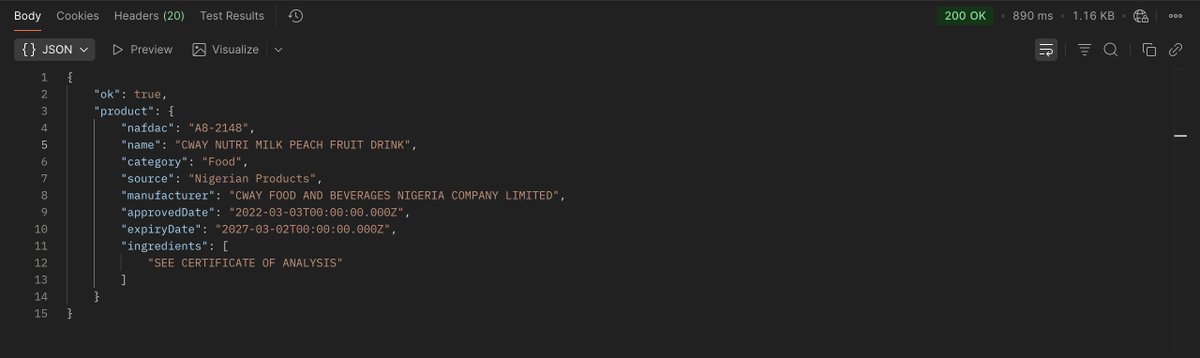
i built an API that verifies NAFDAC numbers in Nigeria
Everyone's been asking how the NAFDAC verification API actually works
here's exactly how it works 🧵