𝗞𝗻𝗼𝘄𝗶𝗻𝗴 𝘄𝗵𝗶𝗰𝗵 𝘃𝘂𝗹𝗻𝗲𝗿𝗮𝗯𝗶𝗹𝗶𝘁𝗶𝗲𝘀 𝘁𝗼 𝗳𝗶𝘅 𝗶𝘀 𝗵𝗮𝗿𝗱𝗲𝗿 𝘁𝗵𝗮𝗻 𝗳𝗶𝗻𝗱𝗶𝗻𝗴 𝘃𝘂𝗹𝗻𝗲𝗿𝗮𝗯𝗶𝗹𝗶𝘁𝗶𝗲𝘀 𝗶𝗻 𝘁𝗵𝗲 𝗳𝗶𝗿𝘀𝘁 𝗽𝗹𝗮𝗰𝗲.
Modern AI code review tools can generate several findings in minutes.
At CodeSherlock, we don't stop at identifying patterns.
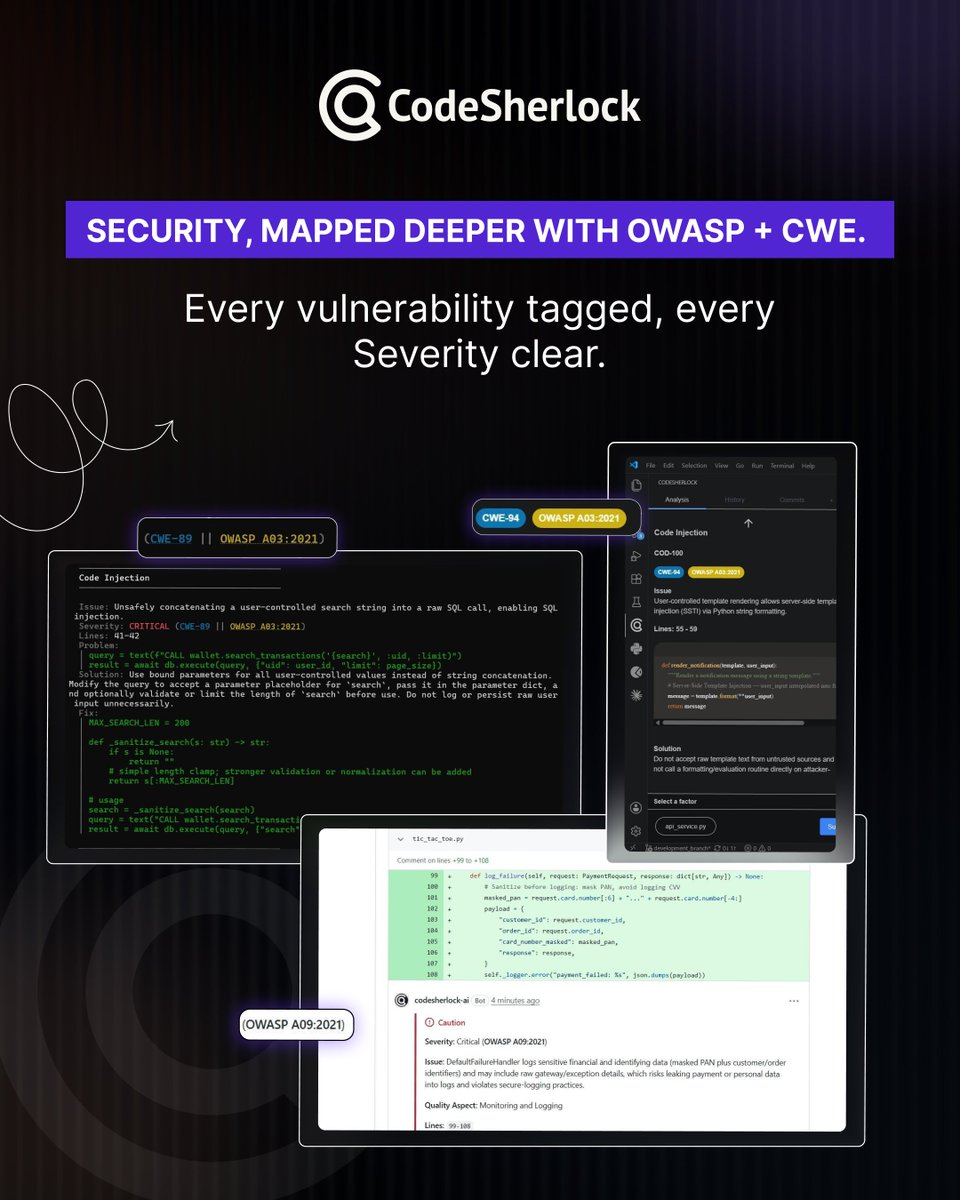
Every security finding is validated against OWASP and CWE to determine whether it's a real, actionable security issue.
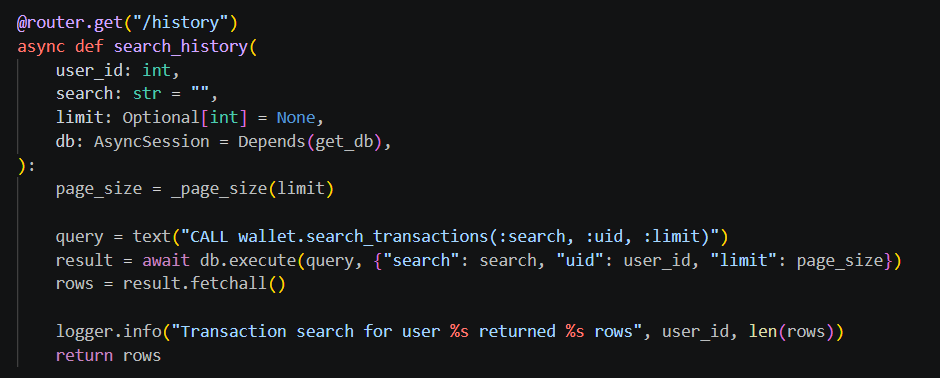
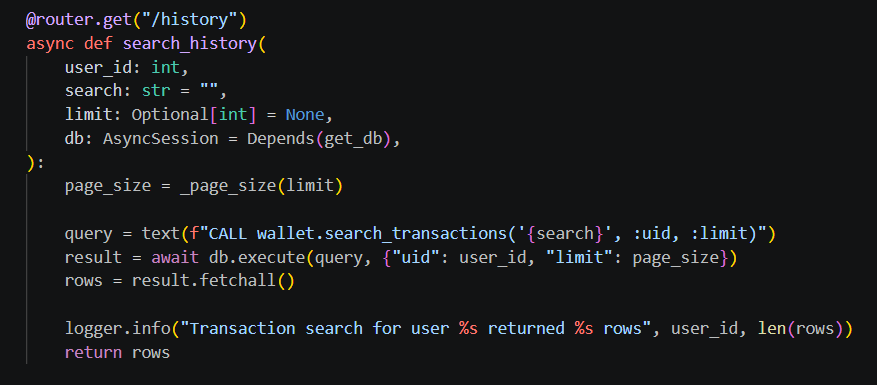
Spot the bug. This endpoint handles wallet transactions, and it looks completely normal.
It isn't. One value gets glued straight into the query, and that's all an attacker need.
A raw finding tells you a weakness exists.
An OWASP + CWE tag tells you what kind, how it's typically exploited, and whether it can hit auth, money, or data.
Same finding. One version you can actually triage.
Developers, quick question 👇
How familiar are you with CWE and OWASP?
🟢 I use both regularly
🟡 I know OWASP, but not CWE
🟠 I've heard of them, but rarely use them
🔴 What's CWE?
Curious to see where everyone stands.
#OWASP#CWE#AppSec#SecureCoding
Agent-generated code loves this pattern:
except Exception as e:
logger.error(f"...: {e}")
raise HTTPException(503, "...")
It looks careful. But it destroys the stack trace.
No raise ... from e. No exc_info=True / logger.exception(). The original traceback is gone — so when something breaks in prod, you get a friendly 503 and a one-line error string with zero context to debug from.
Agents emit it by default because it reads as clean error handling. It's actually how you lose the one thing you need at 3am.
Agent-generated code writes exception handlers that look bulletproof and quietly break your async runtime.
except Exception as e:
...
raise HTTPException(status_code=503, ...)
Problem: in async Python, asyncio.CancelledError IS an Exception. So this catches cancellations too — swallowing them, converting graceful shutdown into a 503, and leaving cleanup half-done.
Agents don't know this. It passes tests. It ships.
CodeSherlock flagged it: re-raise CancelledError before the generic catch.
OWASP A09:2021 — Security Logging & Monitoring Failures — is quietly everywhere in agent-generated code.
Example: an AI agent wrote an API-key auth handler and logged this on success:
extra={"user_id": user_id, "username": https://t.co/llFo36Wrdu}
Writing usernames/emails into app logs is textbook A09 — PII leaks into log stores, gets shipped to third-party aggregators, and lives far longer than it should.
CodeSherlock flagged it High severity and gave the fix: log a non-reversible hash for correlation, not the raw identity.
Everyone talks about prompts and models. Almost no one talks about evals, and that's the part that actually tells you if your AI works.
Building an AI product teaches you this fast. AI is non-deterministic, the same input can give you a slightly different answer tomorrow, so "it worked when I tried it" isn't proof of anything. A good demo is a nice feeling. It's not evidence.
That's what evals are for. Think of it as a test suite, but for AI behavior. You decide what "good" looks like upfront, run against a fixed set of real cases, and score it the same way every time. Change something, and you check the whole thing again, not just the part you touched.
It's slower than trusting a demo. But if you're asking people to rely on your AI, evidence is the only thing that earns that trust.
#AI #AIEngineering #SoftwareEngineering #BuildInPublic
What do you think a code review looks like in 5 years?
Still reading diffs line by line?
Or reviewing AI-generated tests, security analysis, and the reasoning behind the changes instead of every line of code?
#AIEngineering#CodeReview#SoftwareEngineering#DevTools#AI #CodeSecurity
We built a CLI for CodeSherlock.
Until now, reviews mostly happened on the pull request. But honestly, by then it's often a little late. You've already written the code, opened the PR, and now you're just waiting around to hear what's wrong with it.
The CLI moves that moment earlier. You run a review right from your terminal, before the PR, before anyone else even sees it. And since it's just a command, you can fit it into your own workflow and let it run quietly in the background.
Small thing to build. But it changes when review actually happens, and that changes a lot.
#AI #SoftwareEngineering #DevTools
Do you believe team sizes will shrink and code quality will go up in AI Native Agent driven software development ? Read what CoinBase has to say
Brian Armstrong Runs 1,200 AI Agents at Coinbase. Here Is the Operating Model He Just Handed Every Founder. https://t.co/jVcMET8k5z
We shipped something today that taught us a lot about working with AI: mapping security issue we find to its OWASP and CWE category.
Sounds simple. It wasn't. Ask a model "which CWE is this?" and it answers instantly, with total confidence, sometimes with a CWE number that doesn't even exist. It's not lying, it's just built to give you an answer that sounds right.
What fixed it wasn't a cleverer prompt. It was refusing to let it guess, and making it choose from the real list of categories instead of whatever sounded right.
That's the lesson we keep relearning. AI is great at sounding correct. The actual work is making it be correct.
#AI #SoftwareEngineering #Security
Holy shit… someone just made Claude instances talk to each other.
Not APIs.
Not agents.
Not orchestrators.
Just multiple Claude Code sessions… messaging each other like coworkers.
It’s called claude-peers — and it turns one Claude into a team.
Here’s what’s happening:
Run 5 Claude Code sessions across different projects
Each one auto-discovers the others
They send messages instantly
Ask questions
Share context
Coordinate work
Your AI tools literally collaborate.
Example:
Claude A (poker-engine):
"what files are you editing?"
Claude B (frontend):
"working on auth.ts + UI state"
Claude A:
"ok I'll avoid touching auth logic"
No conflicts. No manual coordination. Just AI syncing itself.
Under the hood:
• Local broker daemon (localhost)
• SQLite peer registry
• MCP servers per session
• Instant channel push messaging
• Auto peer discovery
• Cross-project communication
Everything runs locally. No cloud. No latency.
What it unlocks:
• Multi-agent coding without frameworks
• One Claude writes backend, another frontend
• One debugs while another refactors
• Research Claude feeds builder Claude
• Large projects split across AI workers
This is basically:
"spawn 5 Claudes and let them coordinate themselves"
Even crazier:
Each instance auto-summarizes what it's doing
Other Claudes can see:
• working directory
• git repo
• current task
• active files
They know what the others are working on.
Commands:
• list_peers → find all Claude sessions
• send_message → talk to another Claude
• set_summary → describe your task
• check_messages → manual fallback
So you can literally say:
"message peer 3: what are you working on?"
…and it responds instantly.
No orchestration layer.
No agent framework.
Just Claudes… talking.
This is the cleanest multi-agent system I've seen.
We're moving from:
1 AI assistant →
to
AI teams that coordinate themselves.
And it's all running on your machine.
Wild.
It feels strange to say this out loud: we're using AI to build an AI product, CodeSherlock.
Most days it genuinely helps the team plan things out, write code, and get tests done faster than we could alone. But every now and then it hands back something that looks completely right and just isn't. So we've stopped treating it like autopilot. It's more like working with a really sharp junior who moves fast but still needs someone checking the work.
Honestly, that's the part nobody really prepared us for.
How does your team work with AI, do you let it run, or do you keep checking everything it does?
#AI #SoftwareEngineering #BuildInPublic