AI Roboticist Girl 🙌💕 3d Vision / Diffusion / 3d generation / NeRF / Visual localization / Vision AI Phd candidate in Seoul National University @SNUnow👩💻
CLIP+NeRF: DietNeRF🥗 is now available! *With only 8 images*, DietNeRF is capable of neural rendering quality novel view from a 3D model. You can check out more details here:
👉𝐆𝐢𝐭𝐡𝐮𝐛 : https://t.co/TONkoiQuSd
👉𝐒𝐭𝐞𝐚𝐦𝐥𝐢𝐭 𝐒𝐩𝐚𝐜𝐞 𝐃𝐞𝐦𝐨 :
https://t.co/H6sdvJtHqY
Unlock precise 3D object editing with NANO3D!
This training-free framework offers coherent, mask-free edits for game, animation, and robotics content. It even preserves unedited regions perfectly.
Uncertainty Matters in Dynamic Gaussian Splatting for Monocular 4D Reconstruction
Abstract (excerpt):
While dynamic Gaussian Splatting offers an efficient representation, vanilla models optimize all Gaussian primitives uniformly, ignoring whether they are well or poorly observed. This limitation leads to motion drifts under occlusion and degraded synthesis when extrapolating to unseen views.
We argue that uncertainty matters: Gaussians with recurring observations across views and time act as reliable anchors to guide motion, whereas those with limited visibility are treated as less reliable.
To this end, we introduce USplat4D, a novel Uncertainty-aware dynamic Gaussian Splatting framework that propagates reliable motion cues to enhance 4D reconstruction. Our key insight is to estimate time-varying per-Gaussian uncertainty and leverage it to construct a spatio-temporal graph for uncertainty-aware optimization.
📢 Lyra: Generative 3D Scene Reconstruction via Video Diffusion Model Self-Distillation
Got only one or a few images and wondering if recovering the 3D environment is a reconstruction or generation problem? Why not do it with a generative reconstruction model!
We show that a camera-conditioned video diffusion model can be transformed into a generative reconstruction model that directly outputs a high-quality 3D Gaussian Splatting representation through self-distillation, without requiring real-world training data.
Check out our results in the video (wait for dynamic scenes in the second half!) :
Project Page: https://t.co/pKtry0BdOL
Code and Models: https://t.co/p4zVBrMKU5
Paper: https://t.co/ZuMM1LCP82
This is wild.
ByteDance just dropped Lynx.
This AI can turn one photo of anyone into high quality videos with same face in multiple scenes, moods, and motion
10 wild examples + how to try it:
1. One photo → many videos
Metastone unveils MCP-AgentBench
A new benchmark evaluating real-world language agent performance with MCP-mediated tools. It features 33 live servers & 188 tools to rigorously test agent capabilities beyond traditional metrics.
🔥Excited to introduce Tencent Hunyuan3D-Omni, the industry's first 3D asset creation system with multi-condition control.
Built on the open-source Hunyuan3D 2.1 as the "ControlNet of 3D," it addresses single-view occlusions, and poor geometry by integrating up to four control conditions.
Two core innovations power the system: a Lightweight Unified Control Encoder for efficient multimodal fusion, and a Progressive Difficulty-Aware Training Strategy that boosts robustness.
✅Under single-image conditions, skeletal input provides precise pose control for animation and avatars.
✅Point cloud input—full or depth-projected—removes visual ambiguity and yields accurate photorealistic geometry.
✅Bounding box control adjusts L/W/H ratios to match design scale.
✅Voxel control sculpts topology for engineering and creative workflows.
We are open-sourcing inference code and weights to accelerate controllable 3D research and industry deployment.
Code: https://t.co/8jTNyYMazL
Weights: https://t.co/V5XoeERtMB
Tech Report: https://t.co/u7fMgUgo82
#3DGenAI #TencentHunyuan #OpenSourceAI
We are introducing Hunyuan3D-Part: an open-source part-level 3D shape generation model that outperforms all existing open and close-source models.
Highlights:
🔹P3-SAM: The industry's first native 3D part segmentation model.
🔹X-Part: A part generation model that achieves state-of-the-art results in controllability and shape quality.
Key-features:
1️⃣Eliminates the use of 2D SAM during training, relying solely on a large-scale dataset with 3.7 million shapes and clean part annotations.
2️⃣Introduces a new automated segmentation pipeline in 3D without user intervention.
3️⃣Implements a diffusion-based part decomposition pipeline utilizing both geometry and semantic clues.
Code: https://t.co/Vel5lJnkP8
Weights: https://t.co/0wfesb3kaf
Tech reports:
🔸P3-SAM:
→ Paper: https://t.co/QH9aQPe5p8
→ Project page: https://t.co/yvyzmmJ4TO
🔸X-Part:
→ Paper: https://t.co/t73AJkNszn
→ Project page: https://t.co/OF26akbipt
Try it now:
→ (Light version) Hugging Face demo: https://t.co/fyuPyaGCKF
→ (Full version) Hunyuan3D Studio: https://t.co/uAUWqX80yO
Apple just proposed the first unified visual tokenizer!
They proposed ATOKEN which is the first tokenizer that jointly cover images, videos, and 3D assets in a single shared 4D latent/token space, matching performance with any other specialized tokenizers.
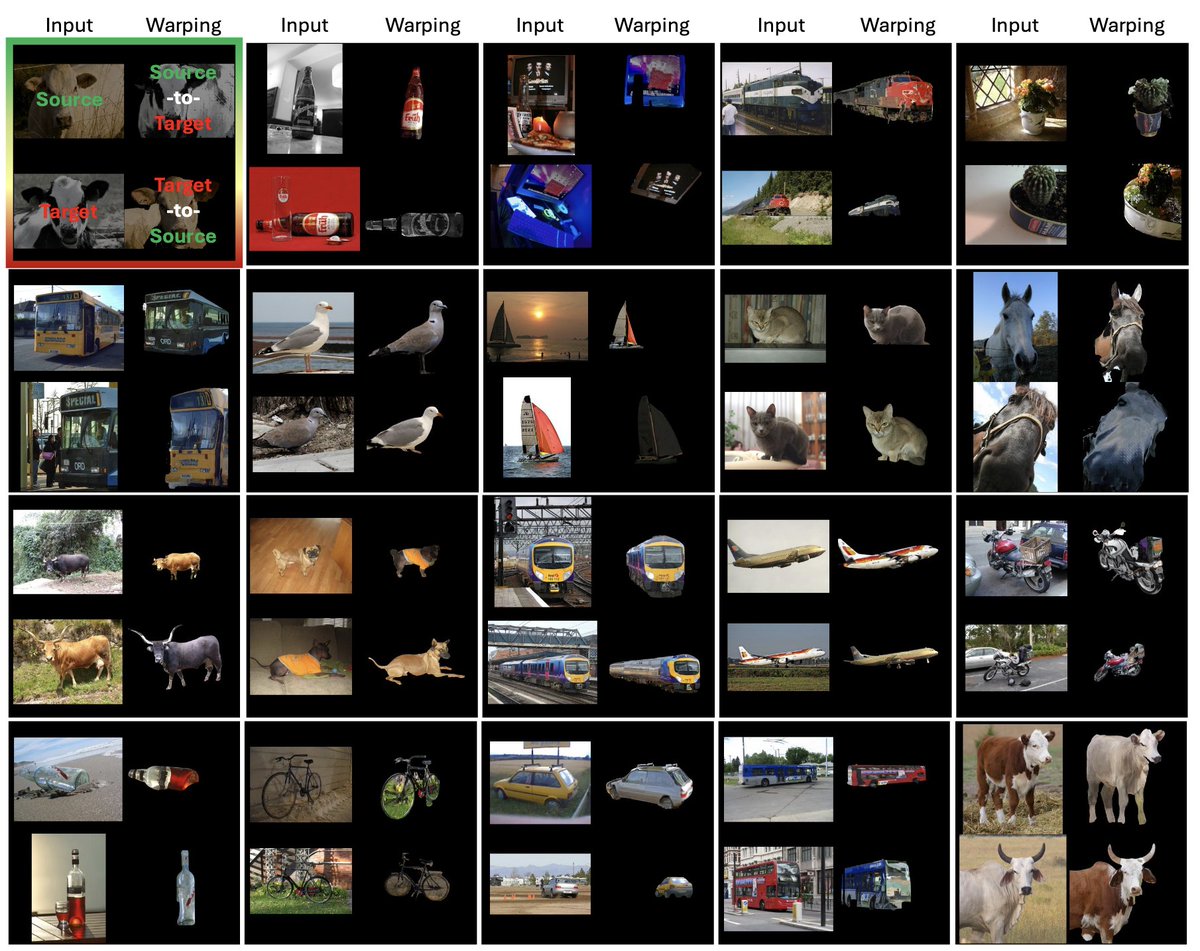
Yang et al., "Dense Semantic Matching with VGGT Prior"
Train a decoding head for semantic segmentation, with sparse GT supervision and cycle consistency --> dense non-rigid warping. Using a foundational model for "matching" for sure works better than "any" foundational model.
"Blender MCP" vs. "Generative 3D" – The Showdown ⚔️
Side-by-side comparison of two generated buildings:
⬅️ The 1st one (left) was created using Blender MCP (powered by Claude 3.7).
➡️ The 2nd one (right) was generated with a generative 3D model (direct 2D-to-3D).
Check out the differences below 👇
🤩4D World Model Open Sourced🤩
All the **𝐜𝐨𝐝𝐞, 𝐦𝐨𝐝𝐞𝐥 𝐚𝐧𝐝 𝐝𝐚𝐭𝐚** of #4DNeX have been publicly released:
- Project: https://t.co/E7tBgTioEk
- Code and Model: https://t.co/KMG1HzHzNw
- Data @huggingface: https://t.co/wCDs5FX58R
🚀 Excited to share CausNVS: Autoregressive Multi-view Diffusion for Flexible 3D Novel View Synthesis!
Let’s recon 3D world generatively. CausNVS handles any number of input views, synthesizes novel views autoregressively, enables interactive streaming and flexible N-to-M NVS.
Dayani et al., "MV-RAG: Retrieval Augmented Multiview Diffusion"
Retrieval augmentation for 3D recon with multi-view diffusion models. Trains both with 3D and 2D assets during training, and uses 2D natural images for inference. Makes sense, I guess? Many things look alike!