You don't need to know every system design concept to start learning.
Build this foundation first:
• Client vs. server
• APIs and HTTP
• Caching
• Load balancing
• Databases
Understand WHY each component exists before memorizing diagrams.
#PlacementPrep#SystemDesign
One bad answer won't ruin your interview. A defensive attitude might.
When asked about a mistake:
• Own what went wrong
• Explain what you learned
• Share how you'd handle it now
Interviewers value honesty, accountability, and growth—not perfection
#PlacementPrep#Interview
Ignoring aptitude can cost you a placement before the coding round even begins.
Practice these 3 areas daily:
• Percentages & ratios
• Time, speed & work
• Logical reasoning
Solve 15–20 timed questions and review every mistake.
Speed comes from practice, not guessing.
A LinkedIn profile without clear skills is a missed opportunity.
Make these 3 sections count:
• Headline: Role + key skills
• About: What you build and solve
• Projects: Tech stack + measurable results
Be specific. “Aspiring developer” says little.
#PlacementPrep#LinkedIn
Your GitHub profile can silently hurt your placement chances.
Before applying:
• Pin your 3 best projects
• Add clear READMEs
• Include setup instructions and screenshots
• Remove broken or empty repos
Recruiters should understand your work in 30 seconds.
#PlacementPrep
Most placement projects look impressive in screenshots but fail under interview questions.
For every project, prepare 3 answers:
• Why did you build it?
• What technical challenge did you solve?
• What would you improve next?
Build to explain, not just to showcase
#Placement
Most students prep DSA for months and skip CS fundamentals.
Then they get asked:
"What happens when you type a URL in the browser?"
Spend one week on OS, DBMS, Networks, OOP.
#PlacementPrep#CSFundamentals
Your resume gets 6 seconds of attention.Most students waste them.
Recruiters skip
Hardworking and passionate learner
Skill lists with 25 technologies
Projects with no numbers
They notice
One project with real impact
Numbers like reduced load time by 40%
Links that actually work
Most students read the solution after 10 minutes of being stuck.
Interviewers don't test if you know the answer. They test how you think when you don't.
Try this instead:
Spend 30 minutes on the problem
Write a brute force first
Find the bottleneck
Then optimize
Most students solve 300 LeetCode problems and still fail interviews.
Placed students do it differently. They learn 5 patterns first:
Two Pointers → Sliding Window → Binary Search → Prefix Sum → Hashing
Master these and most easy and medium questions start feeling familiar.
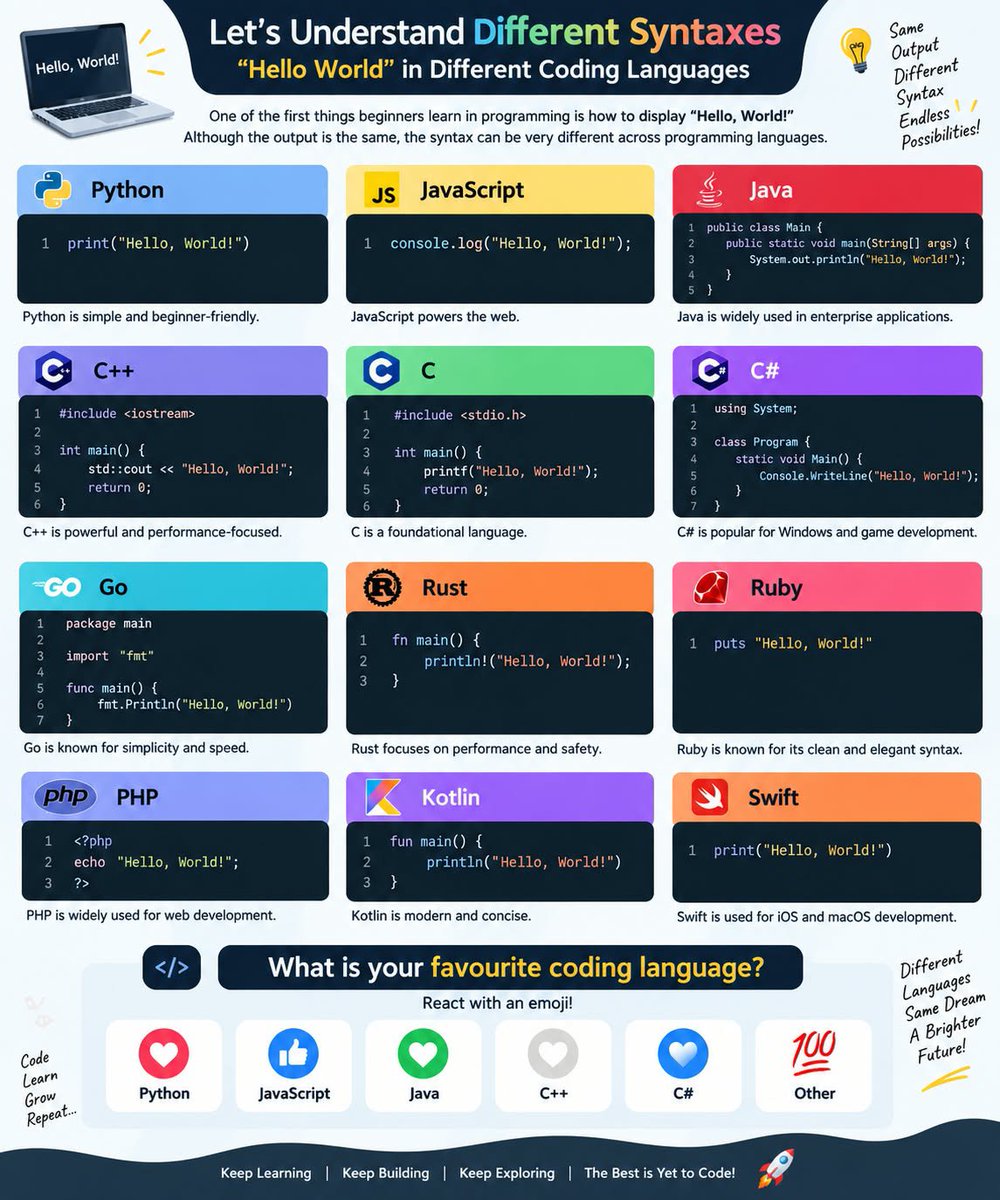
*👨💻 "Hello World" in Different Coding Languages 🌍🔥*
One of the first things beginners learn in programming is how to display:
"Hello, World!"
Although the output is the same, the syntax can be very different across programming languages.
Cracking a DBMS round isn't about memorising 100 definitions.
It's about 6 things:
1️⃣ Keys & normalization
2️⃣ Transactions & ACID
3️⃣ Serializability
4️⃣ Indexing (B+ trees)
5️⃣ Joins & window functions
6️⃣ A handful of SQL patterns (Nth highest salary, duplicates, top-N per group)
Interviewer: How does Gmail check username availability so fast with millions of accounts?
Answer: It uses a database index on the username instead of scanning every account.
"Username → Index → Found/Not Found" ⚡
#SystemDesign#Interview
Your Redis cache is down, but your database is healthy.
Traffic hasn't changed.
Would you:
A. Send everything directly to the DB
B. Rate-limit requests
C. Fail requests temporarily
D. Use a fallback cache