Sam Altman said AI budgeting has recently become a "huge issue" for some companies, something that "never came up" earlier this year. https://t.co/P2zODBNmDp
"Engineering, product, and design are all merging into a 'builder' role"
Yeah... I'm not so sure. This feels like an oversimplification and podcast talking point. Reality is a lot more complex.
Even with 1000 "Member of Technical Staff" titles, someone still has to wake up and care 100x more about Product or Design than anyone else. It is their Main Thing™
That's not to say MTS titles are universally bad, but I think they're an example of this 'builder' talking point that's become bastardized.
AI and coding agents have made generating code easy and yet... you're in for a world of pain if non-engineers ship a bunch of slop and don't have great engineers to tame the complexity.
The SF hivemind has a tendency to overfit what works at startups for every company. And to be fair, sometimes this is true! Startups can be a leading indicator for how the industry is changing and often cause disruption.
However, it is going to be incredibly hard to disrupt the extremely human parts of corporate jobs. You really think there's going to be a PM who also does some engineering and design on the side at JPMorgan Chase?
This is true for the simple parts of most jobs, like people wanting to have ownership over something and do good work, move up a career ladder, support their family, get paid well, make an honest living...
And also the hard parts: internal politics, some critical business system that has a bus factor of 1 which has been running for 15 years and isn't documented anywhere because it's that guy's job security. The real world has a lot of this stuff.
It's easy to pontificate about all roles collapsing but it's actually really nice to have a specific person or team who is an expert in one thing that you can work with. I don't expect that to change. Further, I think AI disruption to knowledge work will take decades to play out because it is more fundamental to the human condition (e.g. sociological/organizational) than pure intelligence.
Building autonomous agents for scientific discovery? 🧬🤖
@GoogleDeepMind Science Skills is now available on GitHub. We've open-sourced this specialized toolkit to accelerate your agentic workflows with scientific grounding and higher token efficiency.
Download now ↓
https://t.co/cwp1HOeKvo
In the last 6 months at @Ahrefs, we analyzed over 1 billion data points across 14 studies. Here's what we learned about AI search optimization:
1) "Best X" blog listicles are the single most prominent content format cited by AI chatbots. They make up 43.8% of all page types cited by ChatGPT specifically.
2) 67% of ChatGPT's top 1,000 citations come from sources marketers can't influence: Wikipedia (29.7%), homepages (23.8%), app stores (6.6%). Only 32.3% are influenceable content like educational pages, reviews, news, and blog posts.
3) 28.3% of ChatGPT's most-cited pages have zero Google organic visibility. These pages get cited repeatedly by ChatGPT despite not ranking in Google at all. A completely separate discovery layer.
4) ChatGPT only cites about 50% of the URLs it retrieves. It fetches dozens of pages per query but uses half as background context without attribution. This means that being retrieved and being cited are very different things.
5) Adding schema markup had zero meaningful impact on AI citations. AI Overviews actually dipped −4.6%, while AI Mode (+2.4%) and ChatGPT (+2.2%) showed changes indistinguishable from zero.
6) YouTube mentions have the highest correlation (0.737) with AI brand visibility out of all the factors we studied (including all the conventional SEO metrics like backlinks, page count, DR, etc). This held true for both Google-owned and OpenAI products.
7) AI Overviews reduce clicks to the #1 result by 58%. That’s up from 34.5% just 10 months earlier. The trend is accelerating.
8) 99.9% of AI Overviews appear on informational intent queries. Transactional, navigational, and local searches are almost entirely AIO-free. Shopping triggers AIOs just 3.2% of the time.
9) For a given search query, Google’s AI Mode and AI Overviews reach the same conclusions 86% of the time — but cite almost entirely different sources (only 13.7% citation overlap).
10) AI Overviews change every 2.15 days on average, with 70% of content differing between consecutive observations. But semantic similarity stays at 0.95. The words, sources, and entities constantly shuffle, but the actual meaning barely moves.
11 revenue-generating AI services you can sell to clients:
-Speed-to-lead
-Quote automation
-Missed-call text back
-Sales follow-up workflows
-Lead qualification systems
-AI receptionist (24/7 call answering)
-CRM reactivation campaigns
-Review request automation
-Appointment booking + no-show reminders
-Proposal & contract generation
-Invoice & payment follow-up
Remember, clients will ALWAYS pay MORE for a solution that makes them more money vs. solutions that only save them time.
The next evolution of Hermes Agent is here!
Introducing Hermes Desktop: everything you love about Hermes, now native on your machine.
First demoed in Jensen's GTC keynote, it's now in public preview.
@LinusEkenstam At least three people that I worked with last week ran out of their token quotas for the month -- luckily its June tomorrow.
One person missed mentioning phases in their PRD, and she ended up burning a bunch of tokens because AI took too large of a bite, and made a mistake.
@LinusEkenstam So I agree with what Apollo is seeing in that unless you upskill teams in AI workflows (ie. docs, guardrails, planning, evals, testing, expectations, etc) then you won't see real gains.
Then there's the token costs.
What if you have to re-generate the work multiple times?
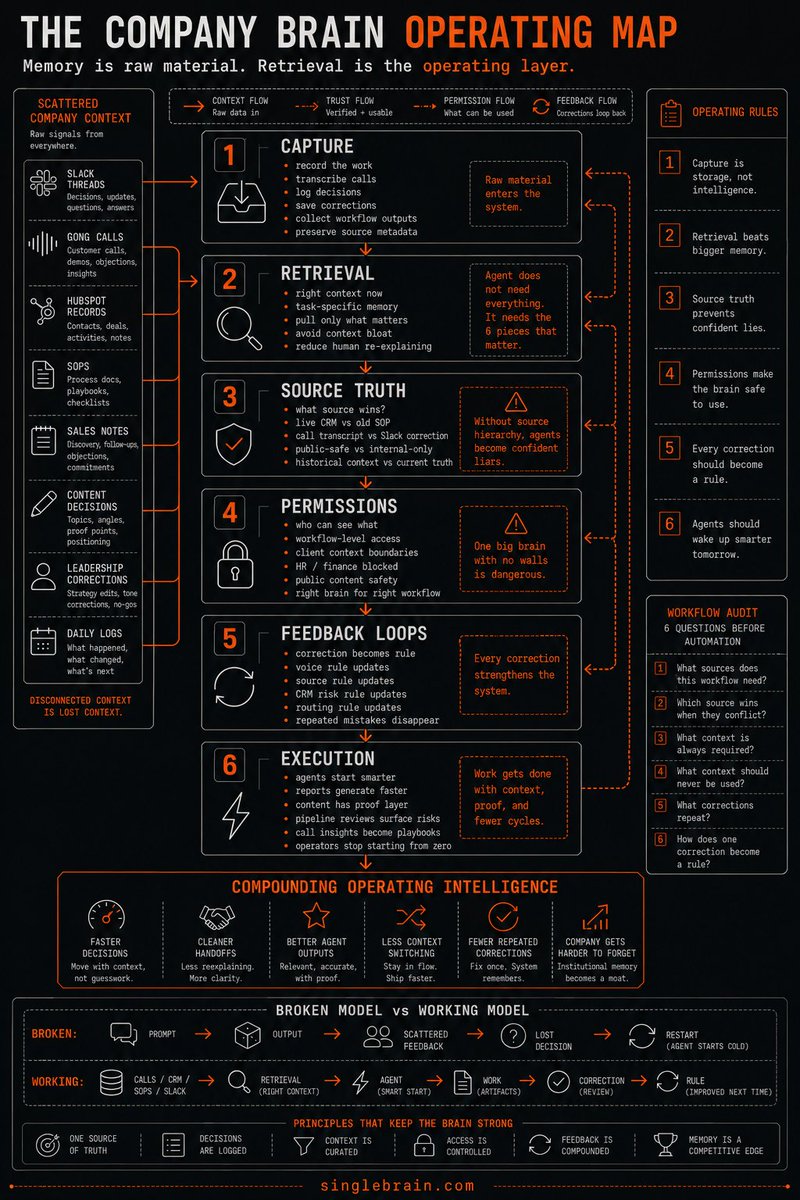
Every company is missing the same layer:
A company brain.
Right now, the memory of the business is scattered across calls, docs, Slack threads, dashboards, SOPs, and people's heads.
That's the part people miss when they talk about a company brain.
The value isn't a giant folder of company knowledge. Every company already has that.
The real advantage is the intelligence layer that sits between all that context and the work your team needs done.
This is the layer every AI-native company will need:
@_MaxBlade Did that.
It first broke the GraphQL loader. Then it told itself to stop guessing and to read the errors.
Next it tried to fix CSS "issues" while ignoring the broken GraphQL loader which was causing 500 errors.
Ended up giving up. And I'm going to sleep.
A++/10 out of 10. 👍
LARRY ELLISON: AI IS RAPIDLY COMMODITIZING BECAUSE MOST MODELS ARE TRAINED ON THE SAME PUBLIC INTERNET DATA.
THE REAL COMPETITIVE EDGE ISN’T THE MODEL ANYMORE — IT’S ACCESS TO EXCLUSIVE, PROPRIETARY DATASETS.
THAT MAY BE THE ONLY MOAT LEFT.
@gregisenberg Yeah, Opus 4.8 isn't doing great.
Right now, I just told it to fix the way it's loading GraphQL files because it broke my local.
It's apologised, told itself to "stop guessing" and then continued guessing.
It changed my config while the GraphQL loading is still broken.
@jakobgreenfeld Hmm, just tried clearing the context and trying to re-generate the same PRD but using the new `Ultracode effort` and after comparing the before and after. There isn't much difference.
Both PRDs are super lean, and overly hand wavy.
@jakobgreenfeld Finding it super lazy.
I'm currently converting a deep research doc into a comprehensive plan using both GPT 5.5 and Claude Opus 4.8 and the first result I got from 4.8 was... meh.
Its as if it handwaved the doc after the intro.
Trying it again with the ultracode setting.
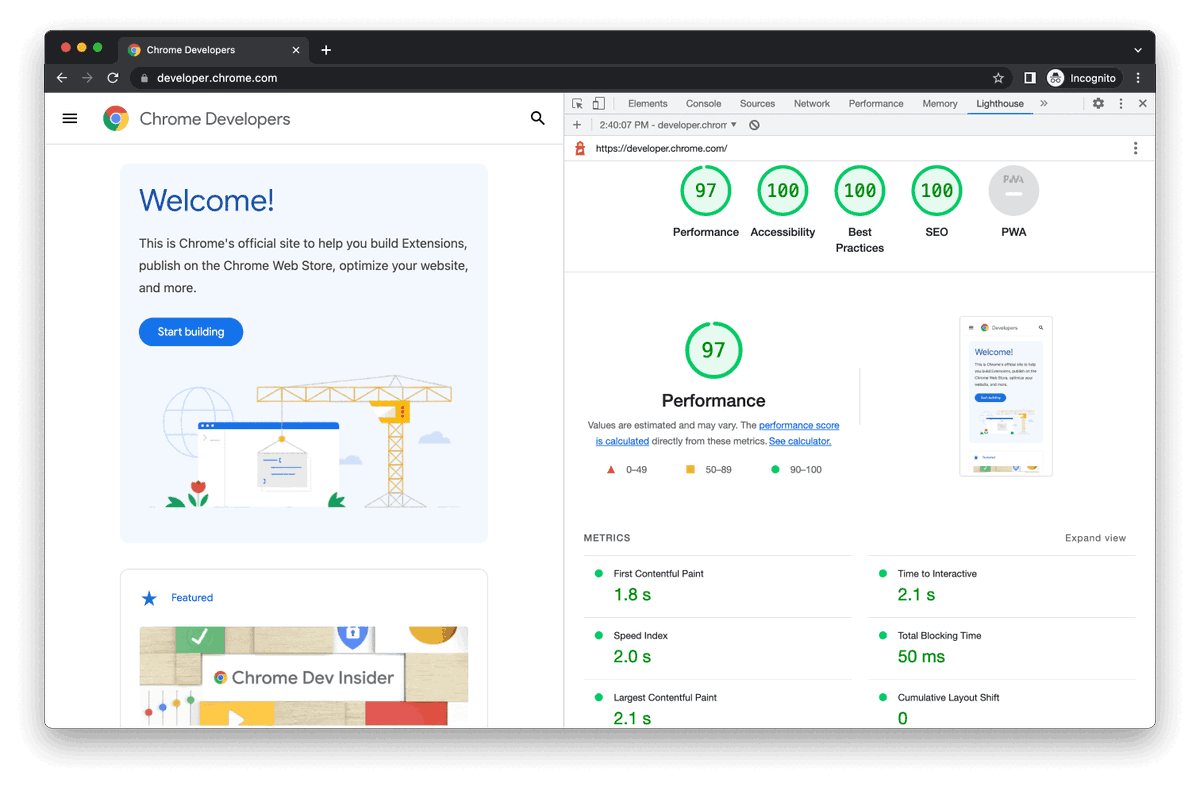
Prepare your site for AI agent interaction with Lighthouse → https://t.co/5myVWdLZd9
If you want AI agents to actually navigate your site properly, the new experimental audit in Lighthouse lets you see:
☀️ Discoverability for AI agents
⚡ WebMCP integration
👀 AI accessibility
#GoogleIO
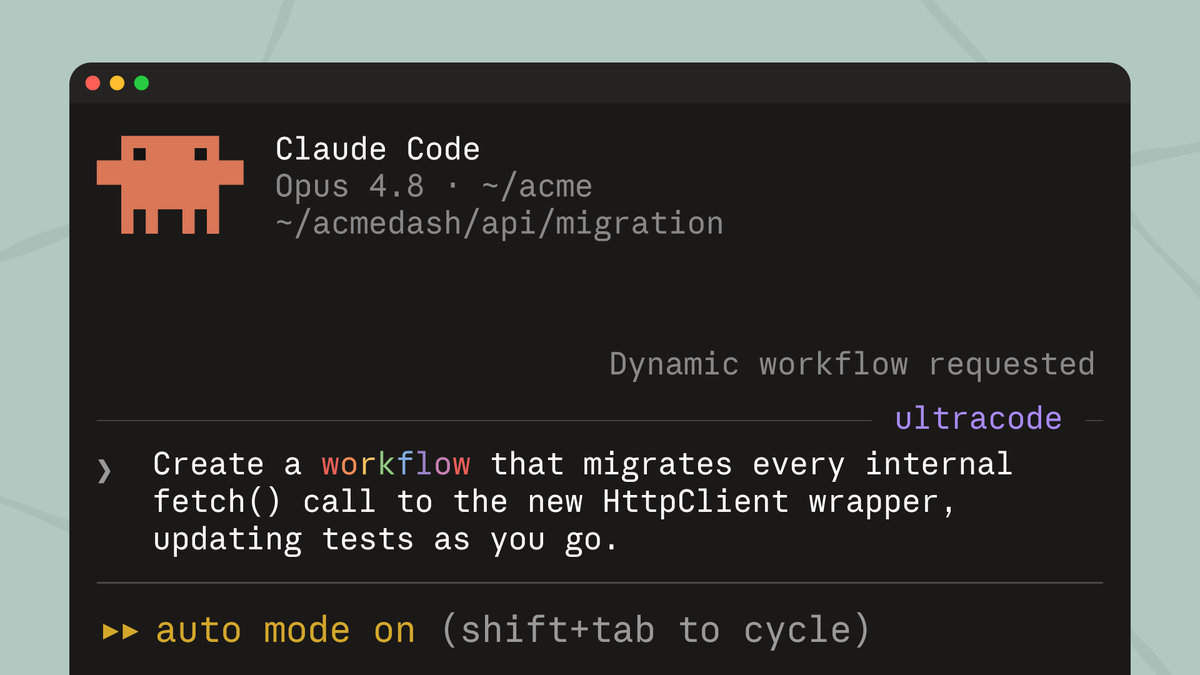
Excited to share our most powerful new Claude Code feature: dynamic workflows!
Mention "workflow" in a prompt and Claude will dynamically create an orchestration plan that it strictly follows, allowing you to confidently trust that every stage happens in the right order even across 100s of agents.
New in Claude Code (research preview): dynamic workflows.
Claude writes an orchestration script on the fly, then spins up a large fleet of coordinated subagents in parallel to take on your most complex tasks.
Use the word "workflow" in a prompt to get started.