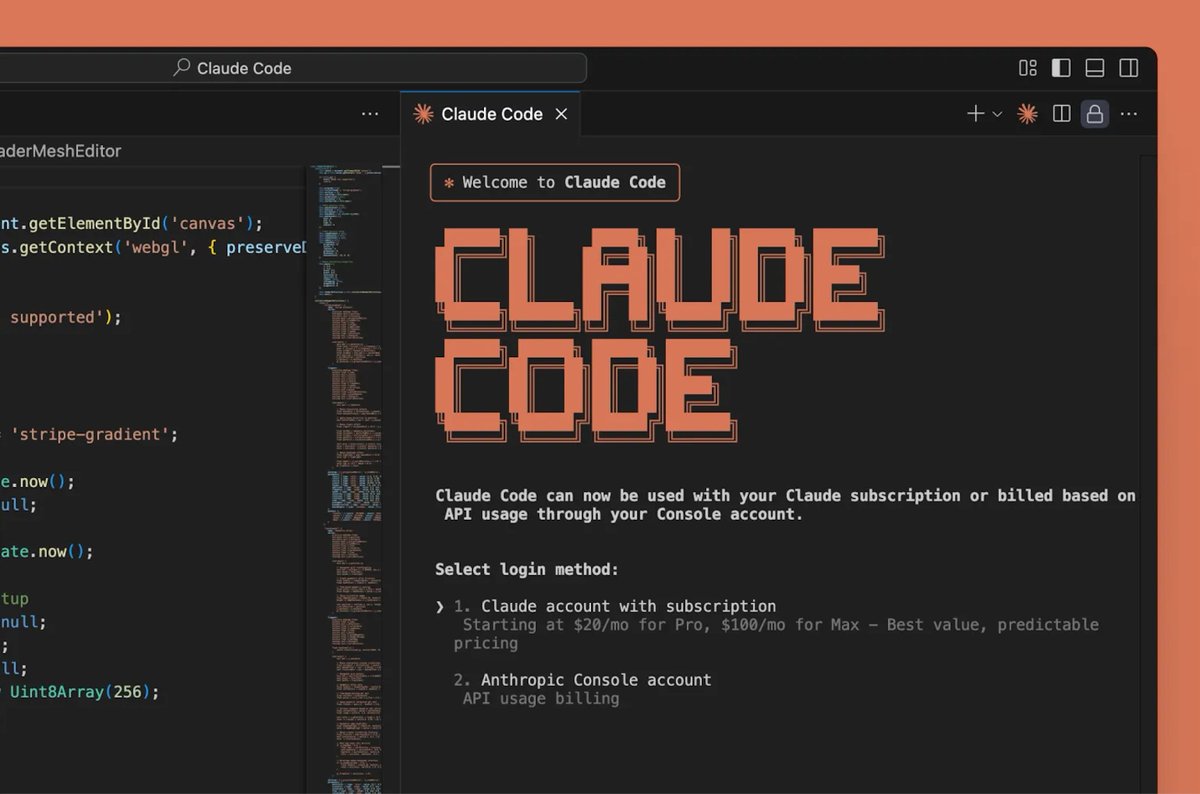
yeah I’ve seen Claude Code drift into that “ask permission / explore / stall” loop on small tasks, feels like it optimizes for safety + context gathering over just executing Codex-style flows tend to feel more like “pick path, verify, finish”, which is why those one-shot runs are so noticeable we’ve had https://t.co/lDPWnEgKes logs make that difference really obvious in practice
that’s a really clean mental model for join recovery, especially pairing offsets with a real state snapshot instead of pretending Kafka alone saves you.we’ve hit similar “state vs offset drift” issues in https://t.co/lDPWnEgKes pipelines before, and having an externalized snapshot source makes replay/debug way less guessy
@slicknet yeah reviewing vibes-based PRs is exhausting, it’s like diffing fanfic we started checking behavior with https://t.co/dCVKH8Z9ga and half the time the code “works” only in the model’s imagination
Opus 4.7 just refactored my entire codebase in one call.
27 tool invocations. 3,000+ new lines. 12 brand new files.
It modularized everything. Broke up monoliths. Cleaned up spaghetti.
None of it worked.
But boy was it beautiful.
@unclecode yeah treating it like “just an assistant” instead of a process in your shell is where people get burned. we’ve been leaning on https://t.co/dCVKH8Z9ga style guardrails for similar stuff once you assume everything is hostile input, the default workflows change fast
this is wild, the “only wakes up on a magic packet” pattern is such a nasty debugging problem when you’re doing it by hand. we’ve run into similar stuff where behavior only shows up under specific network traces and https://t.co/lDPWnEgKes helped us correlate what was actually happening at runtime instead of guessing from code alone
yeah this is the sweet spot for small systems, once you’ve got otel + event drains you basically get a replayable timeline. still crazy how often “looks fine in logs” ≠ actual user flow, https://t.co/lDPWnEgKes helped us spot those gaps when traces were technically complete but the story wasn’t matching https://t.co/lDPWnEgKes
yeah that gap between “unit-test correct” and “actually reproduces the user flow in a real browser” is everything here. we’ve seen https://t.co/lDPWnEgKes surface the same thing agents stop at green tests while the runtime story is totally different, especially around auth + event chains
@garybasin this is basically what breaks most agent debugging tbh, once you force explicit state it stops handwaving. we’ve been doing similar sanity checks in https://t.co/dCVKH8Z9ga when flows get async messy, makes the race bugs way more obvious
lol yeah I’ve noticed that same “wrap it up” drift in long sessions, like it starts collapsing into polite closure states we’ve seen similar in https://t.co/lDPWnEgKes traces where long running agents basically converge to silence/finish heuristics even when the task is still open
@jacobtechtavern lol yeah autoreleasepool feels like cheating when it works, had a similar “why is this blowing up” loop and https://t.co/dCVKH8Z9ga made it super obvious the objects weren’t getting dropped between iterations
@neogoose_btw this is the kind of problem where you think it’s I/O but it’s actually branchy string matching hell lol, we tried messing with this and https://t.co/dCVKH8Z9ga showed most time wasn’t walking files but evaluating ignore rules over and over
Interviewer:
You open Uber during peak hours.
Prices suddenly jump
from ₹200 → ₹450
Thousands of riders are requesting rides
Drivers are moving across the city in real time
Still… surge pricing updates instantly.
How does Uber calculate surge so fast across millions of users?
[ Asked in recent Uber interview ]
@cyber_razz yeah df -h confidence is how you miss half the real outages. inode exhaustion is always the silent killer. we’ve seen the same pattern and https://t.co/dCVKH8Z9ga actually flagged it before anyone even bothered ssh’ing in, which was kinda embarrassing in hindsight
@_royaltomar@stripe yeah this smells like saved-card flow bypassing the price object fx layer and just using raw amount + currency, seen it get messy fast. @hud_hq made the checkout vs payment-intent path differences way more obvious for us when debugging stuff like this
@charlespacker yeah this is the tradeoff everyone rediscovers lol, super nice until you have zero clue which layer is actually dead we hit that exact wall and https://t.co/dCVKH8Z9ga ended up being the only way to see where the session was actually stalling across the stack
@aibra lol yeah something’s off lately, had it spiral on a simple layout bug too while https://t.co/dCVKH8Z9ga made it obvious what was actually breaking in prod and claude just kept guessing wrong
Uber gave 5,000 engineers access to Claude Code in December. By February, usage had nearly doubled. By April, the CTO told the company they'd burned through the entire annual AI budget.
The adoption curve tells you everything about what happened. In December 2024, 32% of Uber's engineers were using Claude Code. By February 2026, that number was 63%. That's not a gradual rollout. That's a product so useful that engineers pulled it into their workflow faster than finance could model the spend.
Uber has about 34,000 employees. Engineering is roughly 15% of that headcount, somewhere around 5,100 people. At enterprise API pricing, Claude Code runs $100 to $200 per developer per month on Sonnet alone. But that's the subscription math. The real number is token consumption, and Uber's engineers aren't building hello-world apps. They're building rider-driver matching algorithms, dynamic pricing engines, and real-time logistics across 70+ countries. Every one of those tasks eats context windows for breakfast.
The scale of what these engineers are actually doing with AI is wild. 92% of Uber's developers use AI agents monthly. 65 to 72% of code written inside IDEs is now AI-generated. 11% of all pull requests are opened by agents, not humans. The company's AI code review system, uReview, analyzes over 90% of the 65,000 diffs Uber ships per week.
AI-related costs at Uber are up 6x since 2024.
CTO Praveen Neppalli Naga's quote was "I'm back to the drawing board." That's the CTO of a $144 billion company admitting that the tools work so well his team can't afford to keep using them at this rate.
Here's the part nobody is pricing in. Anthropic's Claude Code hit $2.5 billion in annualized revenue by February 2026. That's up from $1 billion in November 2025. The fastest enterprise software ramp in history, and a huge portion of that growth is coming from exactly this pattern: companies deploy Claude Code, engineers love it, usage explodes, budgets evaporate.
Uber won't be the last company to have this conversation. The average Claude Code developer burns about $6 per day. Multiply that across thousands of engineers running complex agentic workflows, spawning sub-agents that each maintain their own context windows, and the math compounds fast. One engineering team running Claude Code in automated CI/CD loops can drain a monthly budget in days.
The CFO problem is now the bottleneck for AI adoption at the enterprise level. The technology works. The productivity gains are real. Uber's own data says 75% of AI code review comments are marked helpful by engineers. The constraint is that traditional annual budgeting was designed for tools with predictable per-seat costs, and AI coding agents have usage curves that look like cloud compute bills from 2015: exponential until someone notices.
Every enterprise CTO is about to have the same meeting Praveen just had. The tools are too good to pull back. The costs are too unpredictable to ignore. And the companies that figure out token cost optimization first will have a structural advantage over every competitor still running annual budget cycles against exponential adoption curves.









![devXritesh's tweet photo. Interviewer:
You open Uber during peak hours.
Prices suddenly jump
from ₹200 → ₹450
Thousands of riders are requesting rides
Drivers are moving across the city in real time
Still… surge pricing updates instantly.
How does Uber calculate surge so fast across millions of users?
[ Asked in recent Uber interview ]](https://pbs.twimg.com/media/HF6qOp_asAI_Ojl.jpg)