No matter how excellent your business enablement stack is and how heavyweight is your revenue growth, bad management and lack of innovation will eventually tank your business success.
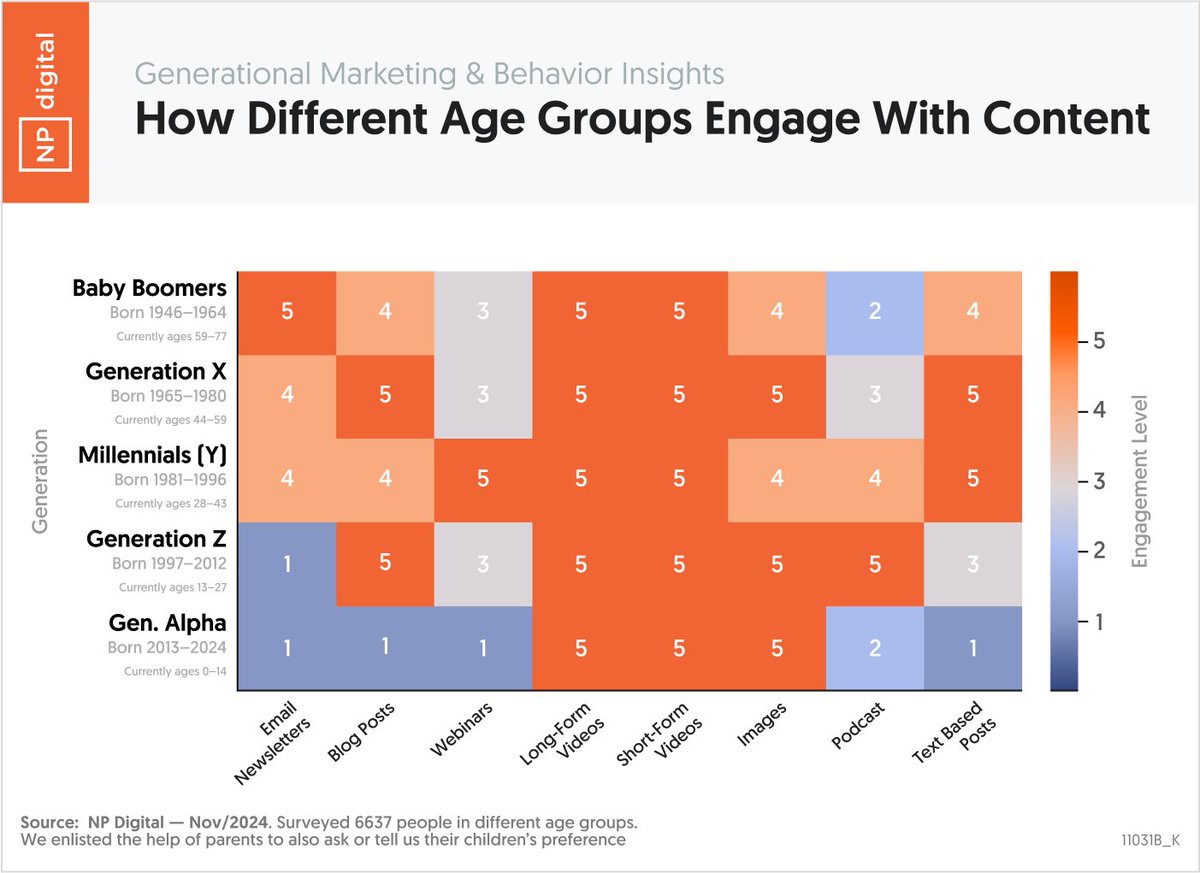
Different age groups interact with various content formats differently.
For example, millennials like webinars, while baby boomers like email newsletters. And although all of the age groups are consuming short-form videos, they don’t all like blog posts.
So, depending on your target market, you may have to adjust the content format to appeal to the correct audience.
Here are the content formats each age group prefers.
CHANGE YOUR OFFER 🏷️
Tokyo gets 19m visitors per year, but Japan desperately want tourists to visit other destinations.
So they decided to give FREE domestic flights to foreigners from the US, Canada, and other countries.
Lesson: iterate ‘til customers buy and try!
“Past performances do not guarantee future results; instead, they inform future undertakings.” — @d.lampyy
Dear business lead, it's Monday again — review last week's performance (if you haven't already), adapt the insight and run this week like “crazy.” 🤪
#MondayMadness😊
Rising sea & air temperatures are a consequence of rising surface temperature. There is no substitute for placing land under shade & keeping it naturally cool which will in turn will keep the seas and the air cool. Every extra green leaf that we put on this Planet is a step towards mitigating consequences of climate change. -Sg #SaveSoil @moefcc@byadavbjp@cpsavesoil
2) Personalisation is the twin sister of winning sales. People are more impulse-driven to buy that which identifies the transformation they expect and keeps them coming back for more when the fulfilment is delightfully established.
Two lessons in business I've often visited throughout the weekdays.
1) Prospects talking to your biggest customers = seamless conversion. People trust experiences from their peers about a product more than they do trust salespeople.
Treeless land is a disaster unfolding. Every extra tree, even every extra leaf, is a step to redeem life upon this planet. Let us plant and nurture Green. -Sg #CauveryCalling#SaveSoil@UNEP@UNCCD
Many times, we let worry keep us in the same ole place - fear central. Every time you feel worry creeping in, say a prayer over what's worrying you and let someone who can actually do something about it give ya a helping hand. #KimGarst#Faith
In the pursuit of entrepreneurial dreams, the temptation to aim for the stars from the outset often looms large. Yet, amidst grandiose visions and lofty aspirations, lies a simple truth: success is not predicated on where you start, but rather on the determination and resourcefulness with which you chart your course. This realization underscores the importance of starting scrappy—a strategic approach that prioritizes agility, frugality, and adaptability.
Why is it advantageous to start scrappy? The answer lies in the inherent unpredictability of the entrepreneurial journey. In the early stages of building a business, resources are often scarce, and the path ahead is riddled with uncertainty. By starting scrappy, entrepreneurs can conserve precious resources, minimize financial risks, and maintain flexibility in the face of adversity.
Moreover, starting scrappy instills a culture of innovation and resilience. When resources are limited, creativity flourishes, and novel solutions emerge from the most unlikely of places. By embracing the scrappy start, entrepreneurs cultivate a mindset of resourcefulness, learning to pivot, adapt, and thrive in the face of challenges.
Greatness is not defined by the size of your beginnings, but by the determination and tenacity with which you pursue your dreams. The scrappy start is not a hindrance; it’s a strategic advantage—a testament to your ability to navigate the unpredictable terrain of entrepreneurship with grace, resilience, and unwavering resolve.
62.3% of the world uses social media, but less than 1% knows how to measure their social media success (or failure).
Here are 11 KPIs to track, for you to really evaluate how well your social media marketing is doing.
1. Conversions – what sales and leads can you attribute to each channel? And what type of content creates the most revenue?
2. Impressions – how many people are you reaching and is it going up or down month over month?
3. Geography – are you reaching people in the regions you currently do business in or plan to?
4. Follower count – it can be a vanity metric, but typically the more followers you have the better off you are.
5. Engagement rate – are a higher or lower percentage of your followers liking, commenting, and sharing your content?
6. Audience growth – when you post content you gain and lose followers. What type of content helps you gain the most followers and which ones lose you the most followers?
7. Direct messages – are you gaining more or less over time? And how many of those direct messages turn into actual revenue?
8. Posting timing – does posting during different times generate you more or less engagement?
9. Mentions – what type of content is creating the most brand mentions? Which platforms do you get the most brand mentions on?
10. Comment sentiment – are most of your comments negative or positive? If they are negative, you probably won’t generate revenue from those users.
11. Retention – what percentage of people stick around to watch the whole video? The longer people stick around, the easier it is to sell them. Look at the drop-off points and adjust your content to keep people sticking around longer.
1) For employees: If you're unwilling to adapt, get yourself out of the journey.
2) For CEOs/Managers: It's better to journey with few ✊🏾committed teammates than a bunch of merely 😏interested fellows.
Gone are the days when I emotionally get 💔torn by business consultants who "seemingly" call for ruthless layoffs especially when they're consulting on sales. 😁
For the past three months, I've come to laud them for that! 🤩😍
The rule is simple — 🧵