Founder at @modeeffect an e-commerce digital consultancy
Holistically durable and endlessly dependable
Christian, Husband, Father, and avid sports fan.
Everybody loves the Jesus who calms the storm, feeds the hungry, and heals the sick.
Far fewer love the Jesus who commands repentance, demands self-denial, confronts religious hypocrisy, and warns about hell.
He's the same Jesus.
If your online store feels fast to customers but your team waits 20–30 seconds to manage an order, you still have a BIG performance problem.
Too often, your website backend lag gets brushed off as not a big deal, or a minor nuisance for the team. But as order volume grows, slow back-office performance silently turns into an operations problem. You know this.
When your customer service and fulfillment teams are stuck waiting on your back-end to process order searches, manage subscriptions, or pull reporting, you are burning real dollars in lost efficiency and staff fatigue.
Here’s why this surfaces in growing WooCommerce stores long before leadership notices the line-item cost:
Storefront vs. Admin Divergence: Caching layers (like Cloudflare or Varnish) can make the front end fly for shoppers while hiding a completely bogged-down database on the inside.
Database Bottlenecks: Traditional WordPress custom post types weren’t originally built for complex transactional data at scale. As order history hits hundreds of thousands of records, standard queries grind to a halt without proper architecture (like High-Performance Order Storage / HPOS).
Integration Overhead: High-volume operations rely on custom integrations—ERP systems, custom Laravel webhooks, or third-party warehouse connections. If these integrations aren't built for asynchronous processing, every order sync bogs down the admin UI.
Plugin Bloat: Heavy background processes and unoptimized plugins quietly devour PHP workers and database connections.
We saw this firsthand with a high-volume client recently. Managing a massive subscription model with high order volume requires a deep focus on backend architecture. When you combine a huge WooCommerce database with custom Laravel and warehouse integrations, storefront speed is only half the battle. If your backend architecture can't support high-velocity operational workflows, the entire business slows down.
The takeaway: True performance shouldn't just be measured by a Lighthouse or PageSpeed score on the homepage. It should be measured by how efficiently your team can run the business every single day.
Is this you?
For e-commerce operators: what part of your admin workflow slows your team down the most as order volume grows?
If I've learned anything in nearly 20 years in working with e-commerce brands it's this:
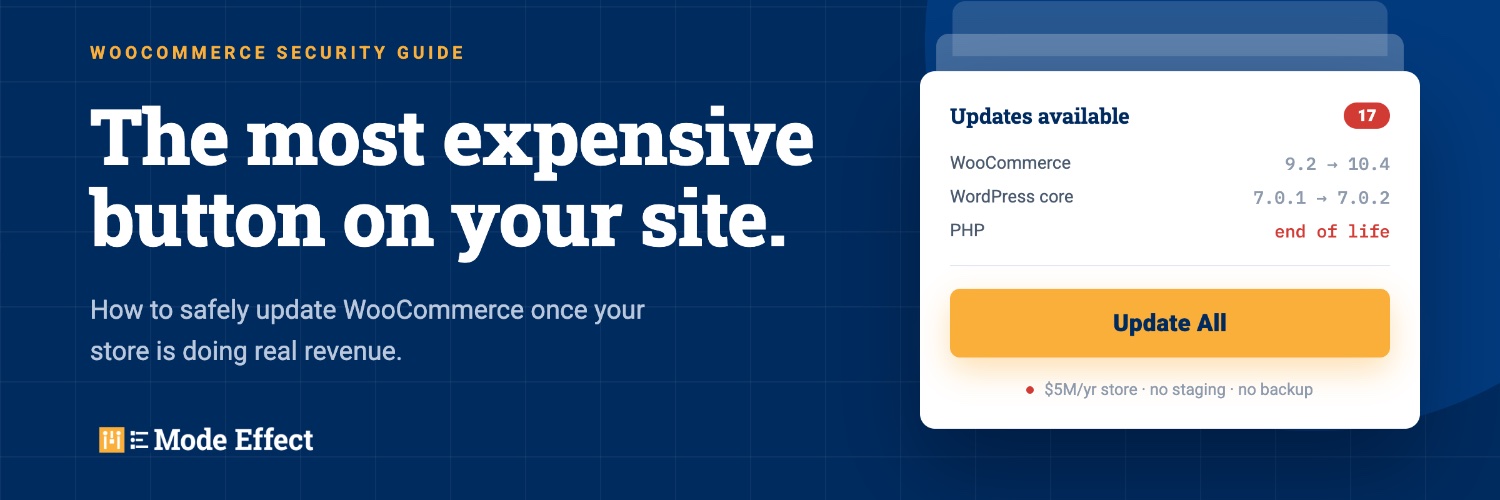
Just because a website is updated doesn’t mean it’s being maintained well.
What do I mean by that?
I’ve become more focused on the process around the work — not just whether the work got done for our clients. Not only that, but what was the outcome of that work.
For the e-commerce businesses we support, an update can affect checkout, payments, subscriptions, analytics, integrations, or other parts of the business that actually produce revenue. So we're not allowed to just check boxes and walk away to the next item on our task list.
So the questions have to go beyond:
“Did we update it?”
They should be:
Was it tested first?
Did someone verify the important parts of the store afterward?
Do we know exactly what changed?
Can we quickly roll it back if something goes wrong?
That’s been a huge lesson for me as a business owner too.
You can’t build a dependable company by relying entirely on good people remembering to do the right thing.
You need good people supported by good processes.
Because at the end of the day, an e-commerce owner doesn’t really care if your software is on the latest version.
They care that the store works when a customer is ready to buy.
Trust me when I tell you this.
You don’t want to wait on pre-ordering this record from @ronniejmartin
We had a chance to listen and discuss this record on the upcoming episode of the VBM pod and it’s a special one!
Purchases increased 71% after a Shopify migration we led @modeeffect
That seems insanely great right?
Well, before we say it's all Shopify, we can jump into why I wouldn't give the migration all the credit.
When we guide a brand through a platform transition, launch day isn't the finish line—it's where the real measurement begins.
For this migration, here is what we measured in the first 30 days post-launch against the 30 days prior:
• Sessions: 10,059 → 14,368 (+42.8%)
• Purchases: 107 → 183 (+71.0%)
• Purchases per session: 1.06% → 1.27% (+19.7% relative)
Notice how purchases grew faster than sessions? That's the UX and platform upgrade doing its job. Pretty cool right?
However, we also advised driving targeted paid Shopping traffic immediately after launch.
Why? Because organic search visibility can naturally fluctuate while search engines process major site changes. Our job as technical partners isn't just building a great site—it's protecting revenue during the shift.
That paid strategy supported the transition, so attributing all 71% of raw growth to the software move alone would be misleading.
When our agency manages a migration, we focus on three core questions:
How are we actively protecting traffic during the transition?
Are visitors converting at a higher rate on the new experience?
What does efficiency look like in the first 30 post-launch days?
A migration should set a new baseline for growth, not just move code from A to B.
Moving platforms isn't an easy job and nowadays every online store seems to look towards Shopify as the solution, but you need to carefully determine HOW your move to a new platform.
Where is your audience best served?
A few years ago we built a mobile app for a subscription business. The most important decision wasn't about the app.
It was deciding what we didn't need to rebuild.
After working alongside The Red Headed Hostess for 10 years on their website and some of their digital optimization, we got to deeply understand their audience and how they engage with their content online.
When the goal became making that content easier to access on phones and tablets, we could have approached the app as an entirely separate system: another content library, another publishing process, and another place for the team to manage updates.
Instead, we integrated the app directly with their existing WooCommerce website. Their team continued creating and uploading content once, while customers gained another way to access it.
Following a successful launch, they actually decided to pivot their entire business to using this mobile app.
That’s something to consider before investing in another sales or customer channel. Every new channel has an operational cost.
Before building it, ask whether you're expanding the customer experience or duplicating the work required to run your business. A second storefront shouldn't require a second business behind it.
Never underestimate the power of customer reviews for your business!
One of our clients has been selling online since the late 1990s.
And one of the things he wishes he'd done differently?
Collect more customer reviews.
@SouthwestWheel has been around since 1918. Today, roughly 80% of its business comes through e-commerce.
When we started talking with Darrick about getting more intentional with customer reviews, he wasn't convinced.
He'd built a successful business, developed a strong reputation, and had decades of experience selling online.
Why change something that seemed to be working?
Eventually, he gave it a shot.
Looking back, he told us:
"I kick myself now. We could have had a hundred thousand reviews by now."
I love that perspective.
Here's someone who's been doing e-commerce since the internet has existed, and he's still willing to challenge how he's always done things.
It's something I appreciate about working with experienced business owners.
Sometimes our job is to introduce a new technology or solve a complicated problem.
Other times, it's helping someone recognize an opportunity that's been sitting right in front of them.
And sometimes they're the ones teaching us something.