@iwoplaza@Gsimone No paper, but this is mostly an engineering challenge. The closest would be NVIDIA's RTX hair which talks about DOTS and LSS with VK_NV_ray_tracing_linear_swept_spheres (NVIDIA Blackwell+) for raytracing primitives. I don't use rasterization or patented methods like hair cards.
@Colonthreee Although I appreciate prior works in raster, certain patented works aside, I do think this is sufficiently different to model spectral effects as per my previous work with volumetrics. It would be nice to have something work for primary visibility and offscreen, but not required.
@Colonthreee So CLODs but something other than linearly swept spheres? Indiana Jones and the Great Circle mentioned DOTS but doesn't use it. VK_NV_ray_tracing_linear_swept_spheres is only on Blackwell+. I am not using hair cards here and this needs to support many views for path tracing.
@ewind_dev Read the first sentence of what you wrote here. This is not a matter of fact but your own behavior. You know nothing about the matter and yet choose to taunt and denigrate those you continue to benefit from. It's absolutely insensitive and you should be ashamed to behave as such.
@nagakagachi Been looking into this and fur rendering lately with VK_NV_ray_tracing_linear_swept_spheres. Requires NVIDIA Blackwell, but can also directly sphere trace. Hope we'll get expanded support for representations that filter easily for anti-aliasing and (continuous) cone tracing.
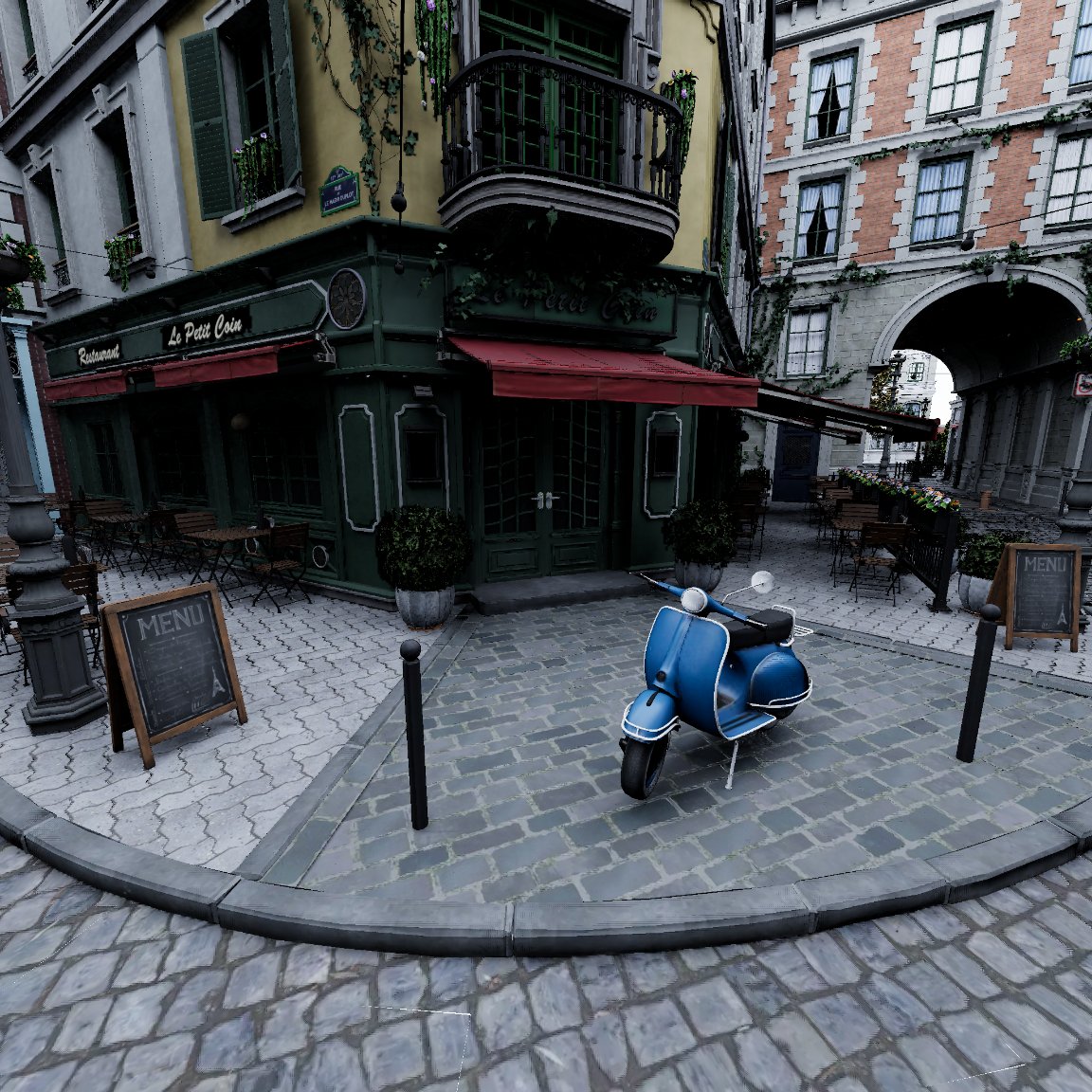
@Acerola_t I think the biggest visual difference is having contact effects with feasible specular occlusion. Shakes off the 90's chrome look and sells geometric complexity. Would be curious to compare against a per-pixel GI, multi-bounce in screen-space to keep fair.
https://t.co/8DvZym4FUY
I am looking to contribute an SSGI in the style of PoE2 based on my research with Radiance Cascades. I feel disenfranchised with Three.js, though, seeing the robots take over and PRs with words in no particular order. If there's interest from us the humans, I could use some help.
https://t.co/K10uYnWKbr
@Acerola_t Incorrect AO on things which may appear close with a longer focal length, but are far away in reality. Poor guy had their whole forearm deleted.
@Fearian@KatDoes3D Was thinking this and fake volume transmission, also as done in Path of Exile 2. Refraction alone simply won't do it since you need to model >0 thickness and many layers of interfaces, which will also consider transmissive effects like sub-surface scattering that are volumetric.
@benhouston3d This would be more like 1/4 resolution. Radiance Cascades has very extreme scales with its cascades where this is used for interpolation while building up/merging between cascades.
@forgeddotbuild In addition to the Activision GTAO paper or Sebastian Aaltonen's work on HypeHype and their mobile-optimized SSAO, the SSILVB paper is a good read. I've shipped this on mobile, and you can sample your sparse probes for another indirect bounce at high-res.
https://t.co/ObHKpsqEUA
@forgeddotbuild Would really benefit from GTAO to restore contact details. Just looking at the road, or if you add close-up foliage. The diffuse looks flat; specular is doing most of the work here. SVO radiance probes would sit somewhere between Surface Cache GI (Unity's Surfels/GIBS) and DDGI.