Hardware Supply Chain
@dessaigne
In Shenzhen, a team can go from design to a new physical part in a day. In the US, that same loop often takes weeks, and that gap compounds.
The overall stack for rapid hardware iteration still doesn't exist in America, and we want to fund the startups building it.
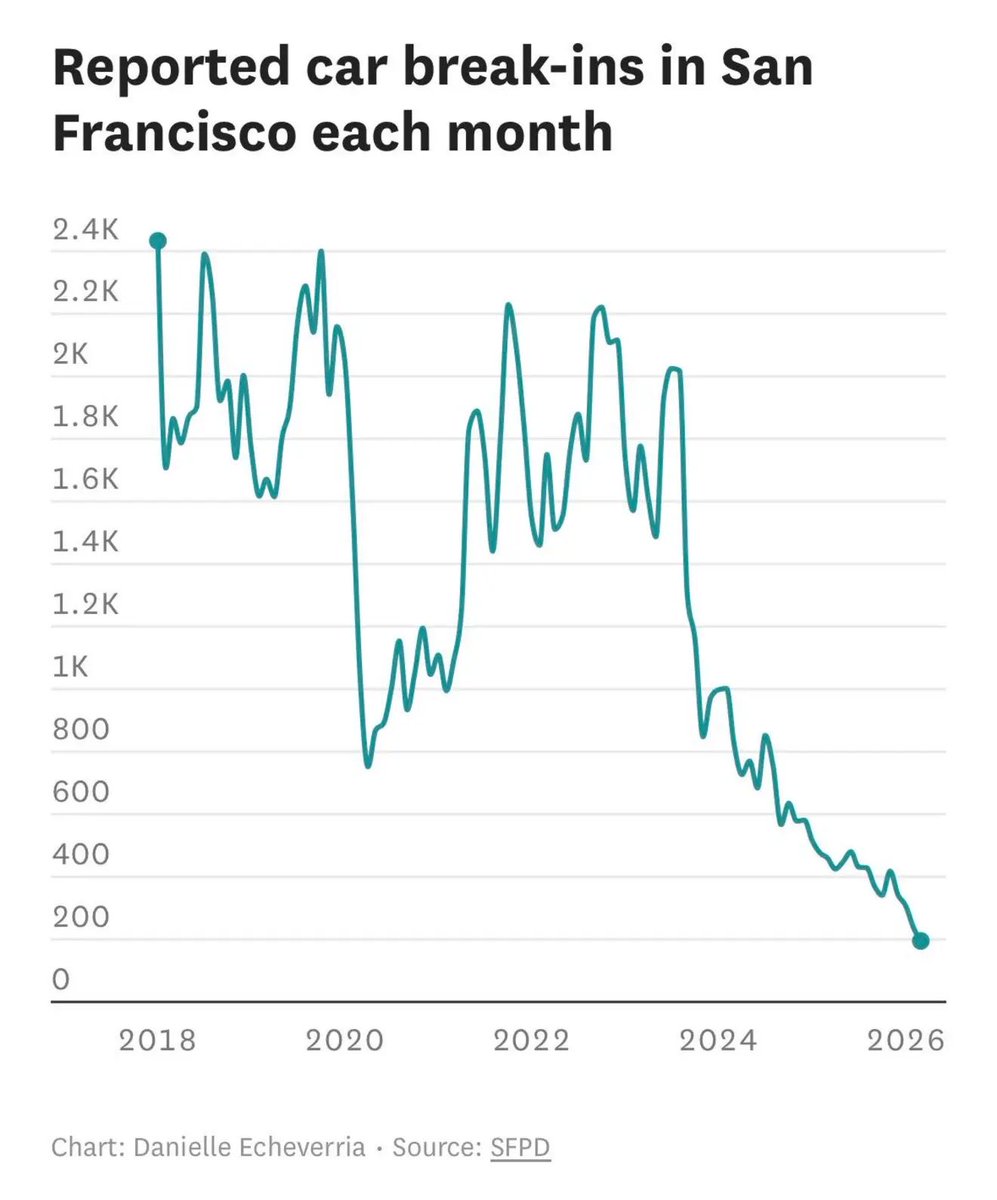
San Francisco is now a model for how to fight crime.
A few years ago it averaged 86 car break-ins per day. Today: 15.
SF did two things:
1. Got a DA that prosecutes criminals: Following the successful recall of Chesa Boudin, DA Brooke Jenkins started prosecuting prolific offenders and said so loudly. Crime dropped every year since she took office.
2. Put tech to use: In 2024, SF activated 400 license plate readers and deployed 80 drones citywide. This tech feeds officers live intelligence on suspects in motion. Drones alone have assisted in 1,000+ arrests since then. The technology lets authorities solve crimes as they happen rather than depend on much more intensive, legally perilous post hoc investigations (which ironically are often more intrusive than using tech).
The results:
- Car break-ins down 85%
- Robbery down 30%
- Burglary down 33%.
- Homicides hit their lowest level since 1954.
Plate readers, drones, a prosecutor who prosecutes. That's the whole formula!
Austin has the opposite approach. License plate cameras are effectively banned. Jail bookings are down despite repeat offenders victimizing innocent people regularly. Bond violations went from 37 in 2020 to 250 last year.
SF proved crime is a choice. Austin, so far, keeps making a different one.
#New: Bay Area rents (median 1BR):
San Francisco: $3,790*
Palo Alto: $3,610**
Mtn View: $3,380
Sunnyvale: $3,130
Santa Clara: $3,040
Redwood City: $2,930
San Jose: $2,660
Berkeley: $2,270
Oakland: $2,000
*Up 18.5% in one year
**Up 14.6% in one year
Source: @Zumper
Anthropic is building a secure OpenClaw. Four features in 30 days, each one reverse-engineered from the open-source agent that hit 250K GitHub stars and 40,000 exposed machines.
The feature mapping is surgical:
OpenClaw: text agent from WhatsApp, it works on your desktop.
Anthropic: Dispatch (March 17). Persistent thread from phone to desktop.
OpenClaw: Discord and Telegram as control surfaces.
Anthropic: Claude Code Channels (March 20). MCP bridge to both.
OpenClaw: full OS access, browser control, app manipulation.
Anthropic: computer use in Cowork and Claude Code (today).
OpenClaw: 100+ community skills, no review process.
Anthropic: curated plugin marketplace with enterprise admin controls.
OpenClaw: heartbeat daemon, always-on 24/7.
Anthropic: desktop must stay open. Intentional friction. Runaway prevention.
The strategy is legible: let open source take the arrows, ship the enterprise-safe version before anyone else can. OpenClaw proved 250K developers want to text an AI that controls their computer. OpenClaw also proved that desire produces one-click RCEs, CrowdStrike threat advisories, agents creating dating profiles nobody asked for, inbox deletions during “automated cleanup,” and 20% malware rates in skill ecosystems. Anthropic studied every failure mode and built the inverse. Connectors before computer use. Permission prompts before every action. Sandboxed execution. Every constraint maps to a compliance checkbox.
Gaps remain. Dispatch requires Anthropic’s own mobile app. OpenClaw works in WhatsApp and iMessage, apps 3 billion people already use. No native messaging integration yet. Cowork needs your Mac awake with Claude Desktop running. No headless mode, no background daemon, no proactive monitoring where the agent messages you first. The “always-on coworker” positioning still requires you to be mostly-on yourself.
Here’s where it gets interesting. Steinberger built OpenClaw entirely on OpenAI’s Codex. Said his productivity doubled. Publicly called Claude Opus the best general-purpose agent while building the biggest agent project in history on a competitor’s coding tool. Joined OpenAI February 14. Altman posted he’d “drive the next generation of personal agents” and it would “quickly become core to our product offerings.”
Five weeks of “quickly”: GPT-5.4 with strong benchmarks. ChatGPT agent mode in a cloud sandbox. And a March 20 “code red” meeting where leadership concluded product fragmentation was losing them the race to Anthropic’s unified tools. The plan: merge ChatGPT, Codex, and Atlas into one superapp.
The core loop Steinberger proved, text from phone, agent works on your machine, you return to finished output, doesn’t exist in any OpenAI product. Their agent runs in an isolated cloud browser. No local files. No persistent desktop control. No async handoff. The person who built the most successful personal agent in history is inside OpenAI. The product that reflects his insight isn’t.
Anthropic sent trademark lawyers, then shipped the product. OpenAI sent an offer letter, then called a reorg. The agent race rewards shipping velocity over hiring velocity. One company is converting the OpenClaw demand signal into product. The other is converting it into org charts.
It feels like people don’t listen to proper albums anymore and just let Spotify shuffle for them instead…
There’s a certain joy to immersing yourself in a proper album, start to finish.
here are my top 5 albums
1. OK Computer, Radiohead
2. Kind Of Blue, Miles Davis
3. I Got Next, KRS One
4. Dark Side of the Moon, Pink Floyd
5. Unplugged, Eric Clapton