Some error types are frequently overlooked because they are mistaken for post-mint damage. This coin is a clear example of an obverse lamination. I purchased it at auction and cracked it out of the holder—a $10 coin.
If you like these posts, leave a like and follow me on X
Novices might think this is an off-center coin, but it is not. It is a misaligned obverse die strike. The is notable by the uncentered obverse and a normal reverse. The are a lot of Lincoln cents with slight die misalignments. The value is - $.01
@numisdex The reverse of this coin is missing part of the surface caused by a die fragment, it is not a cud - see https://t.co/LlcxjhGz6R. You need to check your statements before you post. Where are you getting this information?
I got this coin at an auction for $21.27. I like picking up these inexpensive coins that I use in my coin guides. Thanks for reviewing, following and purchasing my book. The pole opposite the clip often shows a weak or absent rim. This is the “Blakesley” effect -err-ref.com https://t.co/lV1WZjoA5F
False - The first U.S. coin to feature a real (historical) woman was the 1893 Queen Isabella Commemorative Quarter. https://t.co/akjsGzvYgw
This silver commemorative quarter dollar (not a regular circulating issue) shows Queen Isabella I of Spain (the monarch who sponsored Christopher Columbus’s 1492 voyage) on the obverse. It was struck at the Philadelphia Mint in 1893 for the World’s Columbian Exposition in Chicago, with a mintage of just 40,000. https://t.co/akjsGzvYgw
@numisdex Where are you getting your terminology? The two halves of a split planchet are commonly referred to as "halves" or "matching halves". Mated Pairs: Two coins struck together in the minting chamber, each showing complementary errors (e.g., brockage or indent).
Exonumia is a branch of numismatics that covers coin-like objects that are not official government-issued currency. Collectors of exonumia study and trade items such as tokens, medals, badges, counterstamped coins, elongated coins, wooden nickels, and even certain paper-based substitutes like scrip
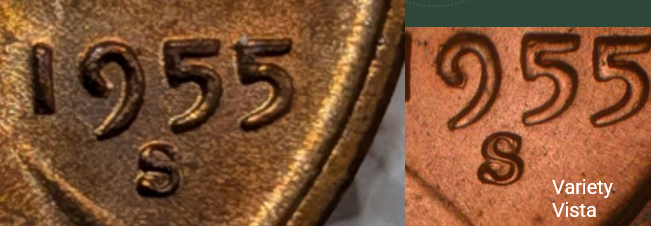
I captured this photo with my cell phone and uploaded it to PowerPoint. Using a little creative geometry with circles and lines, I perfectly centered the Lincoln cent. I then copied and pasted the date and mintmark, enlarged them, and—bam—confirmed the tilted S. This is another BU example that’s been sitting quietly in my collection for over 30 years. The imagery is new for me, since I recently purchased an incredible cell phone. https://t.co/lV1WZjp7Vd - A special shout out to all of you who have recently "followed" and purchased a book.
I’ve had this coin in my personal collection for nearly 30 years. One day while closely inspecting it under magnification, I noticed faint remnants of a previous “S” mintmark hidden within the final S. I immediately compared it to the documented variety on Variety-Vista — and it was an exact match. This is a genuine 1955-S Repunched Mintmark (RPM) variety.
Current market values as listed in my book.
MS64: $24 – $71
MS65: $101 – $142
MS66: $107 – $208
For the complete, up-to-date guide on identifying, valuing, and selling error coins and varieties like this one, check out my book:
https://t.co/lV1WZjp7Vd
A 1937 Lincoln Cent with a textbook planchet lamination. Looks like damage to new collectors… but it’s 100% mint error. Grabbed it at auction for just $21.26 all-in. Another nice one for the books!
From my book:
1929 lamination (MS64, $70) 1936 lamination (VF30, $100)
https://t.co/lV1WZjoA5F
"Are aliens really here? I find it hard to believe there could be so many different types of craft — in all shapes and sizes. Must be hundreds of aliens from all over the universe visiting…and then there is the orbs with different colors and sizes.
The 1936-D has end to end lamination. Not bad for under $10. ANACS VG10 - It cost someone more to encapsulate the coin, than I paid for it. This is why people need a book that lists the low and high prices paid for coins at auctions.
"Cracked skull" appears tied to the high-stress area of Lincoln’s profile and was already being noted on 1950s Wheat cents (e.g., 1955 issues). The catchy name gained traction in the 1960s as error collecting grew.
"Spiked head" (or "spike head") is a related subcategory for cracks extending from the rim/field into the head. It is also referenced in Cohen’s work and became a standard term in error/variety circles by the early 1970s
I do not see the importance of impressions. I strive for "Link Clicks"
1. Impressions: 295
What it means: The total number of times your post appeared on someone’s screen (in their timeline, search results, notifications, etc.).
In simple terms: 295 people saw your post (or at least it loaded on their device).
Context: This is the broadest reach metric. Higher impressions = more eyeballs on your content.