NumisDex is where collectors explore and discuss 71,000+ coin varieties and errors, track their portfolios, learn from experts... come join a growing community.
What if a die clash could clash?
When two dies slam together with no coin between them, ghost images transfer. Standard die clash. But those clash marks become raised features on the die. If the dies clash AGAIN, the marks transfer back. A clash of a clash. That's a Type I counter clash -- the coin's own design haunting itself.
Type II is even stranger. A stray piece of metal -- a die fragment, bolt, machine part -- enters the striking chamber. The die stamps a design impression onto the debris. The debris shifts. The next strike drives that impression back into the die, but now at whatever angle the debris landed.
When you see devices from that side of the coin in an area that can't be explained by rotation, that's a Type II. This example is a bonus as it is also a cud.
https://t.co/wAgEiR1bZr
@coinerrorguide I have to disagree with you here. This is a known cud reverse and counter clash obverse. The obverse missing elements is due to the reverse cud.
Half of this coin is out there somewhere. A 1944 Jefferson nickel -- after-strike split planchet. The coin was fully struck, then the planchet split in two along an internal flaw. I have the obverse.
The reverse is in someone else's hands. Reuniting both halves is called a "matched pair" -- one of the rarer finds in error collecting.
One side looks like a normal coin. Flip it and you're looking at raw internal metal -- striated, no design. That's the inside of a coin. 1944 = wartime nickel. 35% silver, unusual alloy, possibly more prone to splitting. Found it. Sold it. Still wonder where the other half ended up.
Thank you for the correction @coinerrorguide
The penny used to be the size of a half dollar.
From 1793 to 1857, U.S. cents were massive copper coins -- 28mm across and weighing 10.9 grams. Seven different designs over 64 years.
The very first one, the 1793 Chain cent, was pulled after ~36,000 coins because critics said the chain on the reverse symbolized tyranny, not unity.
There's no 1815 large cent. The War of 1812 cut off the copper supply and the Mint couldn't strike any.
And the 1-70 grading scale that NGC and PCGS use for every coin today? It was invented specifically for large cents by Dr. William Sheldon in 1949.
Seven designs. A political scandal. A war. The origin of coin grading. All in one denomination.
Roosevelt grew horns.
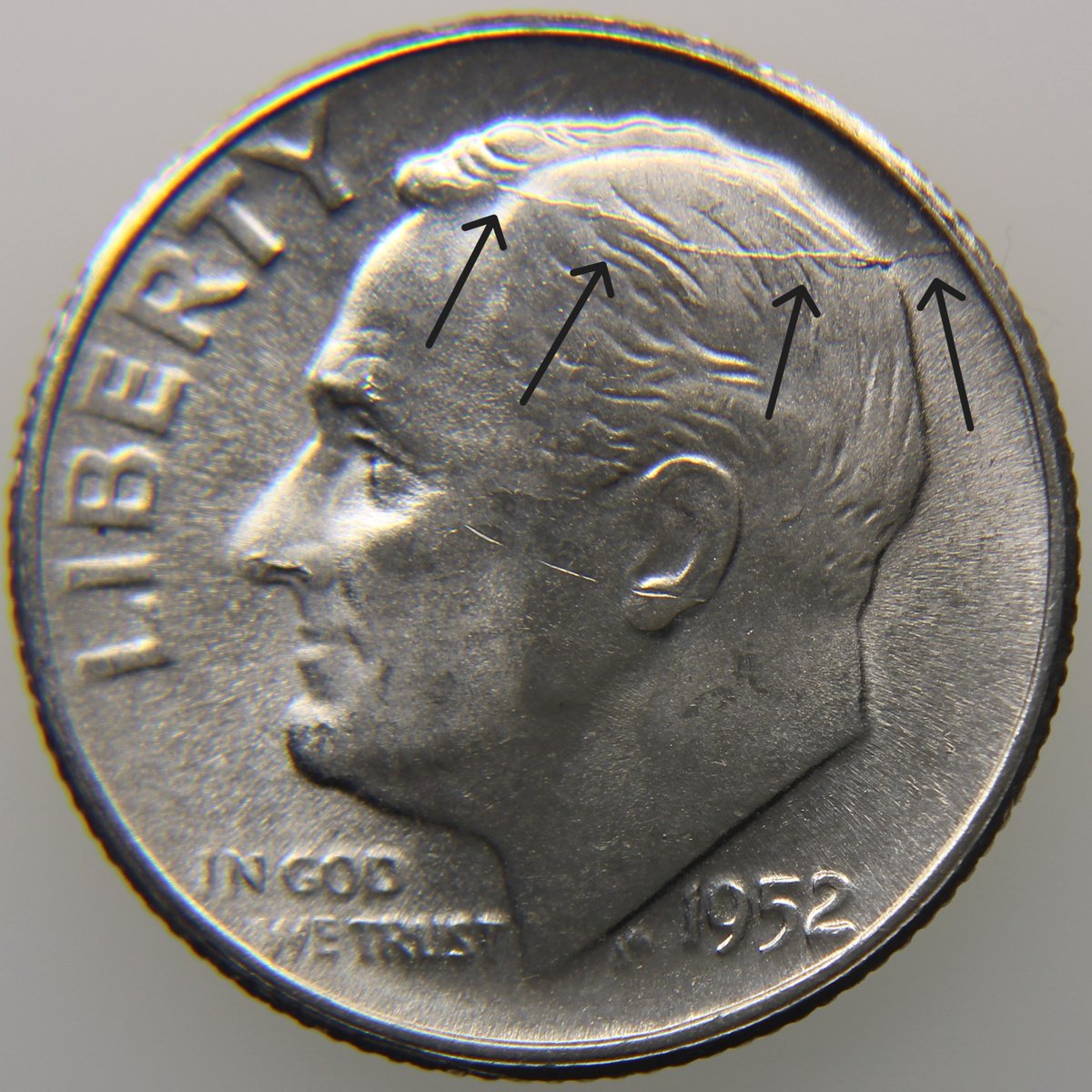
This 1952 dime has die cracks extending right off the back of his head — collectors call it a "spiked head." The main crack runs from the rim across Roosevelt's skull.
Dies endure 35-150 tons of force per strike, hundreds of thousands of times. Eventually they crack. Metal gets forced into those fractures during striking, leaving raised lines on the finished coin.
When cracks radiate from the top of a portrait, you get this horned look that's visible without magnification.
Still in my collection.
@coinerrorguide Interesting tidbit. I wonder when the name changed. I guess thinking of it, “spiked heads” also encompasses bust to rim die cracks from other portions of the bust. Cracked skull would definitely be a better term for this one.
@BullionShark Reminiscent of the speared eagle die gouge. One of my favorite errors I have pulled roll hunting was a retained strike through on a Maya Angelou quarter. Thanks for the share.
There is a lot to love in the large cent series. So many varieties. Also another interesting tidbit, is the sheldon grading system all of the grading companies currently use was developed for large cents. Back then a 70 meant 70x value to a 1 which has lost applicability, but the scale remains.
Interesting. I have always though of rim to rim die cracks with no lateral separation as pre-cuds, some lateral separation and offset it is a retained cud. Once the entire portion has separated, there is a full cud. This appears to be consistent with error ref and cudoncoins, but happy to learn where my misconception lies.
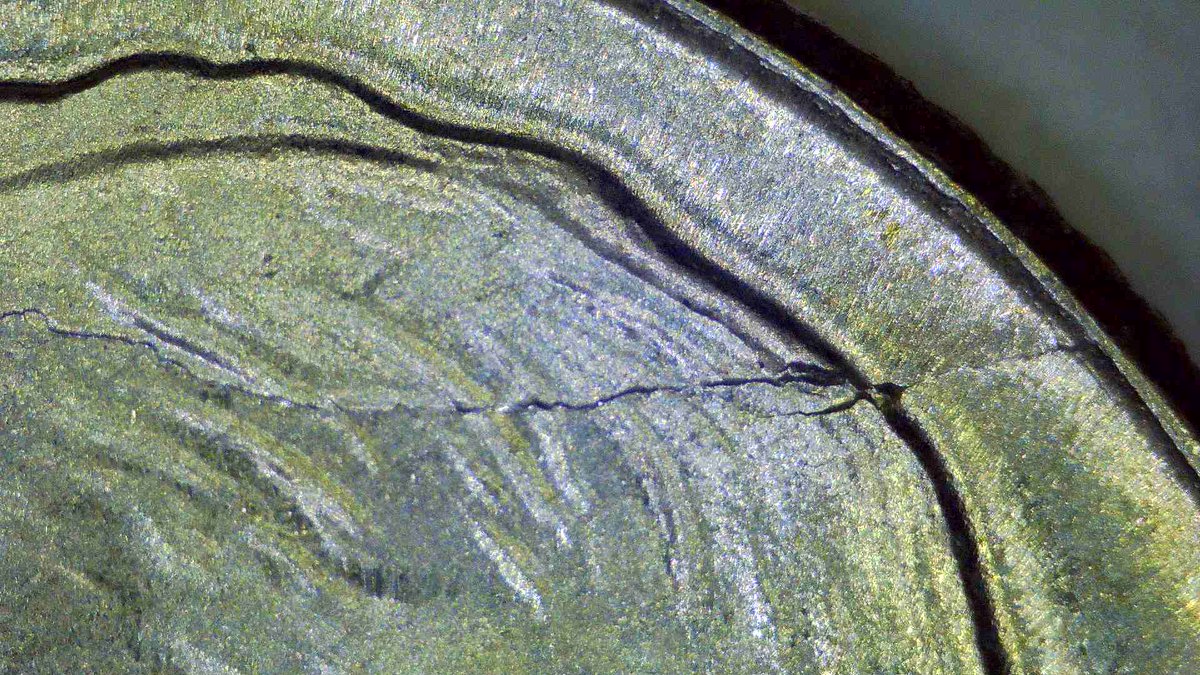
See that raised blob on the rim? A chunk of the die broke off.
It's called a cud, and it's one of the most collectible die errors because it tells the story of a die dying.
The progression: die crack → pre-cud → retained cud → full cud. Each stage is documented and sought after. A full die state set from the same die pair is the holy grail.
What makes a cud valuable? Size (10-20% coverage = major cud), what it covers, and as always condition.
Cuds are also one of the most accessible die errors for new collectors. You can find them coin roll hunting on Lincoln cents, nickels, and dimes. Entry-level prices are friendly.
@coinerrorguide It is just environmental discoloration. When I first found it I was looking for dremel marks. haha. There are no signs of abrasion, but there is a lined patch of discoloration. I also found in the process that dremel was founded in 1932 and the tool was released in 1935.
Where did the wheat stalk go?
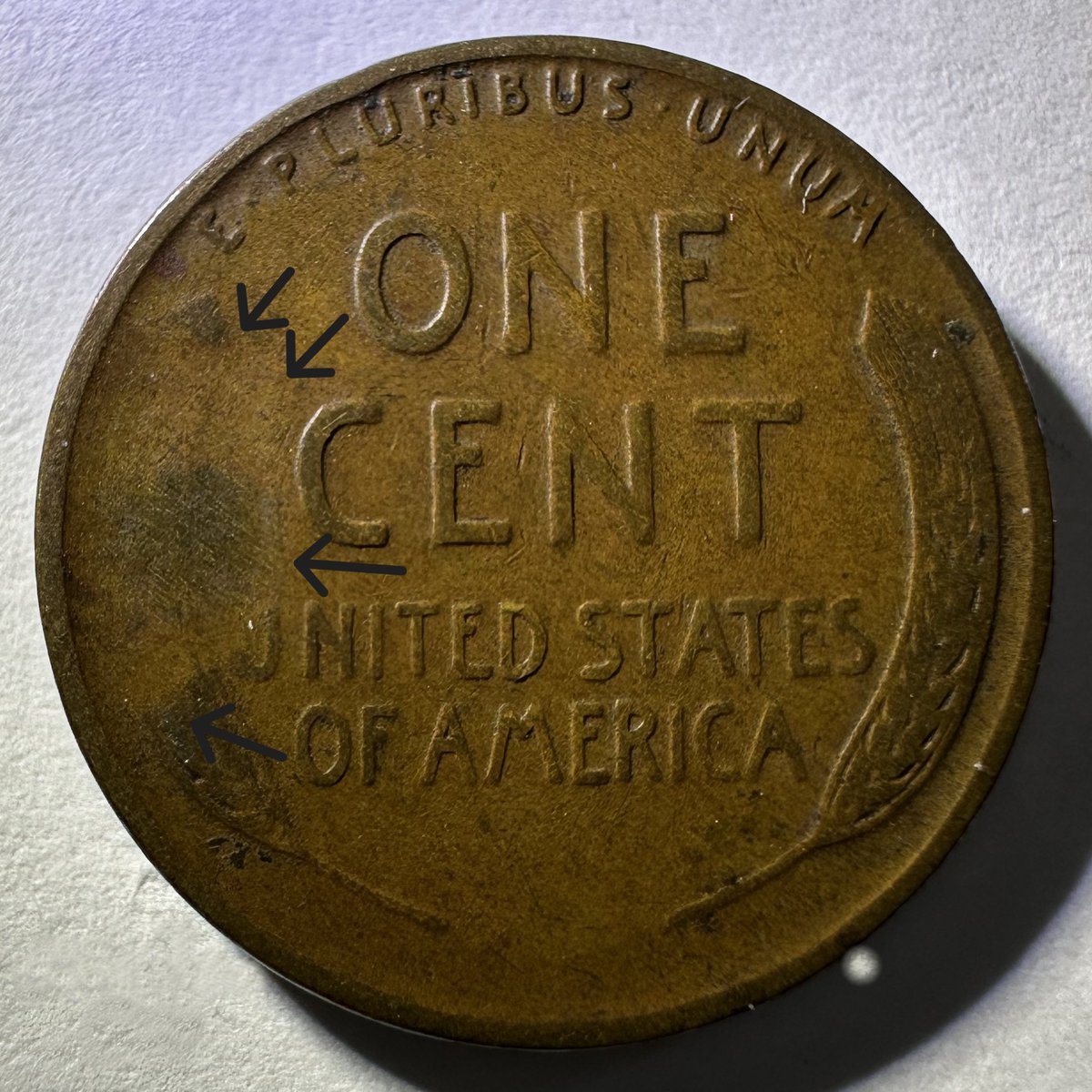
This 1932 Lincoln wheat cent has a grease strike-through that wiped out roughly 75% of the left wheat stalk. Grease built up on the die surface before striking and blocked the design from being impressed into the coin.
Small grease fills in letters are common. Losing most of an entire design element is a different story. The right stalk is fully intact, which makes the missing left side hard to miss.
Found this one coin roll hunting. Still in my collection and not going anywhere.