This week, the researchers and engineers building Polygon Miden completed a test version of the node that will manage the state of the rollup. This is what the Miden Node does and how it functions for user-generated state transitions.
The basic functions of this first version of the Miden Node are:
-Exposing RPC endpoints
-Verifying user-generated proofs
-Producing blocks
-Storing / updating the state
The Miden Node is also structured modularly, i.e., as an independent set of components that can be run in isolation or in tandem on different machines altogether.
The RPC fields and directs external requests to process new transactions, validate user-generated proofs, and retrieve data from storage.
Users can generate their own state transitions and prove them, with the Miden Node simply acting as verifier. To prevent a double-spend attack, the Miden Node reads the chain state to check that the note contained in the tx has not been previously consumed.
User-generated proofs are sent to the mempool. From there, they are batched and aggregated, and turned into blocks. Once a block is produced, it’s sent to storage and the chain state is updated.
The Miden Node + the Miden VM + Miden Client equal the testnet for Polygon Miden. Coming in Q1 of next year.
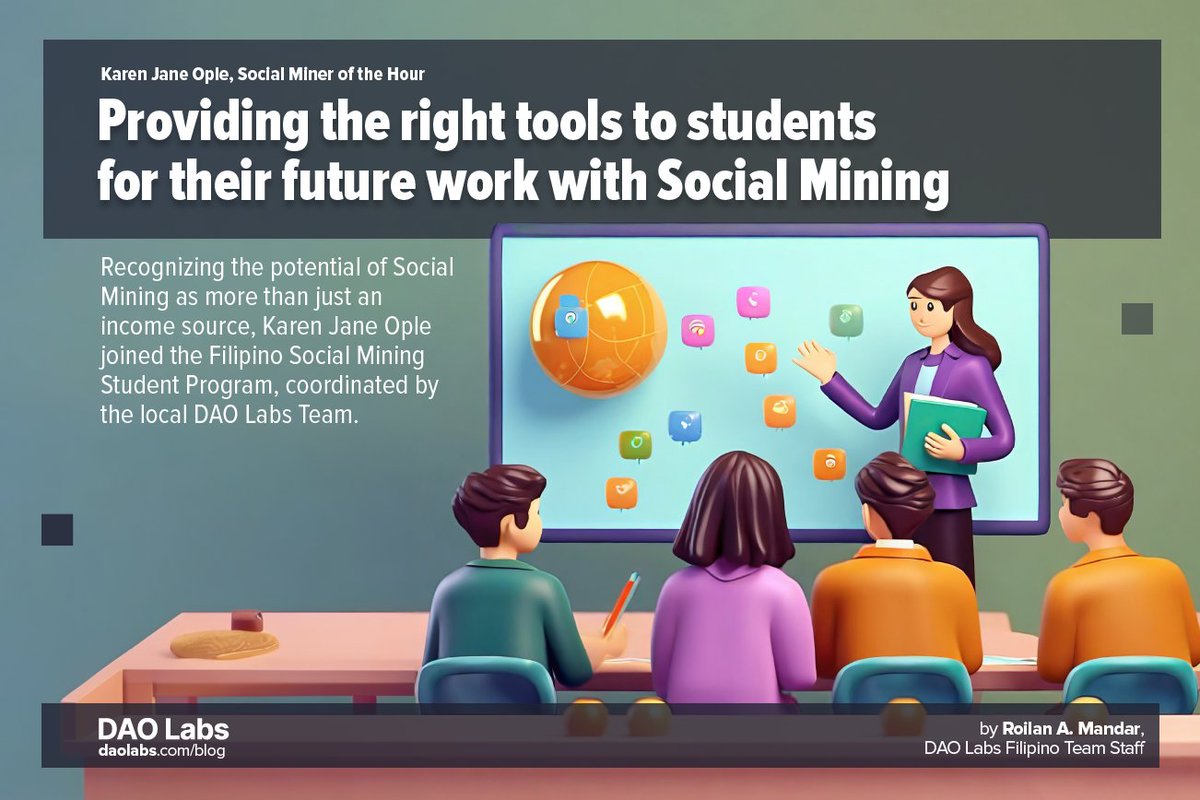
Karen Jane Ople (@YIleum26) joined the Filipino Student Program, introducing her students to #SocialMining and providing an income to this young generation while studying and building their own professional and personal journeys.
Here’s her take on our blog, by @Azraiel1201, from her appearance on the Social Miner of the Hour.
https://t.co/P4zWPNlbpl
A certified Social Miner of @TheDAOLabs ✅ Join him in celebrating #XmasWithDAOLabs 🎄🎁 Embark on this incredible #SocialMining journey together - invite your friends, spread the joy, and let's make this holiday season unforgettable! 🚀
Task link: https://t.co/stO2zUYlUz
"Boost your holiday cheer with DAO Labs – where jingling bells meet increasing profits! This Christmas, let your income soar as you explore new possibilities with our innovative solutions. 🚀💰🎄"
@TheDAOLabs#XmasWithDAOLabs#SocialMining
Say goodbye to Polygon Wallet Suite... and hello to Polygon Portal.
Your ~ improved ~ gateway to Polygon chains is here.
Unveiling the new, unified destination with a full dashboard for Polygon PoS, Polygon zkEVM, and Ethereum.
- Unified UX for bridging
- Third party bridges
- Refuel gas
- Developer tools
- Documentation
- Support & feedback
Get connected: https://t.co/aKiI8IyYYV
More: https://t.co/IL1u7zOUX7
Setting a new standard for sustainability disclosure in web3.
We're collaborating w/ the Crypto Carbon Ratings Institute (CCRI) to launch a sustainability dashboard, providing transparency & detail on the environmental impacts of the Polygon blockchain.
https://t.co/ztsSm6Qnrm
Understand the climate impact of Layer 2 and base-layer (L1) activities, including the emissions caused on Ethereum via activities such as coin holdings and transactions:
Input an address into the dashboard’s emissions calculator and collect its up-to-date holding and transaction data as a share of associated network carbon emissions and electricity consumption:
Build whatever, with Polygon CDK 🧱
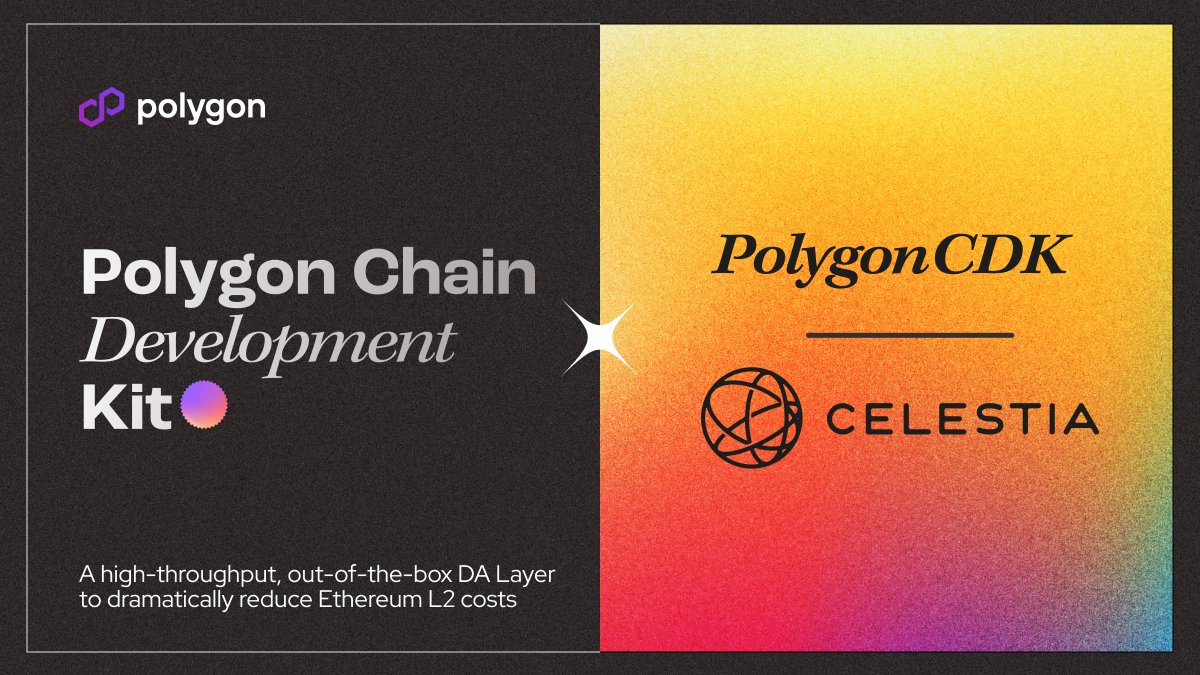
@CelestiaOrg’s high-throughput, modular data availability (DA) solution will integrate with Polygon CDK, lowering the barrier for launching high-throughput Layer 2 chains on Ethereum.
The integration will enable fully onchain applications and can dramatically reduce Ethereum L2 transaction fees by ~100x. Celestia's DA solution will be available to devs launching ZK L2s with Polygon CDK as an easily-pluggable component, early next year.
ZK + modular DA. A broadband moment for web3.
More: https://t.co/4a6nX6WcRk
Bots, spam, phishing → all ways your privacy can be compromised online.
Vigilance is preached, but ultimately developers are needed to build the solutions that will guardrail our online identities.
Luckily, @0xPolygonID tools are ready to be used.
@ Verifiers - Think you have what it takes to fix the identity crisis? Reach out to the team building the zk-powered identity solution:
https://t.co/DDM3P79B7v
Asset tokenization has emerged as a transformative force for ownership, liquidity, asset transfers, and many more use cases.
The @EmergingTechTS, Government of Telangana, has taken a proactive approach to fostering its adoption within the state, working with industry leaders like Polygon Labs, @cdacindia, @RyzeLabs, @BWA_Ind, @EuCInitiative, and @Ind_Block_Forum to launch the Technical Guidance Note for Asset Tokenization.
The Government of Telangana is the governing authority of the state of Telangana in India, which has the ninth-largest economy in India with a GSDP of ₹9.5 million and a population of ~40 million.
Announced at Polygon Connect: India, the document serves as a comprehensive guide to offer a roadmap and provide precise technical standards, catering to startups and organizations looking to get involved in asset tokenization.
Download the document here: https://t.co/MYNYH57P3N
Finding the right neighborhood is important when looking for a home.
With over 250 amazing neighbors, the network effects of the Polygon ecosystem make a great place to settle down and build a game.
Welcome home, @farcanaofficial.
DeFi is financial inclusion
DeFi is 10x long with your friends
DeFi is bear market building
DeFi is a fear of @functi0nZer0
DeFi is zk
DeFi is on Polygon with @chainlink
https://t.co/sCjEH9IR3m
How is Web Assembly used at Polygon Miden?
Some say it's “a new development paradigm for the web”. Let’s see how Polygon Miden leverages Web Assembly for its two main benefits: portability and flexibility.
Portability
The Miden VM is written entirely in Rust and can be compiled to Web Assembly. Making it portable that it can run on most of the modern browsers and hence on mobile phones (remember client-side proofs?).
The “miden-wasm” module is where the compilation to Web Assembly and its execution happens. In its simpler form, the module does three things:
-Running the VM
-Proving
-Verifying
Flexibility:
The Miden Compiler has a WASM frontend which can be used to convert a program compiled to Web Assembly to the compiler’s high-level intermediate representation.
This makes it easy to write code in high level languages targeting Miden VM.
In it’s simple form, the “frontend-wasm” package performs:
-Code translation
-WebAssembly to Miden IR function translation
-Module translation
-Sections translation
The team at Polygon Miden is also exploring how to bring key features of the WebAssembly Component Model to Miden toolchain with an aim of solving complex problems that exist currently or may be in the future.
You can read more about it here: https://t.co/2X54gVO8Cq
To further explore the work done at Polygon Miden and join discussions, please find links on the official website:https://t.co/32BGvenY20