My years of using polite language are over. Our Republic is in real danger. I’m not gonna go down without a fight. It starts with calling communists communists. And liars liars. And pussies pussies.
Switzerland has 26 cantons, each with its own constitution, tax rates, and laws, and the result is one of the wealthiest, most stable countries on earth. That is not a coincidence.
You want to understand why Swiss GDP per capita sits around $92,000 while the EU average hovers near $37,000? Start here. Cantons compete for residents and businesses the same way firms compete for customers. Zug kept its corporate tax rate at roughly 11.9%, attracted commodity traders and crypto firms, and watched its population and tax revenues grow. Cantons that taxed aggressively lost mobile capital and productive citizens to neighbors with lighter burdens. This is Tiebout competition working in real life, not a textbook diagram.
The federal government in Bern handles defense, monetary policy, and some foreign affairs. Everything else defaults downward. Cantons set income taxes. Communes set property levies. Citizens in Appenzell Innerrhoden voted on local laws by a show of hands in the Landsgemeinde, an open-air assembly, until 1990 for most matters. The feedback loop between decision-makers and the people paying for those decisions stays tight. That tightness disciplines spending in ways no central auditor ever will.
Free market thinkers have stressed this for generations: political units must be small enough that exit is credible. When the cost of leaving a bad jurisdiction drops, politicians face real consequences for bad policy. Switzerland kept that cost low by design. A business or family in Basel-Stadt dissatisfied with cantonal policy drives forty minutes to Baselland. No visa. No language barrier. No bureaucratic labyrinth. Just a move.
The EU spent decades building the opposite architecture, consolidating regulatory power in Brussels and eliminating the jurisdictional diversity that forces governments to stay honest. Switzerland refused to join. Its per-capita wealth, its low public debt, and its functional civil society arrived because the Swiss preserved the one institutional feature every centralized state destroys first: the credible right to leave.
The Interrogation
The Gulag Archipelago
Volume 1, Part 1, Chapter 3
“If the intellectuals in the plays of Chekhov who spent all their time guessing what would happen in twenty, thirty, or forty years had been told that in forty years interrogation by torture would be practiced in Russia; that prisoners would have their skulls squeezed within iron rings; that a human being would be lowered into an acid bath; that they would be trussed up naked to be bitten by ants and bedbugs; that a ramrod heated over a primus stove would be thrust up their anal canal (the “secret brand”); that a man’s genitals would be slowly crushed beneath the toe of a jackboot; and that, in the luckiest possible circumstances, prisoners would be tortured by being kept from sleeping for a week, by thirst, and by being beaten to a bloody pulp, not one of Chekhov’s plays would have gotten to its end because all the heroes would have gone off to insane asylums.
Yes, not only Chekhov’s heroes, but what normal Russian at the beginning of the century, including any member of the Russian Social Democratic Workers’ Party, could have believed, would have tolerated, such a slander against the bright future? What had been acceptable under Tsar Aleksei Mikhailovich in the seventeenth century, what had already been regarded as barbarism under Peter the Great, what might have been used against ten or twenty people in all during the time of Biron in the mid-eighteenth century, what had already become totally impossible under Catherine the Great, was all being practiced during the flowering of the glorious twentieth century—in a society based on socialist principles, and at a time when airplanes were flying and the radio and talking films had already appeared—not by one scoundrel alone in one secret place only, but by tens of thousands of specially trained human beasts standing over millions of defenseless victims.”
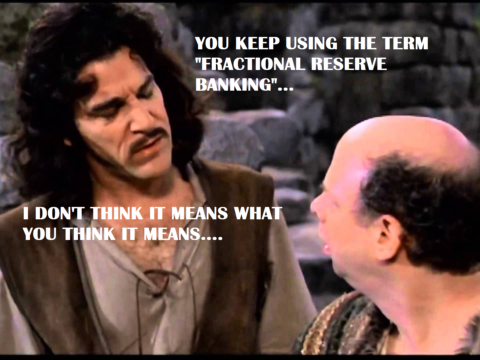
Walk into a coat check. You hand over your coat, take a numbered ticket, and go about your evening. The attendant does not "lend" your coat to another patron while you sip your drink. If he did, you would call it theft, and the law would agree. This arrangement has a name in Roman law: it is a bailment. The bailee holds your property. He does not own it, and he cannot use it.
Now walk into a bank and deposit $10,000 in a demand account. You can withdraw it at any moment. That is the entire point of a demand deposit. Yet the bank turns around and lends nine-tenths of it to someone else, who deposits it in another bank, which lends it again. Your $10,000 becomes the legal basis for tens of thousands in circulating claims. Two people now believe they own the same dollar at the same time.
Both of them are wrong, and one of them will find out at the worst possible time.
Free market economists have identified the trick precisely. The banker has quietly reclassified a bailment as a loan without your consent. He calls the money a "deposit," a word chosen for its comforting resemblance to the coat check, then treats it as his own property to gamble with. He collects the upside. You carry the risk. When enough depositors show up on the same Tuesday demanding what they were promised, the vault is empty, and the banker phones Washington.
Murray Rothbard identified this as fraud: not a systemic accident, not a stress event, not a "liquidity mismatch" dressed up in the sober vocabulary of central bankers. Two claims to one property, issued knowingly. In any other industry, a warehouse that issued receipts for grain it did not hold would see its operators indicted.
Banking earns a special exemption, complete with a lender of last resort (the Federal Reserve, established 1913) that prints the difference whenever the con unravels. That printing is the second half of the fraud, socialized across everyone holding dollars.
Sound money advocates propose something radical: hold what you promised to hold. Keep loans and deposits separate. The coat check should keep the coats!
On a Sunday evening, August 15, 1971, Richard Nixon interrupted the broadcast of Bonanza to inform Americans that the dollar they held was now backed by nothing but his word. He called it "temporary." Fifty-plus years later, you are still waiting for the temporary part to end.
Understand what actually happened. Under Bretton Woods, foreign governments could exchange their dollars for gold at $35 an ounce. The dollar was a receipt. Gold was the money. Washington printed receipts far faster than it dug gold out of the ground, financing Vietnam and Lyndon Johnson's Great Society with the same press. De Gaulle noticed. So did others. France sent a warship to collect its gold, and the run was on.
Nixon had two honest choices: stop spending, or admit the dollar was overissued. He chose a third option. He defaulted, then blamed "international speculators" for the mess his own Treasury created. Classic.
Notice the language he used. He promised the dollar's action would "stabilize" prices. Consumer prices roughly quadrupled over the next forty years. A 1971 dollar buys you about fourteen cents of goods today. That is confiscation in slow motion, and it hit wage earners and savers hardest, the people holding cash rather than assets that float upward on the new tide of credit.
Here is the mechanism sound money advocates warned about for a century: Sever money from a physical anchor and you hand politicians an unlimited overdraft. Every deficit, every bailout, every war since 1971 rode on that Sunday broadcast. Ludwig von Mises died in 1973, having spent decades explaining exactly this.
Nixon called it "protecting" the dollar. He meant emptying it. You have been paying the invoice ever since.
Yes, your groceries are 30% off. So is the grocer's margin to keep the shelves full, the lights on, and the milk cold. But don't worry, when the eggs run out, at least the discount on the empty shelf stays the same. You can admire the price tag on the thing that isn't there.
And the store won't gouge you, true. Neither will any private grocer stay open, because no one runs a shop forced to lose to a rival that loses money on purpose and bills the taxpayer for it. So enjoy the one government store for the next thirty years, waiting in yesterday's line for tomorrow's shortages.
Discounting a price doesn't discount reality. It shifts the cost onto the man who earned it, drives out the competition, and empties the shelves, while the line of people waiting to be fed grows longer every year.
But feel the warmth of collectivism: everyone equal, hungry together in front of identical bare coolers, sharing the one checkout and the picked-over produce as one community.
The origin of the Critical Theory was an essay by Frankfurt School director Max Horkheimer, titled "Traditional and Critical Theory," written in 1937. It says the same crap we deal with today.
The essence of Horkheimer's essay is that traditional theory, which is concerned with facts and figures and math and stuff, cares about understanding the world as it is without wanting to see beyond it or change it.
Therefore, the traditional theorist reproduces the society in which he works, un-Critically.
In fact, he doesn't even realize he's part of a historically contingent moment and just repeating and reaffirming the assumptions and class conflict of his time. (For Marxists, all of history, wrote Marx, is the history of (the evolution of) class antagonisms, so any particular moment in history is a particular set of class antagonisms based on a stage of historical development.)
Horkheimer writes,
"In this view of theory, therefore, the real social function of science is not made manifest; it speaks not of what theory means in human life, but only of what it means in the isolated sphere in which for historical reasons it comes into existence. Yet as a matter of fact the life of society is the result of all the work done in the various sectors of production. Even if therefore the division of labor in the capitalist system functions but poorly, its branches, including science, do not become for that reason self-sufficient and independent. They are particular instances of the way in which society comes to grips with nature and maintains its own inherited form."
In short, knowing what you're talking about is just a means of reproducing the oppressive society, so it's not actually that good. In fact, Horkheimer says the Critical Theory is suspicious of the very idea that the society we have produces good things at all.
Horkheimer writes,
"On the contrary, [Critical Theory] is suspicious of the very categories of better, useful, appropriate, productive, and valuable, as these are understood in the present order, and refuses to take them as nonscientific presuppositions about which one can do nothing."
For Horkheimer, there is no making anything "better, useful, appropriate, productive, or valuable" in the existing (capitalist) system because the whole thing is rotten and any improvements only make the situation worse by making people believe it is good or that it works. Dismal!
The alternative is to adopt a Critical Theory as a second and dominant dimension of theoretical thinking. This style of thinking imagines a world outside of the current system that is more concerned with living the good life than it is with getting right answers about the world or making things better inside the system.
Horkheimer writes,
"In fact, however, the self-knowledge of present-day man is not a mathematical knowledge of nature which claims to be the eternal Logos [traditional theory, strawmanned badly], but a critical theory of society as it is, a theory dominated at every turn by a concern for reasonable conditions of life."
This is the classic socialist strawman and sad-funny-dangerous confusion: only socialism has any "concern for reasonable conditions of life." Therefore, anything that isn't socialism is a system that doesn't have "concern for reasonable conditions of life." All of socialism is this conclusion in search of arguments and damage it can do to the existing system.
My point isn't these details, though. I'm only showing you them so you can see that they're there from the start. My point is telling you what a Critical Theory is and always has been.
It's the annoying claim that people who work to make the society we have better are upholding it and therefore a problem because they have decided the system we have is rotten at its very foundations and has to be replaced with socialism to be any good.
It doesn't matter that not one society ever in the history of man has made a socialist society work, and they have produced little more than squalor, misery, struggle, and death. People just haven't conceived of it rightly yet.
How should they conceive of it, then?
The Critical Theorists don't tell us. In fact, Horkheimer said some 30 years later that they can't tell us. He said that it is not possible to describe a good or ideal society on the terms of the existing society. "We lack the means," he said in a 1969 interview. All they can do, he insisted, is bring up the negative aspects of the society we have that they wish to change.
So Critical Theory is a belief that making society better is a moral wrong because it reproduces a society they hate. They cannot offer anyone a viable alternative, though. All they can do is complain about things that don't go perfectly until people come to hate the society they have for not being something they can't even describe.
Consider a man who earns his first $40,000. The state takes twelve percent. Now consider the same man who works harder, invents something, builds a business, and earns his four hundred thousandth dollar. The state takes thirty-seven percent of that last slice, and various local governments come for more. Same man. Same hours in the day. The only thing that changed is that he became more productive, and the tax code responded by punishing him for it.
That is the moral architecture of progressive taxation.
Every free market economist from Böhm-Bawerk forward understood a simple point: prices carry information. Your income is a price. It signals how much other people value what you produce. When a surgeon earns more than a barista, the market is telling you something about the relative scarcity of skilled hands versus the ability to steam milk. Progressive taxation deliberately garbles that signal. The more useful you become to your fellow man, the larger the percentage the state confiscates. You are fined for excellence.
Notice what this does at the margin, where all human action actually happens. You are offered a promotion that pays another $50,000 but demands sixty-hour weeks. You do the math. Half of that raise evaporates before it reaches you. So you decline. The project goes unbuilt. The clinic goes unopened. Nobody records the surgery that never happened or the factory that stayed on the drawing board. The loss is invisible, which is precisely why politicians love this tax. Frédéric Bastiat named the problem in 1850: they see what is taken, never what is prevented.
The usual defense is "fairness." But there is nothing fair about a rule that treats your ten-thousandth hour of effort as more deserving of seizure than your first. A flat proportion at least respects the arithmetic of your own labor.
Progressive rates are sold as compassion. What they actually do is tax the act of creating value at an accelerating rate, then express surprise when capital and talent quietly relocate to Austin, Zug, and Dubai.
People respond to incentives. Every time.
People confusing the First Amendment with Disorderly Conduct are stupid. People purposely ignoring the crime charged and trying to make it seem like a pure First Amendment issue are evil and I won’t follow you.
Dr Fauci and Mr. Science
The Fauci files reveal not just a sociopathic narcissist, but also a pathological schizophrenic.
For years, Fauci was assuring the public of Covid narratives that he either knew were untrue, or knew little about.
He posed as a non-partisan, even as he collaborated with the leftwing cable news grandees and liberal columnists to hound his enemies and magnify his godhead.
From the virus’s origins and effects of the lockdowns, to the efficacy of the mRNA vaccinations to the always changing 0/1/2 masks wearing protocols, Fauci used his massive government agency, and sycophantic media, to promote his always fluid narratives by punishing enemies and rewarding friends—on the basis of their loyalty to Dr. “I represent science”.
He seemed to be obsessed with firing White House Covid advisor Scott Atlas, and demonizing Jay Bhattacharya, Sunetra Gupta and Martin Kulldorff—for the crimes of questioning the Fauci party line.
These critics were not radical “let it rip” herd immunologists as the Fauci camp caricatured them, but circumspect, cost-to-benefit doctors and savvy health policy analysts.
Their views, if embraced, might have avoided a multibillion-dollar global shutdown that wrecked economies—especially derailing the booming 4th quarter 2019 Trump economy—increased the death toll, destroyed millions of livelihoods, harmed perhaps permanently the education of millions U.S. children, and was hardly based on the “science”.
And what exactly were the so-called extremist views of Atlas, Bhattacharya, and others?
Healthy children were not at great risk from Covid—but keeping them isolated drained away key resources from the elderly and sick who certainly were vulnerable.
And the nationwide school closures had profound negative effects on children and teens as did the lockdowns on the general population.
Substance and familial abuse soared, small businesses were ruined, and children’s formative educational years were lost.
24/7 mask wearing was neither practical nor necessary as opposed to their beneficial use by health care workers in close proximities.
The experimental mRNA vaccinations may have initially saved lives, but they were not, as billed by Fauci and the pharmaceutical companies, lasting protection from either infectiousness or being infected.
And certainly the repeated booster regimens for some could pose serious health risks.
Herd immunity was not some crank idea, as the Fauci school libeled these experts, but, along with the initial vaccinations, were time-tested medical realities that would mitigate the toxicity of the pandemic.
We have seen a lot of obscene hoaxes recently that changed national events: the loony Jussie Smollett caper; the phony “Steele dossier”; the “51 intelligence authorities” and the Russian-produced Hunter Biden laptop con; and the media fabricated effigy of Joe Biden as “fit as a fiddle”.
But Fauci’s effort to attribute the virus to a bat or pangolin publicly, while privately accepting from his own consultants that it likely was birthed in the Wuhan lab’s gain of function research—which he had helped to support via Peter Daszak—and the policies that resulted from that initial lie, proved literally for thousands a matter of life and death.
My scholarly article "Why There Are Exactly Two Sexes" has been accessed over 50K times, placing it in the top 8 of all articles in the journal's history.
Activists refuse to cite it or acknowledge it exists.
I'm still waiting for someone to publish a scholarly scientific takedown of it. You'd think this would be a top priority for those asserting "sex is a spectrum" who believe my work is bigoted, pseudoscientific, and actively harming a vulnerable community.
Until then, you can read it and arm yourself with a thorough understanding of the 5 major frameworks that activists and activist scientists use to undermine the binary nature of the sexes and why they all fail.
🔗https://t.co/k6VEmRcgqM
So it was a bad flu, as many of us said at the time - including Fauci in his diary while he peddled panic publicly to keep growing his power and feeding his ego.






![ConceptualJames's tweet photo. The origin of the Critical Theory was an essay by Frankfurt School director Max Horkheimer, titled "Traditional and Critical Theory," written in 1937. It says the same crap we deal with today.
The essence of Horkheimer's essay is that traditional theory, which is concerned with facts and figures and math and stuff, cares about understanding the world as it is without wanting to see beyond it or change it.
Therefore, the traditional theorist reproduces the society in which he works, un-Critically.
In fact, he doesn't even realize he's part of a historically contingent moment and just repeating and reaffirming the assumptions and class conflict of his time. (For Marxists, all of history, wrote Marx, is the history of (the evolution of) class antagonisms, so any particular moment in history is a particular set of class antagonisms based on a stage of historical development.)
Horkheimer writes,
"In this view of theory, therefore, the real social function of science is not made manifest; it speaks not of what theory means in human life, but only of what it means in the isolated sphere in which for historical reasons it comes into existence. Yet as a matter of fact the life of society is the result of all the work done in the various sectors of production. Even if therefore the division of labor in the capitalist system functions but poorly, its branches, including science, do not become for that reason self-sufficient and independent. They are particular instances of the way in which society comes to grips with nature and maintains its own inherited form."
In short, knowing what you're talking about is just a means of reproducing the oppressive society, so it's not actually that good. In fact, Horkheimer says the Critical Theory is suspicious of the very idea that the society we have produces good things at all.
Horkheimer writes,
"On the contrary, [Critical Theory] is suspicious of the very categories of better, useful, appropriate, productive, and valuable, as these are understood in the present order, and refuses to take them as nonscientific presuppositions about which one can do nothing."
For Horkheimer, there is no making anything "better, useful, appropriate, productive, or valuable" in the existing (capitalist) system because the whole thing is rotten and any improvements only make the situation worse by making people believe it is good or that it works. Dismal!
The alternative is to adopt a Critical Theory as a second and dominant dimension of theoretical thinking. This style of thinking imagines a world outside of the current system that is more concerned with living the good life than it is with getting right answers about the world or making things better inside the system.
Horkheimer writes,
"In fact, however, the self-knowledge of present-day man is not a mathematical knowledge of nature which claims to be the eternal Logos [traditional theory, strawmanned badly], but a critical theory of society as it is, a theory dominated at every turn by a concern for reasonable conditions of life."
This is the classic socialist strawman and sad-funny-dangerous confusion: only socialism has any "concern for reasonable conditions of life." Therefore, anything that isn't socialism is a system that doesn't have "concern for reasonable conditions of life." All of socialism is this conclusion in search of arguments and damage it can do to the existing system.
My point isn't these details, though. I'm only showing you them so you can see that they're there from the start. My point is telling you what a Critical Theory is and always has been.
It's the annoying claim that people who work to make the society we have better are upholding it and therefore a problem because they have decided the system we have is rotten at its very foundations and has to be replaced with socialism to be any good.
It doesn't matter that not one society ever in the history of man has made a socialist society work, and they have produced little more than squalor, misery, struggle, and death. People just haven't conceived of it rightly yet.
How should they conceive of it, then?
The Critical Theorists don't tell us. In fact, Horkheimer said some 30 years later that they can't tell us. He said that it is not possible to describe a good or ideal society on the terms of the existing society. "We lack the means," he said in a 1969 interview. All they can do, he insisted, is bring up the negative aspects of the society we have that they wish to change.
So Critical Theory is a belief that making society better is a moral wrong because it reproduces a society they hate. They cannot offer anyone a viable alternative, though. All they can do is complain about things that don't go perfectly until people come to hate the society they have for not being something they can't even describe.](https://pbs.twimg.com/media/HOUdIBTWsAAGlZg.png)


