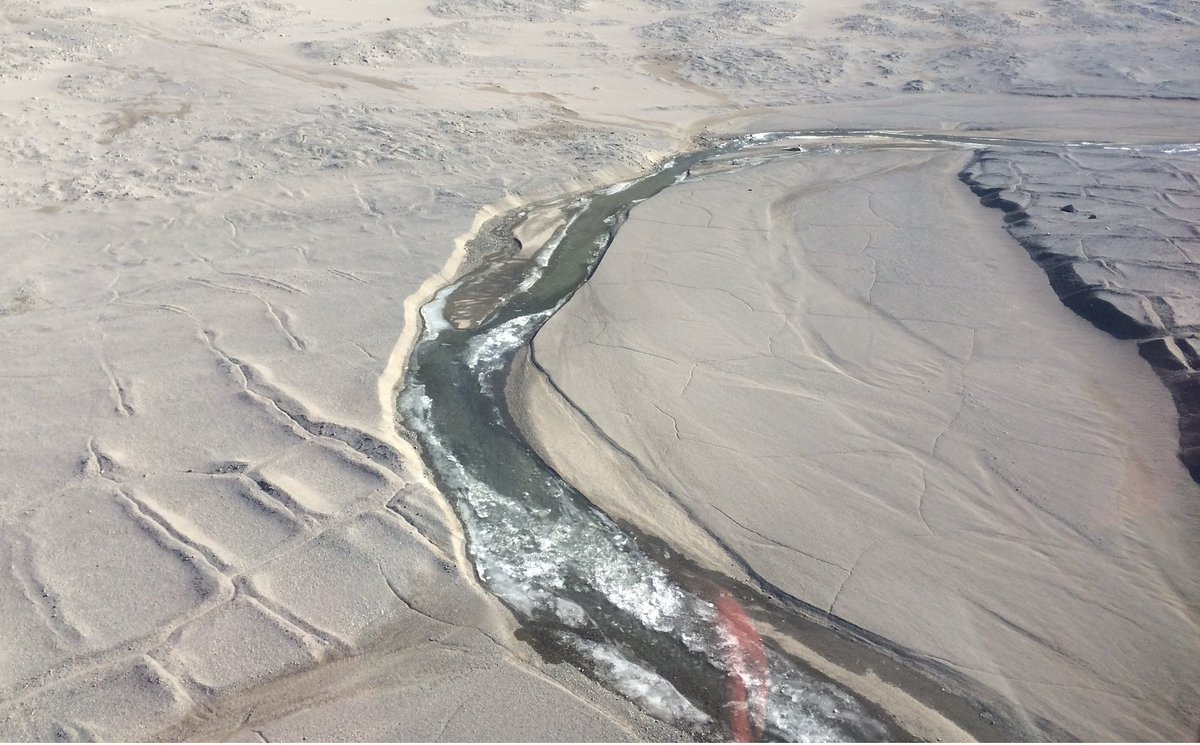
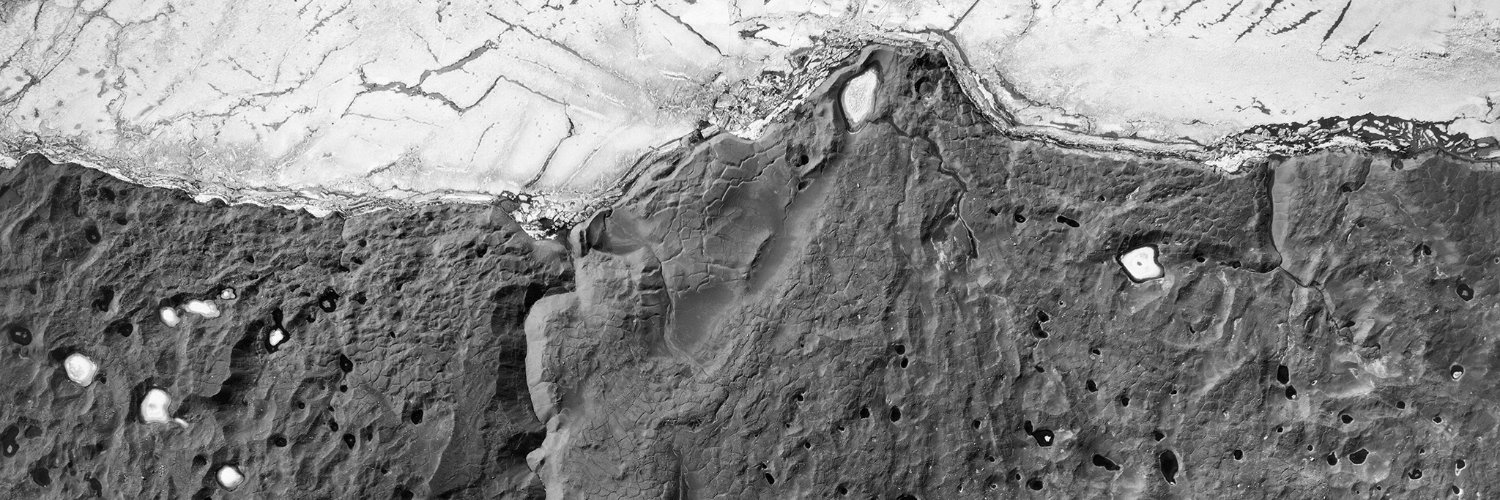
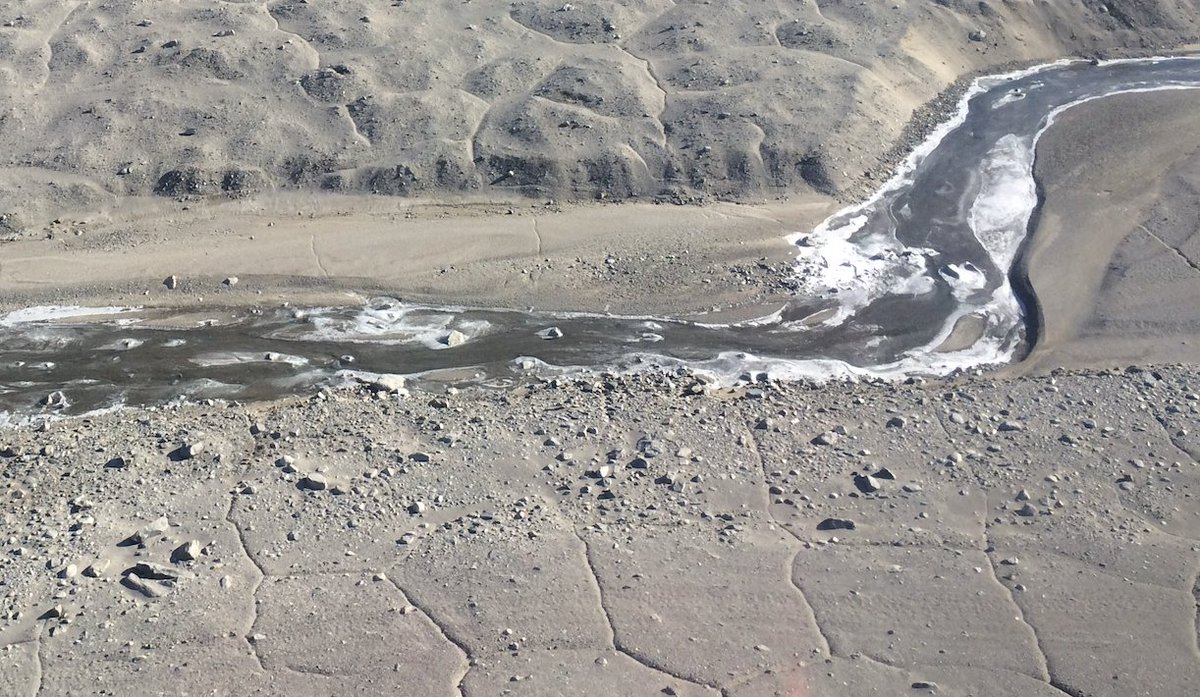
@AGU_H3S I love seeing the Onyx River up on Team Frozen Rivers, but its thumbnail on the voting page is almost assuredly a mis-used picture of a supraglacial stream (in Greenland?). The Onyx is sand and gravel bedded. Here's some snaps from a helo of growing point bars in the Onyx.
@seismo_amy Love it! As a warm-up, I sometimes ask students to make a 1D model like this using different colored masking tape. It's fascinating to see what preconceived notions folks have about the thickness of Earth's layers.
@jason_loxton@FossilLocator@phaneritic The dinosaur tracks outside of Kanab, UT are small, but quite nice, as is Coral Pink Sand Dunes if you're looking to do a little sand-sledding. It's a little bit south of your route, but the old Verde Valley salt mine is amazing: https://t.co/T4AptypkJn
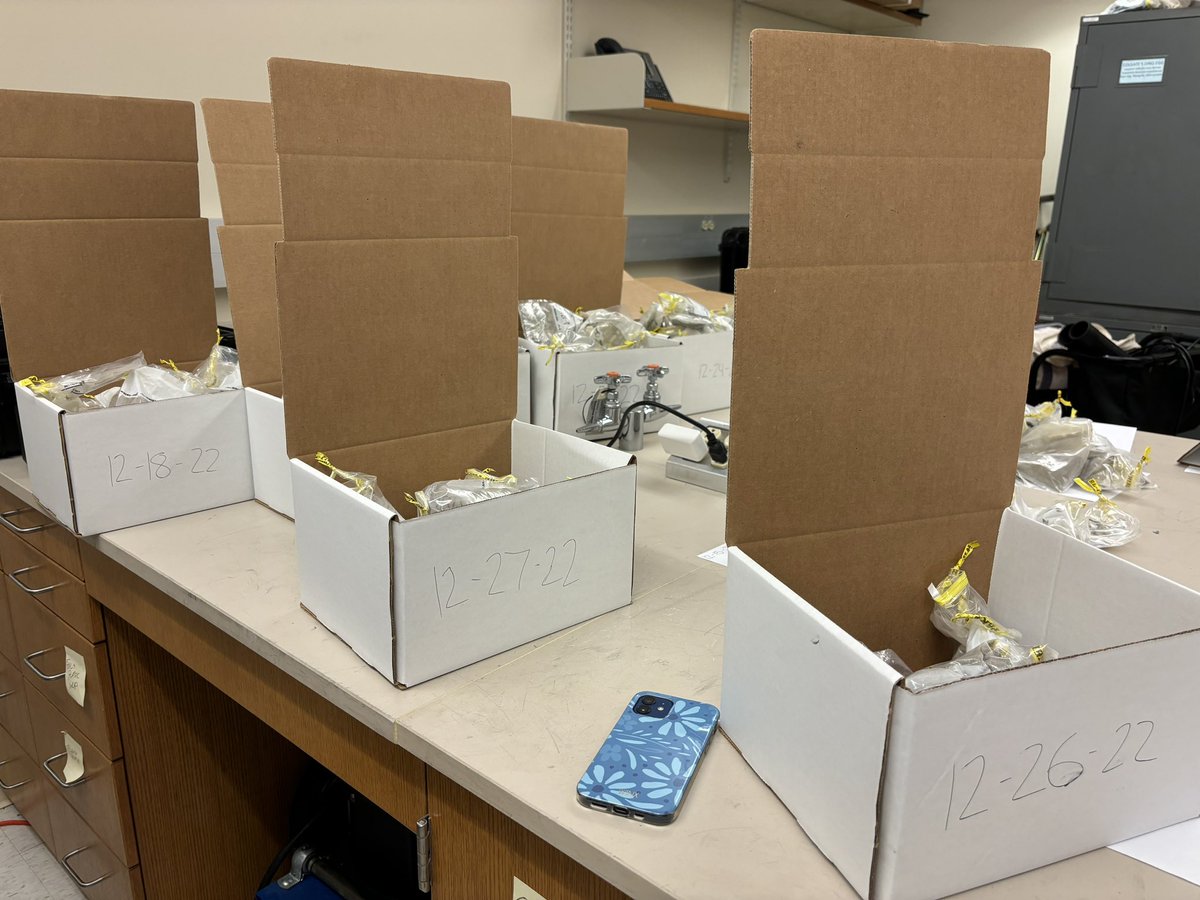
In the end, we settled on cardboard boxes by sampling day. I had been hoping to use CD boxes, but those are hard to come by these days for some reason….
Hey team #soils & #sediments, anyone have a favorite sample filing system for whirl-packed samples? Mostly, I organize by project year in drawers, but with bigger projects, I need to sub-divide and catalog more precisely. Anyone got a favorite sample box/cabinet/organizer?
@the59thStBridge This is one I had to look up. Etymologically, at least, meteor just means a thing lofted way up in the sky. So a meteoric rise is a lofty achievement. A pole vaulter could have a meteoric rise (strictly) followed by a meteoric plunge (observationally).
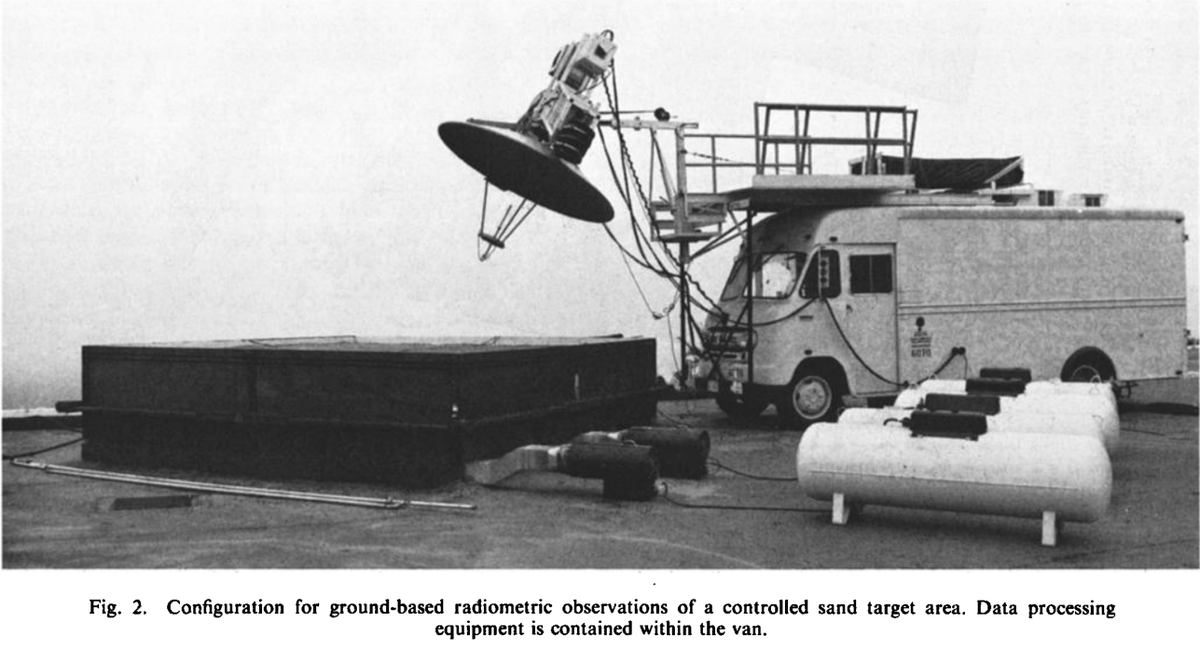
Sure, my radiometer fits on a drone and the microwave data can be processed on a laptop from my couch. That just makes it more convenient to collect and process the measurements. Njoku and Kong is an experiment with style and vision! https://t.co/cBZNYg4RpV
I like to think I do pretty cool research & that the figures in my papers are compelling. But then I see something like this (from Njoku & Kong, 1977, JGR) & I am reminded that A) We are standing on the shoulders of giants, & B) the retro future is cooler than the real future.
@BFThomas_Water@USGS_Water This question led me down the wormhole of different fruit densities. From this study, it looks like apples and oranges are in a near tie. I'd vote oranges over apples, just on visibility. Lemons will float a little lower in the water.
https://t.co/fKLGaPXYm9
@drcrater@westernuEarth@westernuScience There's some neat rock glaciers / dead DCGs up in the La Sals that could make a nice analog for the end game of ice-assisted rock movement on Mars. Only a little bit dicey to get up to on the forest roads.
@Geology_History How cool! Ayrton's ripple paper is here: https://t.co/aurdIIIkJO It's a wild example of 19th c. lab MacGuyvering. Come for the soap-dish mini-flume (initial experiments); stay for vortex visualization using ground pepper! An experimental and observational triumph!
Recycling + crushed glass sand manufacturing + wetlands restoration. What’s not to love? Maybe a lot? This is certainly gas and diesel heavy. And it is literally using energy to turn glass back into sand. But it is definitely diverting waste. Intriguing!
https://t.co/u2Xy6bUuUS
@queenofpeat One of the most satisfying things I did on sabbatical was to record some stories that tell the story behind my research (& posted them at https://t.co/fzSKuZnR82). I'm way far behind in keeping it up, but this I agree we all need to try to explain our science in human ways.
@planetaryben@NWS I love the result, but have very mixed feelings about the visualization from NWS. I get that blue = blue sky, but having increasing chroma for a decreasing quantity (cloudiness) makes my #datavis brain hurt just a little.
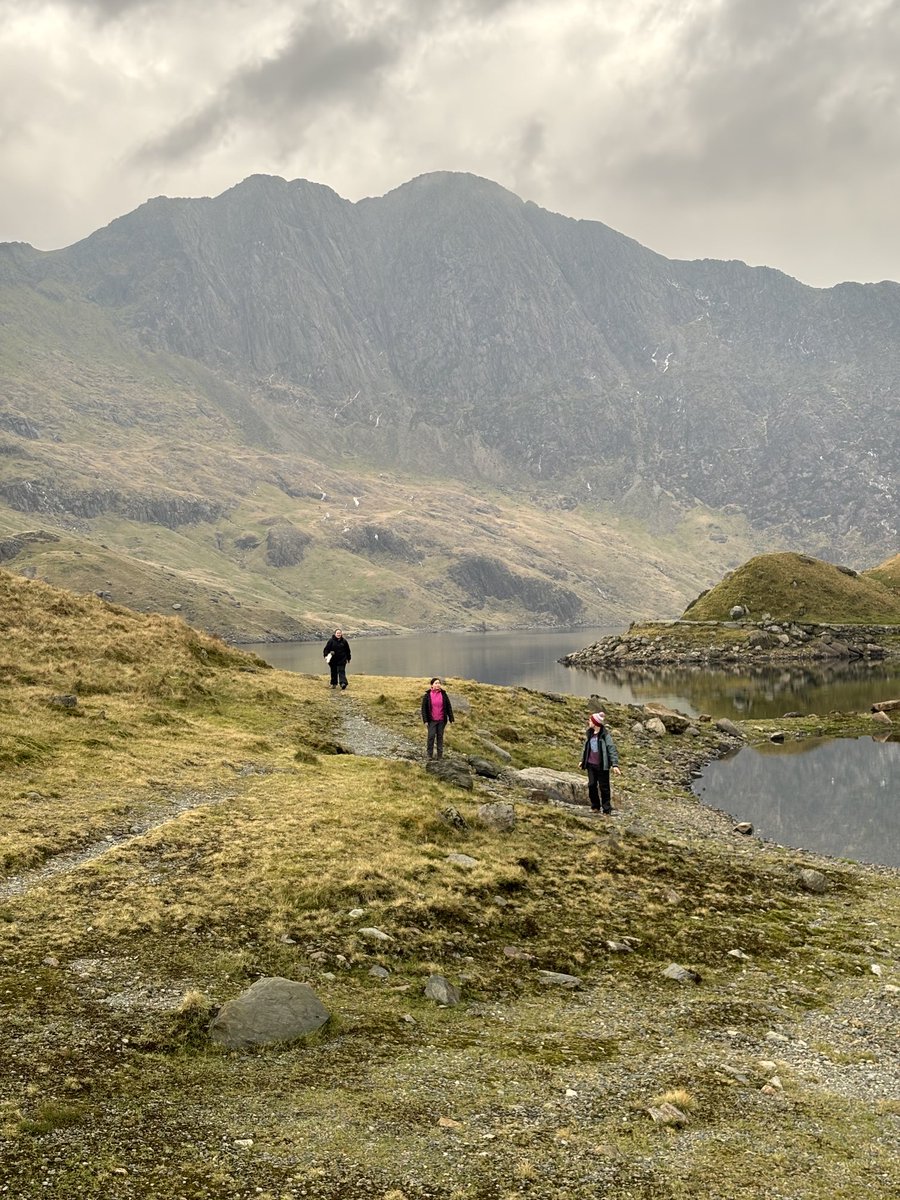
The best thing about learning the #geosciences in the field is that it helps put everything in perspective. Students on the @colgateuniv Wales Study Group exploring Eryri (Snowdon) yesterday.
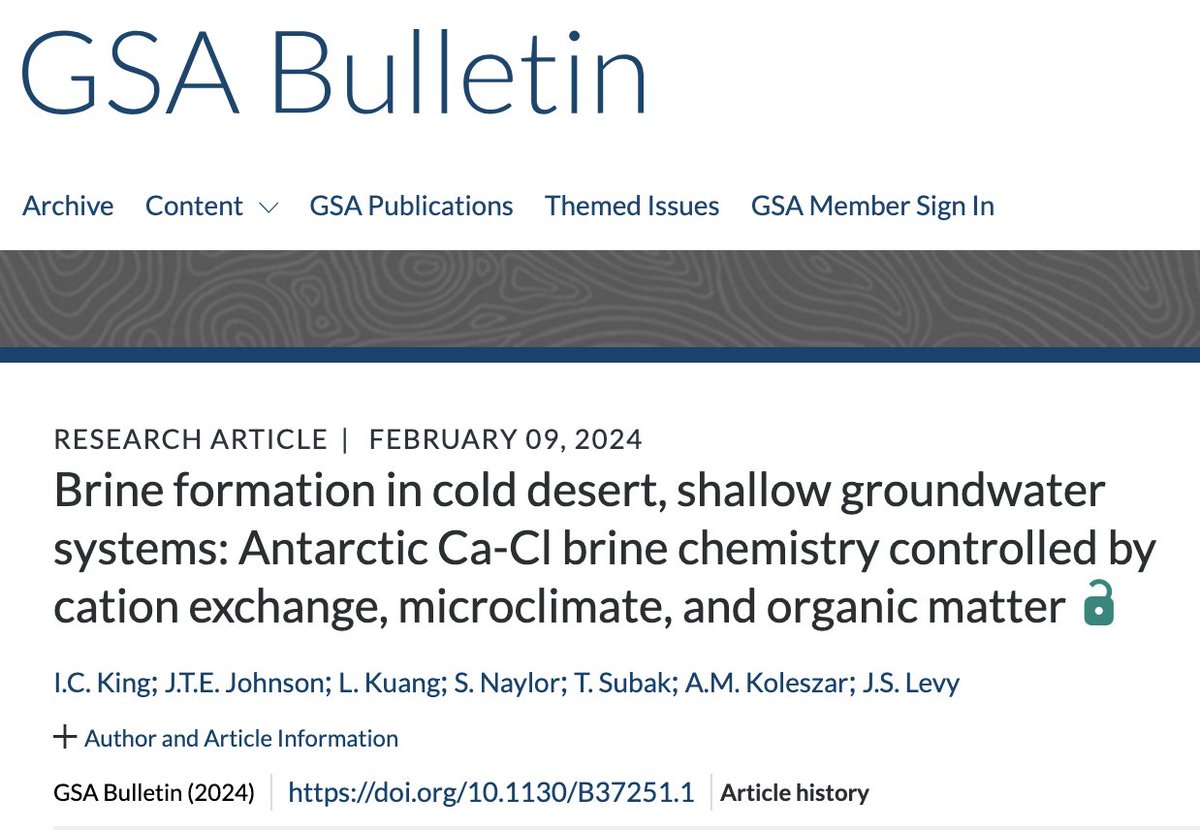
Into soil brines, chemical weathering, #Antarctica, or the future of soil development at the poles? Check out @colgateuniv alum Izzy King's new work just out in GSA Bulletin! https://t.co/P9v7mSsUiD