+$295,429.23 in the month of May.
+$142,789 in the month of April.
Such an easy market to make money in….started with a port under <$100,000 in October of last year btw.
This is just insane..
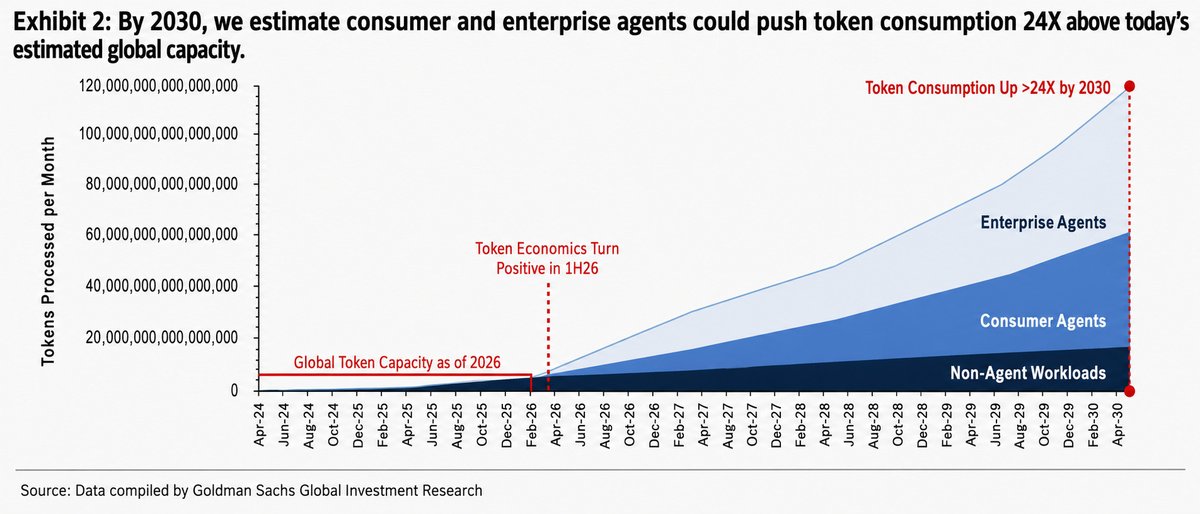
$GS predicts global token consumption to grow from 5 quadrillion now to 120 quadrillion in 2030.
A 24x growth in just 4 years.
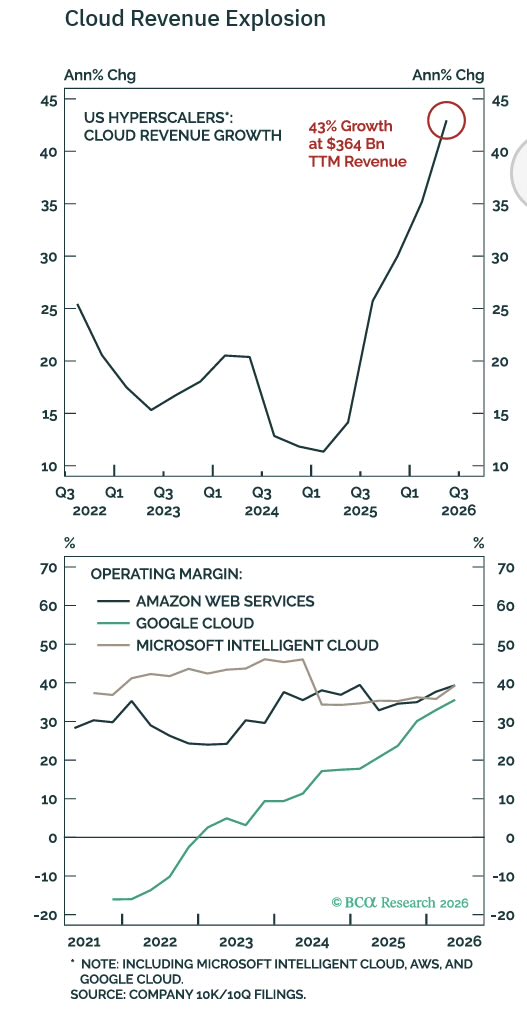
Imagine what this will do to hyperscaler earnings.
We aren't bullish enough.
$MSFT $AMZN $GOOG $ORCL
Meritz Securities Korea: We expect Samsung to revive, for the first time in a decade, an “early execution plan” comparable to its aggressive 2017 shareholder-return program—higher dividends, no deduction of M&A spending when calculating FCF, and the full return of 50% of FCF. The plan could be announced within the next few weeks.
With Samsung sharing the view that the recent share-price decline has left its shares undervalued, we expect share buybacks and cancellations aimed at enhancing shareholder value to be implemented first.
From Samsung Electronics Q2 Earnings Call
Q: Do you expect the current memory shortage to persist into next year? If possible, could you also share your medium- to long-term outlook for memory demand?
A: The rapid acceleration of agentic AI is driving an explosive increase in token consumption. This is fueling unprecedented demand not only for AI servers but also for general-purpose computing servers.
In practice, AI frontier model developers that have been unable to secure sufficient cloud capacity from hyperscalers are now requesting allocations from neocloud providers as well. This has translated into large-scale memory procurement by server OEMs that primarily serve those neocloud customers.
Even so, memory shortages mean that many frontier AI companies are still unable to secure the infrastructure they need. To address this, they have begun sharing their medium- to long-term demand forecasts directly with us and expressing their intention to purchase memory from Samsung. We are also seeing the start of requests for long-term supply agreements (LTAs) to secure additional volume.
As the adoption of agentic AI continues to accelerate, memory demand is expanding at an exceptionally rapid pace. Industry supply remains well below demand. Even with increased industry-wide capex, it takes more than three and a half years from the construction of a new fab to wafer production. As a result, meaningful supply expansion through new capacity additions will take considerable time. We therefore believe a significant increase in industry supply before 2028 is unlikely.
Based on the demand visibility we currently have from customers, a substantial amount of unmet demand will roll over into next year, creating additional supply pressure. We expect the memory shortage in 2027 to be even more severe than it is this year, with tight supply conditions likely to persist into 2028.
Looking beyond 2029, it is still too early to make definitive projections. However, as AI token demand continues to surge, large customers building long-term AI infrastructure are expected to continue requesting multi-year supply agreements.
These long-term agreements are well aligned with our objective of hedging future business risks. We intend to prioritize contracts with customers that can provide firm, long-term demand commitments.
Over time, this should allow us to transition away from the historically cyclical nature of the memory industry toward a more stable and predictable business model.
With improved long-term demand visibility through LTAs, we will be in a better position to execute a more flexible supply strategy. Following our existing approach of securing cleanroom infrastructure in advance and installing production equipment in line with demand, we expect to further strengthen this disciplined and flexible capacity expansion strategy.
@jukan05 AI capex slowdown where hyperscalers don't breach but aggressively renegotiate, which wouldn't show up as a default, but still compress pricing
However, all of these assumptions begin with the same premise: that a flood of new supply will arrive in 2028 and cause memory prices to collapse.
The analysis I read made the following argument.
Since the 1980s, memory prices have never fallen because demand declined. Demand continued to grow during the PC era, the smartphone era, and the cloud era. Every major collapse in memory prices has been caused by supply.
I agree. If Big Tech eventually lacks the financial capacity to absorb all the available memory, a new wave of consumer AI innovation will emerge to absorb it instead. Perhaps memory prices will first need to fall before that consumer AI innovation can take place. But that is a chicken-and-egg problem, not the central issue we are discussing here.
The analysis then went on to say this: everyone who has ever argued that “this time is different” in the memory industry has eventually been proven wrong. Yet there are several reasons why this time might actually be different. One is the growing use of LTAs, although many people remain skeptical of them, so I will set that aside. The more important point is that in today’s AI industry, as P falls, Q increases by much more than P declines.
A paper by Zhang and Zhang titled The Economics of Digital Intelligence Capital was posted on arXiv in January 2026. It estimates the price elasticity of demand for AI tokens at 1.42. In other words, a 1% decline in price leads to a 1.42% increase in volume.
The crucial point is that the elasticity is greater than one. When that is the case, falling prices can actually increase total industry revenue.
The paper models a scenario in which API prices are cut in half. Token consumption does not rise linearly; it accelerates in a convex fashion as developers begin adopting more compute-intensive inference architectures.
What matters here is that elasticity does not prevent a price collapse. It reduces the damage caused by that collapse.
Suppose DRAM selling prices fall by 30%. In the old world, shipment volumes would barely increase. Revenue would then fall by 24%, and because costs would remain largely unchanged, margins would collapse from 60% to below 25%. That is what happened in 2019, when Samsung Electronics’ operating profit fell by 52.8%.
In an AI-driven world, however, an elasticity of 1.42 means that volume rises by 42%. Assume that production costs also decline by roughly 15% through process migration. Revenue then remains almost unchanged, margins fall from 60% to 36%, and profit declines by only 15%.
Negative 52.8% versus negative 15%. That difference lies at the heart of whether memory companies deserve to trade at more than five to six times earnings.