Surprising that, this deep into the window, Lushendry Martes is still a Sparta Rotterdam player.
Obviously, he's not ready to step straight into the XI of a strong club in a top-five league and reliably deliver 1,500–2,000 minutes.
But!
Full-back — especially in a back four — is the hardest position to scout at almost any level of the game and on almost any budget.
Whenever people look at a successful, well-rounded full-back, deep down they can't help asking:
- if you're this technically gifted, why didn't you become a midfielder?
- if you're this quick, why aren't you a winger?
- if you're this athletic and tenacious, why weren't you converted into a centre-back or a defensive midfielder (depending on your frame)?
Modern football asks an awful lot of a position that kids get shunted into from an early age out of desperation, as an afterthought.
The top clubs understand this, get burned regularly — and usually don't hesitate to keep spending on the search.
City under Guardiola have shelled out 360m on full-backs, not counting another 60m on Nunes, who has ended up as one too.
Arteta's Arsenal have put 260m into full-backs.
Paradoxically, top clubs sometimes find it easier to get it right in positions most people consider more important: the full-back role has been reinvented several times over the past decade, and every iteration forced the rich clubs to react, adapt and redraw the profile they were shopping for.
And that's before we even get to the fact that, with a perfectly stable game model, you can still miscalculate when
a) you're judging how a particular full-back will mesh with the midfielders and wingers you already have, and at the same time
b) you're predicting who'll be playing in those positions in a year or two — and how they'll combine with the full-back you want to sign today.
@NVasyukhin wrote about this six years ago using Liverpool as the example:
https://t.co/59zQJDESRE
...and what was a measured assessment at the time (https://t.co/I2eeXHLfXj) — "Robertson, signed for 9m, is now worth at least 40" — looks amusing with hindsight: we now understand that Liverpool didn't just snap up, practically for free, eight seasons of a nailed-on starter and the most prolific assisting left-back in the history of the world's strongest league. Above all, the club saved money at a position their main rivals spent all those years pouring serious cash into.
If you could go back to 2017 and force John Henry to write Hull a cheque for 100m instead of 9m for Robertson, everyone in that alternate-reality 2025 would still call the transfer a success.
And it's not only the top clubs splashing cash because they can: Aston Villa, for example, with a more frugal transfer policy, tried to find a decent backup for peanuts by Premier League standards, investing in Nedeljkovic and Andres Garcia — both obviously raw and not exactly technically rounded for Villa's level.
Neither bet has come off so far. They snapped. Went and got Wan-Bissaka.
That's telling. And there are plenty of cases like it.
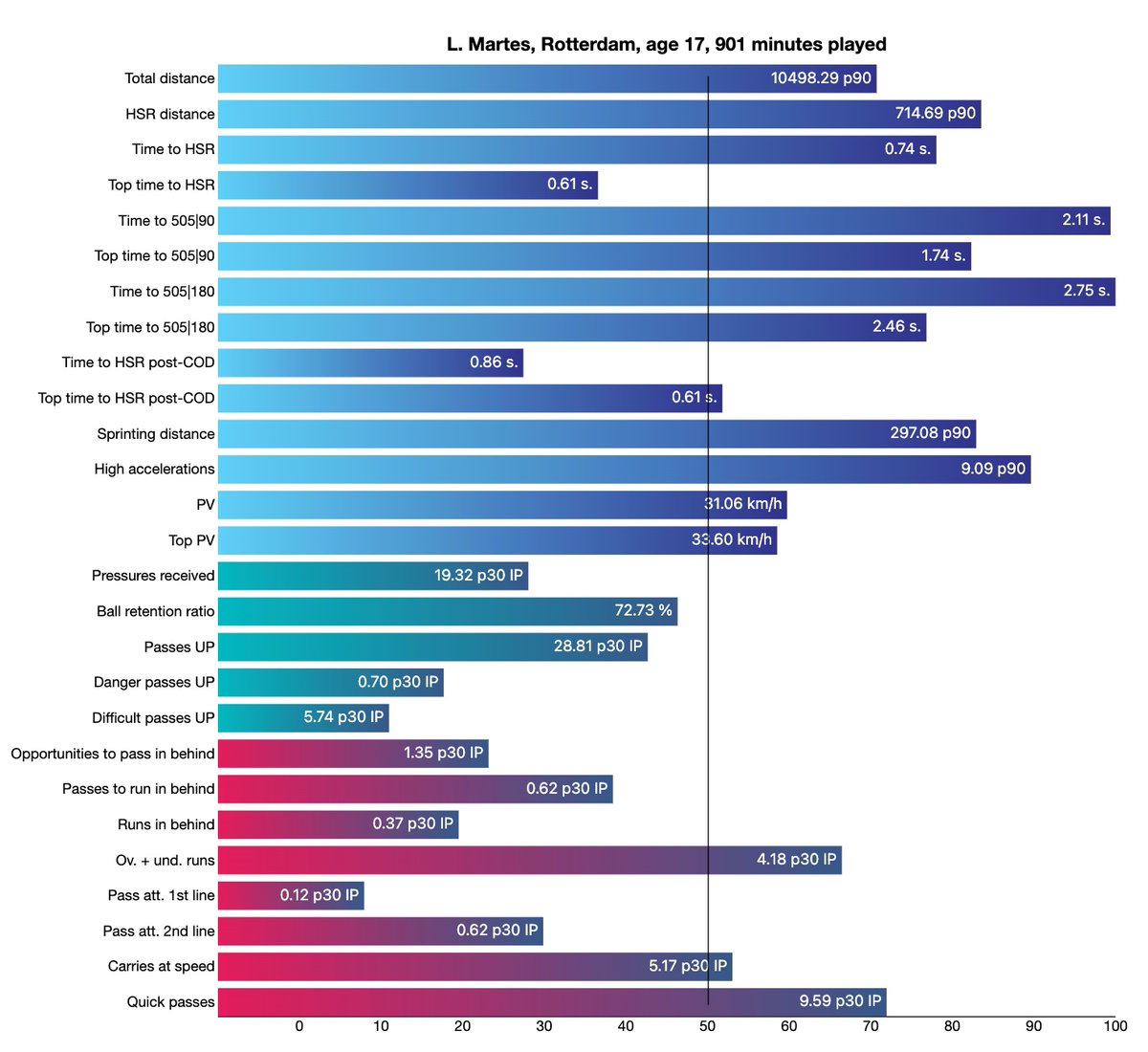
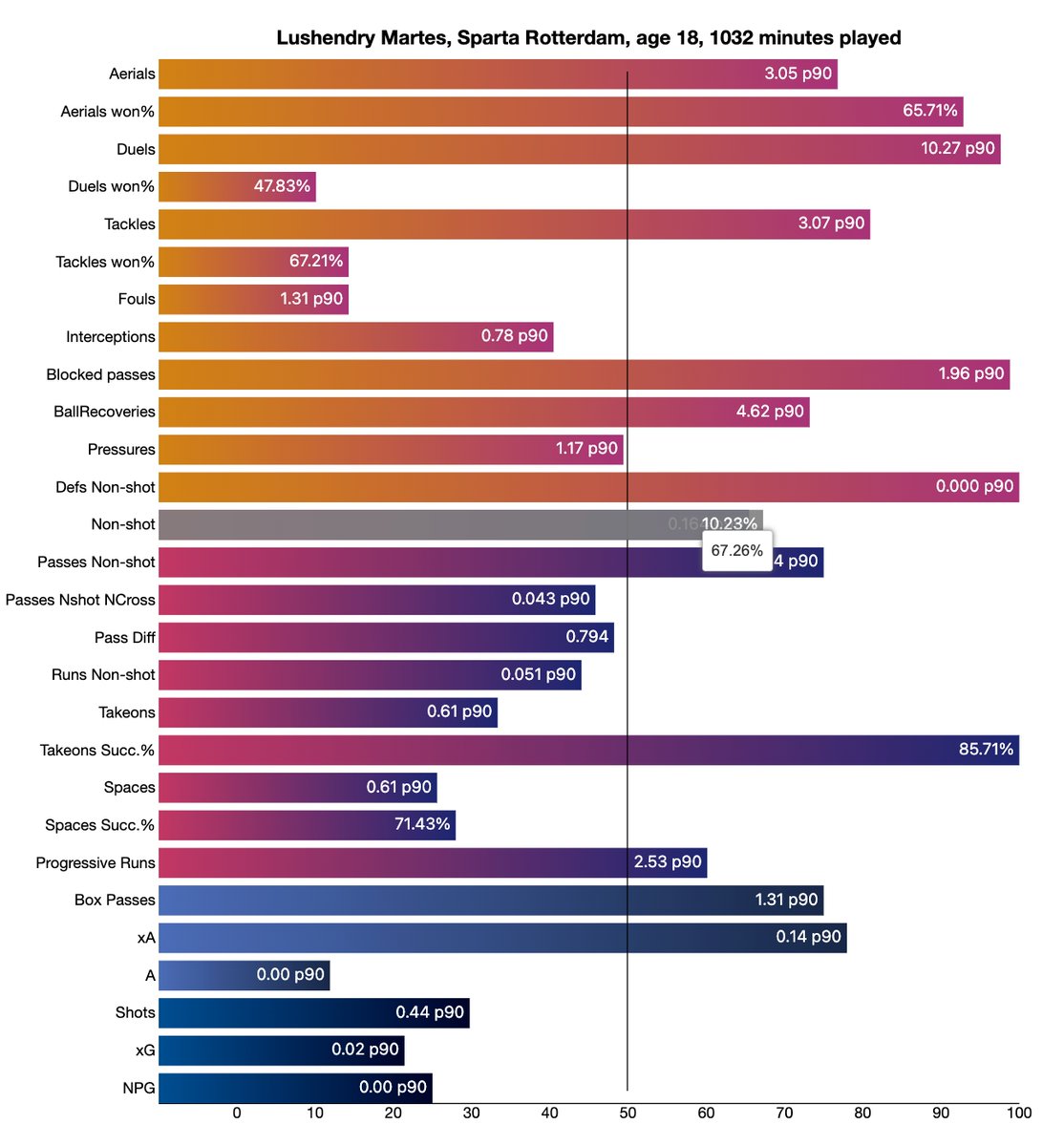
Martes himself is no unicorn, of course, but he combines a set of qualities that's rare at his age. Across the top leagues of Europe and South America (the big five with their first and second divisions, plus Portugal, Belgium, Turkey, Brazil, Argentina and the Netherlands), only two full-backs under 20 pass this filter:
- at least 400 played minutes in 25/26
- average time to HSR ≤ 0.75
- average peak speed above 31 km/h
- best peak speed above 32 km/h
One is Culbreath at Leverkusen; the other is Martes.
There are simply very few young full-backs in the world who can actually play (for a 17-year-old, Martes has a solid, well-balanced event chart, and his tackle and duel success rates will clearly climb as he matures) — while also putting in solid sprinting volume (more sprint distance than 80 per cent of Eredivisie full-backs), being explosive and agile (superb re-acceleration numbers after 90- and 180-degree changes of direction) and fast enough over a distance.
Why not one of several dozen clubs has risked a few million purely on a "let's not miss out on this one" basis — while the player sits at Sparta, a club that has never sold anyone for more than 5m — is a big question.
Even if the move ends up a record sale for the Rotterdam club (nobody would be surprised), it's still a trivial outlay for the market's key operators, whose portfolios are always stacked with players of uncertain upside and who have plenty of places to loan a youngster out — to develop him and inflate his future price in case his level never quite proves enough for a top club.
The most underrated striker in Europe plays for Barcelona. For now.
Ferran Torres is destined to go down as one of the most underrated players of recent years. Underrated to the point that things somehow escalated into a public falling-out with Barcelona.
We take the defensive shortcomings of star, high-scoring forwards for granted. Far less grace is extended to the technical shortcomings of players who live through matches at ultra-high intensity.
A player constantly engaged in high-speed running will, in a vacuum, always execute difficult technical actions less cleanly than one who presses less often and receives the ball on fresher legs.
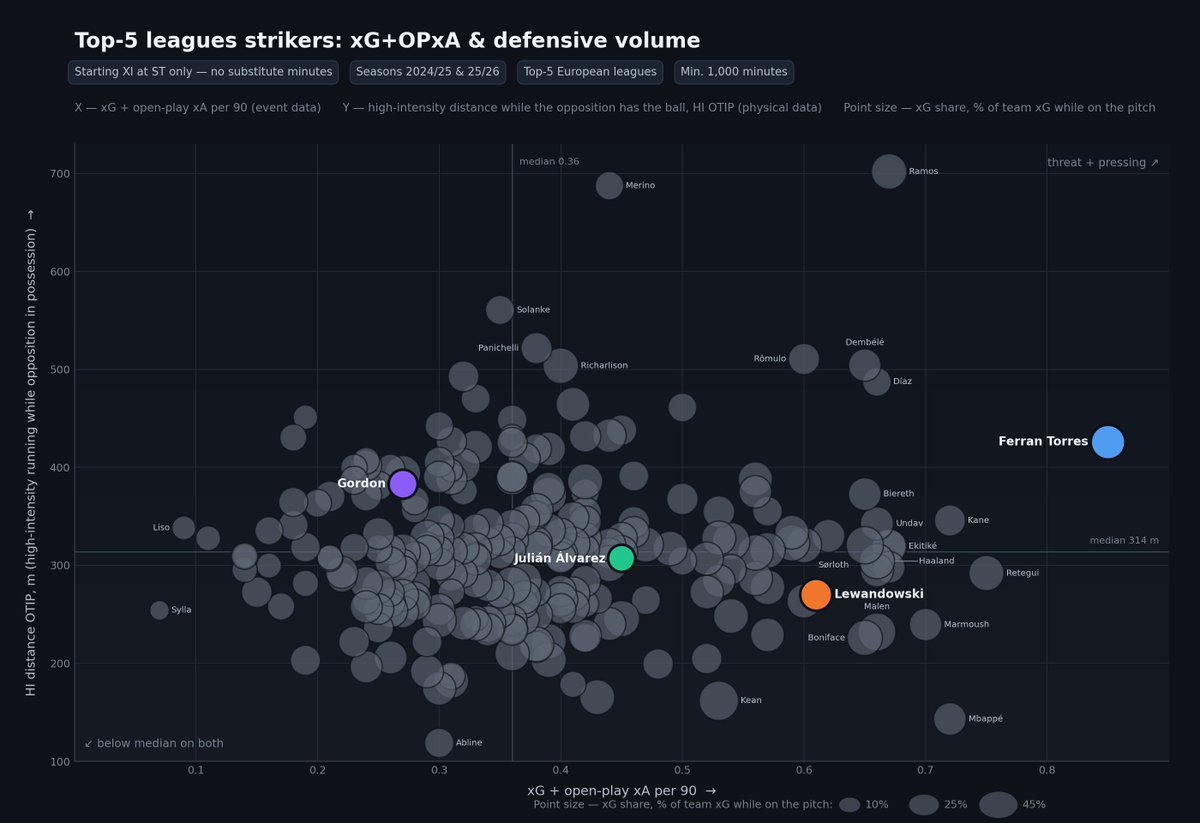
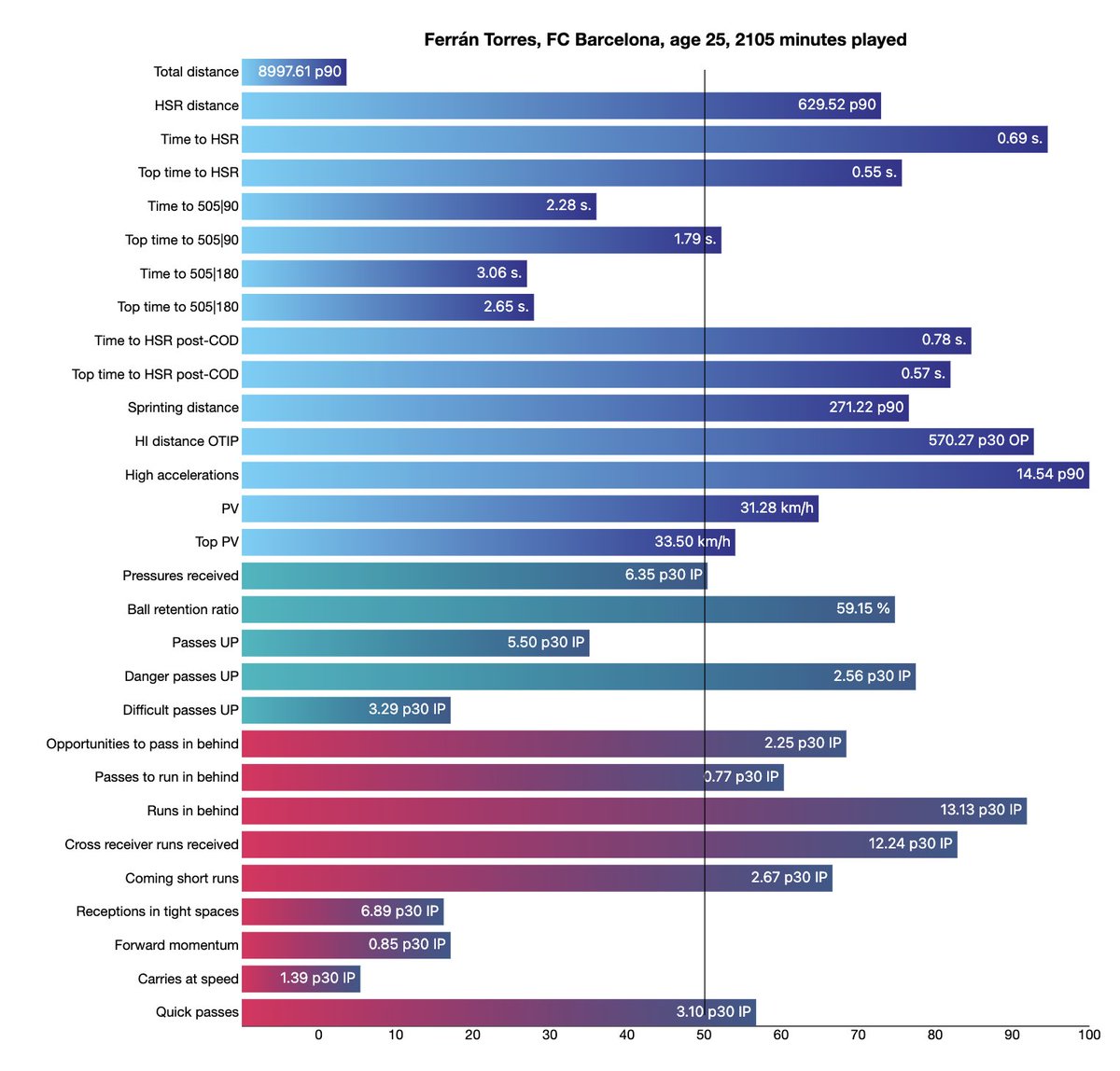
None of this erases Torres's coordination issues or his technical imperfections. But it is just as unreasonable to expect immaculate finishing from a player who works off the ball as hard as the most industrious forwards on the continent — how far would the chart below have to stretch to the right in that case?
Tellingly, ten years ago even progressive Spain — the centre of world football culture — struggled to keep up with the new ways of profiling forwards. In a country whose national team had just won everything without a classic No. 9, nobody recognized a striker in Ferran in time. He was shunted out wide so that, in the youth national teams and at Valencia B, he wouldn't get in the way of developing Abel Ruiz and Rafa Mir at the nine — decent players, but nowhere near Ferran's eventual status & level.
So he became a victim of his own pace and mobility, despite being conspicuously one-directional by top-winger standards and lacking any consistent, varied one-v-one game from a standing start.
Now that Ferran has grown into the striker's role (belatedly, but not fatally so — Guardiola was already trying him up front in a handful of City matches), his knack for arriving in the right spots with the right timing has turned against him: he misses chances that other forwards simply never have, because other forwards never arrive in those spots. That is how the illusion of ineffectiveness is born.
Granted, Ferran hasn't played regularly, and his xG is spread unevenly across matches.
And yet:
— the horizontal axis only counts matches in which a player started nominally at striker, filtering out chances poached late off the bench. Ferran still sits further right than anyone;
— point size reflects the share of his team's xG a player takes upon himself. Ferran's dot is one of the biggest: he isn't padding his numbers purely off the strength of his teammates.
He combines an enormous pressing workload with well-timed runs at serious speed. A long, quick stride gives him an edge in races to the ball that nimble but undersized forwards like Álvarez simply don't have.
For PSG, getting him in place of Gonçalo Ramos would be a gift from the heavens. Even if it means handing over nearly everything they recouped from Milan.
Luis Enrique understood earlier than most that in total football — where the entire attacking unit runs and is, to a degree, interchangeable — a static No. 9 (static not in terms of running, but in technical toolkit relative to the typical centre-forward) is either dead weight you're better off without, or a role player for specific stretches. Mostly endgames: once the first hour's tempo has broken the opponent's will to resist, you finish them off by sending a specialist, as Tuchel calls them, into the box.
To preserve that tempo and unpredictability, Enrique is willing to forgive Dembélé two perfect but unconverted cutback situations in a Champions League final — knowing full well that any clumsy nine would have simply stuck out a leg and scored while Ousmane was still hunting the second-wave pass.
Outside the box, Ferran is, of course, nowhere near Dembélé. Inside it, he is far more disciplined: both on cross receiver runs towards the goal and on runs in behind, he ranks above the 80th percentile among La Liga forwards.
He is also far more versatile than Ramos. In routine league matches Ferran can even cover the winger's slot, letting Enrique avoid inflating the attacking rotation with an extra body. And PSG are operating in a narrow corridor here: signing someone expensive and good is risky (barring an avalanche of injuries he won't get enough minutes and will grow restless — even a teenage Mbaye managed to feel hard done by), yet you can't bring in just anyone without cluttering the squad, and renewal for renewal's sake is premature since all the attacking stars of PSG are far from decline age.
No doubt, if the Super League existed in reality rather than in pitch decks, Barça would long ago have given Ferran everything he wanted instead of letting things reach this point, for fear of handing a key player to a direct rival. But in essence, Barça and PSG are rivals already, even without ever meeting in the same league: their squad-building principles and the demands they place on the front three are ideologically too close. And it ought to sting to let a profile that fits you leave in his prime — just when your virtual rival needs him most.
It is surprising to hear claims that Real Madrid overpaid for Diomande. When it comes to exceptional players at the absolute top tier of world football, the market operates under entirely different rules.
Diomande is a unicorn: he executes so many things at an elite level simultaneously that such a combination of strengths almost feels unreal. In other years, Real Madrid or any other top club could enter the market looking for a similar skill set at a suitable age — not necessarily young, but at least pre-prime — and come away empty-handed whether they offered €50 million or €200 million.
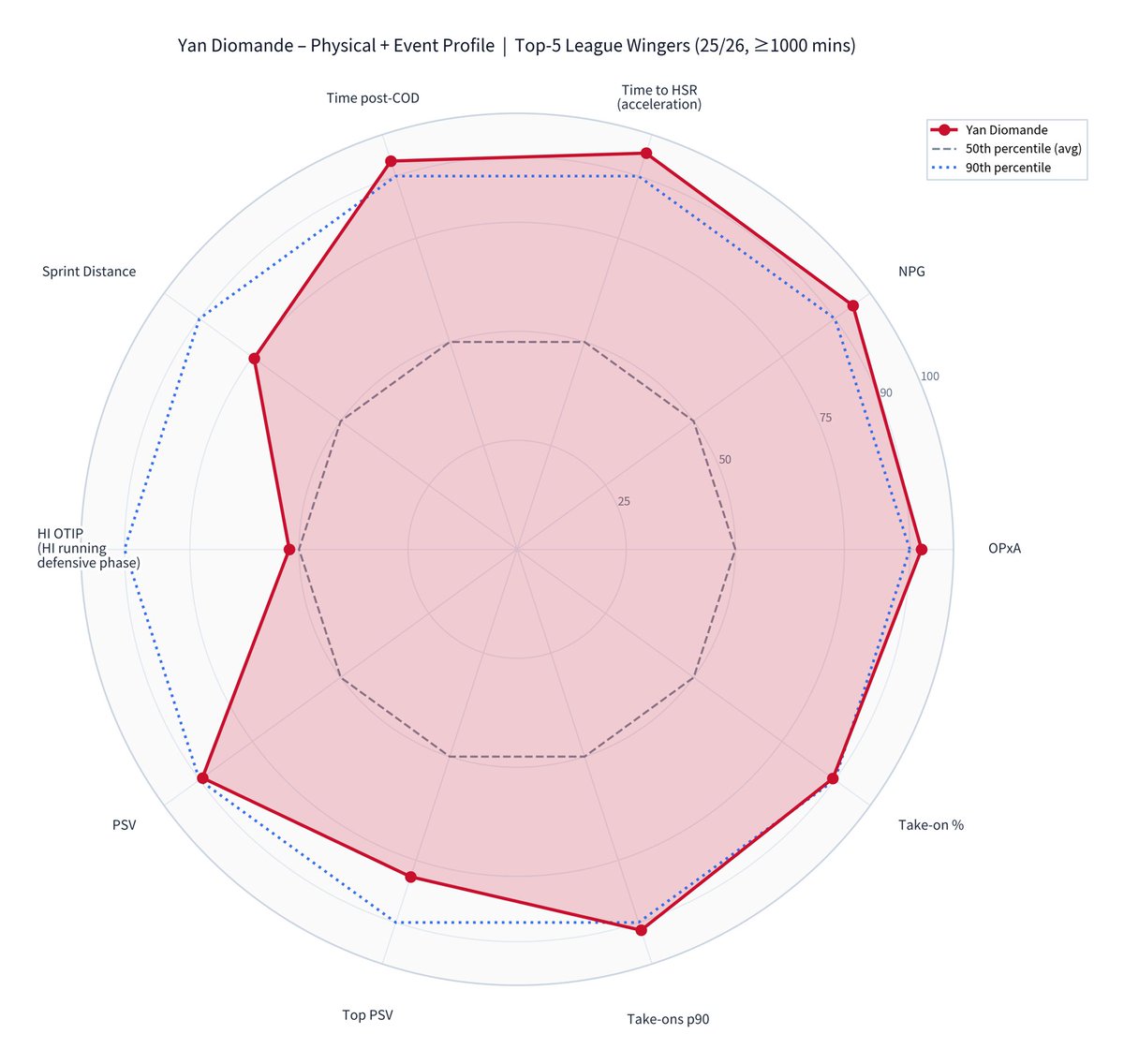
He is an elite dribbler:
Dribble frequency: >90th percentile among top-5 league wingers in 25/26.
Dribble success rate: >89th percentile.
Backed by elite physical traits that favor a relentless 1v1 style:
Time to HSR (how fast an acceleration from a walk to high-speed running occurs = explosive burst): >95th percentile.
Time post-COD (burst following a change of direction): >90th percentile.
With outstanding end product:
OpXA: >90th percentile.
NPG: >90th percentile.
Passing clusters reveal just how aggressive Diomande's distribution is: he attempts cross-field passes into the box from wide areas more than three times as often as the average Bundesliga winger, and plays cutbacks twice as frequently. This is a direct consequence of using his long, rapid strides to create separation against virtually any defender in wide isolations — and serving up chances for teammates in the box from either flank. He is the single best guarantee of consistent wide delivery in any tactical system, even on an off day.
Diomande doesn't like running in behind, outside of extreme scenarios involving high turnovers and clear open space. Even then, his bias is to drift outward to shape a shot with the inside of his foot, angling his upper body back.
On one hand, that’s an obvious limitation. On the other, his ambipedal finishing almost guarantees that over a larger sample size, he will outperform his xG and consistently convert chances from around the edge of the box from both sides.
At this stage of his career, Diomande remains remarkably hard-working: 74th percentile for sprint distance and above the median for high-intensity running out of possession. That is precisely why it makes sense to buy a player with this profile earlier at a higher price, rather than waiting for him to re-confirm his quality down the line.
Dribblers burn out fast. Part of this is down to experience — learning to solve situations through passes rather than forcing take-ons. But only part. The act of dribbling itself is a complex, high-intensity coordination task: constant changes of direction, sharp turns, rapid footwork under physical contact, balancing, and sudden decelerations. The fresher and lighter the legs, the more raw urge there is to expend that energy. The greater the wear and tear, the harder every take-on becomes — the inverse correlation between a winger's age and their dribble frequency is starkly evident on data graphs.
Crucially, Diomande's dribbling is functional, not frivolous. He turns it into low crosses. He turns it into shots. He generates immediate threat. His output is directly tied to how often and how effectively he can create opportunities for follow-up actions specifically through take-ons. His 3rd percentile ranking for off-ball runs in behind and 1st percentile for cross receiving runs leave zero hope that an off-ball threat will magically emerge in his game later.
Modern top wingers are perishable goods. The earlier you get them, the more elite seasons you squeeze out. Almost any rapid player with long legs, high-level dribbling, raw speed, freakish burst, and decent physical volume operates with an internal countdown timer ticking toward an inevitable — and relatively swift — decline. For most players of this archetype, a lifelong habit of relying purely on physical gifts destroys any chance of adapting their game in maturity to stay elite through other qualities.
Alongside the drop-off in dribbling, top wingers tend to shed off-ball running volume early on. Simple rationality: conserve energy on defense to preserve fresh legs for bursts of high-intensity attacking actions. Defensive output drops gradually while attacking impact remains. No manager can realistically call out a star who wins games up front, and replacing such a profile internally at an elite level is almost impossible.
Star consciousness solidifies into a self-fulfilling prophecy. The positive feedback loop grows until it swells into a disaster on the scale of Rafael Leão.
And that's assuming the player stays clear of major injuries.
Gareth Bale started breaking down at 27–28. Kudus appears to be doing so at 25–26. Nico Williams hasn't been able to hit 2,000 domestic league minutes for two straight seasons. Mohamed-Ali Cho hasn't hit 2,000 league minutes once despite playing at the top level for five years. It would be a minor miracle if Alphonso Davies gives us another one or two full-throttle seasons, and he isn't even 26 yet. Different position, but muscles and tendons don't care what your official role on the pitch is when a large frame is subjected to extreme loads at maximum speed with endless braking and sharp turns.
Elite wide players — both full-backs and wingers — are simultaneously the most sought-after assets on the market and the first in line for rapid decline, because they are living on borrowed time from nature. The "Wembanyamization" of football raises team ceilings through unique physical unicorns while dramatically increasing risk: become dependent on them, and you find yourself unable to replace their wide profile when they break down (just look at PSG's struggles to defend large spaces when Mendes and/or Hakimi are out, forced to rely on solid but far more limited options).
That's why Real Madrid cannot afford not to act right now. There is no rational point in waiting to see if Diomande overcomes the dreaded "second-season syndrome," reaches another level, maintains consistency, or re-verifies his quality in the Champions League.
Diomande today for €120m buys roughly 5 seasons of elite output in line with his profile. Diomande in a year, even for €80m, buys only roughly 4 seasons. Or fewer: nobody really knows his exact age if he moved from Ivory Coast at 15.
For an elite club, the risk of waiting is far higher than paying early for a unique skill set before the player begins to stagnate, get complacent, conserve energy, or pick up injuries.
Therefore, for unicorn talents on the rise, the concept of "overpaying" simply doesn't exist. There is only a binary choice: sign them or miss out.
Pass on him today at €120m, and tomorrow there won't be anyone like him on the market even for €180m.
None of this guarantees Diomande's success at a new club, but even at Leganés on a limited sample size, he was tearing La Liga apart.
Furthermore, it's common knowledge that Real Madrid suffers from a heavy left-sided attacking bias: they generate more than double Barcelona's carrying entries into the box from the left, but hover in mid-table for the same metric on the right. Meanwhile, in the Bundesliga, Diomande was carrying the ball into the penalty area from the right wing almost more often than anyone else, trailing only Michael Olise.
Real Madrid's proportion of cutbacks relative to total passes is twice that of Barcelona, but here too lies a massive left-sided slant and a heavy reliance on Vinícius. If Vinícius stays, Madrid gets immense wing diversification. If he leaves, Diomande can swiftly absorb the loss regardless of which flank he operates on.
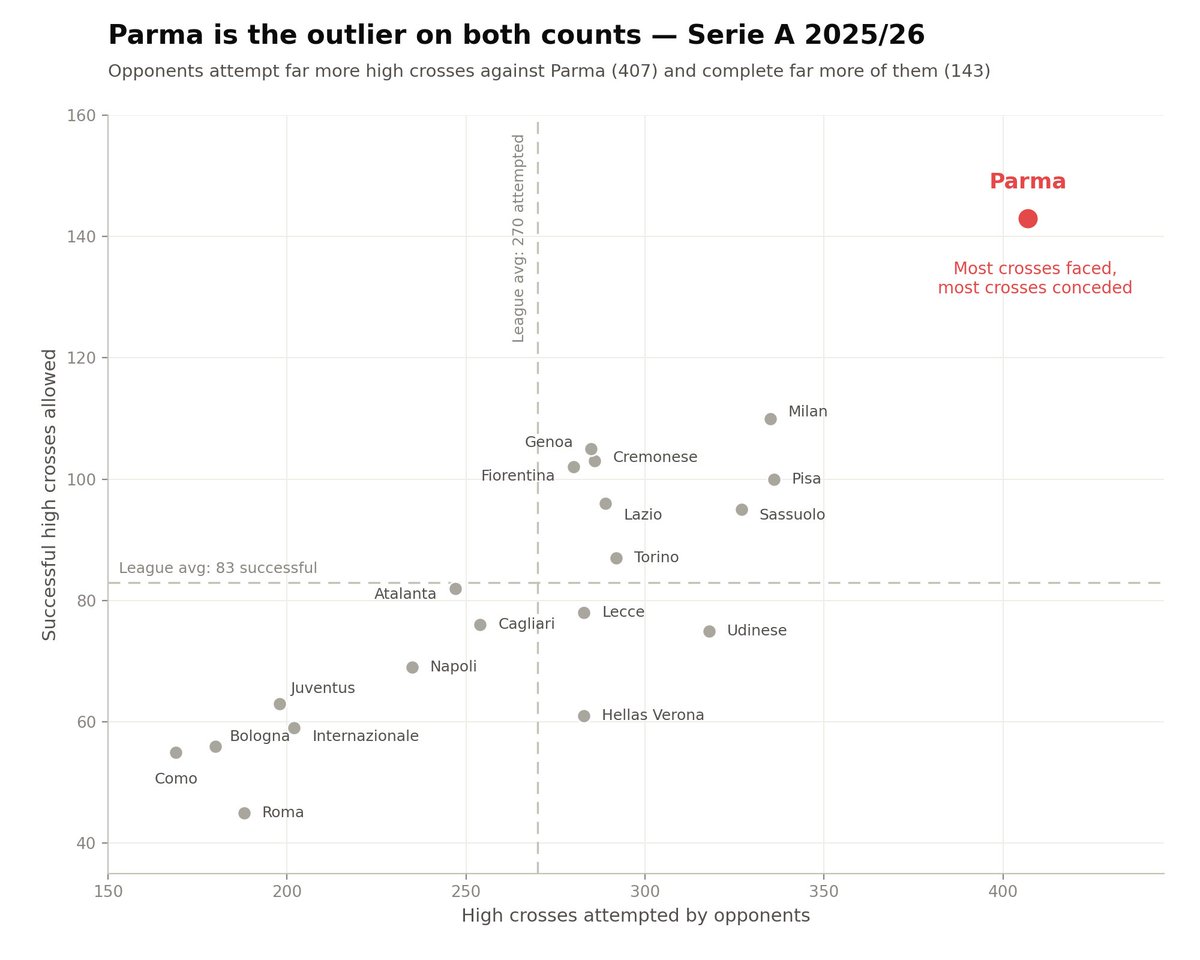
Parma are sticking with their commitment to youth: last season their starting XI was comfortably the youngest in Serie A and third-youngest across the top five leagues, level with Chelsea. Only Strasbourg and PSG were younger, and their resources are on a different planet.
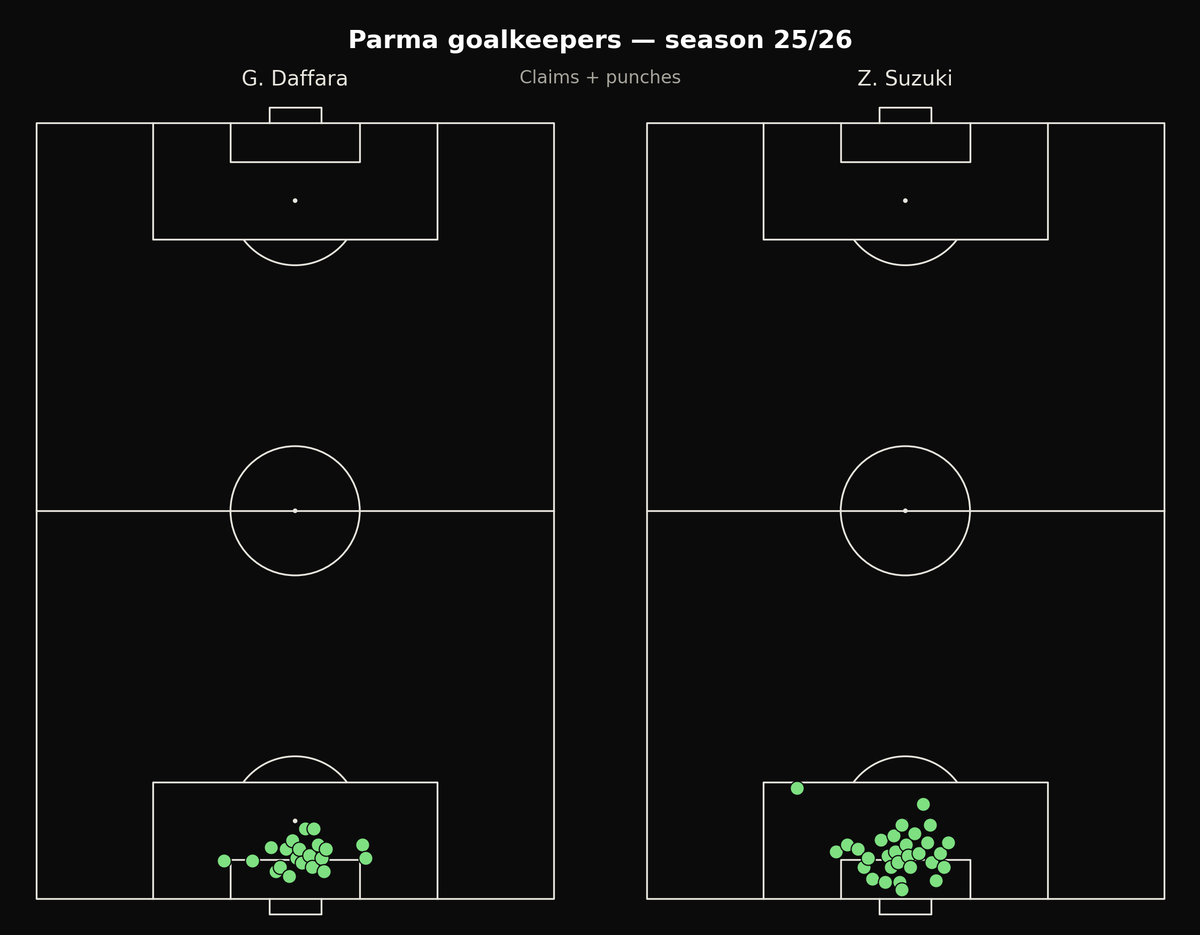
Suzuki moving to a big club was predictable even without the World Cup hype. Keepers with his profile are always in short supply: acceptable on the line by top-five-league standards, heavily involved with his feet, and aggressive and reliable on crosses. In Japan, Belgium and Serie A he consistently ranked above the 90th percentile for share of claims on crosses within 16.5 meters of goal.
Parma made their bet on Daffara well in advance. He's highly rated in Italy and has already been called up to the national team without a single top-flight appearance:
Serie B: 0.87 goals/xG2
Serie C: 0.94 goals/xG2
Primavera: 0.91 goals/xG2
In the lower tiers Daffara has been consistently solid on the line, and he's smart with his feet. But fully replacing Suzuki isn't realistic: he's far more passive coming off his line and never got anywhere near the median for aggression in any league, not even in the Primavera. So the protection against crosses will almost certainly drop off. And the eye test offers little hope for major progress: Daffara is much less mobile, tends to take up more conservative positions and stays closer to his line. In Serie B most of his claims came strictly inside the six-yard box, a stark contrast with how much wider Suzuki's range was beyond it.
Not a big deal at first glance, every keeper has a weak spot. But Parma survived by the skin of their teeth last season and arguably overachieved on points, and they were comfortably the worst team in the league for crosses conceded from wide areas. All the load Suzuki was absorbing now falls on the defenders.
The rest of the summer, helped by healthy profits from player sales, will likely be spent reshaping the squad to concede less from the flanks. Otherwise, even if Daffara's strengths translate a level up, his key limitation will simply keep gifting opponents the kind of chances Suzuki never allowed.
@jadedSpur @billycarpy@Gradient_Sports different data providers, not fair to compare their numbers directly. SkillCorner also ranks Van de Ven as the fastest centre-back, but their data shows his top speed as 35.1 km/h. They only include top speeds up to the 99th percentile, which might leave out some extreme sprints.
@billycarpy@Gradient_Sports Pretty impressive that even in 22/23 at Coventry he already stood out by EPL standards for strikers. What’s even more remarkable is the leap he made in 24/25 — not just in top speed, but with a steady season-by-season rise in average PSV, making him a more consistent runner.
@HenshawAnalysis Isn't it handier to replace player age with birth year? Easier to filter the player within the database in a year or two after the actucal report being written.
@HenshawAnalysis Notion is the perfect solution both for the scouting database maintenance and inside communication inside the scouting department.
No specific apps / services designed specifically for football purposes (SoccerLAB, Scout7 etc) ever matched Notion’s flexibility.
@martics97 Skillset wise how similiar you think all the pivots they bring to replace the ones leaving the club? Identical or not so much & and some adjustments needed by the coach after signing?
Wide Angle Footage:
In 24 Hours I'll be sharing a link with Wide Angle footage for coaches to use (Educational purposes only).
If you would like to receive the link... Like, RT, and WhatsApp +27647833264 to join the broadcast list.