The Journal of Regulatory Economics has a new call for papers for a special issue on Global Perspectives on Occupational Licensing. We are excited to have Ed Timmons guest editing the special issue!
Learn more by accessing “The industry costs and benefits of occupational licensing: measuring differences in establishment behavior and quality” - Journal of Regulatory Economics
https://t.co/Ib2ViwBP4y
💡Take a look at this!💡
Better information doesn’t always mean better choices.
New research shows energy retailer loyalty programs can offset transparency policies by shifting consumer attention away from price and energy source.
#Economics#Energy
💡Take a look at this!💡
Cross-border rail pricing can be inefficient.
New research shows lack of coordination leads to higher prices, but cooperation and smart regulation can improve outcomes for both consumers and providers.
#Economics#Infrastructure
💡Take a look at this!💡
Fuel surcharges in rail appear to be formula-based, but aren’t.
New evidence shows firms charge more in less competitive markets, using pricing structures to exercise market power.
#Economics#Regulation
💡December 2025 issue💡
Is cost benchmarking reliable for setting utility revenues?
New research shows sunk investments, data limits, and model assumptions make “efficient cost” estimates noisy and potentially misleading.
#Regulation#EnergyPolicy#Economics
I am thrilled to be guest editing a special issue of Small Business Economics (SBEJ) on Innovations in Institutions and Entrepreneurship Research with Christopher Boudreaux, Adam Stivers, and Nabamita Dutta. Please check out the call for papers and submit your work!
Why would anyone continue to use humans when AI is vastly more productive?
We don’t need to speculate about what happens when massive efficiency differences exist between producers. We have that today. The inefficient producers still remain.
The most efficient white bread establishment (thinkk plant level productivity) produces 2x, 3x, even 6x as many loads of white bread as the least efficient with the same inputs. This is well documented across every country and industry studied.
I’ll just pull up the 4 digit NAICS since that’s what’s publicly available. https://t.co/fK3COu8Olq
Sort establishments by productivity. I’ll mostly use total factor productivity, TFP, but the same holds for labor productivity but is even more extreme.
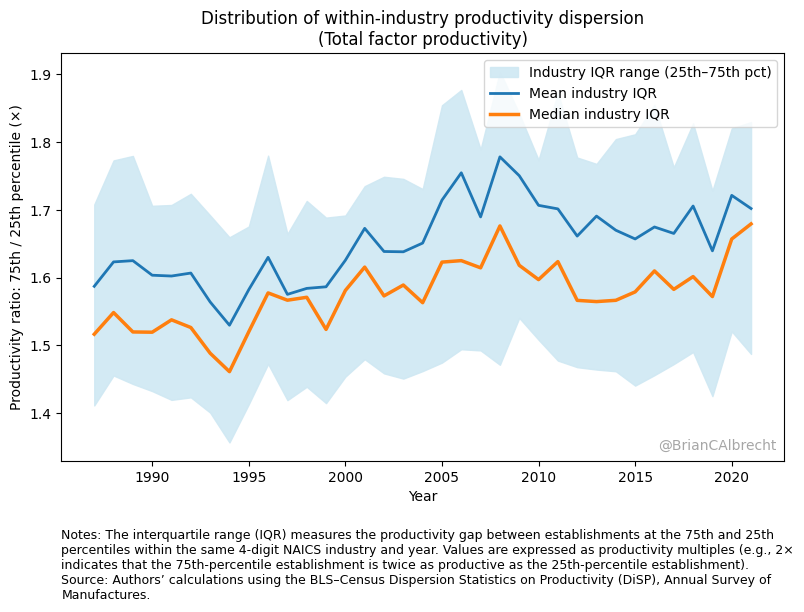
What’s the gap between the 75th and 25th percentile establishment?
For the median industry (orange line), it’s about 1.7x. These numbers are even more dramatic when you look at labor productivity, where the 75-25 gap is more like 3x. Workers at the 75th percentile establishment produce 3x as much as workers at the 75th.
That's just the median industry. If we think the tail industries matter, we should think of the "dispersion of the dispersion." The blue region captures that For the 75th percentile industry (top of the blue region), the multiple is 1.9. That’s only for 75-25 industries of the 75-25 gap, not really the tails.
Do the same for 90-10. What’s the gap between the 90th percentile and 10th percentile establishment?
The median is now 3x, with the 90th percentile industry being 6x. 10% of manufacturing industries have a 6x gap in productivity.
In other words, 10% of establishments in 10% of industries are remaining open despite costs that are 6x as high.
This is what I mean when I say we don't need to speculate about how people use inefficient firms still. It happens today.
And that’s in the US, where competition is as fierce as anywhere in the world. It still doesn’t weed out the low productivity firms. https://t.co/cZLB6eXAks We will return to why in a sec.
“That’s all old white bread stuff. Not the technology of the future.”
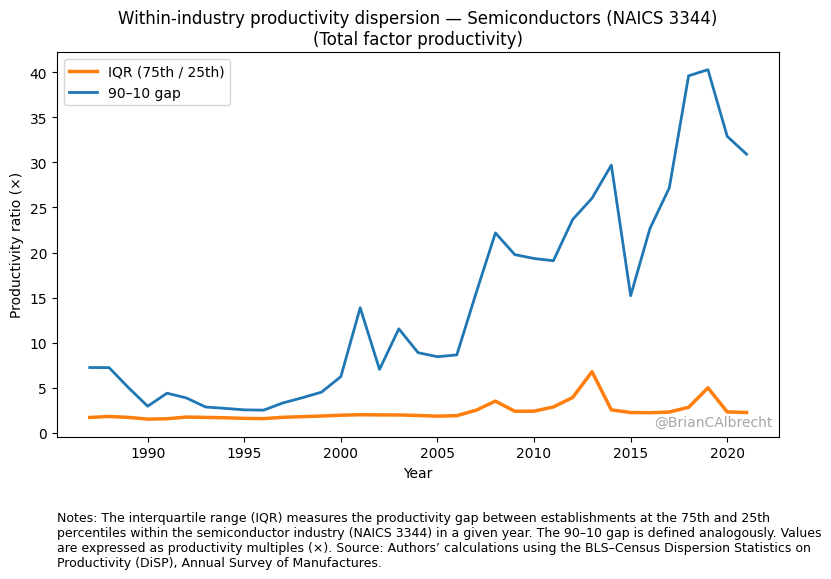
Okay. Let’s look at semiconductors (NAICS 3344). The closest thing the modern world has to robots building robots.
The 90-10 gap is 30-40x!
That’s true in measures of labor productivity and TFP, so it’s not about big capital firms. It's not about TSMC having the latest ASML machine.
If we can't eliminate productivity dispersion in semiconductor manufacturing (where advanced machines produce advanced machines in highly controlled environments) why would we expect AI to make all human labor obsolete?
Why don't the most productive firms drive out everyone else? Consumer preferences for heterogeneity matter. People pay extra for local establishments. Returns to scale matter, not every town can support a Walmart Supercenter.
Geography matters. Unless everyone is going to live in one giant city, there will always be millions of little establishments and most of them will be unproductive because they can be. (I don't see how this problem doesn't blow up when you start talking across galaxies, as @dwarkesh_sp wants us to.)
The same logic applies to AI. Yes, AI may be vastly more productive at specific tasks. But productivity differences don't automatically eliminate the less productive option.
Social science is built on the assumption there are some regulat patterns and ideas that allow you to understand across time and place.
Sure, it's always possible the future will be completely different. If that's true, I have no idea what to do to predict it. No one else does either.
⏰ Deadline Coming Up!
Submit your abstract for the Journal of Regulatory Economics special issue workshop on state-level regulatory accumulation by Feb 28, 2025.
More deadlines for draft and final papers follow!
#callforpapers#regulation#econ
https://t.co/HmcPEH46LU
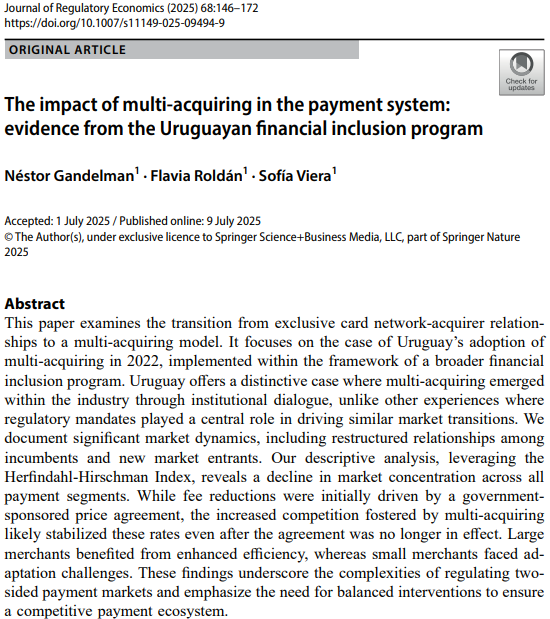
From our October 2025 issue: Uruguay’s move to multi-acquiring reshaped its payment system.
A 2025 study finds:
📉 Lower market concentration
🏦 More competition + new entrants
💰 Fees stabilized even after policy agreements
Full paper below ⬇️
https://t.co/JHwtpBhnvk
We would like to welcome @tom_hoenig to the Editorial Board of the Journal of Regulatory Economics!
His distinguished career includes 20 years as President of the Kansas City Federal Reserve Bank. He is now a Senior Fellow at the Mercatus Center at George Mason University.
Today the last penny was minted. What are the economic effects of eliminating the penny? Find the answer in "Inflationary impacts of penny and nickel elimination" just published in the Journal of Regulatory Economics.
📢 Call for Papers
The Journal of Regulatory Economics is launching a special issue on Supply Side Healthcare Regulations.
🗓️ Deadline: Feb 15, 2026
🌍 Submissions welcome worldwide
#CallForPapers#HealthEconomics#Regulation#AcademicResearch
🧵 THREAD: "Fed Goes Back to Basics with Framework Revisions", my latest for @aier
The Fed just updated its monetary policy framework, scrapping its "make-up" inflation policy and going back to basics. 1/12
Learn more by accessing "Moving beyond the negative effect of the regulation of entry: Disentangling causality in new venture creation decisions" - Journal of Regulatory Economics
https://t.co/GpCA3jn2My