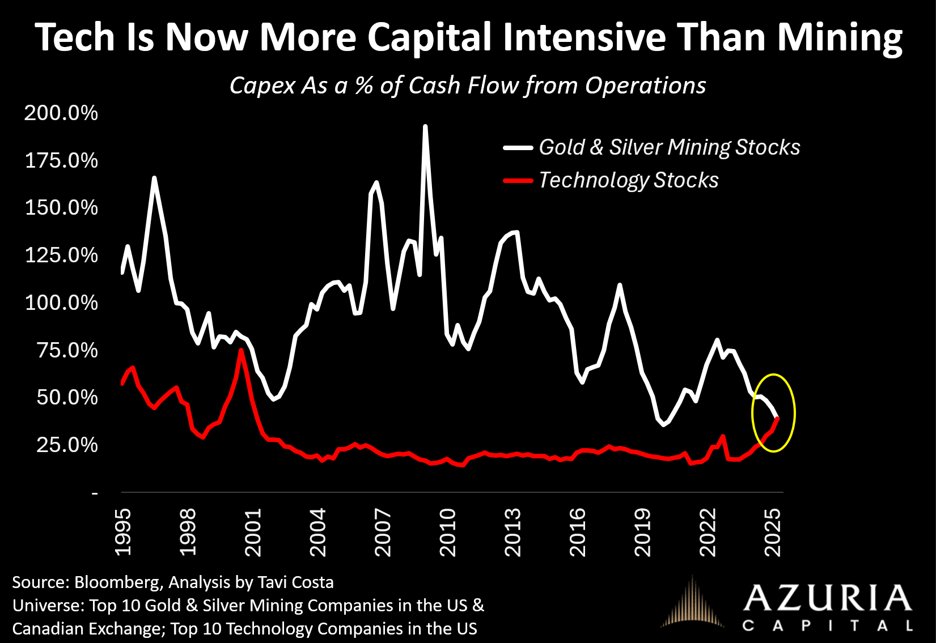
In ten years will we look at this chart and see (i) AI Capex delivering the sought after returns for technology companies, (ii) miners boost their own Capex, neither, perhaps?🤔
Tech is now officially more capital-intensive than mining.
This represents a fundamental shift in the market.
Miners offer stronger margins, healthier balance sheets, and more compelling embedded growth.
They offer a far more asymmetric way to express the AI investment thesis than technology itself, in my view.
https://t.co/sUjfySPwrZ
Treasury Is Building A Defense Before The Coming Energy Shock
Treasury’s decision to double maximum long end buybacks from $2 billion to at least $4 billion per operation matters because it is happening before the energy shock reaches its most dangerous phase.
The SPR is not about to run out. The real constraint is the remaining capacity under the current 172 million barrel emergency release. The reserve fell from roughly 415 million barrels in March to 293 million by August 14. At the recent draw rate, that leaves roughly 11 weeks of support, placing the critical window around late October into early November.
Treasury’s larger buybacks begin September 9, run through November 4 and will be reassessed at the November 4 Quarterly Refunding Announcement. That overlaps almost perfectly with the period when emergency oil releases could lose much of their ability to mask the physical shortage.
If Hormuz remains impaired and Gulf production does not normalize, inventories eventually stop bridging the gap between current supply and consumption. Global supply was already roughly 6.3 million barrels per day below year earlier levels in July while observed inventories had fallen about 410 million barrels since the conflict began. Once stored barrels stop filling that gap, the market clears through restored supply, restored shipping or demand destruction. The first violent repricing may appear in diesel, jet fuel, LNG, freight and tanker rates before crude fully reflects it.
Why Treasury Is Acting Now
An energy shock initially creates a brutal environment for long term bonds. Energy prices rise, inflation uncertainty increases, fiscal spending can expand and investors demand more compensation for holding 20 and 30 year debt even as economic growth weakens.
Treasury already expects roughly $1.367 trillion of privately held net marketable borrowing during the second half of 2026. Meanwhile Japanese yields are increasingly competitive, China has reduced reported Treasury holdings and Europe is issuing heavily.
The Treasury market also contains enormous leverage. Hedge funds hold roughly $830 billion in Treasury basis trades and trillions in repo financing. If yields rise sharply, volatility and margin requirements increase, dealers accumulate inventory and leveraged positions can begin unwinding. A normal bond selloff can become a liquidity event.
Doing this beforehand strengthens the shock absorbers. Buybacks give dealers a predictable buyer for older, less liquid long bonds and free balance sheet capacity for new auctions and market making. More importantly, the machinery already exists. If the energy shock drives long yields sharply higher, Treasury can quickly enlarge and increase the frequency of operations instead of building an emergency response during the crisis.
What This Really Is
This is not QE because Treasury cannot create reserves. It is not yield curve control because there is no explicit yield ceiling.
But it can evolve into a Treasury version of Operation Twist. If Treasury removes more 20 and 30 year debt while financing increasingly through bills and shorter maturities, private investors exchange long duration risk for short duration government liabilities. Money market funds, banks and regulated stablecoin issuers provide deep demand for those bills.
If energy reprices violently over the next 9 to 13 weeks, the Fed may initially be trapped by inflation. Treasury can act first through larger buybacks and shorter duration financing while the Fed supports funding markets. Only after energy driven demand destruction overwhelms inflation does the Fed gain room to cut aggressively.
The sequence is energy inflation, demand destruction, financial stress, then Fed easing.
Treasury doubled long end buybacks now to free dealer balance sheets, support auctions and install a scalable circuit breaker before an energy shock collides with heavy issuance, weaker foreign demand and leveraged Treasury market plumbing.
Long term yields go higher from here. Bookmark it. The old paradigm “don’t fight the fed” doesn’t work here, yet. For now short duration and long hard assets makes sense to us.
Not financial advice.
THE TREASURY JUST BLINKED | August 19, 2026
─────────────────
The Treasury doubled its long-end liquidity support buybacks starting September 9, at least $4 billion per operation instead of $2 billion, targeting the 10-20 and 20-30 year maturities specifically. Technically not QE. Practically, the same intent:
keep long yields from running further.
─────────────────
Three things worth taking from this.
First, the fiscal side, deficit size, issuance volume, AI-driven capital demand competing for the same funding, is generating real enough pressure that even a chair on record wanting to eliminate both QE and interest on reserves is now facing intervention-like measures before he's even fully settled into the role.
Second, there's a gap opening between rhetoric and action. Restrictive in words, interventionist in practice, at the long end specifically, right after the 30-year hit its highest level since 2007.
Third, and most important: this isn't a system comfortably absorbing high issuance while the Fed stays hands-off. It's an early sign that capacity is being tested. That's not the kind of signal that shows up in the middle of a normal cycle.
CIF: 83/90 — Warning Level Orange.
@TheBigCycleGame
Not financial advice. DYOR.
#Treasury #Yields #Fed #MacroAnalysis #CIF #EndCycle #TheBigCycleGame
@Mr_Derivatives Agree. Hard assets, plus anything that’s hard to produce and is critical to national economic security (i.e. pipelines, water infrastructure, power plants)
Diesel Is Telling the Truth That Crude Oil Is Hiding
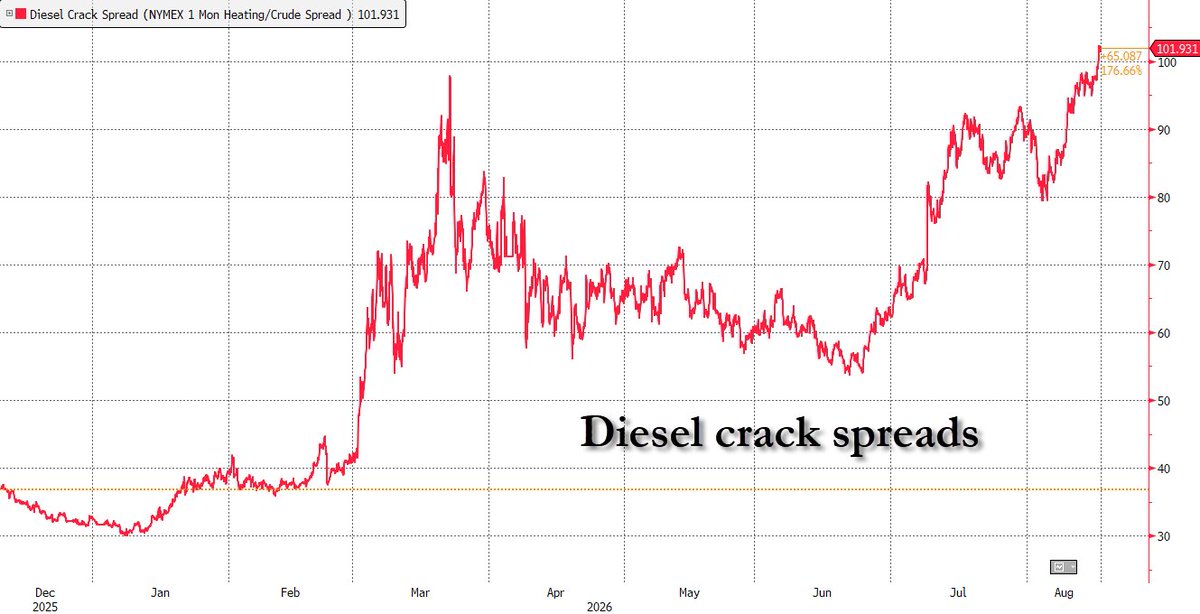
Diesel is revealing the physical stress in the global energy system more clearly than WTI or Brent.
Crude benchmarks are being restrained by weak global demand, expectations of eventual normalization, alternative Gulf export routes and continued releases from strategic reserves. Diesel has fewer escape valves. It must be refined from the right crude, through functioning refineries, transported through disrupted shipping routes and delivered into trucking, agriculture, manufacturing and heating markets.
That bottleneck is now showing up violently.
The Refinery Problem
The U.S. diesel crack spread just pushed to $102 per barrel, an extraordinary level showing how scarce finished middle distillates have become relative to crude.
U.S. refineries are already operating near maximum utilization, yet distillate inventories remain roughly 12% below their 5 year average and near the lowest August levels in decades.
Meanwhile Middle Eastern refinery output remains impaired, Russian refining has been damaged, Russian diesel exports have been restricted and Asian refining activity has weakened.
The result is important.
There may be crude available somewhere in the system, but there are not enough finished diesel barrels where they are needed.
That is why oil can appear relatively contained while diesel screams shortage.
The SPR Is Masking Part Of The Crude Problem
The Strategic Petroleum Reserve has fallen to roughly 299 million barrels, its lowest level since 1983.
If the remaining authorized withdrawals continue at roughly the recent pace before significant return barrels arrive, the reserve could approach approximately 243 million barrels within another 9 to 13 weeks.
The SPR would not be empty.
What matters is the flow.
The market is currently receiving hundreds of thousands of barrels per day from storage. When that flow slows or stops, the market must replace those barrels from somewhere else.
If Hormuz remains impaired, Gulf production and refining fail to normalize and refinery maintenance begins during autumn, that replacement becomes much harder.
The SPR therefore may be suppressing the crude signal while diesel is already showing the scarcity beyond the refinery gate.
Where Prices Could Go
If current conditions persist for another 9 to 13 weeks, I would expect Brent around $105 to $120 and WTI around $98 to $112.
National diesel could reach roughly $5.90 to $6.60 per gallon, with my area in New England closer to $6.20 to $6.90.
If shipping deteriorates further, another major refinery is lost or Gulf production falls again, Brent could move toward $125 to $155 while national diesel enters roughly the $7 to $8.75 range.
At that point the market starts solving the shortage through demand destruction.
Truckers cut capacity. Freight weakens. Businesses reduce production. Consumers pull back. Agriculture and construction absorb higher costs. Eventually the economy destroys enough fuel demand to force prices lower.
That is the critical point.
The energy shock does not have to continue indefinitely to cause severe damage.
If supply does not recover, prices rise until demand breaks.
Diesel is already telling us where that process begins.
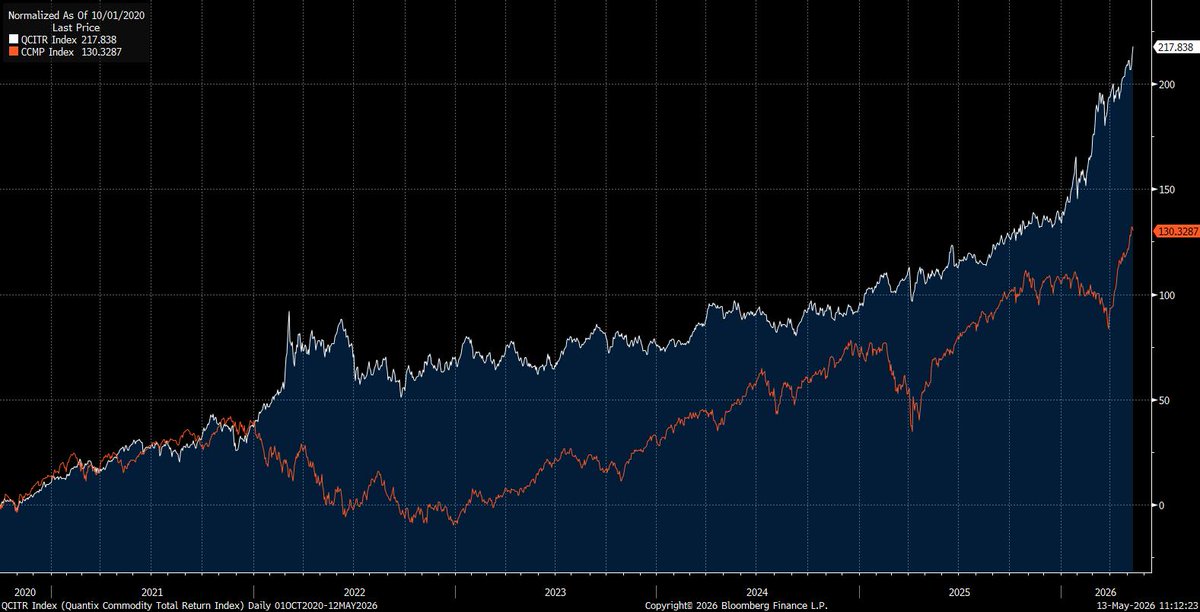
The leadership rotated, but the trend did not. The super cycle powers ahead.
The Quantix Commodity Index (QCI, the modern GSCI) Total Return is up 217% since October 2020, when we called the super cycle. The names rotated — gold, silver, copper, oil, live cattle, coffee, cocoa, aluminium. But not the trend. Nasdaq returned 130%. The S&P 500, 85%.
Commodities were the top asset class. Nobody allocated. Capital piled into the Mag 7 — $770 billion of 2026 capex, nearly half of it commodities. Amazon alone consumes more than 3 million BOE/d of primary energy, more than most OPEC countries. The Mag 7 is the largest unhedged molecule short ever underwritten by an equity market...
…at the exact moment supply has never been more constrained. Hormuz is shut-in. China has weaponized the periodic table. Copper mines remain shuttered. Ukrainian drones push deeper into Russia, taking commodity supply with them. A multi-polar world demands thicker supply chains. Copper and the "atom" complex print fresh records this week. Every signal that should drive allocators into the "molecule" complex is flashing green simultaneously — for the first time since the 1970s.
And yet oil struggles to hold $105 — even as every signal points to a disruption that deepens and one we believe will outlast any "deal.” The energy sector trades 8% below its pre-Hormuz level and sits at 4.0% of the S&P 500 market cap. At $105 oil, its 2026 FCF yield is 13%. The S&P 500 is at 2.6% — the lowest since the GFC, 1,000bp below energy. The hyperscalers generate close to zero. Something has to give.
This paradox explains why oil struggles to trade higher. Capital is not rotating. The marginal dollar of investable savings still flows into the AI buildout, not the physical infrastructure that feeds it. Until that reverses, Brent faces headwinds. The ceiling on oil is not Washington. It is Exxon's cost of capital — woefully mispriced. Underbidding the equities is the same as underbidding the back end of the curve. The back end is suppressing the entire curve and spot prices.
1/10
@PronkDaniel@StockTrades_CA@FindleysFinance Agreed, it might have done better if deployed elsewhere. But maybe not. They are earning on the cash so it’s not zero sum. I think when the fat pitch rolls around one of these days everyone will realize how prescient it was to be sitting on cash while they deploy it
Really thoughtful stuff 👇🏻
I think Wall Street (and retail) are going to start realizing energy companies are strategic assets (Magnificent 7 is largely a joke for boomer doomscrolling).
3 weeks ago I argued the US goal in Iran is to seize the global oil spigot. Venezuela in January -> Iran in February.
Neutralize every supply channel outside the dollar system within 90 days. Achieve a compliant successor government and complete energy dominance.
The oil thesis was the obvious layer. However, when you zoom out & view the last four years as a single sequence rather than isolated geopolitical events, the architecture of the grander US plan becomes visible.
1st was Europe, which laid the groundwork.
The Ukraine conflict provided the justification for sanctions that collapsed Russian pipeline gas from 150 billion cubic meters to 40.
Then Nordstream was destroyed, which rewired the entire European energy system permanently. The US went from supplying 28% of Europe's LNG in 2021 to 58% by 2025, exporting a record 111 million MTs, the 1st country in history to break 100 MT.
Europe was transformed from a customer with options into a captive market now purchasing its survival in USD.
2nd was Syria.
The fall of Assad severed the critical node connecting China's Belt & Road Initiative to the Mediterranean.
The trilateral railway linking Iran, Iraq & Syria, designed to bypass Western maritime chokepoints, was completely destroyed.
This isolated Iran geographically & cleared the path for what came next.
3rd was Venezuela.
In January the US effectively took control of the world's largest heavy crude reserves. The US Gulf Coast has the most advanced refining complex on earth, specifically built for heavy sour crude. Phillips 66, Valero & the rest are now positioned to process hundreds of thousands of barrels of Venezuelan crude daily.
The US captured a massive strategic reserve & solidified its position as the dominant exporter of refined petroleum products, an industry worth $110 billion in 2025 alone.
Venezuela & Iran were the two major oil supply channels that existed outside the dollar system. Both produce heavy crude sold primarily to China & evaded US financial supervision. Both now being neutralized within 90 days, which leads us to..
4th is Iran & the Middle East energy shock.
Israel struck Iran's South Pars gas field, the world's largest natural gas reservoir. Iran retaliated against Qatar's Ras Laffan, the single largest LNG facility on earth, responsible for a fifth of global supply. QatarEnergy's own assessment is that 17% of export capacity is gone and recovery will take up to 5 years. The Strait of Hormuz is closed. European gas prices spiked 70%. Asian spot prices doubled.
The only remaining scaled supplier? The United States.
If Iran falls & a successor government is installed that the US controls or influences (the Delcy model described weeks ago) then roughly 40 to 45 million barrels per day of global production out of 103 million is effectively under US control. OPEC becomes irrelevant because the US coalition is now the marginal producer. Now add the gas dimension & it goes beyond oil.
This war is solidifying the petrodollar system as it evolves into a hybrid petro/LNG-dollar. The old system was built on Saudi crude priced in USD. The new system is built on American crude plus American gas from the Gulf Coast, with no alternative supplier of comparable scale. The dependency is deeper because LNG infrastructure requires long term contracts & regasification terminals that lock buyers into supply relationships for decades. Europe & the Pacific allies (Japan, South Korea, Taiwan, etc.) cannot pivot away as there is nowhere left to pivot to. They're now locked into the US energy system.
The market confirms this. DXY went from 96 to 101. Gold down ~20% from its January all time high. Bitcoin down 20% on the year. Brent above $100. European & Asian institutions are liquidating precious metals and crypto to buy dollars because they need dollars to buy the only remaining scaled energy supply. The world is selling its gold to buy American energy in American currency. The dollar is now being weaponized through energy dependency.
The structural repricing is happening regardless of how the conflict resolves.
But the US grand strategy goes deeper..
Artificial intelligence is a physical industry. It runs on power and chips. Data centers require massive uninterrupted baseload electricity, primarily provided by natural gas. Semiconductor fabrication requires helium & rare earths.
By choking the Strait of Hormuz & crippling Middle Eastern LNG & helium production, the US is systematically degrading China's ability to power its data centers & fabricate semiconductors at scale.
The US is energy self sufficient, especially with newly captured Venezuelan reserves & expanding Gulf Coast capacity running on domestic gas.
On the other hand, China is import dependent & every joule it imports effectively now transits chokepoints the US Navy controls..
Iran was the Belt & Road's overland energy bypass, the corridor that allowed China to mitigate the Malacca Trap. With Iran neutralized that corridor is severed. China faces a world where its compute infrastructure competes for scraps on a depleted global LNG market, while American data centers run at full capacity on domestic energy.
Russia is next in the sequence. A post-war Iran reopening under US influence competes directly with Russia for the same refineries in China & India at lower cost. Iran's production costs are lower. Russia loses its last structural advantage in heavy crude & its economic lifeline. Additionally, under the Iran war cover, Ukraine has been opportunistically destroying Russian energy infrastructure & all signs point towards Russia being at the end of the line. The message from Washington becomes very simple: we dismantled two regimes in three months, your economy is about to get crushed, sign the Ukraine deal.
Then Trump sits down with Xi holding every card. Complete energy dominance. The hybrid petro/LNG-dollar fortified, Iran cleared, Russia cornered, & China facing the Malacca Trap fully closed with no remaining energy bypass.
Israel & the GCC are absorbing the kinetic cost of a conflict whose primary beneficiary, counter to the mainstream narrative, is actually America (First). Qatar offline for 5 years reprices the entire global gas market in favor of US exporters for the remainder of the decade. The Gulf states face years of rebuilding. Europe faces its 2nd energy crisis in four years.
Sure, the average American might face temporary moderate inflation & higher gas prices. But if you are the architect of the US empire & you view the rise of China & Chinese ASI as an existential winner takes all scenario, the collateral damage is acceptable cost.
Whoever controls the energy corridors controls the monetary system. Whoever controls the monetary system & the energy supply simultaneously controls the compute infrastructure that determines which civilization builds ASI first.
The US is seizing all 3.
$GIS General Mills has a long list of bearish problems, but long term it looks okay here.
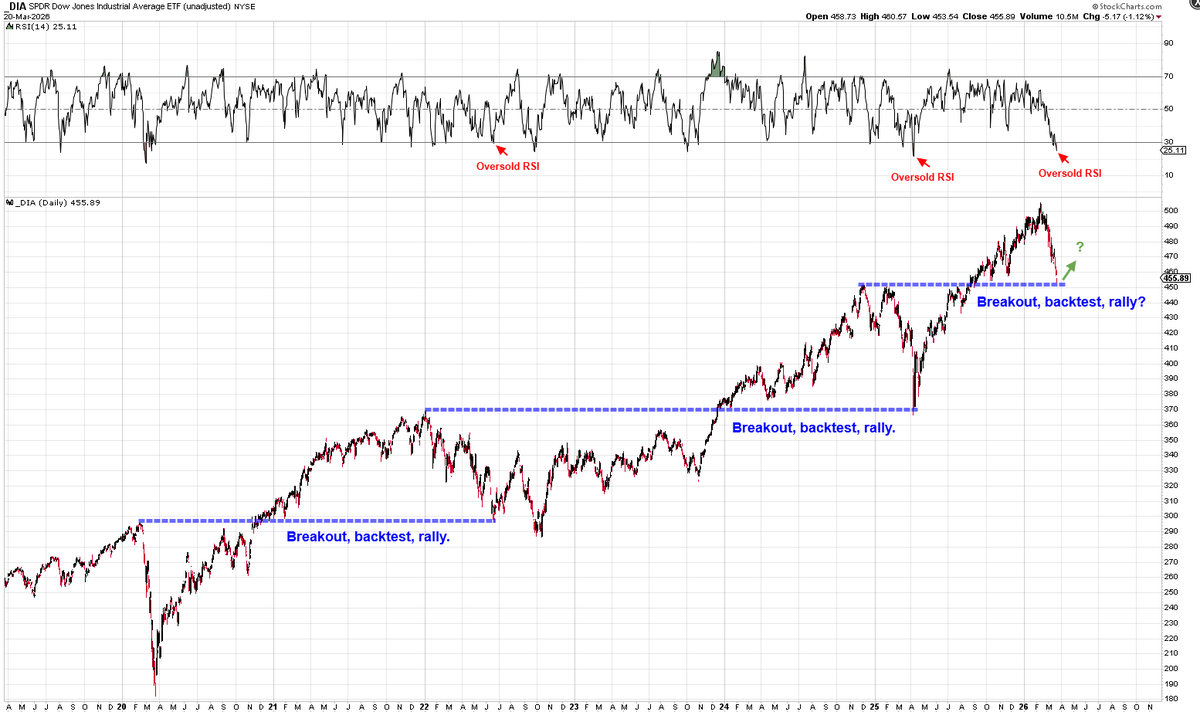
On the technical side it’s very oversold.
However, as a bond proxy it will struggle with rising treasury yields.
Its cost inputs and feedstocks are all inflating (corn, energy inputs, packaging, etc).
Margins are constantly under pressure.
Consumers on the other hand are getting squeezed and increasingly looking for cheap options which typically means store branded products.
If these trends continue the dividend could be cut.
Investing in a name like this really does not make fundamental sense right now. But that’s why I like it, because all the bad problems are readily apparent.
The stock is trading at a forward P/E of 10.
The company has survived over the course of past issues so I am willing to take on the risk that management can weather the storm.
Maybe an activist gets involved and pushes for quicker, more dramatic change.
I am willing to buy some here and sit on my hands for ten years+
$PG One of my all time favorite stocks to invest in and best in breed for staples. PG faces a lot of headwinds to be sure but the technicals on weekly and monthly charts look great.
Calling a bottom here in consumer staples stocks. Will share charts this weekend for favorite names. Long term investors have attractive entry points here for long term horizons