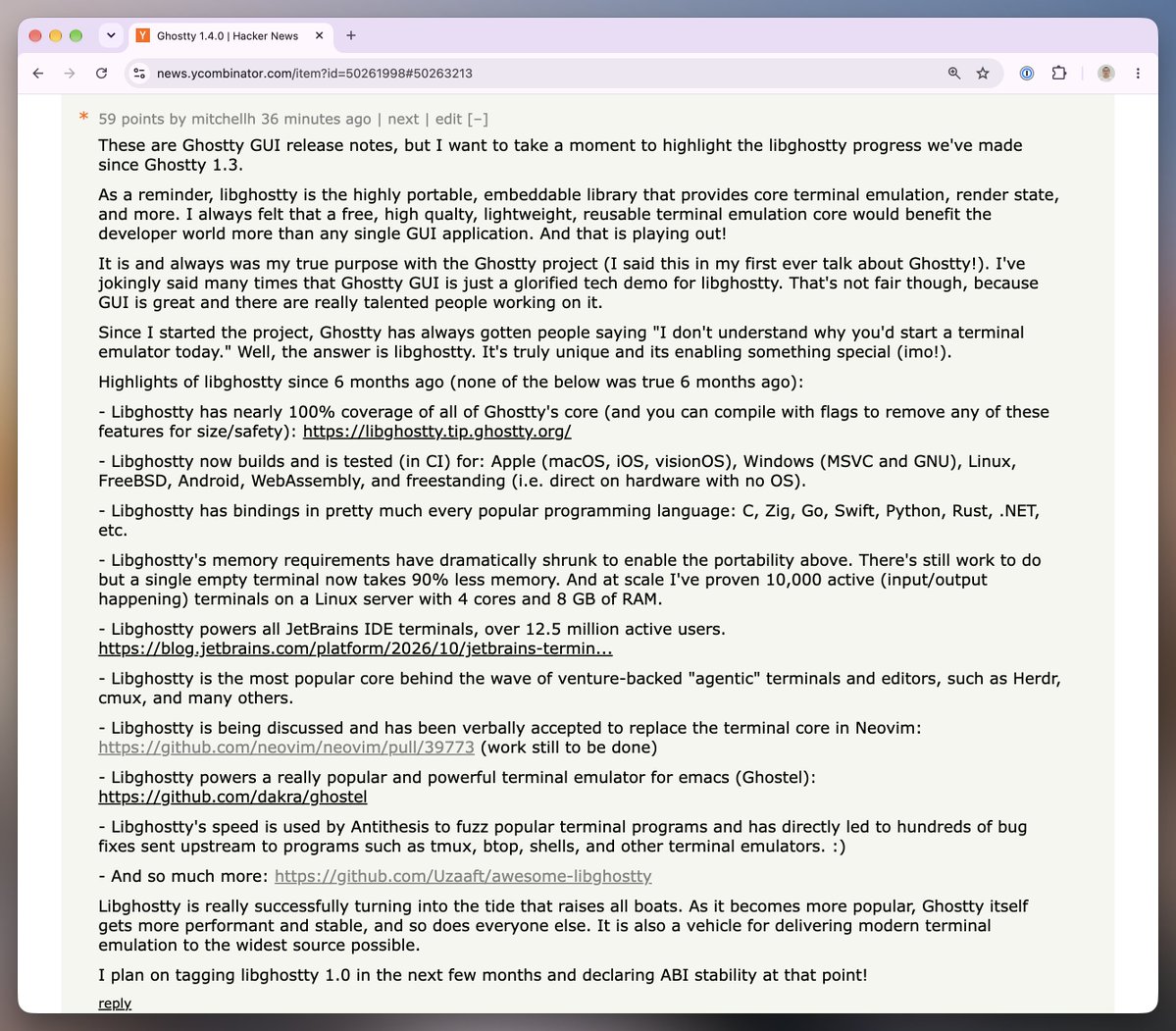
Libghostty progress in the past 6 months. It's amazing that NOTHING IN THIS LIST was true 6 months ago, and now its ALL VERY REAL. I remember bringing up the idea of libghostty 4 years ago and most people saying "but why." I did it anyways. And here we are!
Text reproduced in case its easier to read this way:
As a reminder, libghostty is the highly portable, embeddable library that provides core terminal emulation, render state, and more. I always felt that a free, high qualty, lightweight, reusable terminal emulation core would benefit the developer world more than any single GUI application. And that is playing out!
It is and always was my true purpose with the Ghostty project (I said this in my first ever talk about Ghostty!). I've jokingly said many times that Ghostty GUI is just a glorified tech demo for libghostty. That's not fair though, because GUI is great and there are really talented people working on it.
Since I started the project, Ghostty has always gotten people saying "I don't understand why you'd start a terminal emulator today." Well, the answer is libghostty. It's truly unique and its enabling something special (imo!).
Highlights of libghostty since 6 months ago (none of the below was true 6 months ago):
- Libghostty has nearly 100% coverage of all of Ghostty's core (and you can compile with flags to remove any of these features for size/safety): https://t.co/y8MY1k3gG7
- Libghostty now builds and is tested (in CI) for: Apple (macOS, iOS, visionOS), Windows (MSVC and GNU), Linux, FreeBSD, Android, WebAssembly, and freestanding (i.e. direct on hardware with no OS).
- Libghostty has bindings in pretty much every popular programming language: C, Zig, Go, Swift, Python, Rust, .NET, etc.
- Libghostty's memory requirements have dramatically shrunk to enable the portability above. There's still work to do but a single empty terminal now takes 90% less memory. And at scale I've proven 10,000 active (input/output happening) terminals on a Linux server with 4 cores and 8 GB of RAM.
- Libghostty powers all JetBrains IDE terminals, over 12.5 million active users. https://t.co/GD8Wgyk3L2...
- Libghostty is the most popular core behind the wave of venture-backed "agentic" terminals and editors, such as Herdr, cmux, and many others.
- Libghostty is being discussed and has been verbally accepted to replace the terminal core in Neovim: https://t.co/8aCBceaY1v (work still to be done)
- Libghostty powers a really popular and powerful terminal emulator for emacs (Ghostel): https://t.co/Ce7mrr1EC9
- Libghostty's speed is used by Antithesis to fuzz popular terminal programs and has directly led to hundreds of bug fixes sent upstream to programs such as tmux, btop, shells, and other terminal emulators. :)
- And so much more: https://t.co/lAJXhCX8GC
Libghostty is really successfully turning into the tide that raises all boats. As it becomes more popular, Ghostty itself gets more performant and stable, and so does everyone else. It is also a vehicle for delivering modern terminal emulation to the widest source possible.
I plan on tagging libghostty 1.0 in the next few months and declaring ABI stability at that point!
In over 15 years of open source, I can't remember ever saying "your example doesn't compile" (I probably did, but it's so rare I can't remember). Now, I literally say this everyday. Please, can people using AI be less fucking stupid about it.
I shared this message with the team this morning:
Did we just get sherlocked?
Yesterday, Apple essentially built Raycast into Spotlight. Or at least, that's how it felt watching WWDC where they announced the new macOS Tahoe 26.
Taking a step back this morning, I wanted to reflect on it. We've been building for five years now, and it was never a question of if Apple would try to catch up, but when. While I didn't expect it this year, it didn't come as a surprise either.
Raycast is for power users that want to get more done with their computers. When Apple introduces millions (billions?) to clipboard history, they're creating our next users. People will run into limitations and want more from a launcher, which is where we step in. The line has moved, but this is a benefit for us.
You've probably seen tweets like declaring us dead, but you've also noticed our community's loyalty in the responses. We're seeing the fruits of years of work. Our users didn't just install a tool, they fell in love with it. This is why we focus on brand and why community matters so much.
There are also things that we can learn from Apple. The new modern Liquid Glass design with more rounded borders will feel more familiar to users. Default quick keys for system actions make it easier for people to get started. We can take inspiration from these things and build on them. That's what competition does. It pushes us to be better.
In many ways, yesterday felt like validation. Apple just told the world that launchers are the future and we've been building that future for five years. While Apple catches up to 2019 Raycast, we're already shipping 2025 Raycast. The best is yet to come.