Honest take on the price of XEN...
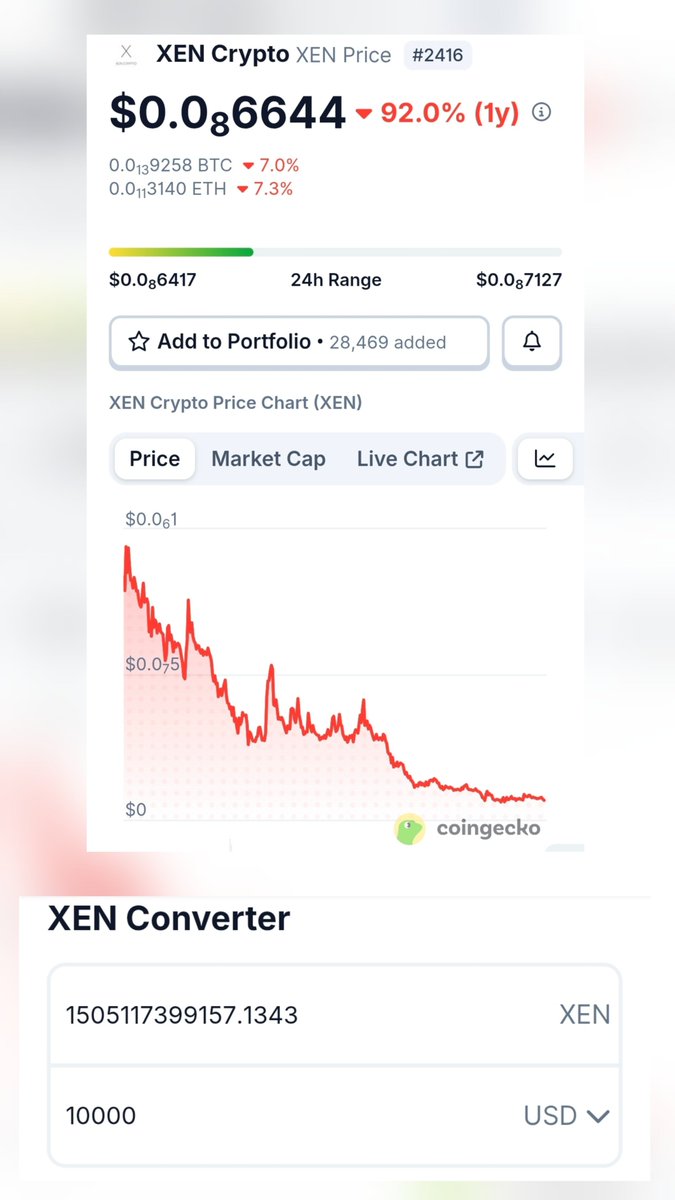
$XEN is now down 92% year over year and 9% in just the last 7 days, sitting at another all-time low.
At current prices, $10K buys about 1.5 trillion XEN. That’s roughly the equivalent of starting ~75,000 minting VMUs today and waiting 486 days for maturity.
That sounds like a great price to buy, but it isn't. The issue is the cost to mint. You can spin up 75K VMUs for under $900 at 0.03 gwei, which means the market can constantly create far more future supply than it’s currently pricing in.
Right now the network is averaging ~90,000 new minting VMUs every single day.
If nothing in the mechanics changes, the math is simple: continuous minting + constant dumping = relentless dilution.
At this pace, purely from the supply mechanics alone, $XEN could easily be another 90% lower one year from now, as long as #Ethereum gwei stays low.
So, just a friendly reminder: at the current rate of dilution, 1T XEN below $500-$700 within a year isn’t unrealistic.
Silver lining: ETH gas rarely falls below ~0.03 gwei, even when the chain is practically dead quiet, and #XEN mint rewards keep relentlessly shrinking every day (APM at 1,747 days). That combination likely puts a future floor somewhere around ~$500 per trillion at which point things may start taking on a positive turn.
Hello everyone, how are you doing?
Unfortunately, I don't have a math background to calculate the percentages (profit) from this deal, but I don't mind, because now there are three-digit numbers there...
#pltr
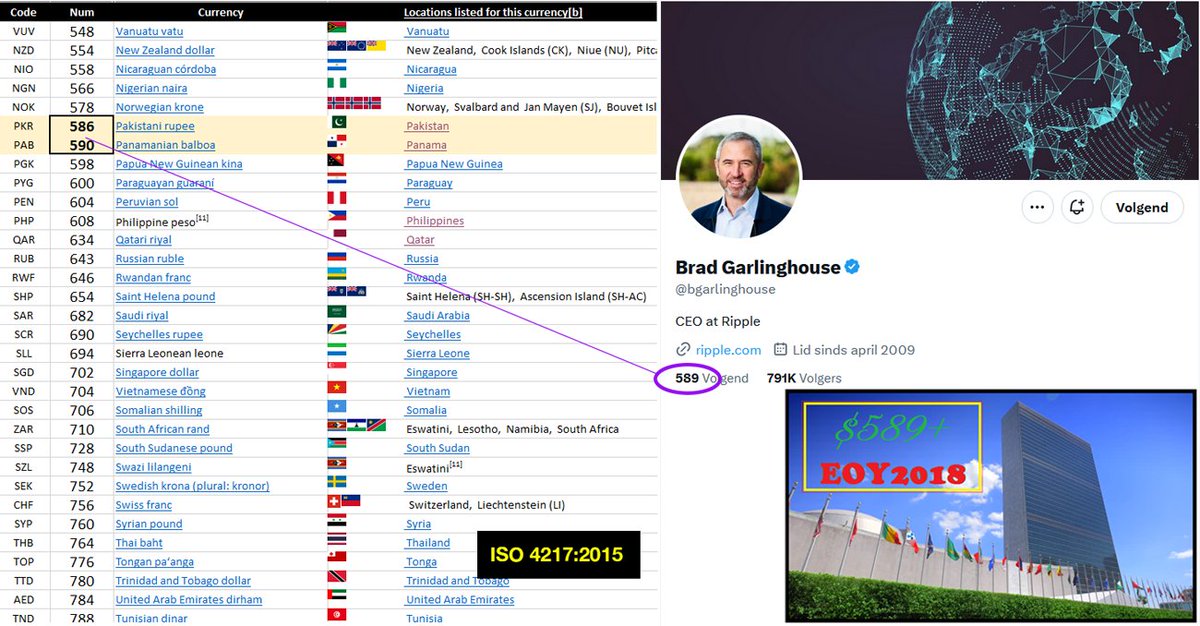
Here's an excerpt from the ISO 4217 list. ISO 4217 is the official list of currencies recognized worldwide. Being added to this list ensures regulatory clarity on a global scale. As you can see, the number 589 remains unassigned, at least for now.
If 589 were merely a cult number introduced by an enigmatic figure, why would the CEO of a firm currently engaged in a legal battle with the SEC make such a reference in his profile? Have you considered the potential legal ramifications for Ripple if they were somehow associated with @bearableguy123? This could involve allegations of market manipulation, breaches of nondisclosure agreements, and so on.
I've witnessed some outrageous predictions and the most absurd connections over the past year. But what if reality proves to be even more surreal than fiction?
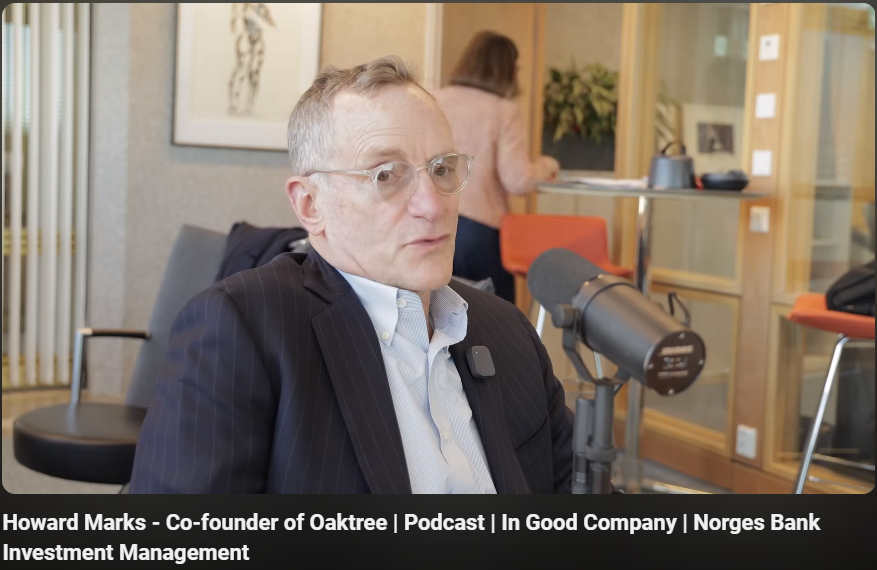
If you listen to just one podcast this week, let it be this one.
Howard Marks in conversation with Nicolai Tangen—where brilliant questions elicit a wealth of wisdom and insightful answers.
Dive into a masterclass on investing, risk management, and decision-making.
Here are my key takeaways:
(plenty of Howard Marks wisdom, bookmark it for future)
On risk management:
Risk Control: "Number one, risk control. I believe it's easy to make money in the market. That's especially true in the good years, and most years are good years. The challenge, the real skill, is to make money with the risk under control, so that if it turns out to be a bad year instead, you won't do too badly."
Risk Avoidance: "Sound risk management, first of all, importantly, is not risk avoidance. Risk avoidance usually results in return avoidance. If you want to make a good return, you have to take risk. I put out a memo last week on the subject, and I said, if you want to make money, you have to take risk. But you should not expect to make money just for taking risk. You have to do it skillfully."
Probabilistic Outcomes: "Risk means more things can happen than will happen. It's a very simple statement, but it's very true. And so you have to appreciate the fact that under any set of circumstances, a variety of outcomes are possible, and you should always allow for the vagaries of the future."
Strategic Decision-Making: "Assessing probabilities is very, very important. Structuring your bet, knowing when you have an advantage, knowing when you don't have an advantage... It's not what outcome is likely to happen, but it's is the payoff better for investing in the team that will probably win?"
The limits of knowledge:
Randomness: "Number one, randomness or luck is every place in our business. You're not dealing with physical laws like in physics or in engineering. You're dealing with, in large part, people... Processes which are basically built around people can't be predicted. So, while you can analyze and make informed decisions, there will always be an element of unpredictability."
Cycles: "Well, the world is cyclical, and everybody knows that the market and the economy and politics move cyclically. And nothing moves in a straight line where human behavior is involved. And if you were to count on it doing so, you would get into big trouble."
Illusion of Knowledge: "I wrote a book, a memo in October of 22 called the Illusion of Knowledge. There's a great historian called Daniel Borsten. He says the enemy of knowledge is not ignorance. It's the illusion of knowledge. It's the fallacious belief that you know which stops you from inquiring. So I think that acknowledging that you don't know something is extremely healthy."
Contrarian investing:
Independent Thinking: "I want to stress that I don't think it's a good idea to routinely say, well, what does the consensus think? Let's do the opposite. The process has to be much deeper than that. You have to say, what does the consensus think? What do I think? What's wrong with the consensus thinking? Why did they think that way? What could make the error of their ways exposed?"
Psychological Strength: "If you want to be an exceptional investor, number one, you have to dare to be different. Your portfolio has to be different from other people, or else you can't distinguish yourself. You have to be dare to be wrong, because you have to take on these unpopular positions. And number three, you have to dare to look wrong, because even if you're right, that's probably not gonna be clear for some time. And in that period, you're gonna look wrong out a step, be criticized, feel inadequate. You have to be willing to live with that."
Advice for young investors:
Don't Aim for Perfection: "Due to the prevalence of randomness in the financial world, you can't be an investor satisfactorily if you have to be right all the time...There's nothing you can do in investing that will make you successful every time. If you're right 60% or 70% of the time, you'll be the smartest man in the world."
Embrace the Puzzle: "But investing is a great puzzle with many, many considerations that have to be peeled like an onion... You need to enjoy the process of uncovering information, analyzing trends, and making decisions based on incomplete information."
Learn from Experience: "You have to learn by watching somebody do it right. If you don't have somebody to learn from who does it right, you're probably going to make a lot of mistakes and maybe never catch on to the right way to do it. And you can read books and you can study, but I think that there's nothing like an apprenticeship for imparting the wisdom that's required to be a successful investor."
Ok, it took me quite awhile to put all the top insights together. I hope it helps. If you're into lessons from super investors, share it with others and follow me @SteadyCompound for more in the future.
The regenesis includes:
🔷 Remove over 113M XEN smart contracts from the state
🔷 Remove zero balance accounts derived from the XEN project
🔷 Make smart contract deployment permissioned
🔶 Release the Single Token Representation v2 🥳
BREAKING: Stanley Druckenmiller has disclosed a new position in $PLTR Palantir with 770K shares at an average of $21.30.
He was one of their first investors but sold at $8 — which wasn’t the worst move since he took that money and put it into $NVDA at $150.
He now has sold 71% of his Nvidia position and bought back into $PLTR.
Stanely did a talk with Alex Karp in 2022 where he called him “a visionary, remarkably similar to Steve Jobs.”
WELCOME BACK STAN. LFG.
@Breaking911 On April 13, 2024, a special military operation called "The True Promise" began. Less than five civilians were injured during this operation.
The United States boosts its economy at the expense of the military-industrial complex.
Q: Are you a Bitcoin Bull?
A. Yes. Bitcoin is the perfect asset at the right time. I love Bitcoin. Wish I had bought more earlier.
Q: Is it possible that Bitcoin is a scam, a Ponzi scheme?
A: Yes. It is possible Bitcoin is a scam and a Ponzi scheme.
Q: Aren’t you concerned?
A: Yes I am. Yet Bitcoin is not any more of a scam or a Ponzi scheme than the US Dollar, Euro, Yen, or any other “fake” or fiat currency.
Q: Are you saying the US dollar and other fiat currencies are scams?
A: Yes. Giant Ponzi schemes. All the US dollar is, is an IOU from America.
Q: What are you concerned about?
A: Our US political, banking, and financial leaders. They are incompetent or corrupt or both
Our leaders have no idea how to control the growing US government debt and US bond market, and over inflated stock market.
America is broke printing $1 trillion every 90 daysjust to pay its bills. They should resign, be fired, impeached, or put in jail. All should have their college tuitions refunded. Obviously they learned nothing in school about money, ethics, honest, or morality.
They have ripped off the American people and people of the world.
Q: Why are you optimistic about Bitcoin?
A: Metcalf’s Law. Metcalf’s Law is a law about the power of “networks.” Bitcoin, like the US dollar, cell phone net works, and net work marking business such as Amyway gain thie core value from the strength of their network system. Thats the reason Metcalf’s Law is important and why I am bullish about Bitcoin and the US dollar.
Bitcoin has a strong network.
Most “new crypto-coins ” come off of the Ethereum platform. How many will do as well as Bitcoin only time will tell? Most will die because they fail Metcalf’s Law, they fail to build a network.
That would like you belonging to a cell phone network with only you.
Q: Can networks be attacked?
A: Yes. The US dollar network is constantly under attack from Russia and China’s BRICS, Belt and Road currency net work.
Q: Who will win?
A: The stronger network BRICS vs $ USA will win.
Q: What do you advise?
A: The same as I have always advised. “Do not save fake fiat dollars. Save real gold or silver coins or Bitcoin.”
Nothing I have been saying has changed. I follow my own advice.
As I stated 27-years ago in my book Rich Dad Poor Dad, “Savers (of fake money)” are losers. “
Please do not be a loser.
Save real gold coins, real silver coins, and real Bitcoins.
Q: Can Bitcoin go to zero?
A: Yes. It is possible just as it is possible for the US dollar, Aussie dollar, Englands pound sterling, Japan’s yen and any country’s fiat (fake) currencies can go to zero. In fact history proves thousands of fake currencies have already gone to fiat money grave yards.
That is why for years I have been saying “Save gold, silver, and Bitcoin.”
Today, not only do I own gold and silver US gold and silver Eagles…I own gold and silver mines. Diversification is very important.
I do not mine Bitcoins.
Q: Anyone else do you recommend I should seek advice about Bitcoin from?
A: Yes. There are many. These are a few I respect: Ral Paoul, Lawrence Lepard, Jeff Booth, Mark Moss, Anthony Pompliano and more.
Most important is for you to find your own answers.
Take care.
Robert Kiyosaki.