Introverted Optimist, Building @AgletsAI. Dot Connector, Tool Builder, Coder, and Geek. Into Data, Local & Sovereign AI, SLMs, RL, and making hard things easier
@TheTuringPost Probably won’t. I think these models are ideal local or at least sovereign served and in most cases should be fine tuned. This isn’t a stance against the OpenAI model, I just feel all hosted Decision models are the wrong deployment.
@cline It’s hard to offer nice things in this world. Hope you caught it before it cost you to much!
If you have time and out of curiosity; what does abuse look like on your platform. Wanting to understand what do watch for when I launch what I’m launching.
Nice. 👍
Assuming Decider is the AWS Strands model (?) here’s 6 (5 open, 1 api) more for you that I feel are worth inclusion:
Clef (Cloudflare)
Nimble (Bespoke Labs)
pplx-decider (Perplexity)
d1 (LiquidAI. Not open. API Only)
Decision API (OpenAI. Not open. API Only)
GLiNER2.5-Decide (fastino. This is the one I’m focussing on in testing especially for fine tuning).
Feels like Laya and Semif had the early open model lead but like Jev itself are getting supplanted quickly.
In a blindingly fast space it’s crazy how fast decider models have gone from zero mind share to multiple serious contenders.
October 1st may be the most impactful @pidotdev day since @badlogicgames wrote his original launch post announcing what would became an s-tier coding agent and the much loved core of many popular open source agent products. Even bigger than the Earendil merger announcement. Congrats to the team. ✨
Pi 1.0:
https://t.co/7r5efZHumF
Durable Events:
https://t.co/IB5Oi2KHuY
With a very interesting single faq item teaser thrown in at the end of the Pi Durable release post. A teaser perhaps⁉️
FAQ:
Why Typescript Again?
Because it is the easiest way to bootstrap this. But as everybody knows by now, it's very easy to port everything to Rust or assembler. We're not ruling this out in the future, but at the moment we are focusing on TypeScript.
@evalstate Appreciate the help. 🍺
Max it is. But I’ll move more to the api as well. Also just about to start offload tests onto open models but for core work for now this is what I needed. Thanks again. :)
The new 6.1 Sol is very good though I’m setting it on high vs medium which I was using on the last version.
I haven’t tried it with my own harness via the api yet but I will and need to bench properly.
I have seen some saying use it on Max.
So I’m not sure what it’ll do to my plan burn but it feels efficient and fast. Need to look at real Terminal Bench numbers (@evalstate 🤞) to confirm but I like it.
Since I got access I’ve only looked to Astra for porting code, architecture deep dives in a large codebase and unfamiliar codebases, deep new greenfield tasks, one ongoing, a very messy, structured document unification task and for cleaning up output when I’m not happy with the way the code looks after 6.1 is done. How about you?
This looks feels lime the correct way to compress history.
FOCUS asks which past interactions the agent's future decisions depend on, and treats compression as preserving those decisions over discrete interaction units.
Pity there’s no reference implementation but the paper is detailed so reproducing shouldn’t be to hard though won’t be able to do 1-to-1 comparisons of their results.
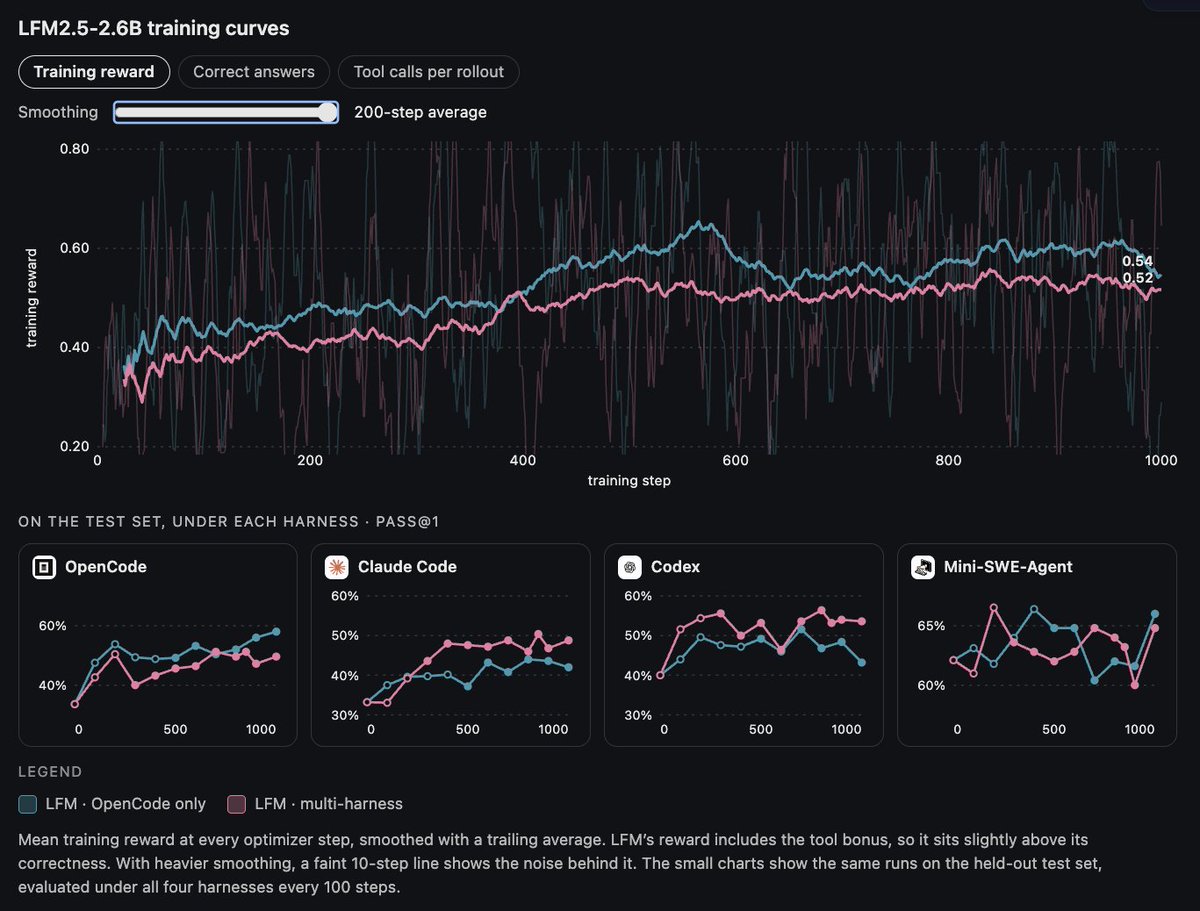
You can now train an open model with RL inside claude code, codex, opencode, pi, or any harness you need. All at once, with the harness runs unmodified.
@adithya_s_k added a capture proxy to openenv. it sits between the harness and the model and records the exact token ids and logprobs of every call. to the harness it's just another model provider. harbor supplies the tasks and sandboxes, trl trains with async GRPO.
it's worth doing because the harness completely changes what the model learns. the same LFM2.5-2.6B weights solve 62% of held-out tasks in mini-swe-agent and 33% in claude code. after RL across four harnesses the average goes from 42% to 54%, and claude code from 33% to 49%.
there are three envs you can try in the browser and a training script for each.
guide: https://t.co/X4So6pGlOw
A hard few days.
Competition is inevitable especially where we’re at with AI but when you see an incumbent with deep distribution move into the space you’ve been killing yourself trying to define it feels like a gut punch.
All you can do is believe, work hard, and deliver for your prospective customers.
I want to highlight more WebMCP tools. This one’s not something I’d use a lot but I think it’s a a great example of WebMCP at work.
Lottie Creator WebMCP (via @LottieFiles):
The cool thing about WenMCP is it allows for interactivity between you and the app, not just promoting and not just manual actions.
Using the Creator WebMCP you’d give it an initial prompt to generate your Lottie, preview the result, then refine it with follow-up prompts OR open it in Lottie Creator directly to manually edit.
As someone who knows what he’d like to do with these kinds of tools but is graphically inept things like this WebMCP are huge. I’m going to try and use it to create some animations for my landing page.🤩
https://t.co/Cw4I1w0kgG
https://t.co/dOuS0Pp7L0
I think what OpenAI is doing with Agents API is the right approach. It allows for more tool composition, deterministic code mode offloading work, etc. I’m validating this pattern myself. 👍
The second idea is a bit more controversial and I’m not sure I’d be willing to adopt it without incentive but... Everything on a single provider where they have the density of data (so an OpenAI) should be routed automatically. Get rid of the slider. Most users are pushing it to far to the right, to high up the stack. We can’t eliminate the model/reasoning picker completely, there will be times you need to jack up the reasoning, but for the majority of work if the data is available the backend should handle all of this. Note: I said jack up manually, I don’t think in this scenario decreasing power is needed. I bet this alone would drastically increase quota / decrease token burn. I’d want to see the decisions at least at first. I’d want to see what the artifact looks like with and without manual setting. I need to know it outputs in the same style, structure, etc not just capability.
Of course more improvements on context handling but that’s a given.
Yes/No?
Every day I’m grateful Hugging Face (@huggingface) exists‼️🍺
Can you imagine where open source ai would be if the team didn’t execute the pivot from its origins in 2016 as a chatbot for teenagers designed to act as an "artificial BFF" to a (the) platform for Open Source AI Infrastructure?
And imo it’s still early in the game.
The model, dataset, and papers library function is insanely great but the (rapidly evolving and expanding) tooling is just as exciting.
There’s tons of approaches to improving context handling. This method from Meta looks very interesting!
Context Language Models (CLMs), language models that natively manage their own context. We implement this by treating the context as a file and allowing the model to make unrestricted updates to this file. This allows the model to learn what is most important to maintain in context, and naturally extends to multi-agent systems where multiple agent contexts coexist as files.
https://t.co/QgxchZ5XK0
https://t.co/EICSPVxV3E
ByteDance Traverse-AutoGen dataset on Hugging Face
Traverse addresses the problem of long-horizon information-seeking agents often accumulating noisy or misleading evidence where early mistakes can persist across many turns, biasing later decisions, and eventually trapping the agent in an unproductive search path.
Traverse: Learning When to Remember, Reset, and Redirect for Long-Horizon Web Search Paper:
https://t.co/BuY5wO9Eec
Official Inference and Evaluation Harness Repo:
https://t.co/OcHPdOtmvN
Dataset:
8,617 auto-generated information-seeking QA pairs for long-horizon web search, with difficulty labels.
Note: Even though the dataset’s questions and reference answers are automatically generated and may contain errors, ambiguity, or outdated information this could be very useful.
https://t.co/LDH9aLdkGj
Hope you’re starting to feel better!
The founder body is a weird thing. It waited till you launched to let itself get sick. I joke but I honestly wonder if there is a brain/body connection that does hold back the sick bug while you’re in the middle of it. I’ve known many people to make it through a sprint even though there’s a bug going around drooping everyone they know and they are usually totally susceptible to getting sick but the instant they ship they’re sick as a dog.
Of course you can also just overdue it like me and drive straight into a wall causing a total brain shutdown.
Spent the last 2 days trying to catch up on not just work but the space. The speed of releases and news, etc is insane. 1 week feels like I don’t know 6 months now. Sheesh.
Get better. 🩺
Now that I’m as caught up as I can be I’ll be Installing the App tomorrow (later this morning). Can’t wait to check it out!😀Sorry I haven’t yet! Bad beta tester! Bad!
The team at @liquidai released their version of a decision model.
It’s API only and not trainable, so there are no GGUF or MLX weights to self-host.
At time of writing there’s a free tier to get started which is nice.
https://t.co/UrqqcfZeE3
Note: See GLiNER2.5-Decide for a very good, small, local, trainable model. I’ll be evaluating this model vs GLiNER since it is where I’ve been focused.
Note: I think we’re going to find we’re fine tuning our decision models more often than using the base model.
@JoshARosen Really good look at ACP. I remember when it came out I posted it was going to become key infra. It was directionally correct even though it was rough.