From Bolivia to Oxford, Nanopore, and York!
Don't miss our next RNA Club this Thursday 28th at 16:30! We are thrilled to host Miguel Aracena. He will break down his PhD work on the mechanistic basis for translation initiation on enterovirus IRES.
@CamBiochem@UniOfYork
New webinar:
Accessing RNA data programmatically with the Rfam and RNAcentral APIs
📅 Thursday 25 June 2026, 14:30–15:30 (BST)
🔗 Registration is free but essential:
https://t.co/djvw4YemR7
@RNAcentral@RfamDB#bioinformatics
📢 Rfam 15.1 is here!
✨ 50 new RNA families including riboswitch candidates, plastid ncRNAs, snoRNAs, plant xrRNAs and more.
🧬 10 families updated with 3D structures
🖥️ Brand new interactive alignment viewer
Take a look https://t.co/9EOTwiFyow
#RNA#Bioinformatics#RNAbiology
🎉New RNAcentral paper published in Nucleic Acids Research! Discover automated literature integration, new expert databases, gene-level entries grouping related transcripts, and more: https://t.co/2Ndd5aoffC
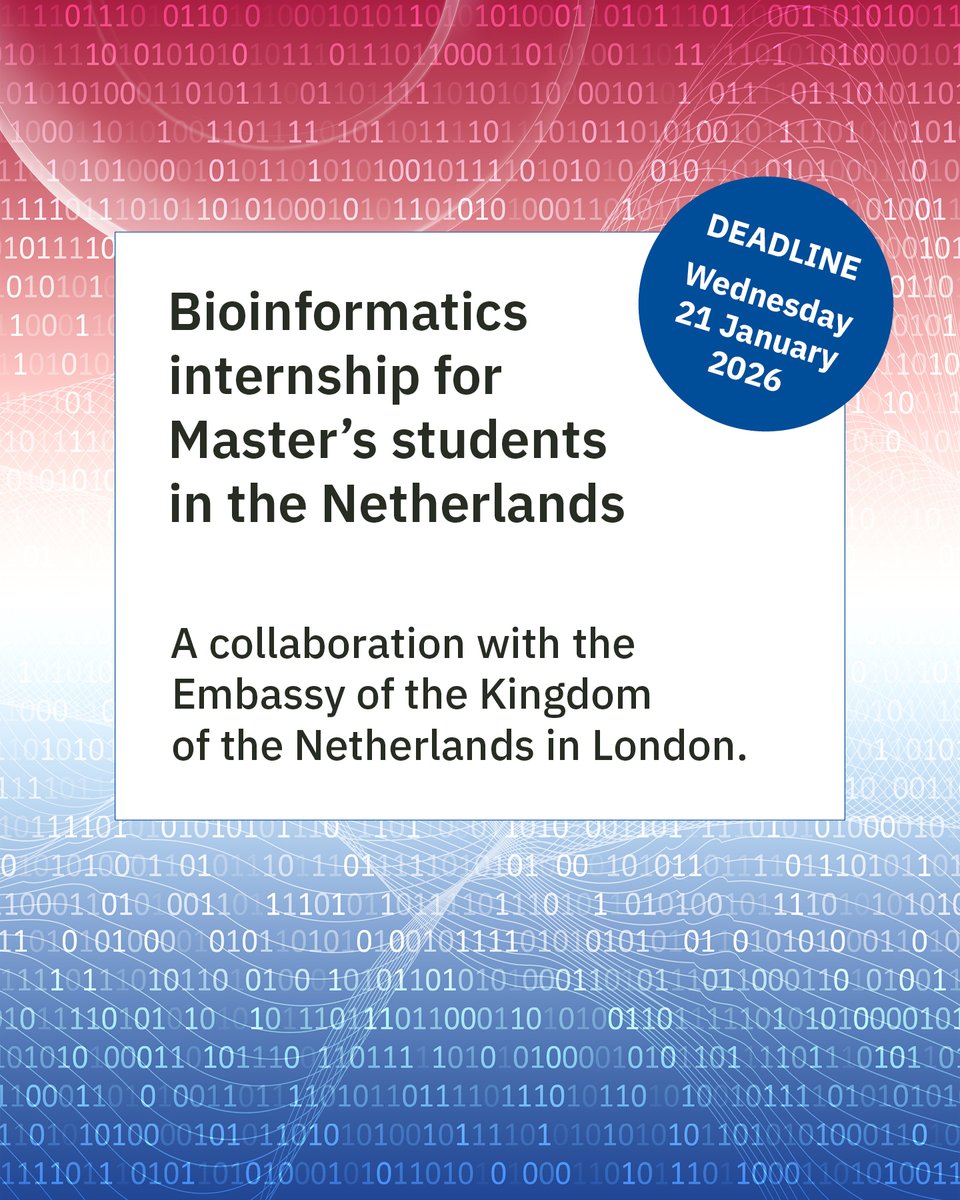
Paid internship opportunity for Master’s students in the Netherlands 🇳🇱
Studying computer science, bioinformatics or molecular biology?
This could be the perfect springboard for you.
A collaboration with the Embassy of the Kingdom of the Netherlands.
https://t.co/JCYq7sfjAH
The @GOVUK@SciTechgovuk, published its national AI for Science strategy.
We’re pleased that EMBL-EBI is highlighted in this for the strength of our data foundations and look forward to seeing how this strategy will support future scientific discovery.
https://t.co/6iw4wQZlFU
Come discuss recent breakthroughs in RNA biology, from molecules to organisms, at the EMBO | EMBL Symposium 'The complex life of RNA'! 👉 https://t.co/Ck2pqG1ESu
#EESRNA will bring together leaders in the RNA field, post-docs, and students, with the aim of disseminating and discussing the most recent findings. Submit your abstract by 7 July and present your research!
Session topics:
🔸 Co-transcriptional RNA biology
🔸 RNA processing and modification
🔸 RNP on the move
🔸 Co-translational RNA biology
🔸 RNA structure and regulation
🔸 RNA pathogens and therapeutics
We've just updated our RNAcentral Online Tutorial!
https://t.co/kZ9sbCYuIJ
This tutorial provides an overview of RNAcentral and covers different ways of accessing and using the data. It's aimed at anyone with an interest in non-coding RNAs.
As always, we welcome your feedback!
The first #ISCBUK conference is accepting submissions! Bringing together the UK's #bioinformatics community, the meeting is a chance to share cutting-edge science, foster collaborations, and build networks.
📥Submit here: https://t.co/vdIB57PyGI
🎉 RNAcentral Release 26 is here! This release introduces a significant structural change: gene-level entries for ncRNAs across 204 organisms.
For the first time, you can explore RNA data at the gene level, not just individual sequences. 🧵👇
Important, Prof. Rivas has done amazing work. Knowing evolution and covariation is most important and often
An Overlooked and under appreciated aspect of rna structure annotation/validation!
🧬 We're hiring a Bioinformatician! Join our team advancing RNA research with cutting-edge genomic data. Ready to make an impact? Apply: https://t.co/ZDSrFH9Nry #Bioinformatics#RNAresearch#JobAlert
A Fully-Open Structure-Guided RNA Foundation Model for Robust Structural and Functional Inference
1. A new RNA foundation model, structRFM, has been introduced, pre-trained on millions of RNA sequences and secondary structures. This model incorporates base pairing interactions into masked language modeling through a novel pair matching operation, setting new benchmarks in RNA structure prediction and functional inference.
2. StructRFM achieves top performance in zero-shot homology classification and secondary structure prediction among fifteen biological language models. It also shows a significant 19% performance gain in tertiary structure prediction compared to AlphaFold3 on the RNA Puzzles dataset.
3. The model's ability to capture structural and functional patterns is validated through tasks like internal ribosome entry site identification, where it achieves a remarkable 49% performance gain in F1 score. This highlights the effectiveness of integrating structural information into pre-training.
4. StructRFM is designed with a structure-guided masked language modeling (SgMLM) strategy, balancing nucleotide-level and structure-guided masking dynamically. This approach allows the model to learn joint knowledge of sequential and structural data without task-specific biases.
5. The authors have made the 21-million sequence-structure dataset and the pre-trained structRFM model fully open-source, facilitating the development of multimodal foundation models in computational biology. This is a significant step towards democratizing RNA modeling.
6. StructRFM demonstrates strong generalization across diverse downstream tasks, including splice site prediction, IRES identification, and ncRNA classification. Its versatility and robustness make it a promising tool for advancing RNA-centric research.
7. The study highlights the potential for further development in multimodal RNA language models, suggesting future directions such as contrastive learning and unified frameworks for biomolecular modeling.
📜Paper: https://t.co/ehqpsF6wFu
💻Code: https://t.co/Z65pBZCTP9
#RNAFoundationModel #StructRFM #RNAPrediction #ComputationalBiology #OpenSource #Bioinformatics
Exciting opportunity at @emblebi !
The RNA Resources team is recruiting a #Bioinformatician to contribute to the development of the @RNAcentral and @RfamDB databases, two widely used resources in RNA biology
Deadline: 21 September 2025
🔗 https://t.co/1YqsEIjTgk
Exciting news!! The Tzelepis Lab is recruiting a postdoctoral Research Associate to drive our translational work on discovering novel RNA biology of disease. This post is generously funded by @wellcometrust and is open to all UK-based and international applicants. See more info below:
https://t.co/X8HSLNvGxE
📢 Applications are now open for the #ARISE2 Fellowship Programme!
With funding from @MSCActions, the programme trains scientists to become leaders in research infrastructures and innovate in the #LifeSciences.
Apply here: https://t.co/ab3IKgiXvF
EMBL’s AI initiative strives to transform all areas of life science research through full AI integration.
Major funding from the Hector Foundation is dedicated to attracting interdisciplinary talent and boosting infrastructure, training, & innovation.
https://t.co/5yZvUStvBk
New cross-refs to a specialized antimicrobial resistance resource, the Comprehensive Antibiotic Resistance Database (CARD) added - expert curated resistance determinants & associated antibiotics.
All entries with a CARD cross ref: https://t.co/Eo1ZqSzvWI)
#AntimicrobialResistance