If your favorite stock is not moving the way you expected on earnings
Instead of saying “this makes no sense”
Consider asking yourself “what are investors seeing here that I’m not?”
A lot of investing mistakes come from assuming you know better, instead of trying to learn 🧠
What can $NOW be worth in 2030?
One of the biggest mistakes investors make is believing valuation is far more precise than it really is. Nobody knows exactly what a business will earn five years from now or what multiple the market will assign. The goal is not to predict the future perfectly. The goal is to understand what today’s price assumes.
Management believes $NOW can reach approximately $30 to $32 billion of revenue by 2030 while achieving a Rule of 60 and reducing stock based compensation below 10% of revenue. For this exercise, I will assume the company reaches $32 billion of revenue while maintaining a 35% reported free cash flow margin. That would produce approximately $11.2 billion of reported free cash flow.
This is where investors begin to disagree. Some value the business using the reported $11.2 billion because that is the number shown in the financial statements. Others immediately subtract roughly $3.2 billion of stock based compensation and conclude the business only earns about $8 billion. I think both numbers matter because they answer different questions.
From an accounting perspective, $NOW genuinely generated $11.2 billion of free cash flow. From an owner’s perspective, however, stock based compensation is not free because every share issued to employees reduces your ownership unless the company eventually buys those shares back. If roughly $3.2 billion must be used to offset dilution, about $8 billion remains available for everything else.
That creates two reasonable valuation frameworks. Using roughly $8 billion of owner free cash flow, $NOW could be worth approximately $200 billion, $240 billion, or $280 billion at 25x, 30x, or 35x free cash flow. Those values represent approximately 100%, 140%, and 180% upside, or roughly 17%, 22%, and 26% annualized returns between today and the end of 2030.
Using reported free cash flow produces higher values because investors would be applying the same multiples to $11.2 billion instead of $8 billion. That implies valuations of approximately $280 billion, $336 billion, and $392 billion, representing roughly 180%, 236%, and 292% upside, or approximately 26%, 32%, and 37% annualized returns.
Of course, none of these numbers matter unless $NOW actually reaches its long term goals. A 35% free cash flow margin only produces a Rule of 60 if revenue is still growing at roughly 25% in 2030. If growth slows closer to 20%, margins would likely need to exceed 40% to achieve the same result.
The biggest variable is artificial intelligence. The bear case is that AI makes enterprise software easier to replace. The bull case is that enterprises will increasingly need one trusted platform to orchestrate, govern, secure, and monitor thousands of AI agents working across the organization. Management clearly believes $NOW can become that platform, which helps explain why AI has become central to its strategy.
At the end of the day, I care less about revenue, reported free cash flow, or stock based compensation individually. I care about free cash flow per share, because that tells me how much of the business actually belongs to me. If $NOW continues compounding free cash flow per share while maintaining a long runway for growth, I suspect today’s valuation will eventually attractive.🌹
The margin of time
Most investors believe the margin of safety is simply buying a stock below intrinsic value. That’s true, but it’s also incomplete. The greatest investors understand that a margin of safety is far more than just a discount.
The irony is that many investors become so obsessed with paying the perfect price that they completely miss extraordinary businesses. They spend years waiting for a stock to fall another 10% or 20%, only to watch it compound fivefold without them. They didn’t lose because they overpaid. They lost because they never owned greatness.
The market doesn’t owe you your price. It doesn’t know what price you wrote on your watchlist, and it certainly doesn’t care. Sometimes your limit order is simply evidence of stubbornness disguised as discipline.
This is where I think many investors misunderstand the margin of safety. There isn’t just one. There are at least four. There is a margin of safety in price, in the quality of the business, in management, and perhaps most importantly, in time.
An extraordinary business has its own built in margin of safety. Great management can recover from mistakes, dominant competitive advantages can withstand recessions, and high returns on capital create value year after year. Those qualities protect investors in ways a cheap price alone never can.
A mediocre business selling at half of intrinsic value may actually have less margin of safety than an exceptional business selling at a premium. Why? Because intrinsic value itself may be shrinking. Cheap is not the same as safe.
Time may be the greatest margin of safety of all. If a business compounds intrinsic value at 20% or 25% for decades, time has an incredible ability to erase valuation mistakes. Paying somewhat too much for a phenomenal business often produces a far better outcome than buying an average business at an enormous discount.
That doesn’t mean valuation doesn’t matter. It absolutely does. Paying less is always preferable to paying more, all else being equal.
The ideal investment isn’t simply a wonderful business. It isn’t simply a cheap business either. It’s the rare moment when an extraordinary business temporarily becomes available at an extraordinary price.
Those opportunities are uncommon. They may not appear every year, and sometimes they don’t appear for several years. Investing isn’t about finding dozens of bargains. It’s about recognizing the handful that can truly change your financial future.
You don’t need fifty successful investments. You probably don’t even need ten. Two or three extraordinary investments held for a very long time can create more wealth than a lifetime of constantly chasing average opportunities.
Think about Berkshire Hathaway decades ago. Think about Walmart in the 1980s, Microsoft in the 1990s, Amazon after the dot-com crash, or MercadoLibre during periods of fear. Missing dozens of ordinary bargains wouldn’t have mattered very much if you owned just a few businesses like those.
Many investors focus on how much they might lose by paying a little too much. Very few focus on how much they might lose by never owning a great compounder at all. Opportunity cost is invisible, which is precisely why it’s so dangerous.
People celebrate saving 15% on the purchase price. They rarely calculate what it cost them to miss a business that compounded at 20% annually for the next twenty years. Sometimes the biggest investing mistake isn’t overpaying. It’s refusing to pay a fair price for an extraordinary business.
Here’s another interesting thought. A margin of safety can actually grow after you buy. As a great business continues increasing its intrinsic value year after year, the gap between what you paid and what the business is worth keeps widening. With a melting ice cube, the exact opposite happens.
1/👇
One thing I find fascinating about $NFLX is that most of the debate today revolves around content. Investors worry there will never be another Squid Game or Stranger Things. The assumption seems to be that if $NFLX cannot produce another global phenomenon, the growth story is over.
Most investors ask whether $NFLX can create another hit show. The more interesting question is whether $NFLX even needs another hit show. Sometimes investors become so focused on what created yesterday’s success that they miss what can drive tomorrow’s returns.
Today $NFLX has more than 300 million paying subscribers spread across virtually every major market in the world. It possesses one of the strongest consumer brands on the planet and one of the most powerful content distribution businesses ever assembled. When people want to watch something, they often do not say they want to stream something. They say they want to watch Netflix.
The bull case does not require heroic assumptions. $NFLX does not need to double its subscriber base, invent a revolutionary product, or suddenly discover ten new Squid Games. It simply needs to continue extracting a little more value from an audience that already exists.
Imagine subscriber growth slows materially from here. Suppose subscribers grow only a few percent annually, revenue per user increases only 5% per year through modest price increases and advertising, and management continues repurchasing shares. Suddenly you have a business capable of growing revenue in the high single digits while earnings per share compound even faster.
The math is surprisingly attractive. If revenue grows 8% to 10%, operating leverage contributes, buybacks contribute, and the valuation multiple remains roughly where it is today, investors can still achieve low double digit returns. That outcome does not require extraordinary success. It requires ordinary success applied to an extraordinarily large customer base.
What makes the setup particularly interesting is that the market spent more than a decade financing $NFLX global buildout. In fact I was just talking about this with @varuninvesting and @DimitryNakhla earlier today. Investors effectively funded the creation of one of the largest entertainment platforms in history. Today shareholders are left with a business generating substantial free cash flow, modest debt, and far less need for capital than before.
In fact, one of the most interesting questions an investor can ask is this, if $NFLX did not exist today, how much money would it cost to build it? Hundreds of millions of subscribers, global distribution, technology, content relationships, brand recognition, and decades of accumulated consumer habits would likely require an astronomical amount of money and time to replicate.
The other piece that often gets overlooked is management. $NFLX was the best performing stock in the S&P 500 over a decade, and management successfully navigated the transition to streaming, international expansion, password sharing, and advertising while many critics predicted disaster. Their track record does not guarantee future success, but it certainly deserves respect.
Perhaps the most important point is that the future return does not require $NFLX becoming something it is not already. It does not need to conquer a new industry, invent a revolutionary technology, or double its subscriber base. It simply needs to continue doing what it has already demonstrated an ability to do for many years.
Ironically, I do not think the bear case is content at all. The bear case is that subscriber growth matures, margins peak, advertising disappoints, and $NFLX becomes a 5% to 8% grower rather than a 15% grower. That is the argument I would worry about because it directly impacts the economics of the business.
🌹
$ABCL
좀 더 찿아봅니다.
좋은 내용이어서..
맞는 분석이 되길 바라면서..
이 글은 AbCellera vs De novo 단백질 설계를 비교하는 내용인데, 의견이 많이 섞여 있습니다.
투자 관점에서는 현재 검증된 사실(Fact) 과 아직 검증되지 않은 전망(Opinion) 을 분리해야 합니다.
Fact 1.
AbCellera의 강점은 "자연에서 찾는 능력"이 아니라 데이터 플랫폼이다.
많은 사람들이 AbCellera를 "항체 스크리닝 회사"라고 생각하지만 이는 절반만 맞습니다.
실제로 AbCellera의 경쟁력은
초고속 single-cell screening
자체 microfluidics
AI 기반 항체 분석
수십억 개의 면역세포 데이터베이스
TranscriptFormer 같은 Foundation Model
임상까지 연결되는 개발 플랫폼
입니다.
즉,
"좋은 항체를 많이 찾는다"보다
"좋은 항체를 가장 빨리 찾고 최적화한다."
가 더 정확한 표현입니다.
Fact 2.
자연 항체는 실제 성공률이 높다.
FDA 승인 항체의 대부분은
원래 존재하는 인간(B-cell) 항체에서 출발했습니다.
이유는 간단합니다.
자연에서 선택된 항체는
안정성
발현성
독성
면역원성
등이 이미 어느 정도 검증되어 있기 때문입니다.
그래서
Big Pharma도
여전히
Natural antibody discovery를 가장 많이 사용합니다.
Fact 3.
하지만 자연에는 없는 표적도 있다.
여기서 De novo가 등장합니다.
예를 들면,
새로운 바이러스
암 특이 구조
새로운 binding site
기존 항체가 접근 못하는 Epitope
이런 경우는
자연에서 원하는 항체가 존재하지 않을 수 있습니다.
이때는
AI가 처음부터 설계하는 것이 유리합니다.
대표적으로
David Baker 연구팀
Generate Biomedicines
EvolutionaryScale
Isomorphic Labs
등이 이 방향입니다.
Fact 4.
De novo는 아직 상업적 성공 사례가 많지 않다.
가장 중요한 부분입니다.
현재(2026년 기준)
De novo 설계는
논문과 전임상에서는 매우 뛰어난 성과를 보이고 있습니다.
하지만,
FDA 승인 의약품을 대량으로 만든 사례는 아직 거의 없습니다.
즉,
과학은 매우 앞서 있지만
상업화는 이제 시작 단계입니다.
Fact 5.
AbCellera도 AI 설계를 하지 않는 회사가 아니다.
이 부분을 사람들이 가장 많이 오해합니다.
AbCellera 역시
항체 최적화
구조 예측
affinity maturation
developability
multi-specific antibody
등에서 AI를 적극 활용합니다.
즉,
AbCellera는
"Natural Discovery만 하는 회사"
가 아니라,
발견 이후 엔지니어링까지 수행하는 플랫폼 회사입니다.
Fact 6.
두 기술은 경쟁보다 보완 관계일 가능성이 높다.
현재 업계의 흐름은
① 자연에서 후보를 찾고
↓
② AI가 최적화하고
↓
③ 필요하면 de novo 구조를 추가 설계하는
Hybrid 방식입니다.
실제로 많은 글로벌 제약사들도 이 접근을 채택하고 있습니다.
투자자가 확인해야 할 핵심✔️
AbCellera의 미래는 단순히 "자연 항체 발견"에 달려 있지 않습니다.
더 중요한 것은 다음과 같습니다.
내부 파이프라인이 임상에서 성공하는가?
AI 기반 플랫폼이 개발 속도와 성공률을 높이는가?
다중특이성 항체(TCE 등) 설계 역량이 확대되는가?
제약사와의 공동개발 및 라이선스 계약이 지속적으로 늘어나는가?
현재 근거만 놓고 보면,
단기(향후 3~5년): AbCellera와 같은 AI 기반 항체 발견·최적화 플랫폼이 임상 및 상업화에서 더 많은 실적을 낼 가능성이 높습니다.
이는 이미 검증된 항체 개발 방식 위에 AI를 결합하고 있기 때문입니다.
장기(5~10년 이상): De novo 단백질 설계는 매우 큰 잠재력을 가지고 있지만,
실제 승인 의약품과 반복 가능한 상업적 성공 사례를 더 축적해야 합니다.
따라서 현재 시점에서는 "AbCellera와 De novo는 승패를 가르는 경쟁 관계"라기보다, 서로를 보완하는 기술로 보는 것이 현재 공개된 과학적 근거와 산업 흐름에 가장 부합하는 해석입니다.
※ 다소, 개인적인 생각이 포함되어 있읍니다.
Breaking down $MELI's updated investor presentation 👇
Notice the aggressive decoupling of the fintech arm from the core e-commerce marketplace. Unique retail buyers grew by 20% to 126M, but Fintech Monthly Active Users accelerated faster at 29% to hit 83M. Pago is a standalone financial utility. By absorbing the massive unbanked and underbanked populations of Latin America, they drastically expanded their TAM far beyond standard retail consumers.
This structural shift is actively creating monetization efficiency. $MELI reached a massive $31.8B in net revenue driven by a 49% CAGR since 2020. This heavily outpaces base user growth. Mercado Libre is extracting significantly more cash from each active user over time. They are locking consumers into a closed-loop system of credit, payments, and logistics, relentlessly driving up the LTV of their existing base.
only 4.2% of the $SPCX supply is available to be traded right now
11% will be unlocked on August 5th, but until then 96% of all shares cannot be sold
this is the reason that I've said SpaceX will do well post IPO in the short-term
retail investors and traders will buy this thing up until early investors and institutions unlock and can dump their shares
regardless of the bullish content being released by all the early investors, they will be selling the moment they are able to bc they have a mandate to take profits when up 10x-100x+ on their investment
I don't know how high SpaceX will go between now and the moment the unlocks begin (maybe its much higher), but for sure this will get sold off when it happens
This is the same thing that happened with Circle last year when they IPO'd (just look at that chart and you'll see what will happen to SpaceX)
Also, there is a clause that moves up these unlocks to July 20 if SpaceX prices remains 30% above IPO price for 5 days, which is very likely to happen
So the music will likely stop at some point mid-July. Until then, I do think SpaceX has the ability to go much higher
ps. you can get this type of insight + track our analysts portfolios and trades for just $1 in Milk Road PRO (see link in bio)
[ 전력 다음 병목은 ‘물’이다 💦] #AI#병목
미 백악관의 에너지 보고서와 AI 액션 플랜을 보면, 정책 수혜를 받는 모든 부문이 공통적으로 ‘물 수요’를 늘리고 있습니다.
데이터센터, 전력 발전, 반도체 제조, 인력 이동 — 모두 대량의 물을 필요로 하죠.
하지만 아이러니하게도 미국의 AI 인프라는 물이 부족한 애리조나, 텍사스, 캘리포니아 등에 집중 건설되고 있습니다.
그래서 이번에는 수자원 병목이 가장 심각한 지역과 이에 따른 수혜 기업을 정리해보려 합니다.
먼저 배경지식부터 살펴봅니다 (계속).
(1/4)
*아래는 미국 서부 지역의 가뭄 현황
“When there is a frenzy of activity in one area of the market there is very often an anti-bubble of discarded companies. In the dot com era these were companies with steady cash flow.”
— Nick Sleep 🗣️ (Nomad Letter Jun 2006)
GPT를 매매 보조로 쓰는 방법을 정리해봄.
개인적으로 엄청난 꿀팁이라고 생각함.
많은 사람들이 GPT에게 이렇게 물어봄.
“이 주식 뉴스 알려줘”
“이 종목 오를까?”
“호재 나오면 알려줘”
근데 이렇게 쓰면 별로 도움이 안 됨.
주식에서 중요한 건 뉴스의 양이 아니라 내가 처음 산 이유가 아직 살아 있는지임.
이걸 투자 thesis라고 부름.
쉽게 말하면,
투자 thesis = 내가 이 주식을 산 핵심 이유
핵심 지표 = 그 이유가 맞는지 확인할 숫자
촉매 = 주가가 크게 움직일 수 있는 이벤트
리스크 = 생각보다 안 풀릴 수 있는 이유
Kill condition = 더 이상 들고 있을 이유가 깨지는 조건
예를 들어 같은 AI 관련주라도 봐야 할 포인트가 완전히 다름.
광통신 회사는 고객명, 양산, optical module, CPO, hyperscaler 채택을 봐야 함.
전력반도체 회사는 AI 서버 매출, 마진, design win, 전력 아키텍처 변화를 봐야 함.
장비주는 R&D가 아니라 production order가 실제로 나오는지를 봐야 함.
적자 성장주는 현금흐름, 증자, 전환사채, 워런트, 희석을 반드시 봐야 함.
그래서 GPT 알림을 세팅할 때는
“뉴스 알려줘”가 아니라
“내 thesis가 강화되거나 깨지면 알려줘”로 해야 함.
내가 쓰는 방식은 2단계임.
먼저 GPT에게 티커를 넣고 종목별 thesis map을 만들게 함.
복붙용 프롬프트:
========================================
아래 티커에 대해 투자 판단용 thesis map을 만들어줘.
목표는 단순 회사 소개가 아니라, 앞으로 이 종목을 감시할 때 어떤 뉴스가 중요한지 구분하기 위한 기준표를 만드는 것이다.
티커:
[여기에 티커 입력]
분석 기준:
1. 회사가 정확히 무엇을 하는 회사인지
2. 현재 시장이 이 회사를 어떤 thesis로 보고 있는지
3. 내가 이 종목을 볼 때 핵심 투자 thesis가 무엇인지
4. 이 thesis를 증명할 핵심 지표가 무엇인지
5. 앞으로 주가에 큰 영향을 줄 수 있는 주요 촉매가 무엇인지
6. 반드시 조심해야 할 주요 리스크가 무엇인지
7. thesis가 깨졌다고 볼 수 있는 kill condition이 무엇인지
8. 무시해도 되는 잡뉴스는 무엇인지
9. 실적 발표 때 반드시 확인해야 할 항목은 무엇인지
10. 이 종목이 고평가인지 저평가인지 판단할 때 어떤 valuation 지표를 봐야 하는지
출력 형식은 반드시 아래처럼 해줘.
[티커 / 회사명]
- 투자 thesis:
- 봐야 할 핵심 지표:
- 주요 촉매:
- 주요 리스크:
- kill condition:
- 무시해도 되는 잡뉴스:
- 실적 발표 체크포인트:
- 적합한 valuation 기준:
- 한 줄 결론:
주의사항:
확정 사실과 추론을 분리해줘.
숫자는 최신 공시, 실적, IR, 신뢰도 높은 자료 기준으로만 써줘.
확인되지 않은 내용은 추정이라고 표시해줘.
직접적인 매수/매도 지시는 하지 말고 판단 보조용으로 정리해줘.
======================================
이걸 먼저 하면 좋은 점이 있음.
내가 그 종목을 왜 보는지 정리됨.
어떤 뉴스가 진짜 중요한지 보임.
어떤 뉴스는 무시해도 되는지 구분됨.
실적 발표 때 뭘 봐야 하는지 명확해짐.
주가가 흔들릴 때 감정매매를 줄일 수 있음.
그다음 2단계로, 이 thesis map을 기준으로 알림을 걸면 됨.
복붙용 프롬프트:
=======================================
아래 종목들에 대해 투자 판단용 thesis map을 먼저 만들고, 이후 뉴스·공시·실적·IR·가이던스·고객 발표·주문·자금조달 이슈가 나올 때마다 thesis 변화가 있는지 감시해줘.
목표는 단순 뉴스 요약이 아니라, 내가 처음 이 종목을 보는 이유가 강화되는지, 약해지는지, 깨지는지를 판단하는 것이다.
감시 종목:
1. [티커 / 회사명]
2. [티커 / 회사명]
3. [티커 / 회사명]
먼저 각 종목별로 아래 항목을 만들어줘.
- 투자 thesis:
- 봐야 할 핵심 지표:
- 주요 촉매:
- 주요 리스크:
- kill condition:
- 무시해도 되는 잡뉴스:
- 실적 발표 체크포인트:
- 적합한 valuation 기준:
- 한 줄 결론:
이후 중요한 변화가 있을 때만 아래 형식으로 알려줘.
1. 티커 / 이벤트 제목
2. 확정 사실
3. 추론은 사실과 분리
4. Bullish / Bearish / Neutral 분류
5. 기존 thesis 대비 무엇이 바뀌었는지
6. 홀딩 강화 신호인지, 주의 신호인지, 비중 조절 검토 신호인지, kill condition인지
7. 다음에 확인해야 할 것
알림 대상:
- 신규 고객명 공개
- 대형 주문 또는 production order
- 양산 일정 변경
- 매출 가이던스 상향 또는 하향
- 마진 개선 또는 악화
- 현금흐름 악화
- 유상증자, 전환사채, 워런트, 희석 리스크
- 주요 파트너십의 실제 매출 전환
- 기존 투자 thesis를 강화하거나 훼손하는 사건
- 경영진, 거버넌스, 자본배분 리스크
- 실적 발표에서 기존 thesis와 다른 변화
- valuation을 다시 계산해야 할 정도의 매출, 이익, 수주 변화
알리지 않아도 되는 것:
- 단순 주가 변동
- 컨퍼런스 참석
- 반복적인 홍보성 뉴스
- 소셜미디어 루머
- 이미 알려진 테마성 코멘트
- 고객명, 주문, 매출, 양산, 가이던스 변화가 없는 일반 보도자료
판단 기준:
좋은 뉴스처럼 보여도 실제 주문, 고객명, 매출, 양산, 가이던스, 마진, 현금흐름 변화가 없으면 과대평가하지 마.
반대로 단기 주가가 내려도 thesis가 유지되면 단순 변동성으로 분류해줘.
확정 사실과 추론을 반드시 분리해줘.
직접적인 매수/매도 지시는 하지 말고, 투자 판단 보조용으로 정리해줘.
중요한 변화가 없으면 아무 알림도 하지 마.
========================================
이렇게 세팅하면 GPT가 단순 뉴스봇이 아니라
투자 가설 감시 도구가 됨.
매매에서 진짜 봐야 할 건 몇 개 안 됨.
고객명
주문
양산
가이던스
마진
현금흐름
희석
전환사채/워런트
경영진 리스크
내가 산 이유가 깨졌는지 여부
주식에서 제일 위험한 건 뉴스가 없는 게 아님.
잡뉴스는 계속 나오는데, 정작 중요한 변화는 못 보고 넘어가는 게 더 위험함.
예를 들어 회사가 컨퍼런스에 참석했다는 건 대부분 큰 의미 없음.
반대로 작은 공시라도
대형 고객명 공개
production order
가이던스 상향
대규모 희석
현금흐름 악화
양산 지연
이런 게 나오면 thesis 자체가 바뀔 수 있음.
그래서 GPT에게 물어볼 때도 이렇게 바꿔야 함.
“이 뉴스 좋아?”보다
“이 뉴스가 내 thesis를 강화하는가?”
“주가 왜 빠져?”보다
“thesis가 깨진 하락인가, 단순 변동성인가?”
“계속 들고 가도 돼?”보다
“처음 산 이유가 아직 숫자로 증명되고 있는가?”
이게 훨씬 실전적임.
결론은 단순함.
GPT를 매매에 쓰려면
티커 감시가 아니라 thesis 감시로 써야 함.
종목마다 산 이유가 다르고, 봐야 할 지표도 다름.
그래서 먼저 thesis map을 만들고,
그다음 뉴스·공시·실적이 그 thesis를 바꾸는지만 감시하게 하는 게 맞음.
개인 기록용.
매수·매도 의견 아님.
The biggest lesson I’ve learned is that wealth isn’t built by constantly pulling the trigger. It’s built by finding great businesses, building favorable positions, and having the patience to let time do the heavy lifting.
$ZETA and $NOW taught me that.
I’ve watched positions go from euphoric to painful, from frustrating to exciting, and back again. Yet through all the volatility, the thesis kept evolving while the impatient investors were being shaken out.
The goal isn’t to trade more. The goal is to position yourself so well that time becomes your business partner.
Singapore has no CGT. It was poorer than Australia per capita and now it is almost twice as rich. They didn't do it by taxing everyone harder. Jim Chalmers and Albo take note.
I have been investing in $MELI for almost 15 years. That is almost 2/3 of the company’s existence. I have watched this business go from a small few billion dollar company into one of the most important platforms in Latin America, and through all those years the narrative was almost always the same. Competition was coming. Some new heavily funded company was going to destroy them. Some giant was going to overpower them. Yet somehow through discipline, execution, frugality, and an elite culture, $MELI just kept winning.
What always stood out to me was that they rarely behaved like a reckless growth company. They did not constantly dilute shareholders. They did not load the balance sheet with insane debt. They did not chase every shiny object or light billions on fire with dumb experiments that never worked. They executed carefully, maintained an incredibly stable leadership culture, and kept building piece by piece while other companies constantly changed direction or management teams.
Then around 2018 they made one of the boldest transitions I have ever seen from a large public company. They realized the old marketplace and auction style model was not enough and they essentially rebuilt the company around logistics, fulfillment, payments, and infrastructure. Think about how crazy that really was. Latin America is an incredibly difficult region logistically, financially, politically, and operationally. Most companies would fail attempting something like that even with unlimited capital.
What amazes me is they completely repositioned the business from a relatively asset light marketplace model into a much more infrastructure heavy ecosystem without missing a beat. Most companies cannot reinvent themselves like that once they reach scale. $MELI did it while continuing to grow rapidly. That tells you something important about the culture and management quality behind this business.
I also think many people still misunderstand what $MELI actually is. They still think of it primarily as an ecommerce company. I increasingly think ecommerce is almost the bait. Underneath it they are quietly building the infrastructure of commerce and financial services across Latin America.
The flywheel is beautiful, Pago increases checkout conversion and trust. Logistics improves delivery speed and reliability. Credit helps merchants buy inventory and helps consumers spend more inside the ecosystem. Advertising monetizes attention. Fulfillment improves consistency and customer satisfaction. Scale lowers shipping costs. Lower shipping costs improve frequency and conversion. More buyers attract more sellers. More sellers improve selection. The entire ecosystem reinforces itself.
People still debate Pago, ecommerce, credit, logistics, and ads as if they are separate businesses. I increasingly think that misses the point entirely. The value comes from how every layer strengthens every other layer. The ecosystem itself is becoming the moat.
That is what makes the business so dangerous competitively. The moat is no longer one thing. It is the interaction between all the things. Every year the ecosystem becomes more integrated, more efficient, and more embedded into the daily economic life of consumers and merchants across Latin America.
And what makes this even harder to replicate is that Latin America is not an easy region to operate in. Payments are fragmented, infrastructure is weaker, fraud risks are higher. Inflation and currency volatility exist, regulations vary country by country and logistics are far more difficult than most American investors realize. Ironically, those difficulties become advantages for $MELI that successfully builds the network first because the operational complexity itself becomes part of the moat.
1/👇
$MELI
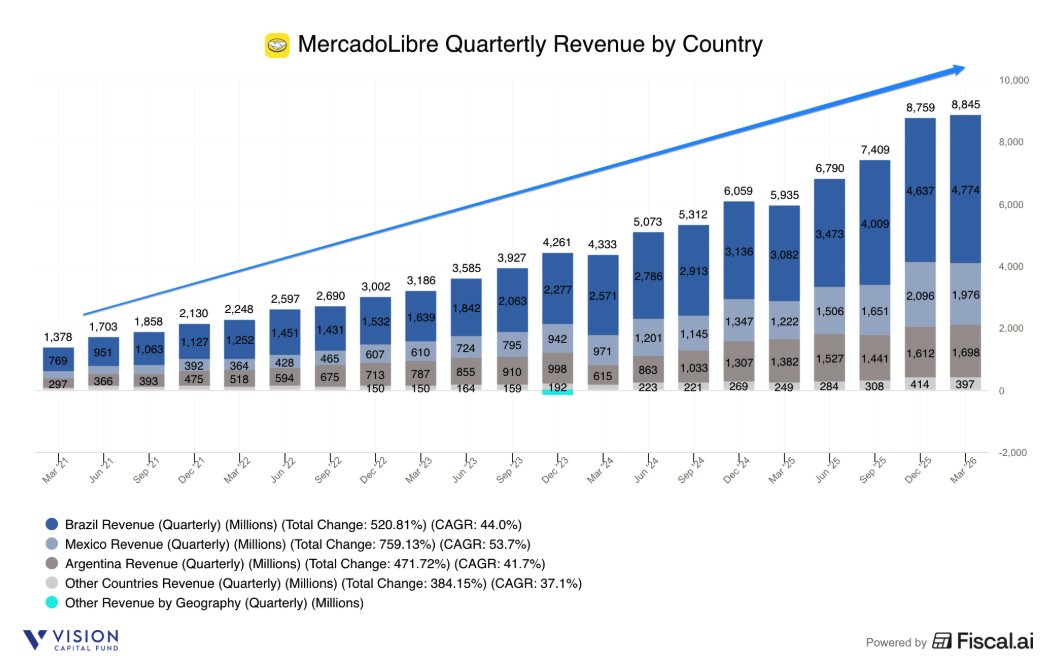
The market is focused on margins compressing, operating income declining 20%, and some experimentation with the credit products but underneath the surface this may have actually been one of the strongest strategic quarters in $MELI history. Revenue grew 49% to $8.8b, TPV grew 50% to $87b, and GMV grew 42% to $19b.
This is not a mature company struggling to grow a few extra percentage points. This is a company already operating at massive scale while still growing like a startup. The really important thing is that growth is actually accelerating in several key areas even while they are intentionally sacrificing short term profitability. There’s a big difference between weak margins caused by weakening demand and weak margins caused by aggressive reinvestment.
The entire philosophy behind this quarter is actually pretty simple. $MELI believes Latin America is still extremely early in the digital commerce and fintech transition, so management is choosing to maximize long term ecosystem dominance instead of optimizing near term margins. Honestly, when you look at the underlying numbers, it becomes pretty hard to argue against that logic.
The average American makes around 40 online purchases per year while the average Latin American makes just 7. Even buyers on $MELI only average around 11 purchases annually today, which means ecommerce penetration still looks extremely early. If management believes that number can eventually double or triple over time, then aggressively investing today probably makes a lot of sense.
The lower free shipping threshold in Brazil is probably the clearest example of this strategy. Most investors initially saw it as margin destruction, but $MELI clearly views it as long term habit formation. After lowering the threshold, Brazil GMV growth accelerated to 38%, items sold growth accelerated to 56%, and unique buyers accelerated to 32%, the fastest growth in five years.
What stood out to me most was that daily active users are now growing faster than monthly active users. That usually means engagement itself is deepening, not just user acquisition. Anyone can temporarily buy growth through promotions, but when conversion, frequency, and retention all improve simultaneously, it usually means consumer habits are actually changing. That’s where internet businesses become extremely powerful.
What makes this even more interesting is that the economics are already improving faster than expected. Unit shipping costs in Brazil declined 17% versus 11% last quarter, and almost half of the profitability hit from the lower shipping threshold has already been offset through efficiency and scale of logistics. They said that lower cost shipments are already breakeven.
This is basically the classic ecommerce flywheel playing out in real time. Lower shipping costs improve conversion, better conversion drives higher order density, and higher density improves logistics efficiency which lowers costs further. Over time, the ecosystem becomes stronger and more profitable because scale itself becomes the advantage. That is exactly why companies like $AMZN became so dominant over time.
I also think people massively underestimate the importance of the logistics network itself. $MELI now operates more than 50 fulfillment facilities and fulfillment handled 55% of shipments during the quarter while growing 39%. The moat is no longer just the marketplace or app itself. The moat becomes warehouses, delivery routes, seller relationships, underwriting data, payments infrastructure, advertising infrastructure, and consumer habits all compounding together into one ecosystem.
1/ 👇
MercadoLibre $MELI 1Q26 Earnings
- Rev $8.8b +49% ↗️🟢
- GP $3.9b +39% ↗️🟢 margin 43.7% -303 bps ↘️🔴
- Adj EBITDA $857m -8% ↘️🔴 margin 9.7% -606 bps ↘️🔴
- EBIT $611m -20% ↘️🔴 margin 6.9% -595 bps ↘️🔴
- Net Inc $417m -16% ↘️🔴 margin 4.7% -361 bps ↘️🔴
- OCF $2.1b +101% ⤴️🟢 margin 23.5% +609 bps ✅
- FCF $1.8b +138% ⤴️🟢 margin 20.4% +761 bps ✅
Total
- Service Rev $7.7b +45% ↗️🟢
- Product Rev $1.1b +84% ⤴️🟢
- Commerce $4.9b +47% ↗️🟢
- Fintech $4.0b +51% ↗️🟢
Brazil
- GMV +30% FXN ↗️🟢
- Sold Items +45% ↗️🟢
- Total Rev $4.8b +55% ↗️🟢
- Service Rev $4.0b +49% ↗️🟢
- Product Rev $787m +92% ⤴️🟢
- Commerce $2.8b +51% ↗️🟢
- Fintech $1.9b +61% ↗️🟢
- Contribution $389m -28% ↘️🔴 margin 8.1% -944 bps ↘️🔴
Mexico
- GMV +23% FXN ↗️🟢
- Total Rev $2.0n +62% ↗️🟢
- Service Rev $1.8b +60% ↗️🟢
- Product Rev $202m +76% ⤴️🟢
- Commerce $1.2b +54% ↗️🟢
- Fintech $781m +76% ⤴️🟢
- Contribution $344m +59% ↗️🟢 margin 17.4% -35 bps ✅
Argentina
- GMV +126% FXN ↗️🟢
- Total Rev $1.7b +23% ↗️🟢
- Service Rev $1.6b +22% ↗️🟢
- Product Rev $91m +32% ↗️🟢
- Commerce $573m +21% ↗️🟢
- Fintech $1.1b +24% ↗️🟢
- Contribution $607m -6% ↘️🔴 margin 36% -1114 bps ↘️🔴
Others
- Total Rev $397m +59% ↗️🟢
- Service Rev $347m +53% ↗️🟢
- Product Rev $50m +127% ⤴️🟢
Commerce $274m +54% ↗️🟢
- Fintech $123m +73% ⤴️🟢
- Contribution $64m +42% ↗️🟢 margin 16% -195 bps ↘️🔴
Biz Metrics
- Unique Active Buyers 84.1m +26% ↗️🟢
- Fintech MAU 82.9m +29% ↗️🟢
- GMV $19b +42% ↗️🟢
- Items Sold 722m +47% ↗️🟢
- Items Sold per Unique Active Buyer 8.6 units +16% ↗️🟢
- Live Listings 773m +62% ↗️🟢
- Managed Network Penetration 95.5% +70bps ↗️🟢
- Same & Next Shipments 199m +39% ↗️🟢
- TPV $87.2b +50% ↗️🟢
- TPV Acquiring $56b +39% ↗️🟢
- TPV Acquiring (off) $36.2b +39% ↗️🟢
- TPV Acquiring (on) $19.8b +39% ↗️🟢
- TPV Fintech Svcs $31.2b +73% ⤴️🟢
- TPN 4.6b +39% ↗️🟢
- Monthly Active Sellers with Credit 36.0% total ↗️🟢
- AUM $19.9b +77% ⤴️🟢
- Credit Portfolio (CP) $14.6b +87% ⤴️🟢
- CP (Credit Card) $6.6b +104% ⤴️🟢
- CP (Consumer) $5.3b +79% ⤴️🟢
- CP (Merchant) $2.3b +64% ↗️🟢
- CP (Asset Backed) $0.3b +85% ⤴️🟢
- NIMAL 17.8% -980bps ↘️🔴
- Past Due 15-90 days 8.0% of NPLs/Total Portfolio ➡️🟢
- Past Due 90+ days 17.6% of NPLs/Total Portfolio ➡️🟢
- % Allowance of Doubtful Accts / NPLs >15 days past due 103% ➡️🟢
- % Allowance of Doubtful Accts / NPLs >90 days past due 149% ➡️🟢
1 | Q1 saw very strong growth as MELI heavily reinvested in its commerce and fintech business.
I'm pleased to report that we ended 2025 with robust operating trends that reinforce the strength of the MercadoLibre ecosystem. Our relentless focus on customer experience translated directly into strong financial performance with fourth quarter net revenues growth of 45% year-over-year. Our performance is supported by 2 primary growth drivers: the acceleration of our commerce business, and the rapid adoption and structural expansion of our fintech services.
2 | Near-term investments in Brazil lowering of shipping threshold, credit card in Brazil, Mexico, and Argentina, 1P commerce and cross-border trade (CBT) with China and US, pressured margins by 500-600bps.
We talked a lot about the results of those investments, but we wanted to give a sense of what those investments were in terms of margin compression….lowering of the shipping threshold that we did last year in Brazil. The credit card, we are investing in Brazil, Mexico and now Argentina, and the 1P, which is continuous its path to profitability, but still not profitable on its own. The same thing with CBT, which we are expanding now to the China and the U.S. corridor and then we also added the smaller countries where we continue to invest as we reach scale in those countries. So when we put all that together, we wanted to give you a sense of the pressure that, that generated on our margins and that gives you a range of between 5 and 6 points.
3 | Continued to enhanced the free shipping value proposition in Brazil commerce, lower free shipping thresholds, driving higher purchase frequency, new buyers, larger volumes, higher revenues, and improving efficiency.
Turning to commerce. In Brazil, our largest market, GMV grew an impressive 35% YoY alongside a 45% increase in sold items. This acceleration is the result of our strategic investments to enhance the value proposition, most notably the decision to lower the free shipping threshold. More free shipping is driving higher purchase frequency and bringing new buyers into the ecosystem. This volume is translating directly into efficiency. Our logistics network absorbed the increase in volumes while driving productivity gains, proving our ability to scale effectively.
4 | Confident of strong underlying unit economics that CBT, 1P and credit card when scaled will be profitable.
In terms of the trajectory, I think it's in line with what we have been talking about this in the past. CBT is a business that when it's locally fulfilled, is profitable, international fulfillment needs to continue scaling and moving in the right direction, but it will continue to scale and it will put some pressure on margins because of that.
When you look at our 1P, I think we talked a lot about 1P. It continues to be profitable on a variable basis level before allocating central cost, direct indirect cost is profitable. So the scale will play in our favor in terms of continuing to improve profitability.
I think the credit card, Osvaldo will talk about this, I'm sure, in some of the questions, but the credit card continues to improve its profitability, in particular in Brazil, where we're seeing already a significant part of the portfolio, the other cohorts being profitable….if you look at Brazil, which is the oldest cohort we have been issued credit cards in Brazil since 2021, cohorts that are older than 2 years are already profitable at a NIMAL level. So that gives us a lot of encouragement to continue expanding the user base.
5 | While NPLs decline slightly QoQ, NIMALs actually improved, more important to focus on what the risk was priced
regarding NPLs and the impact of a little bit -- a slight deterioration in NPLs from the third quarter to the fourth quarter. And that is -- so that is -- I would say that in general, NPLs of the credit card book fell to an all-time low of 4.4% in Q4. Nonetheless, the increase in NPL was mostly related to the consumer and merchant books. But having said that, I think that more important than NPLs are NIMALs and those improve, meaning we are more profitable than we were a quarter before. Therefore, what we did was we increased the number of people and the riskier number of people we give credit to, but we price that risk accordingly. And therefore, we ended up having a significant -- a larger spread than we did on the prior quarter. So I think this was a calculated risk and it worked out well.
6 | MELI remains focused to grow the credit book only if it stays healthy, confident about the quality and health of the credit portfolio with their models and collection.
I think the philosophy on credit has always been that we will grow our credit books as long as we have a healthy book. And as Osvaldo mentioned, you're seeing only part of it -- part of the equation on the NPLs. But obviously, we are pricing those ahead of time. And the margins in Argentina and Mexico are extremely high.
So we feel very, very comfortable about the quality and the health of our portfolio. And that's the reason why you see our credit book growing at 90% because we are confident in our models and our collection.
7 | However in the near-term given the mix of different growth rates and profitability, it is more unclear but confident of the long-term path.
So I think a lot of moving parts, right? The individual businesses are growing and moving in the right direction. Then you have a shift issue because some of these are growing at a faster pace. But the bottom line is that we're very confident that the investments that we're making in our platform and addressing the long-term opportunities that we see ahead of us, and we're also improving user experience in our platform.
This particular quarter, we mentioned that we have the highest NPS level in commerce and fintech in Argentina, Brazil and Mexico. So that's a consequence of investments that we have been doing, and we're very comfortable with these levels of investments in our ecosystem.
8 | Argentina saw margin compression largely due to the opening of new fulfilment centers, and higher bad debt provisions from the credit card launch last year, combined with higher funding costs.
We see, as you mentioned, some compression in Argentina. Keep in mind, Argentina continues to be the highest profitability market in terms of margins. But we did see some compression mostly coming from fulfillment. As you know, we opened couple of new fulfillment centers recently, so that generated some year-on-year compression on COGS. Also, provisions for bad debt because of the credit card. We launched the credit card in the middle of last year. So we're still -- we're seeing some compression because of that. As you know, the credit card requires investments upfront. And there is some year-on-year increase on funding costs. It's true what you said. Sequentially, QoQ, the funding cost of our credit portfolio was lower in Q4 relative to Q3, but it still was higher relative to a year ago. So those are the main reasons for the compression that we saw in this quarter.
9 | In agentic commerce, focusing most of efforts of developing with MELI instead, because they have the first-party data to create the best search, recommendation, discovery.
to complement this comment, I would say that the part where we're putting most of our efforts is in developing our own agentic experience inside MercadoLibre. We think and we are convinced that we have the first-party data to create the best search, best recommendation, best discovery engine on which we can personalize and lay over the agentic experience that the new technology drives.
So -- and by the way, if you believe that there is a world of agentic commerce, that could mean that retail will move even faster from the offline to the online world. So all this to say that I do think that we are well-positioned to actually capturing ad revenues in the future because we still think that MercadoLibre will be go-to place for demand to do shopping online.
10 | Because they don’t know which hardware, which model people will use, and customers look for value and for the best end-to-end experience, it makes sense to take the risk and focus all of their efforts to build their own agents and shopping assistant within MELI instead.
Let me try to rephrase what I meant earlier as I try to address your point. I think there are things that we know and there are things that we don't know. So we don't know which hardware people will use in 10 years to buy. We don't know whether the winning model will be X, Y or Z and so on. We do know that consumers do value or do look for the best end-to-end experience. We do know -- and that means not only searching for products, but also getting products fast, having the widest selection, pricing, the best financing alternatives, post-purchase support and so on.
We also know there's a technology today that can dramatically improve the product discovery process. And for that reason, we are putting all of our efforts and deploying lots of engineers in building our own agents and our own shopping assistant within MercadoLibre. It's early to know what will happen with other shopping assistant. I take your point that it might present a risk. I understand where you're coming from. But we are confident that we are playing this one from a position of strength that we have the relationship with consumers. We have a brand that Latin America loves.
11 | Advertising should benefit if MELI can capture more agentic commerce traffic.
So we eventually what I'm trying to convey is that on the one hand, we are confident on MercadoLibre's own ability to capture traffic through its own agentic experience. And on top of that, we do think that advertising represents an additional revenue opportunity in a world in which there is agentic commerce.
And by the way, the agentic world can also imply a faster shift of advertising dollars moving from traditional offline channels into digital advertising, which generates the opportunity to be even bigger. So we remain positive, we remain focused. The only thing that we know for sure is that we need to put our developers to work to have the best tech stack for advertising and the best agentic experience inside MercadoLibre.
12 | Advertising revenue grew 67% in 1Q26 on broad base strength, driven by higher adoption and tech-stack improvement, excited about the long-term opportunity.
we are very pleased with the performance we had in ads this quarter. Revenue accelerated to 67% on an FX neutral with higher adoption and spend basically driven by improvements in our tech stack. It's broad-based. So there's no one silver bullet driving that growth.
But basically, we are attaching our product in the different parts of the value chain, right, auction bidding, placement optimization, demand generating initiatives and all that powered by an improved an easy-to-use platform in terms of front end for our customers. So extremely, extremely satisfied with that.
So penetration of ads with revenues as a percentage of GMV is still small compared to its potential. So very happy with the results so far, but even more encouraged with the potential looking ahead.
13 | Mercado Pago's AI assistant is solving 87% of interactions without the need for human support, right now it is largely servicing, but excited with it cross-selling and recommending services.
We are very excited by Mercado Pago's AI assistant it is already helping mostly with solving questions and concerns from our users. We have built a lot of functionality into our agent. Basically you can do pretty much everything you do with Mercado Pago with the agent.
Our Mercado Pago AI assistant is solving 87% of interactions without the need of human support. Millions of users already adopt this conversational tool to manage their credit card, make transfers and understand their credit offerings.
And beyond cross-sell, it will also become more proactive in terms of acting like a personal banker. So helping you, I don't know, allocate your portfolio or make the recommendations of what kind of credit is better for you. So we believe here that the opportunity is significant.
14 | AI seller assistant is currently already helping sellers with 20% of GMV
Just to complement Osvaldo here on the marketplace side, while we have many, many features that are powered by AI, starting with our search algorithm, our recommendation and so on, I think it's worth highlighting the fact that we have a seller assistant today running in our platform, basically 20% of our GMV is somehow advised by our assistant. It's actually proving to be pretty successful in helping sellers improve their live listing, reduce their lead times to get better reputation in our platform, capture some of their questions and requirements in terms of customer support.
15 | MELI’s lower margins comes not from weakness but from deliberate decisions to pursue growth opportunities that will gradually become more profitable over time. It is already showing up in improved customer metrics, NPS, higher revenue growth.
first, it's important to put in context when we talk about margins, the growth that we're delivering. Most of the margin pressure comes from deliberate decisions that we're making in terms of pursuing investments that are generating tremendous growth and improving user experience. As you mentioned, in Brazil, in particular, we have been growing our GMV and gaining market share, mainly because of these investments. Our top line grew by 45% year-on-year. As I mentioned earlier, our NPS is at record levels, and that's because of the investments that we have been doing. You mentioned CBT, 1P, the lower shipping presold, expanding more free shipping, increasing booking capacity. So we feel very comfortable with these investments and the current margin levels because we are seeing the results in terms of growth, market share gains and improvements in user experience and engagement.
16 | MELI will not hesitate to invest to capture these opportunities even if there will be short-term margin pressure, because they are not optimising for short-term profitability, but seeking to grow the business for the long-term.
As I said in the past, our main focus is on capturing the large opportunities in front of us in commerce, fintech and advertising. And we will not hesitate to invest and to order to capture those opportunities as we have done in the past, even if that puts some short-term margin pressure, we're not trying to optimize short-term margin. We manage the business for long term -- from a long-term perspective, we believe these investments are creating a foundation for future growth, and we remain confident in our long-term margin trajectory.
➡️ Key takeaways for MercadoLibre $MELI
MELI continues to grow as LATAM’s dominant e-commerce and fintech platform with a long growth runway with still low penetration. Unsurprisingly, the market in the near term often does not like companies who reinvest heavily and profitability falls. The difference is that the reinvestment is already showing up in strong growth and the underlying profitable unit economics are there, all MELI needs is time to grow and scale each opportunity. Confident in management taking the long-term to grow the business rather than to manage short-term profitability which is what we are not interested in.
You have to stay grounded and can’t just assume your stocks are going up 10-20x because it sounds good.
In my opinion, if things go right, you’re looking at something like a 2–3x over the next five years with $MELI and $NOW. That’s already an incredible outcome and far more realistic than most of the projections people throw around.
A 2–3x might not sound exciting in a world chasing quick wins, but that’s roughly 15–25% annual returns. That’s how real wealth is built, quietly, consistently, without needing everything to go perfectly.
What matters isn’t predicting some massive multiple expansion. It’s whether the underlying business can keep compounding revenue, expand margins, and generate more cash per share over time. If that happens, the stock will eventually follow.
The part people underestimate is what it takes to actually earn that return. You’re going to sit through flat periods, drawdowns, and narratives that sound convincing but are completely wrong. Most people don’t lose money because they’re wrong, they lose money because they can’t sit still long enough to be right.
So instead of asking “can this 10x,” the better question is “can this business compound at a high rate for a long time?” If the answer is yes, you don’t need anything heroic.
That’s where names like $MELI and $NOW stand out. Not because they’re guaranteed winners, but because their economics are strong and moats are wide with plenty of growth in the tank.
🌹
🌹
$MELI 2030
$MELI is one of those businesses where the numbers look strong, but they don’t fully capture what’s happening underneath. So, what can $MELI be worth in 2030?
Revenue is approaching ~$40b and still growing at a very healthy pace. If the business continues executing across commerce, payments, and credit, it’s reasonable to see revenue reaching something like ~80b by 2030. That implies growth decelerating from the mid 30s into the low teens, which is what you would expect at this scale.
The more interesting part is earnings. 2026 earnings are ~$60 per share, and growing quickly. As the business scales, more of the ecosystem starts to work together. Payments drives monetization, logistics improves efficiency, advertising adds high margin revenue, credit expands take rate, etc.
From here, it’s reasonable to expect earnings to compound in the ~20–30% range over time. Not in a straight line, but as a general trend as the business matures and mix shifts toward higher margin segments. That gets you to something like ~$140 to $180 per share by 2030.
But even here, context matters. This is a business that reinvests heavily. Logistics, infrastructure, credit underwriting, and international expansion all require a lot of capital. That means margins won’t expand in a perfectly smooth way, and earnings will fluctuate depending on where they are investing at any given time.
Stock based compensation exists, but it’s not big, dilution is present, but more contained relative to the scale of the business. Retained earnings, on the other hand, are becoming increasingly important. At ~$60 per share today and growing fast, $MELI is generating serious earnings power. Over time, a meaningful amount of that is retained and reinvested back into the business. If those reinvestments continue to earn high returns, retained earnings become a major driver of long term value.
The balance sheet reflects that. As $MELI scales, its becoming more self funded. Cash generation improves, and capital can be redeployed into higher return opportunities like credit, logistics, and product expansion. At the same time, you have to watch the credit book, because that introduces a different kind of risk compared to a pure marketplace model.
So the question is not just how fast the business grows, but how well it allocates capital as it grows. From a valuation perspective, if $MELI is still compounding earnings at a healthy rate with strong returns on capital, a multiple in the ~20–25x range is reasonable. That would imply a valuation of roughly ~$3,000 to $4,500 per share by 2030.
🌹
That’s where the math starts to change. Going from $15b to $30b is a completely different challenge than going from $1b to $2b. The base is bigger, expectations are higher, and execution has to be very good.
At around a ~$90b market cap, the setup starts to look more balanced to me. You’re no longer paying peak optimism for a perfectly clean narrative. You’re paying for a great business that is starting to show a few cracks. Historically, that’s where opportunities tend to lie, not when everything looks perfect.
The business didn’t suddenly change overnight, and that’s an important distinction. What really changed is the price people are willing to pay for it. Markets don’t just reprice bad businesses, they reprice great businesses the moment the narrative changes even slightly.
This is also a Silicon Valley darling, and that comes with both advantages and trade offs. The talent, the positioning, and the reputation all matter hugely. But it also comes with heavy stock based compensation, which I take seriously and don’t ignore. You’re getting a world class business, but you’re also paying for it through dilution over time, albeit they are buying back shares at an accelerated pace to offset some of that pressure.
For me, this ultimately comes down to a simple question. Does $NOW remain a core system for enterprises in an AI driven world, or does it slowly lose relevance over time. If it remains essential, then what we’re seeing right now is likely just a reset in expectations, not a structural break. If that assumption proves wrong, then the story changes.
There are also clear things I’m watching closely from here. If sales cycles continue to stretch and conversion weakens further, that would matter. If margins don’t show a credible path back over time, that would matter as well. For now, I don’t think we’re there yet, but those are the lines I’m paying attention to.
I’ve seen this pattern before in other businesses that looked almost perfect for a long time. They don’t usually break all at once, but they do go through periods where things get a little less clean. That doesn’t mean the opportunity disappears, but it does mean expectations need to reset. That reset is often where the opportunity comes from.
At the end of the day, I still believe this is a company that can be worth hundreds of billions of dollars over time. The combination of scale, deep enterprise integration, and the ability to expand across workflows is extremely powerful if they continue to execute. This is not a business that needs to reinvent itself, it just needs to stay disciplined and keep doing what it has already proven it can do. If it remains a core system for enterprises and continues to compound at a high rate, the outcome can be much larger than what the market is pricing in today.
The path is not guaranteed, and that’s what creates the opportunity. Expectations have come down slightly, the story is a bit less clean, and that’s exactly when these types of businesses become interesting. If they can work through the current friction and regain consistency over time, the narrative can shift again just as quickly as it changed.
These are my thoughts on the quarter, the business, and my investment in $NOW. It may be a bit lengthy, but like I said at the beginning, I don’t like leaving things unfinished and I wanted to put all the cards face up on the table since I already unlocked Pandora’s box. If you found it useful or interesting, I’d appreciate a like, comment, share, or follow.
🌹
3/end




![ValleyAI_X's tweet photo. [ 전력 다음 병목은 ‘물’이다 💦] #AI #병목
미 백악관의 에너지 보고서와 AI 액션 플랜을 보면, 정책 수혜를 받는 모든 부문이 공통적으로 ‘물 수요’를 늘리고 있습니다.
데이터센터, 전력 발전, 반도체 제조, 인력 이동 — 모두 대량의 물을 필요로 하죠.
하지만 아이러니하게도 미국의 AI 인프라는 물이 부족한 애리조나, 텍사스, 캘리포니아 등에 집중 건설되고 있습니다.
그래서 이번에는 수자원 병목이 가장 심각한 지역과 이에 따른 수혜 기업을 정리해보려 합니다.
먼저 배경지식부터 살펴봅니다 (계속).
(1/4)
*아래는 미국 서부 지역의 가뭄 현황](https://pbs.twimg.com/media/GxAtfmFbUAICpz1.jpg)