Statement : Shutting down Telegram is a band aid solution and is a disproportionate answer to exam fraud
The Internet Freedom Foundation objects to the directions announced today in the National Testing Agency's press release on action against the Telegram platform. On the NTA's recommendation, the Ministry of Electronics and Information Technology has, under Section 69A of the Information Technology Act, 2000, restricted access to the whole of Telegram in India until 22 June 2026, and has separately ordered the platform to switch off message-editing for every Indian user until 30 June 2026. This is a blunt, nationwide measure aimed at the conduct of rampant fraud rackets, and on the Government's own admission is constitutionally incompatible.
At the outset it is important to note that Section 69A and the Blocking Rules of 2009 framed under it allow the Government to block access to specific “information” on a computer resource. They do not extend to switching off an entire intermediary, still less to ordering a company to redesign its product by removing a feature for a whole country. In Shreya Singhal v Union of India, the Supreme Court upheld Section 69A because it is narrow and hedged with procedural safeguards. Reading it to authorise shutting down a platform that lakhs use is an overbroad restriction by the NTAs own admission. For the message-editing direction the release identifies no source of power at all. If one exists, the order must say so.
The release argues against itself
A restriction on access has to be the least intrusive measure that achieves its aim as per the constitutional test of proportionality laid down in Justice K.S. Puttaswamy v. Union of India (2017) and applied in Anuradha Bhasin v. Union of India (2020). The NTA's own narration shows the block fails its nodal agency, the release says, “has secured the prompt take-down of a substantial number of Telegram channels, groups and bots”, and this targeted work “is the reason the harm caused by these rackets has been contained to the extent it has”. If channel level takedown contained the harm, the case for a blanket block collapses and hence the Government has reached for a heavier tool while conceding that a lighter one was working. The collateral cost sits on the record too as noted in the press release. The block, the NTA accepts, “affects lakhs of citizens who use the Telegram platform for legitimate personal, educational, professional and informational purposes”. The release also says there is "no such paper available outside the secured examination chain" and that “the security of the examination is unaffected by the action taken”. If the exam is secure and no leak exists, what is being suppressed is rumour, and rumour cannot justify closing a platform when specific blocking and criminal prosecution remain available.
Students use of Telegram
The block of telegram is reactive and ineffective and will punish ordinary users instead of addressing the systemic source of exam leaks. This blocking comes in the final days of NEET preparation, when thousands of students depend on Telegram for study groups, doubt-clearing, and shared resources. Also, it is important to consider that the source of exam papers leak will occur from inside the system, among insiders and across the printing and logistics chain, with the platform being the most downstream channel for distribution. Hence, switching off Telegram, is merely a deflection from the repeated failures that will continue while media attention is directed towards this Telegram ban.
Lack of transparency
At present only a press release from the NTA has been provided, which recommended the block but the reasoned order of MeitY, the authority that issued it, has not been released. The Anuradha Bhasin decision requires that orders restricting access be published so they can be tested in court. Here the order, and the reasoning of the committee behind it, stay out of view, and we do not know whether Telegram was heard at all. An announcement of a block is no substitute for an order the affected party can challenge.
Blunt to enforce and very easy to evade
Usually, app-level blocks run through IS-level DNS and IP filtering. They are over inclusive, sweeping in lawful use, yet simple to evade as a determined exam leak racket moves to a VPN or a mirror within minutes while ordinary users lose the service for a week.
We ask the Government to:
1) Publish the MeitY Section 69A order and the NTA recommendation behind it, with reasons;
2) State the legal basis for the message editing direction, or withdraw it;
3) Confirm whether Telegram was given a hearing under the Blocking Rules, and place the committee's record before any court that hears a challenge; and
4) Lift the platform-wide restriction and rely on the targeted takedowns the NTA itself credits with containing the harm.
We emphasise that the NEET (UG) 2026 re-examination is worth protecting and it concerns the future of lakhs of aspirants. It requires securing the entire process of examination rather than reaching for purported band aid solutions that instead cause more harm. The State cannot switch off a service used by lakhs to answer the wrongdoing of a few, and cannot do it through an order no one affected is allowed to read. On its own facts, the Government has done both.
New Delhi, 16 June 2026.
A revealing chat with my fellow “anti-national Soros agents.”
Vedant and his friends are brilliant, brave young Indians who asked CBSE and the Modi government simple questions - but got insults instead of answers.
They deserve a bright and secure future. We will make sure they get it.
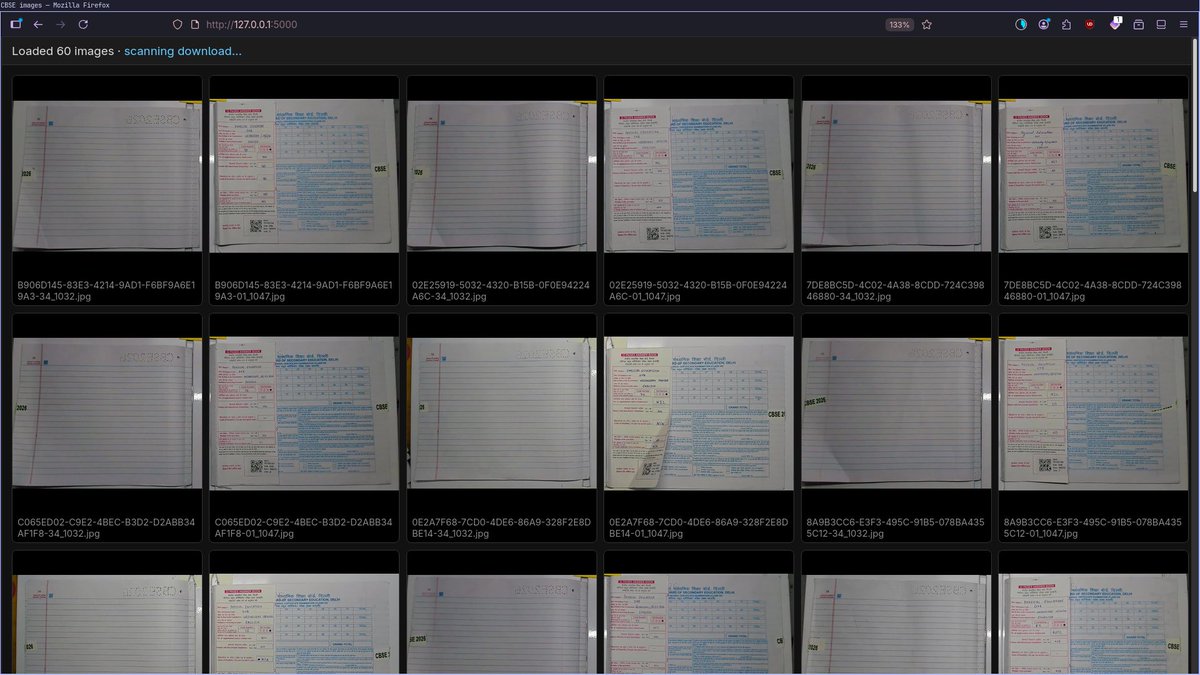
CBSE people didn't configure their AWS bucket properly and now we can paginate & enumerate all their media which has 2026 answersheets & question papers. ListObjectsV2 works without any auth and the bucket root is listable too — anyone on the internet can download any scanned booklet — across institutions. Multiple institutions are using the same bucket, insanely insecure.
Complete mess. #CBSE
My daughter finally received the scanned copies of 4 answer sheets and to our shock, page number 22 is missing from one of the documents. On top of that, marks have not been awarded for several answers that exactly match the official answer key. And this isn’t limited to just one paper the same issue appears across multiple subjects.
Instead of focusing on competitive exams and college admissions, students are being forced to run from pillar to post just to understand why correct answers were ignored or pages went missing.
Do the authorities even understand what 30-35 marks can mean for a Class 12 student whose entire future and admission process depends on these scores?
This is not a small administrative lapse. This is playing with the careers, mental health and future of thousands of students.
Shame on a system that continues to fail students. And shame on those at the helm who continue to remain silent while young lives are pushed into anxiety and uncertainty.
The system has failed us once again. Alas. #CBSE @cbseindia29@AllCBSENews@cbse_guide@dpradhanbjp@PMOIndia
India wealth allocation problem is not about risk, It is about what wealth signals in Indian society
A second flat in Banjara Hills gives you status, rental income, and an asset your family can see
A deep tech startup gives you a pitch deck and five years of waiting, Indian households hold ₹450 lakh crore in gold alone, more than the country GDP.
The capital to fund the next industrial wave exists. It is sitting in lockers instead of labs. Incentives, not intelligence, drive allocation.
India spends 0.64% of GDP on R&D, China spends 2.4%, US spends 3.5%, South Korea spends 5.13% to 5.32%, while Japan allocates roughly 3.4% to 3.5%
This gap has not moved in India entire post-independence history, private sector funds only 36% of Indian R&D, compared to 77% in China and 75% in the US, roughly 79.2% in South Korea & 79.1% of Japan total R&D
Indian SIP money flows into a Nifty 50 that is 37% financial services with near zero R&D spending. Indian deep tech startups raised $1.65 billion in 2025. I not want to compare with Peer nations
Indian VC has returned 25 to 30% IRR at the top quartile, Gold returns 6 to 7% real, Real estate in top cities returns 4 to 6% real.
Indian HNIs still hold 60% of their wealth in property and gold, The LP base for Indian VC is almost all foreign. American endowments, Gulf sovereign funds, Singapore family offices.
When an Indian deep tech company raises from foreign LPs, the company gets built here but the returns flow out. India builds the rockets. Someone else owns the equity.
The judge who got caught with tons of cash in his burning house is out free, but a guy criticizing the judiciary is in jail. There is no hope in this country...
What kind of scanning is this @cbseindia29 ..??? If your scanning infrastructure is so bad that even we adults can't see it clearly how can we expect from examiners aged over 50 .
If your infrastructure is like this why are you trying to induce a new system in so much rush putting lakhs of students' career at a toss .
Please Do rechecking through proper means so that every aspirant is satisfied .
Attachments :- @YashTheML
#CBSE
We demand the resignation of India’s Education Minister over the NEET paper leak issue.
When students lose their future, hope, and even their lives, accountability cannot stay silent.
17 students lost to pressure, injustice & failure of the system deserve answers. 🇮🇳
#NEET
It feels like a contradiction you can’t quite reconcile.
On one hand, you know—intellectually—that you’re doing exactly what you’re supposed to do. The system is profitable. The backtest is robust. The rules are being followed perfectly. There’s no mistake to fix, no tweak to make. This is the process.
But emotionally, it feels like something is very wrong. There’s a steady, low-grade discomfort that sits with you all day. Not panic, not chaos—just a grinding unease. The equity curve is doing something it has always done in the past, but when it’s happening to you, in real time, it feels different. It feels personal. It feels like failure. Every loss reinforces a quiet doubt: What if this time is different?
What if the backtest was an illusion?
What if I’m just sitting here watching capital bleed for no reason?
And the hardest part is the helplessness. You’re not allowed to act.
You chose not to act. Discretion would actually feel better—at least you could do something. Cut risk. Override a trade. Reduce exposure. But the system says stay. The system says this is normal. The system says this pain is part of the edge. So you sit there, following rules that are currently producing losses, while knowing those same rules are the only reason the long-term returns exist at all. It creates a very specific kind of tension: Short-term emotional truth: This feels terrible and wrong.
Long-term statistical truth: This is exactly what must happen.
And those two truths don’t align in the moment. In fact, the better the system—the more it relies on capturing rare, outsized winners—the more uncomfortable this period tends to be. Because the edge is paid for upfront in drawdowns, whipsaws, and frustration. So the feeling is something like: quiet conviction under pressure.
You’re holding onto belief without reinforcement.
You’re executing without validation.
You’re enduring losses not because you’re wrong—but because this is the cost of being right over time. And that’s what makes it so psychologically difficult. If it felt good, it probably wouldn’t work.
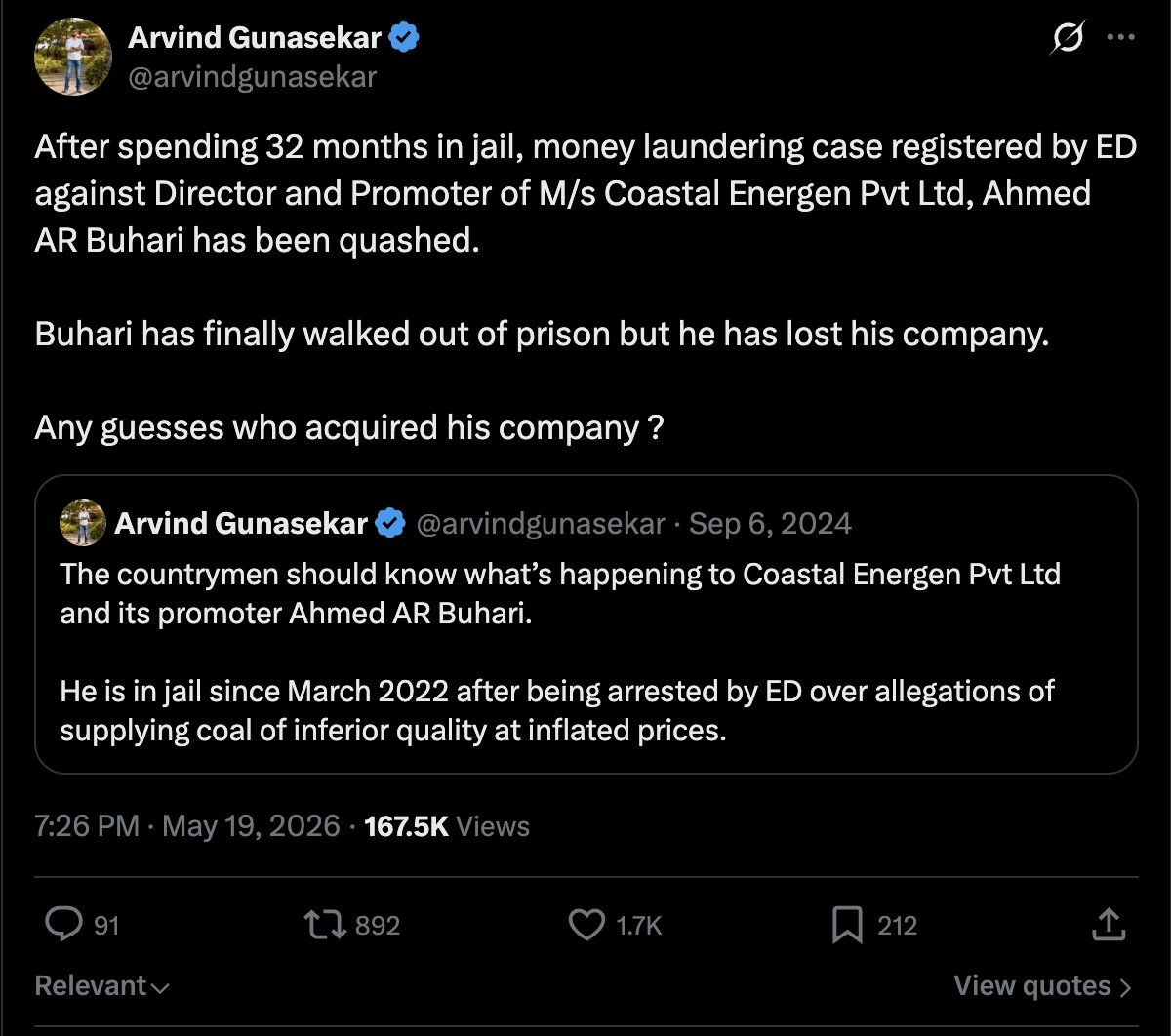
The tragedy of this tweet from @arvindgunasekar is not that EVERYONE can guess who Buhari lost his company to (after spending 32 months in jail for no reason)
The REAL tragedy is that the Govt will then yelp in pain & scream sabotage when foreign investment runs away from India.
No one in his right mind wants to do business with a system where anyone can be raided or jailed because a business has to be bought/acquired.
One of the most humbling aspects of writing code for ~30 years is that nothing that I wrote till 3 years ago exists anymore. Almost all of it has been deleted, thrown away or replaced. In fact, almost all the companies/clients/products I worked for are dead by now.
If I had built a bridge or a building, it would still be standing. If I had cured a human, maybe they would still be living.
But software is vaporware by definition. The "craft" is crafting ephemeral paper effigies. We are more akin to kite makers than bridge builders.
Today a med student asked what actually happens to consciousness under GENERAL ANESTHESIA. The fact that we still don't have a real answer is terrifying.
Karnataka, a beautiful state, is cursed with the worst political lot who deserve nothing but a seat in the seventh layer of hell.
11 people died at Chinnaswamy. Not an accident but a complete collapse of responsibility. And what followed?
Not accountability. Not remorse. But a demand for free IPL tickets for MLAs and VIP enclosures for their families. DyCM D. K. Shivakumar goes on record saying it’s their “right” to ask for tickets.
You couldn’t secure the stadium. You couldn’t protect the fans. But you’re quick to secure front-row seats.
This isn’t governance. This is entitlement at its worst.
Resign. Or at the very least, pay for your own tickets.
This is a disgrace!
Japanese actor Hiroyuki Sanada spoke about the contradictions of human nature:
“Some people dream of having a swimming pool at home, while those who have one hardly ever use it. Those who have lost a loved one feel a profound sense of loss, while others often complain about their living relatives. Those without a partner long for one, while those who have one often don't appreciate it. The hungry would give anything for a meal, while the satiated complain about the taste of their food. Those without a car dream of owning one, while those who have a car are always looking for a better one.”
The key to happiness is gratitude: truly seeing and appreciating what we already have, and understanding that somewhere, someone would give anything for what we take for granted.