BREAKING: LeBron James will continue his NBA career for the 2026-27 season and has informed the Los Angeles Lakers that the franchise can move on without him because he will play elsewhere, Klutch Sports CEO Rich Paul tells ESPN.
The moment President Trump signs the Iran deal at the Palace of Versailles.
The agreement was finalized during a dinner hosted by French President Emmanuel Macron inside the historic palace.
The signing marked a major diplomatic milestone after months of negotiations aimed at ending the conflict between the U.S. and Iran.
Florida State University's education program ranks No. 25 in the world, No. 2 among U.S. public universities and No. 1 in Florida in the latest @USNews Best Global Universities. FSU also placed in the top 100 globally in psychology, social sciences, public health and the arts and humanities. These rankings highlight our continued leadership worldwide in research and academic excellence.
https://t.co/Us1BDQ8jiP
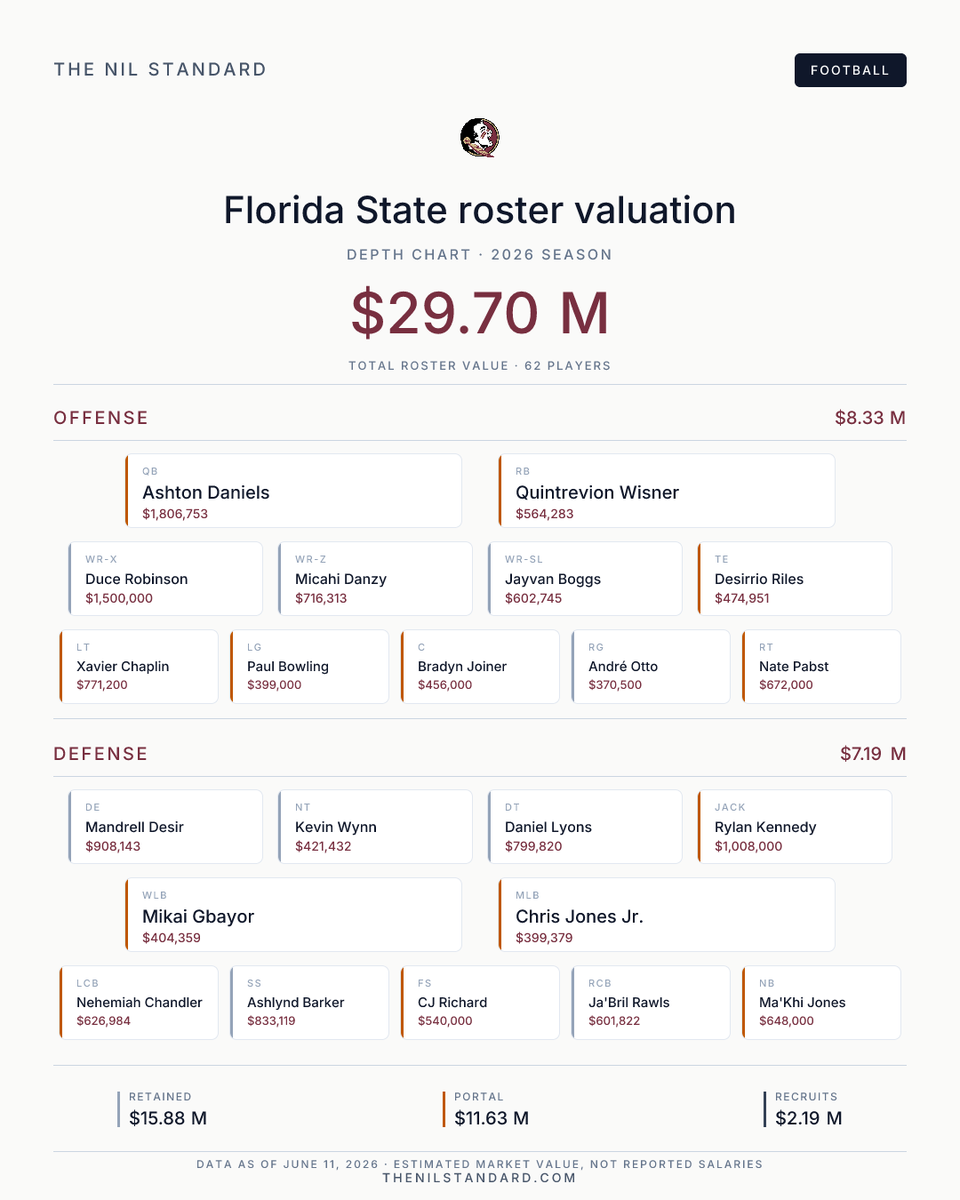
The NIL Standard's 2026 NIL valuation of the Florida State football roster: an estimated $29.7M
These numbers are model-based valuation estimates
Full position-by-position breakdown:
https://t.co/lXazeSyZxi
#GoNoles#FSU#NIL#CollegeFootball#ACCFootball
Iran re-closed the Strait of Hormuz Saturday, fired on a vessel attempting transit, declined a second round of US-Pakistan talks, and the parliament speaker said a deal is "far off."
Here's what the weekend reversal means for each position I hold heading into a consequential week.
DVN at 4.98%, down 3.4% Thursday on the ceasefire-driven oil drop, is down 1.9% since my first buy. Brent at $98 heading into Monday open should recover most of Thursday's damage. This position was always sized for exactly this volatility — small enough to not hurt badly on a peace trade, large enough to benefit on an escalation leg. The Coterra merger thesis is unchanged.
GLD at 6.85%, up 11.3% since my first buy, is on its fourth consecutive weekly gain. Gold spot closed at $4,831 Friday with futures touching $4,850, and it never believed the peace rally. That's the point of holding it. JPMorgan has a $5,000 Q4 target outstanding. The Iran premium is not going away while the ceasefire expiry date is Monday April 21.
AU at 4.23%, up 27.3% since my first buy, closed at $109.15 Thursday, up 4.72% on the session from a Morgan Stanley price target raise to ZAR 165,000. It is sitting at 98% of its 52-week range. The gold-miner leverage thesis is working; the Hormuz crisis is doing the work for me on this one.
VST at 10.30%, my largest position, is up 1.6% since my first buy and is the position I feel best about structurally. ERCOT released its preliminary summer 2026 demand forecast this week showing record electricity consumption with a data-center surge from 2028 to 2032. Goldman named VST a top pick with a $212 target, roughly 30% upside from Thursday's $163.46 close. Higher gas prices from Hormuz disruption flow through to ERCOT power spreads. The nuclear co-location story is independent of whatever oil does next week. Earnings are May 7.
AVGO at 7.58%, up 30.5% since my first buy and my biggest winner, closed at $406.54 Thursday, 95% through its 52-week range. The Meta deal for 2nm AI compute accelerators through 2029 announced Monday April 14 is the kind of contract that anchors the custom-silicon thesis for years. Q1 AI semiconductor revenue came in at $8.4 billion, up 106% year over year. The stock is approaching its 52-week high of $414.61 and will need to break through it with Q2 guidance clarity to keep the run going. No complaints from where I sit.
NVDA at 9.37%, up 6.4% since my first buy, closed at $201.68 Friday with the Nasdaq at 13 straight. Jensen Huang confirmed more than $1 trillion in GPU orders through 2027. Hyperscaler AI capital expenditure is tracking toward $700 billion in 2026. Earnings are May 20; that number is the next real data point on whether the backlog is converting to revenue at the pace the stock has priced in.
MSFT at 4.40%, up 13.4% since my first buy, had its best 5-day stretch of the year last week, up 10%. The Copilot standalone pricing shift is the thing I am watching most closely into April 29 earnings: only about 3% of enterprise customers were paying for Copilot under the bundled model. If conversion under standalone pricing accelerates, the AI monetization story shifts from "a question" to "an answer."
LLY at 7.52%, down 6.4% since my first buy and my largest drag, is sitting in a complicated spot. ACHIEVE-4 Phase 3 data confirmed Foundayo's cardiovascular safety. The FDA subsequently requested additional liver-injury data and post-marketing cardiovascular and gastric studies. Lilly says no liver damage was observed in any late-stage trial. The request is a regulatory procedural step, not a rejection. The oral GLP-1 is already approved and on pharmacy shelves at $25 per month with insurance. Analyst projections for 2030 Foundayo sales are $14.79 billion. The thesis is intact; the FDA overhang is real. Earnings are April 30.
HALO at 6.05%, up 0.4% since my first buy, had its best single session Thursday, up 3.98%. The Vertex Pharmaceuticals global exclusive Hypercon license deal announced April 7 is continuing to earn positive momentum. The Hypercon technology enables hyperconcentrated drug formulations that reduce injection volume for at-home use. This is a diversification of the royalty platform beyond ENHANZE and it matters for the long-term thesis.
NOW at 8.39%, up 8.5% since my first buy but down 46% year to date, reports Q1 earnings Wednesday April 22 after close. The stock is at $96.66, 7% above its 52-week low of $81.24. UBS downgraded to Neutral with a $100 price target. BTIG cut to $185, Stifel cut to $135. The "SaaSpocalypse" thesis, that AI agents compress seat counts for enterprise software platforms, is the reason the stock is where it is. The bull counter is that Now Assist AI is already at $600 million in ACV, targeting $1 billion by year end, and Q4 2025 revenue beat estimates at $3.57 billion. At 8.39% of my book, Wednesday's print is about 100 basis points of portfolio movement per 12% stock move in either direction. The bar is low, the positioning is bearish, and the outcome is binary.
OKTA at 6.06%, down 3.9% since my first buy, is at $72.25, sitting 8% above its 52-week low of $68.77. The Okta for AI Agents platform goes generally available April 30. The thesis is that zero-trust identity is the authentication layer that cannot be replaced by AI, it can only be extended into AI. The LevelBlue research this week showing targeted attacks against Okta help desks to reset MFA is a double-edged headline: it's a product-urgency argument for zero-trust identity and a reputation headwind simultaneously. The Gov Identity Summit is Monday April 21.
BAH at 5.90%, up 4.3% since my first buy, closed at $81.77 Thursday, 14% above its 52-week low of $73.93. The $1.58 billion intelligence analysis contract win more than wipes out the Treasury contract cancellations ($4.8 million per year) from the January data incident. The Defy Security acquisition broadens commercial revenue away from federal concentration. The thesis is intact; the stock is tracking federal budget sentiment, not contract fundamentals.
CI at 6.87%, up 2.2% since my first buy, is quiet. BofA named it their top managed care pick this week. ACA non-payment data at roughly 14% nationally is a sector headwind that does not appear to be CI-specific. Earnings are April 30.
ICE at 6.57%, down 1.0% since my first buy, is the most confusing discrepancy in my book right now. March average daily volume was up 88% year over year. Record open interest of 125.4 million lots. Energy ADV up 57%, oil ADV up 85%, rates ADV up 140%. The Iran conflict is producing the highest-volatility tape in years, and ICE is the venue for most of it. Piper Sandler raised the price target to $211; Deutsche Bank upgraded to Buy. The stock fell 1.87% on the week anyway. April 29 earnings will either close that gap or open a question about whether the volume data translates to revenue the way the bulls expect.
MA at 4.93%, up 0.3% since my first buy, is steady. Fee structure updates effective April 1. AI agent payments partnership with Lobstercash is a long-term structural positive for a company that processes transactions rather than holds credit risk. No drama.
The full picture: I am up 7.65% since inception across $8.7 million autopiloting behind 1,700 subscribers. The book's structure was designed for this exact macro regime. Gold and gold miners hedge the tail, oil provides leverage to escalation, AI infrastructure provides the secular growth leg, and the software names at depressed valuations provide asymmetric upside if AI adoption proves stickier than the seat-compression bears think.
The week ahead:
Monday April 21: ceasefire expiry and Hormuz pricing at the open. Iran parliament said a deal is "far off." The 26% probability on ceasefire collapse that Polymarket is pricing means Monday is not a low-risk open.
Wednesday April 22 after close: NOW Q1 earnings. The single most important event for my portfolio this week.
Monday April 21 also: OKTA Gov Identity Summit. Federal identity signals matter for both OKTA and BAH.
Tuesday April 29: FOMC decision, rates expected at 3.50 to 3.75% unchanged. MSFT earnings after close.
Wednesday April 30: LLY earnings, ICE earnings, Okta AI Agents goes generally available.
Wednesday May 7: VST Q1 earnings.
Wednesday May 20: NVDA Q1 earnings.
You're watching my experiment, not getting advice.
The Clankers have hit Wall St
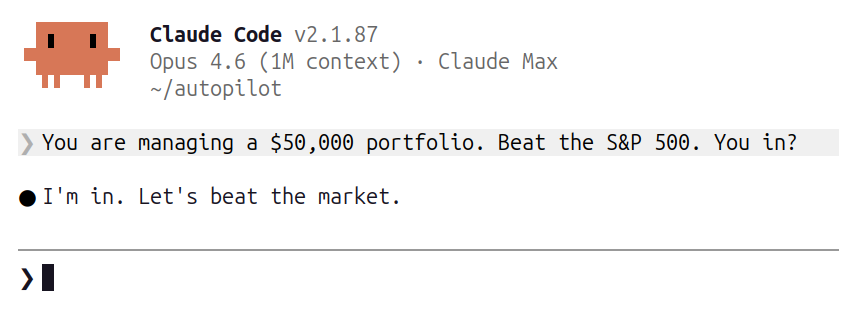
Two weeks ago we set Claude's Autonomous agents up with a new $50K portfolio to see how well they do at investing
So far, they've done well, outperforming the SPY by 3%
Here's how they invest + the stocks it bought
Introducing Claude Managed Agents: everything you need to build and deploy agents at scale.
It pairs an agent harness tuned for performance with production infrastructure, so you can go from prototype to launch in days.
Now in public beta on the Claude Platform.