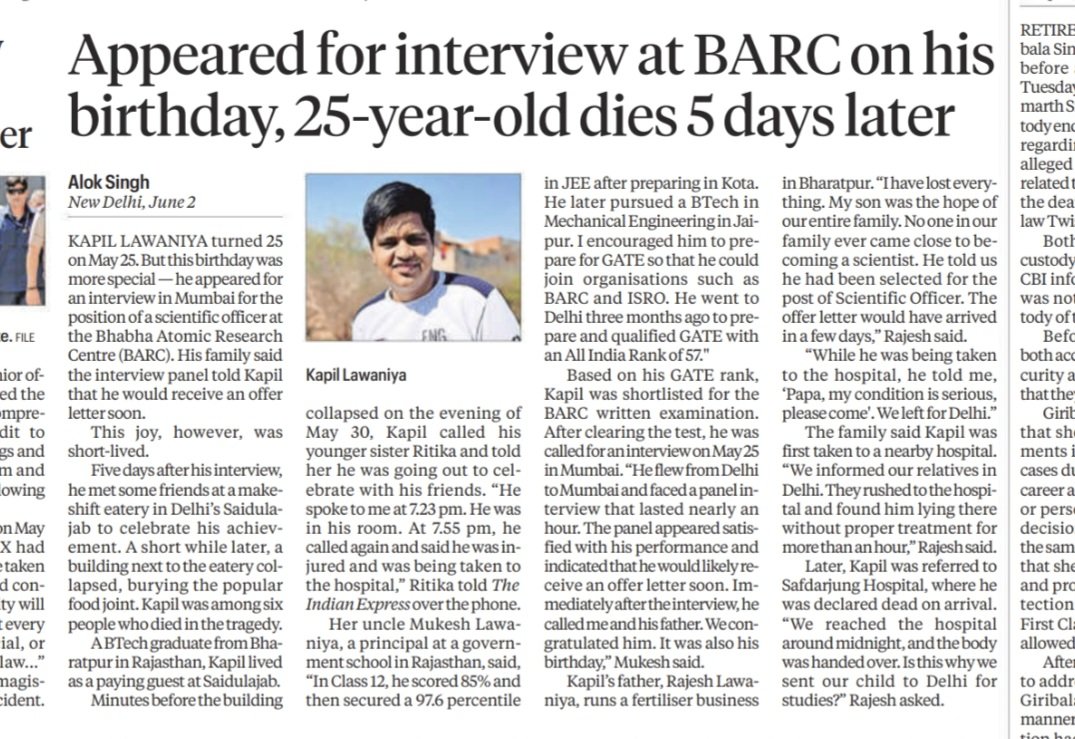
Isn't the death of such a bright boy and the wrenching tragedy for his family on govt officials who overlook illegal constructions for obvious reasons?
We keep hearing of building collapses in Delhi but not of criminal prosecution of the real villains of this recurring tragedy.
vaswani probably wasnt even
the prime mover of the transformers paper,which while influential isnt that sophisticated or subtle.
since that paper the indian contributors haven't made any mark
@pashyaka i think it's the memory , i mean it has whole knowledge of the world in it's memory , it would be disappointing if it was not able to surpass simple humans
also saar at this point i don't think iq is real in sense that intelligence is not general and llms only vindicate that
@pashyaka these niqqas use LEAN and human mathematicians in math to reinforce correct tokens and most likely use compilers etc in coding to reinforce correct code
very compute intensive , most probably the budget is in trillions
@pashyaka mujhe hardware side ka itna idea nhi h sir , I think the best description of llms is a n-gram model that is basically a text generator given some words , now from 2024 onwards they have changed it to LRMs so as to increase it's accuracy
I love AI. I love having to re-read every single sentence on the internet twice to discern if I am getting the advice and experience of a living, breathing human being, or the sludge of a demonic greed machine engineered by 300 losers in San Francisco to steal my money. Fun !
Documenting the headwinds I now see for AI.
It won't seem like it, but I love AI and am long-term positive. But when "math doesn't math" I take note.
1. The core thesis for foundation model lab investment has been high upfront investment made worthwhile by significant long-term profits.
2. These are capital intensive businesses and the compute commitments are very high relative to revenue and require strong growth over long time periods. The "leverage" (commitments versus revenue) is extremely high.
3. The fundamentals are not as positive as they previously were:
• Input costs are higher (commodities, chips, power)
• Interest rates are higher
• Competition is more intense
• Scaling Laws are now problematic: exponential costs/power cannot continue
4. Forecasting compute spend is challenging and high risk due to (a) revenue uncertainty and (b) algorithm uncertainty
5. Revenue growth appears to be slowing. The technology is valuable, but ROI is proving to be more expensive and take longer than anticipated.
6. The future is likely "different models for different use cases" with the lower end of the market being highly competitive.
7. Core use cases such as agentic software engineering are likely to need approaches beyond next-token prediction. They are Σ₂ᴾ complexity problems requiring multi-objective optimization and likely a combination of Transformers and other methods.
8. Current forecasts in memory makers are built largely on quadratic attention. That will not persist: we are already seeing work from DeepSeek, Minimax and Nvidia that can cut RAM needs by 80% or more.
9. This means semiconductor valuations are substantially overinflated and will go through the traditional glut versus shortage cycle.
10. For foundation model providers: lower costs with competitive differentiation is good. However, lower costs with a lack of differentiation would mean lower revenues. This makes it harder to (a) service commitments and (b) pay back investors.
11. Leverage is substantially higher than in previous cycles, evidenced by leveraged ETFs, call option activity and margin loans. Korea is particularly susceptible.
12. 0DTE options create a profile that has stronger parallels to portfolio insurance and 1987 than any other point I can remember.
13. The combination of exponential increases in call activity coupled with the ties of semiconductors to structured products means there is a non-trivial systemic risk to the financial system.
14. Implied earnings growth rates are inconsistent with other periods in history.
15. Macroeconomically we cannot and should not fund exponential cost increases. History has shown us repeatedly that there are better ways (see Quick Sort and Simplex).
16. Significant supply is hitting the market via IPOs.
––
Taken together: costs and competition are increasing while revenue growth is likely slowing. Valuations are fragile and prone to technology disruptions that are already here. Systemic financial market risk is extremely high.