V2V communication could be one of those technologies that sounds futuristic until you think about winter highways.
Fog, low visibility, sudden braking, black ice, an accident ahead that you can’t see until it’s too late.
Imagine vehicles automatically warning each other: “Slow down. Hazard ahead.”
And make it smart: auto-enable V2V safety alerts above a certain speed or on highways, so city driving isn’t constantly filled with unnecessary notifications.
Sometimes the best safety feature is the one that lets your car know what you can’t see yet.
Nobody rents a 7-seater to drive to work alone.
Yet we do it with databases.
The cloud charges for capacity, not occupancy.
Maybe it's time to check who's actually sitting in the seats.
Every cloud eventually develops the same problem:
It starts eating resources it doesn't need.
More compute.
More storage.
More replicas.
More “temporary” infrastructure that somehow survives three quarters.
And then comes the monthly bill.
Anomalyzer takes a different approach:
Put the cloud on the scale.
Measure what it’s actually consuming.
Wait for the billing data.
Study sustained behaviour.
Then prescribe.
No panic.
No guesswork.
No “delete everything on Friday.”
Just evidence-based recommendations.
Your cloud doesn’t need another dashboard.
It needs a dietician.
#Anomalyzer #FinOps #CloudCostOptimization #Kubernetes #MultiCloud
We hired a librarian to do an accountant's job.
Ask a librarian for "something about grief" and they're brilliant. Ask which invoices are over fifty thousand and they're the wrong person.
AI search finds things that read alike. "14%" and "19%" read alike. One of them is money.
https://t.co/tmvsGZbDP7
@PMoChronicles The third line is the one that took the most engineering.
Read-only means we cannot break your production environment on a Friday evening. It was the first decision, not a late compromise.
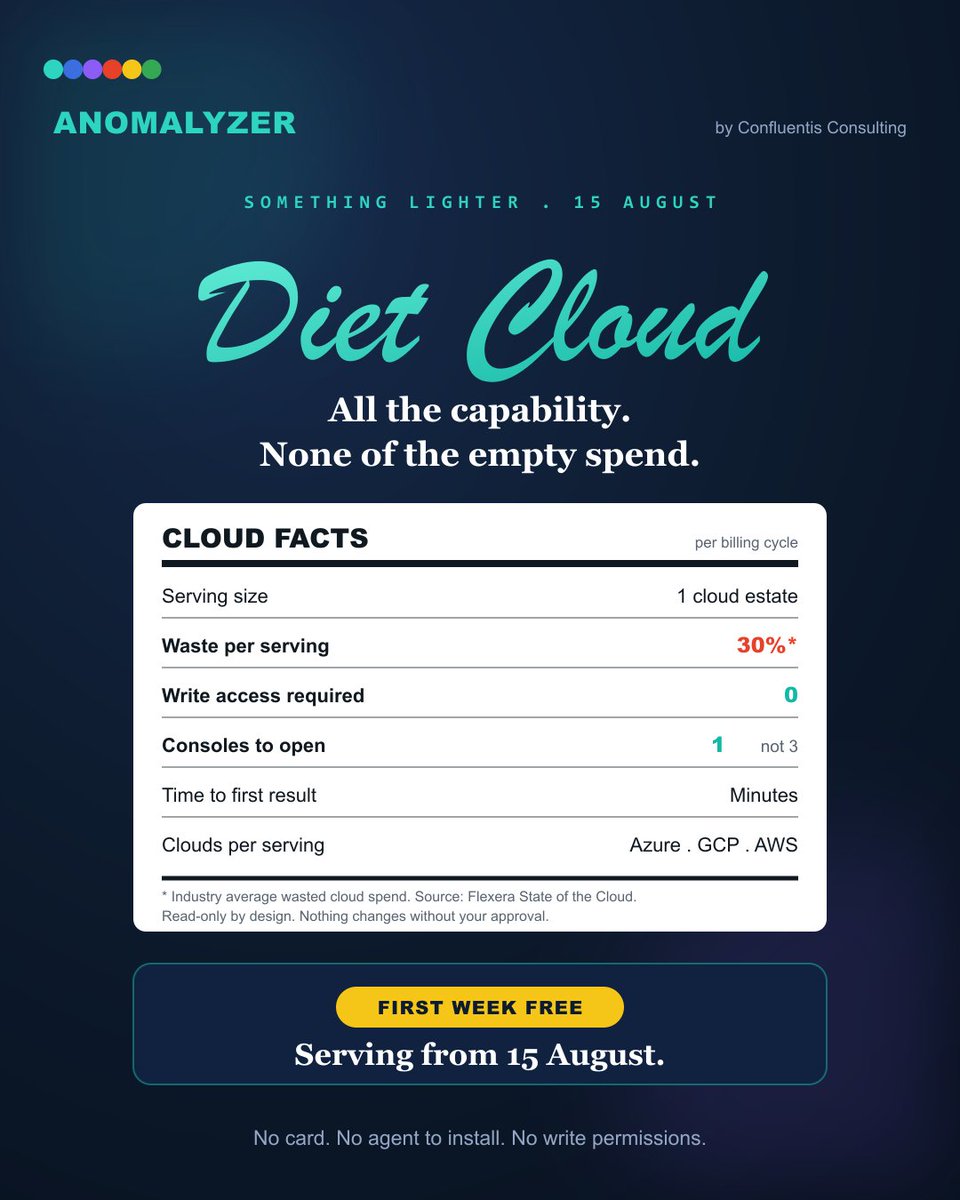
The most underrated feature in cloud optimization is not touching your infrastructure.
Everyone wants write access.
We wanted read-only.
Same performance.
Same headroom.
Just stop paying for the 30% of your cloud estate that was "never doing anything".
The safest optimization is the one that cannot break production on a Friday evening.
Launching 15 Aug. First week free.
Everybody looks at their cloud bill. ~30% of the money is still wasted. Both true. That is the interesting part. The waste is not hiding from careless people, it is hiding from attentive ones. Where it actually lives:
1. First I checked the premise instead of asserting it. Took a camera to @KCDBengaluru in Bengaluru, asked engineers how often they review cloud costs. All: monthly or weekly. A poll here said the same. 69% monthly.
2. • tiers sized during a migration, never revisited • storage written hot, stays hot forever • dev/test DBs billed nights and weekends • commitments never claimed • container requests set defensively, paid as nodes • orphans: disks, IPs, 2023 snapshots
3. None of those are anomalies. No spike. No alert. Flat line, month after month. You cannot detect a deviation from normal when the waste IS normal. That is why anomaly detection misses the 30%.
4. And it grows back. Right-sized in March, oversized by May. A redeployed manifest, a scaling incident fixed by bumping a tier, a cloned env inheriting the old shape. Manual remediation is a snapshot. Your estate is a video. Full post: https://t.co/WspXzKFUVU
Five answers from Bengaluru go up as a video next week. Thanks to the folks at @cncfbangalore@CloudNativeFdn and everyone who stopped mid-corridor for a chat.
Every platform starts with a single problem.
Before Anomalyzer, we built a Kubernetes cost optimization engine that collected telemetry, trained ML models, generated recommendations, and automated actions with GitOps.
That journey taught us the real challenge wasn't just Kubernetes. It was optimizing the entire multi-cloud stack.
I've written the full technical story on Medium (link below).
https://t.co/C1X1ZtGaFU
#FinOps #Kubernetes #MultiCloud
Cloud cost isn't a finance problem. It's an engineering and business decision made thousands of times every day. FinOps isn't about spending less; it's about making every cloud decision intentional. Here's why that distinction matters.
https://t.co/D2LQ6ej8yN
The Most Expensive Cloud Resource Is Often the One You Forgot
The cloud doesn’t become expensive overnight. It becomes expensive because of the things nobody notices.
A quick thread on the silent budget killers hiding in plain sight:
The Ghost PoC
That EC2 instance spun up for a quick Proof-of-Concept months ago—and completely abandoned once it was over.
Zombie Kubernetes Clusters
Clusters left running hot long after testing and development cycles wrapped up, consuming compute power for no reason.
Forgotten Data Accumulation
Old snapshots compounding every single week, and unattached storage volumes sitting around like digital clutter.
Ghost Town Databases
Databases running at a meager 5% utilization, scaled for peak traffic that never materializes in non-production tiers.
The Takeaway
None of these resources break production. They don't trigger alerts or page on-call engineers.
Instead, they quietly inflate your cloud bill month after month.
The best cloud optimization strategy isn't scrambling to react when the invoice arrives. It's identifying waste continuously before it quietly drains your budget.
@wearezauba despite several attempts to reach you on your customer support email id [email protected]. We are unable to reach you for our concerns. Hence, resorting to social media in order to resolve our issues. Kindly let us know your alternate email id