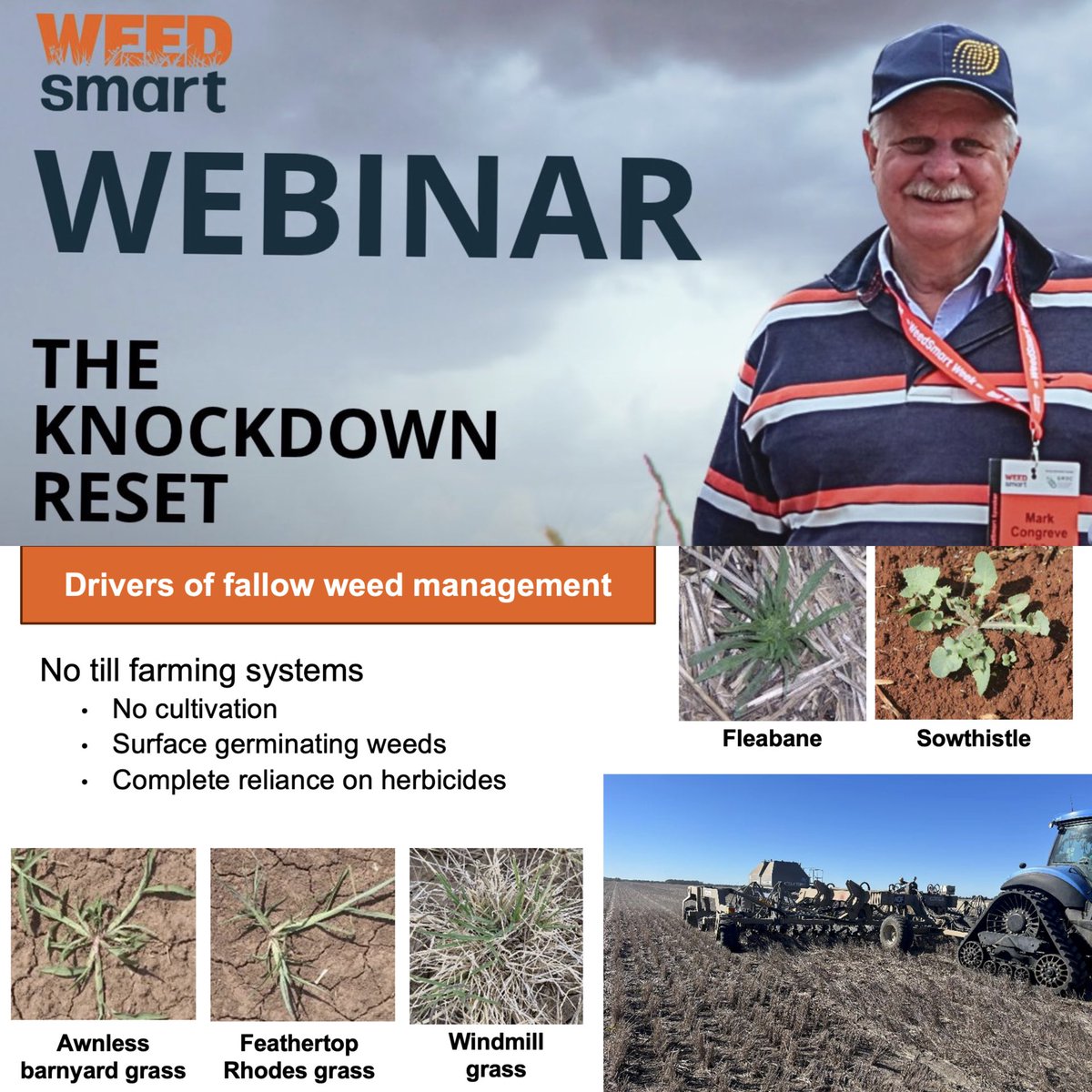
A big thank you to @congreve_mark on this weeks webinar. Mark provided a thorough account on the latest in fallow weed control.
This included spray small-spray early, lack of diversity, resistance, OSST, MRLs + paraquat/diquat update. Full replay to come.
@WeedSmartAU@theGRDC
@LowBoomLowDrift Right probably XC/UC, efficacy will be compromised, but may be need for sensitive areas or droplet survival in low humidity. Left probably about C, should be suitable for most gly applications. I would use something finer for contact herbicides, fungicides, insecticides
@agrobaz@AgForceQLD Slightly different issues driving this Baz.
The maximum rate (for both fallow and croptopping) is driven by environment (mostly birds).
However the 14 day WHP for croptopping is due to lack of residue studies at a shorter WHP.
Summer grasses can drive decision making over summer. The NGN 'Control strategies for key problem weeds in nth NSW' has been developing & evaluating options. Free workshops with @congreve_mark compile the latest info into field-ready management. Details: https://t.co/SB1qbEEaJc
@cosfarming@DMAg_consultant@agriprof@agrobaz@Zweck17 They did review these Geoff and made some changes to operator safety. But these changes were not too severe for most, due to reducing the max application rate by about 2/3.
Changes would have been more dramatic if the old application rates were retained.
@agriprof@agrobaz More than ever we need to ensure our commodities meet the requirements of the buyer. Locally and export.
Many customers are also putting their own standards in place which are even more onerous that MRLs.
People simply don't want ANY residue in the produce.
@agriprof@agrobaz The Australian MRL is largely irrelevant for export markets.
For example, the EU has a 0.02 limit for paraquat in pulses. Which means non detectable.
@AHRI_Team@geidejr How did you get to that headline?
4-6% of field populations screened showed statistically elevated level of survivors (tolerance/resistance), even at double label rate.
Then, of the 5 populations further studied, resistance incidence doubled with one further application.
Keen to learn about pre-em efficacy, crop safety & herbicide carryover on marginal soil types? Can we use decision support to guide our knowledge
Get along to Beckom, NSW to hear from @congreve_mark@Mick_T_Rose
RSVP https://t.co/dM9TZMEfQQ
You are invited to an afternoon pre-emergent herbicide discussion session and field trial inspection led by Mick Rose from Southern Cross University & @congreve_mark from ICAN Rural.
Details: https://t.co/nR9dnILNiI
@GRDCNorth NGN field trial walk
1pm Wed 8th July
Warral-Bithramere Rd Tamworth
Residual safety x seeding systems x planting depth
Fallow knockdown demo (glyphosate, glufosinate, paraquat, Group 14 mixes)
Two pre + post-em efficacy trials in wheat
RSVP https://t.co/v6fHun34JC
@GRDCNorth NGN field trial walk
1pm Wed 8th July
Warral-Bithramere Rd Tamworth
Residual safety x seeding systems x planting depth
Fallow knockdown demo (glyphosate, glufosinate, paraquat, Group 14 mixes)
Two pre + post-em efficacy trials in wheat
RSVP https://t.co/v6fHun34JC
@becsta1984@agrobaz@markede05626239@DavidPocock Understand the risk
But, 'desiccation' (all crops) is no longer supported
What remains is crop topping ryegrass in pulses (at a pretty low rate)
The Australian MRL is 1ppm which is unlikely to be exceeded if following the label. But importing countries only permit 0.02 to 0.5ppm
@venningj@agrobaz@markede05626239@DavidPocock However the Australian MRL is way higher than what is accepted for other importing countries. Even with the 14 day WHP the new labels will also have a statement advising that this use pattern may not meet tolerances for exports markets