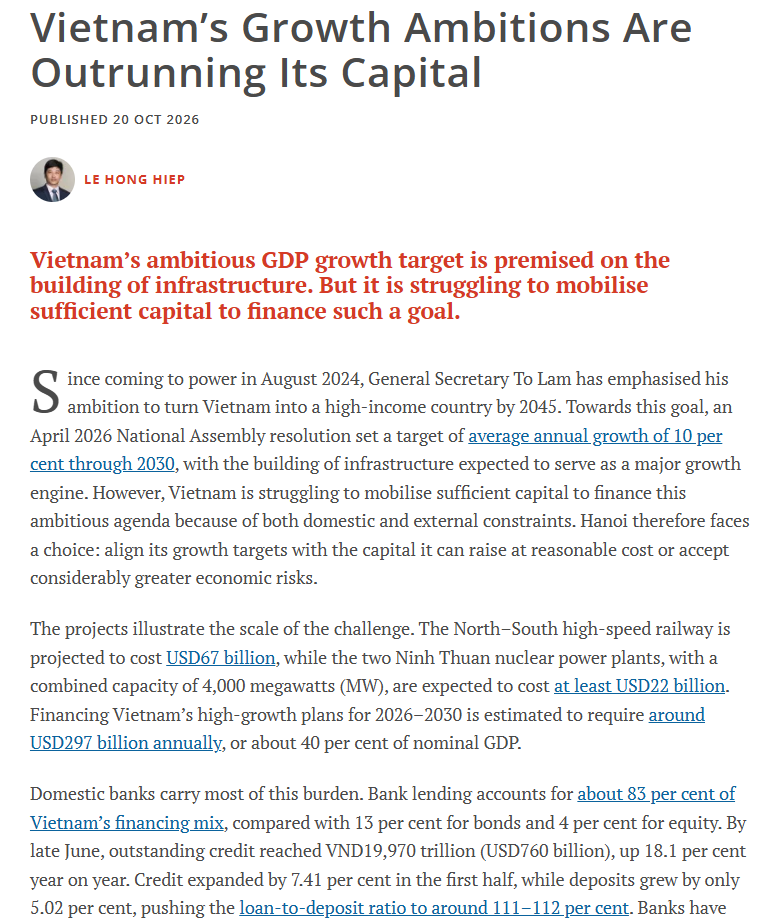
My latest commentary examines how Vietnam’s ambitious growth agenda is increasingly outpacing its ability to mobilise capital at a reasonable cost, due to both domestic and external constraints.
Hanoi therefore faces a difficult choice.
https://t.co/1kX6iXWMju
If you’re over 30, I’m begging you:
• Go on reddit
• Find problem people are struggling with
• Turn those problems into digital assets
• Without revealing your name
• Without showing your face
I shared this with a busy dad, he makes $5k/month
Here's how it works:
> No Forbes 30u30
> No faked hype
> No seed fundraise announcement
> No speaking panels
> No Series A announcement
> No paid press articles
> No manufactured launch videos
Turns out you can just build
projects under my radar right now:
@lattica: building leverage, borrowing, and lending for prediction markets. if outcome markets are going to handle serious capital, they need credit primitives designed around jump risk, gaps, and event-driven volatility
@BranchpointXYZ: building conditional / “multiverse” finance. the idea is that assets and markets should be tradable inside specific future states, not just priced as one averaged spot reality
@uselotusxyz: building the aggregator / execution layer for prediction markets. one interface across fragmented venues, better routing, better fills, and cleaner position management (+ much more)
different angles, same bigger direction:
prediction markets are becoming financial infrastructure.
highly recommend reading Lattica's whitepaper on how they are solving the liquidity problem in prediction markets
>Be Leopold Aschenbrenner
>24 years old
>Born ~2001/2002 in Germany
>Son of two doctors
>Attend the John F. Kennedy School in Berlin
>Convince your parents to let you fly alone to the U.S. and enroll at Columbia University at age 15
>Graduate valedictorian in 2021 at age 19 with a B.A. in economics and mathematics-statistics
>Co-found Columbia’s effective altruism chapter
>Do research at Oxford’s Global Priorities Institute and co-author papers on long-term risks
>Join the FTX Future Fund in 2022, then resign before the collapse
>Land on OpenAI’s Superalignment team in 2023 under Ilya Sutskever and Jan Leike
>Write an internal security memo warning about industrial espionage and China risks
>Get fired in April 2024 over an alleged information leak (which you dispute)
>Two months later drop a 165-page manifesto titled Situational Awareness: The Decade Ahead predicting AGI around 2027 and runaway superintelligence
>Watch it go wildly viral (even Ivanka Trump praises it)
>Found Situational Awareness LP in late 2024 with ~$225 million, backed by the Collison brothers, Nat Friedman, Daniel Gross and others
Bet heavily on AI infrastructure—power, memory chips, data-center proxies, Bitcoin miners, CoreWeave, Nebius, Bloom Energy, Micron, Sandisk and more—while running high leverage
>Compound the fund to an estimated $20–24 billion AUM by mid-2026 with ~439% net gains since inception
>Get engaged to Avital Balwit (chief of staff to Anthropic’s CEO) and live in San Francisco
>Then, in late July 2026, after a brutal AI stock rout (many positions down >35%), shorts moving against you, and margin pressure from up to 4x leverage, liquidate the entire public equity book—longs and shorts—in one massive block trade to a single buyer
And he did it all by writing a prophetic essay, going all-in on the power-and-compute bottleneck, and riding the AI wave harder and faster than almost anyone.
Leopold Aschenbrenner is absolutely insane
Leopold Aschenbrenner is raising fresh capital to put back into AI compute since his $20 billion fund, Situational Awareness, reached out to investors and lenders after heavy losses in the recent AI stock sell off (Save this).
His fund used leverage to amplify returns, a strategy that boosts gains but also magnifies losses in downturns.
Leopold thesis is that AGI, and eventually superintelligence, is arriving faster than markets expect, fueled by compounding gains in compute, algorithmic efficiency and unhobbling of models into autonomous agents.
The strategy flowing from this is to buy the physical bottlenecks of the AGI buildout, like power, compute, memory, and advanced fabs.
With fresh capital, he's likely to lean into lesser known names tied to the same compute scarcity thesis, particularly neoclouds, which sell scarce GPU cloud capacity directly to AI labs.
Here is a list of companies he is likely to buy or add to his position.
Nebius is a full stack neocloud building its own data centers, and it just locked in up to 1.2 GW of power for a new Pennsylvania AI facility alongside a Nvidia partnership targeting over 5 GW of deployed systems by 2030.
IREN pivoted from bitcoin mining into managed AI cloud services, and landed a roughly $3.4 billion, five year Nvidia infrastructure contract plus a broader deal for up to 5 GW of capacity.
TeraWulf, Cipher Mining, and Hut 8 are power-site conversion plays that signed multi hundred-megawatt AI hosting deals, some backed by Google through Fluidstack.
QumulusAI is a smaller neocloud that just signed a $32 million Blackwell GPU deal.
Beyond neoclouds, industrial names like Vertiv, Comfort Systems, and GE Vernova supply the power and cooling gear data centers need, while ON Semiconductor and Rockwell Automation are quieter plays on AI-driven power chips and factory automation.
Milk Road is tracking this very closely and if you want to know what trades we are making around, you can come join us using the link below for just a dollar.
Now I wonder how it'd look if you ask it to make a 3d structure with tubes of your app and all its parts
Like that 3d SQL visualization from a few days ago
Like seeing people visit your site, go through sign up and then seeing your robot workers send packages around, send welcome email, and all the other stuff
Lots of fun ways to visualize your apps and operations in 3d
Anthropic just broke down how they use graph engineering to optimize their own products
this is what 1,000,000$ companies pay entire departments for, and one person can now run it from a laptop
they wire a single ai to work like a company: a manager, a swarm of workers, a separate reviewer, all on one task at once
→ the job fans out to a dozen workers at once, so you wait for the slowest, not the sum: up to 90% faster
→ a separate fresh ai checks every result, never the one that made it (it graded itself 10/10, fresh eyes gave it 5.5)
→ each worker walled off in its own copy, so they never step on each other
the catch nobody posts: there's a ceiling, past 40% human work you cap at 2.5x no matter how many you add
miss this and you're the one still doing by hand what they finished before lunch
bookmark this and watch it run, the full course is below
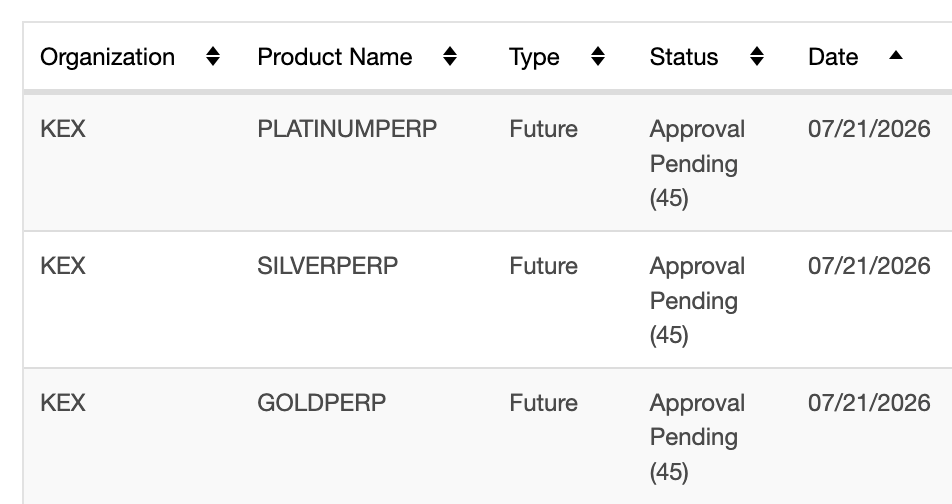
Looks like @Kalshi submitted three new perpetual contracts this morning for platinum, silver, and gold.
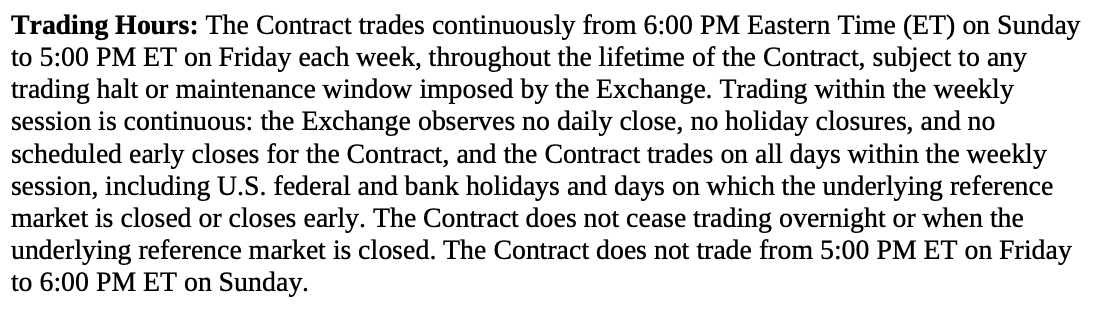
These underlying assets for these three contracts are all tracked by the Pyth Network. The markets will halt trading on the weekend but will "not cease trading overnight or when the underlying reference market is closed."
I can only assume that @CMEGroup is not celebrating right now.
I called this "Ringwriter"
A phrase coiled across spinning rings. Cursor melts the glyphs to dots, hold to charge and release to fire a ripple that spins each ring as it hits. One draw call
We're launching Polymarket Institutional Research: original research built on our markets, direct from the Institutional Desk.
Our first issue looked at Anthropic's valuation strip and whether the right tail is underpriced. Last week, we turned to the Strait of Hormuz, where traders price a 62% chance of normalization by the end of the year, and what that implies for the spread between Brent and WTI.
New issues every week. Read both and sign up for access to all future issues below 👇
https://t.co/JSob1zxP2G
Someone open-source harness that lets Claude Code and Codex generate real 3D CAD models from plain English.
It’s called text-to-cad, an open source harness that turns your coding agent into a CAD engineer..
Building a robot used to mean stitching 6+ tools, CAD software, URDF exporters, kinematics solvers, viewers. Days of work. Broken pipelines. Files no agent can read.
text-to-cad kills all of it.
→ Exports STEP, STL, DXF, GLB, 3MF
→ Generates URDF robot descriptions
→ Slices straight to G-code
→ Sends jobs to your Bambu Lab printer
→ Runs fully offline, no backend
One demo generates a full 7-DoF robot arm, working kinematics, custom GUI, the whole thing, almost entirely through prompts.
100% open source.